Manufacture of Brick
wall, bond, headers, shown, bricks and stretchers
In the kilns of modern design, the heat is well distributed throughout the whole mass, and the above terms are not now as appropriate as formerly.
(3) The form and the use for which the brick are intended make the following terms suitable: Face brick, or those of best appearance as to uniformity of color and dimension, and thus suitable for outside walls. The term is espe cially used to designate re-pressed brick.
Compass brick,
or those having one edge shorter than the other. They are used in build ing curves on which the length of the brick is a part of the circumference.
Feather-edge brick,
those similar to compass brick, but having one edge thinner than the other. They, also, are used in building arches.
Paving brick,
or vitrified blocks, usually larger than ordinary bricks, used in paving streets.
Sewer brick,
or common brick of better grades, so regular in form as to be suitable for building sewers.
Sizes and Weight of Brick.
There is no uni be laid with a shove joint. This means that the mortar is to be spread on first, then the brick is laid lightly in it, and shoved diagonally back from the face and up against the adjacent brick. This manner of laying forces the mortar into the irregularities of the brick, and increases the adhesion between the two substances.
Bond.
By this term in brickwork is meant the arrangement of the brick so that each one tends to transfer vertical pressure to two or more below in such a way that no single tier of brick acts alone. This is accomplished by means of headers and stretchers, as in stone masonry. The two styles of bond in most com mon use are the English and the Flemish bond.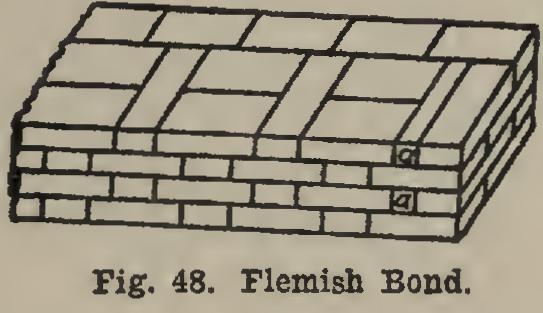
English Bond.
This manner of laying is shown in Fig. 46, where all the bricks in the face of the course a are headers. In the face of the course below, all are stretchers. It is usual to have one row of headers to every half-dozen rows or so of stretchers, although the true bond of this type has them in alternate layers. Thearrangement of the bricks in the back, as at c, depends upon the thickness of the wall. A piece of brick of less than full section in the face or in the interior of the wall, used to fill in where a whole brick would be too large, is called a bat. As it is not always possible to build a wall of entire bricks, bats are used to make the face appearance uniform. The joints in the header courses must be made thinner than the others to preserve the proper spacing, since there are more of them.
Flemish Bond.
This bond makes a very strong wall, and the face presents a particularly pleasing effect. It is considered more difficult to lay; but it is in common use. Figs. 47 and 48 show a wall laid up in this manner. Here, again, the thickness of the wall and the fre quency of the corners determine the arrange ment of the bats to make the face regular. Occasionally both sides of the wall are faces on which the appearance must be that of alternate headers and stretchers. Many apparent headers are only bats, even in walls of good workman ship; and the real headers are not necessarily of full cross-section.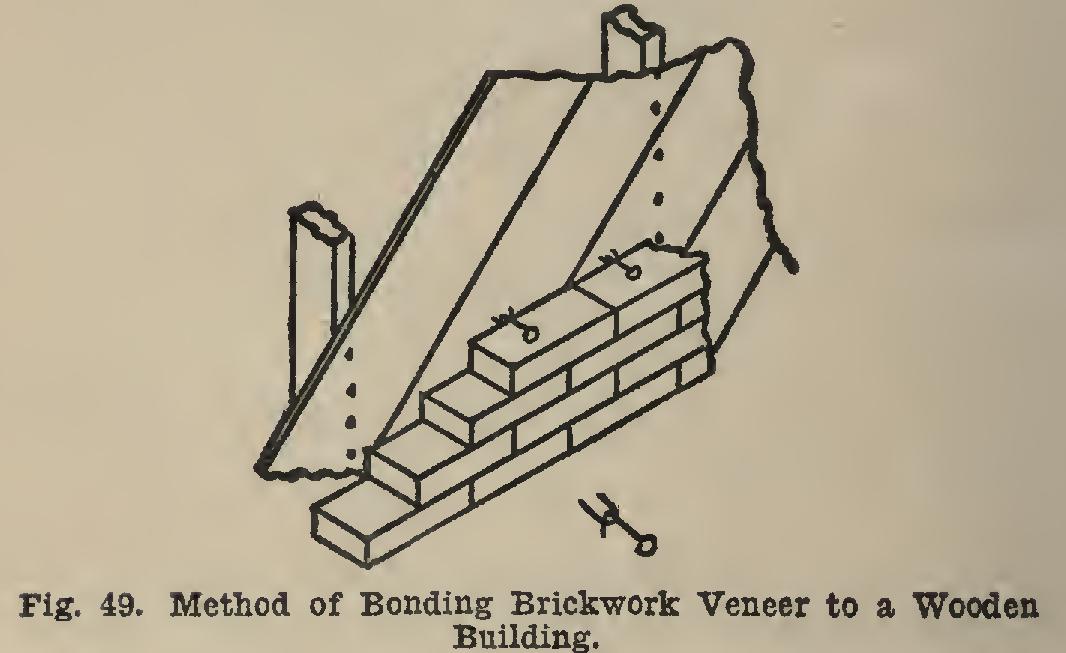
When part of the bricks are darker than others, the dark ones are frequently selected as headers, with pleasing results.
A corner built with Flemish bond to look alike in front and back, is shown in Fig. 47. Bats are shown at points marked a. The brick b is split to secure the proper spacing in both front and back. The course above that shown is built to break joints with this one. The face of the wall is like that in Fig. 48. This is a thirteen-inch wall in which the narrow brick is shown at a.
A method of bonding a veneer of brickwork to a wooden building by means of iron wire hooks, is shown in Fig. 49.