Tests of Stone
test, water, drying, moisture, effect, surface and atmosphere
It may be explained that the coefficient of elasticity is found by dividing the stress per square inch by the change of length per linear inch.
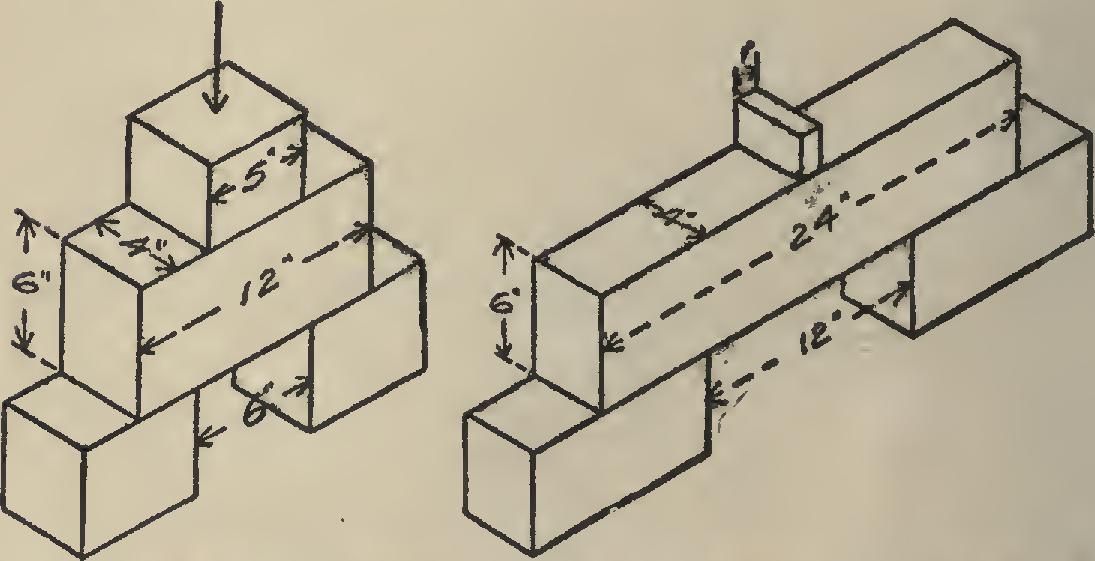
Besides these tests, the attempt is sometimes made to discover the probable resistance to frosts and to acids of the atmosphere. A rather popular experiment, known as Brard's test, is designed to simulate the action of water when Fig. 1. Manner of Loading for Fig. 2. Manner of Loading for Shearing Test. Transverse Test.
freezing. The process is to boil a cube of stone for half an hour in a saturated solution of sul phate of soda. Upon drying, the salts absorbed by the stone crystallize, and, by expansion, pro duce a rending effect similar to that of frost. After the operation has been repeated for, say, a month, the stone will have suffered a percepti ble loss in weight, and, by comparing the losses of several varieties of stone, an inference may be drawn as to the relative weathering qualities.
It is rather unfortunate that the salt has been found to exert a chemical as well as a physical effect, which, to a certain extent, discredits the result. For that reason, this test is not nearly so much used as formerly. If time affords, simi lar results may be attained by alternate drying, soaking, and freezing by artificial means.
The chemical action of the atmosphere is tested by immersing the samples in vessels of water through which carbonic acid is kept con stantly passing, and noting the changes of the stone as to color, smoothness and weight.
Stones for stairs, door-sills, and sidewalks are tested as to wearing qualities, by subjecting them to the action of sand-blasts. The most suit able stones for such uses should resist wear, and always remain rough. The best test of this kind, however, is afforded by the appearance of the face of the rock in the quarry.
Preservation of Stone. The first rule to be observed is to lay stone on its natural bed if it be of stratified variety. This procedure makes vertical pressures perpendicular to the stratifi cation, and the stone absorbs less water, besides being stronger. Neglect of this precaution has had a marked effect in defacing the brown stone ashlar fronts of many handsome residences.
In the design of outside stonework, the at tempt should always be made to leave no depres sion where water can accumulate; and drainage outward from the wall should be provided for every point on the outside surface. The grooves
often cut on the under side of door and window sills are for the purpose of causing the rain and moisture to collect in drops at its edge, rather than to be drawn inward toward the face of the wall.
It is always well to use only stone that has been quarried in the summer and allowed to dry slowly under cover for several months. There is always more or less quarry moisture in newly blasted rock; and by the process of drying, ad ditional cementing material held in solution is deposited in the minute interstices between the grains. For this reason, the drying must for a long time be confined to the thin outside surface of the stone; and experience seems to show that it is unwise to break this skin by dressing or carving.
There is a noticeable difference in the strength and weathering quality of stones dressed in various ways. The method or the tool that finishes the surface with the least im pact is the best. A marble or limestone that has been sawn is often, to a marked degree, stronger and less likely to flake off than is the same stone when dressed by heavy hammers. The frequent redressing of surfaces stained by soot is a pro lific cause of disintegration.
From the above, it is evident that the most effective means of delaying disintegration of stone is to prevent the absorption of moisture. One case of deterioration that caused widespread anxiety in this country, was that of the obelisk known as "Cleopatra's Needle," which was brought from Egypt to Central Park, New York City. This monument had been standing for many centuries, and its hieroglyphic symbols were unimpaired when it was moved to America.
A few years in the damp, gas-laden atmosphere of the American metropolis caused rapid decay, and means of preservation were sought. As de scribed in the Transactions of the New York Academy of Science (November, 1885), the sur face was washed with a preparation consisting of paraffine containing creosote, dissolved in tur pentine. The mixture was applied, at a tem perature of 140 degrees Fahrenheit, to the stone, which had been heated to about the same degree. This treatment is attended by considerable ex pense, but has been reasonably successful.