Reinforced Concrete Bridge
type, spans, types and b-2
2. The reinforced concrete slabs are only slightly more expensive than the Type A spans, and cheaper than Types B-1 and B-2.
3. The Type B-2 spans, I-beams imbedded in concrete, are the most costly construction.
4. The difference in cost between the Type A and Type C spans, does not increase as the span length increases.
5. The difference in cost between the Type C and Type B spans increases rapidly as the span length increases.
It will be noticed that a slight change in the relative costs of the steel and concrete in the various types will affect relative positions of the curves. The costs used are indicated to be average, and therefore the curves indicate the economy of the various types of spans in the average case. It is entirely possible, however, that under certain conditions the cost of con crete may be so low that the Type C spans will be cheaper than the Type A spans.
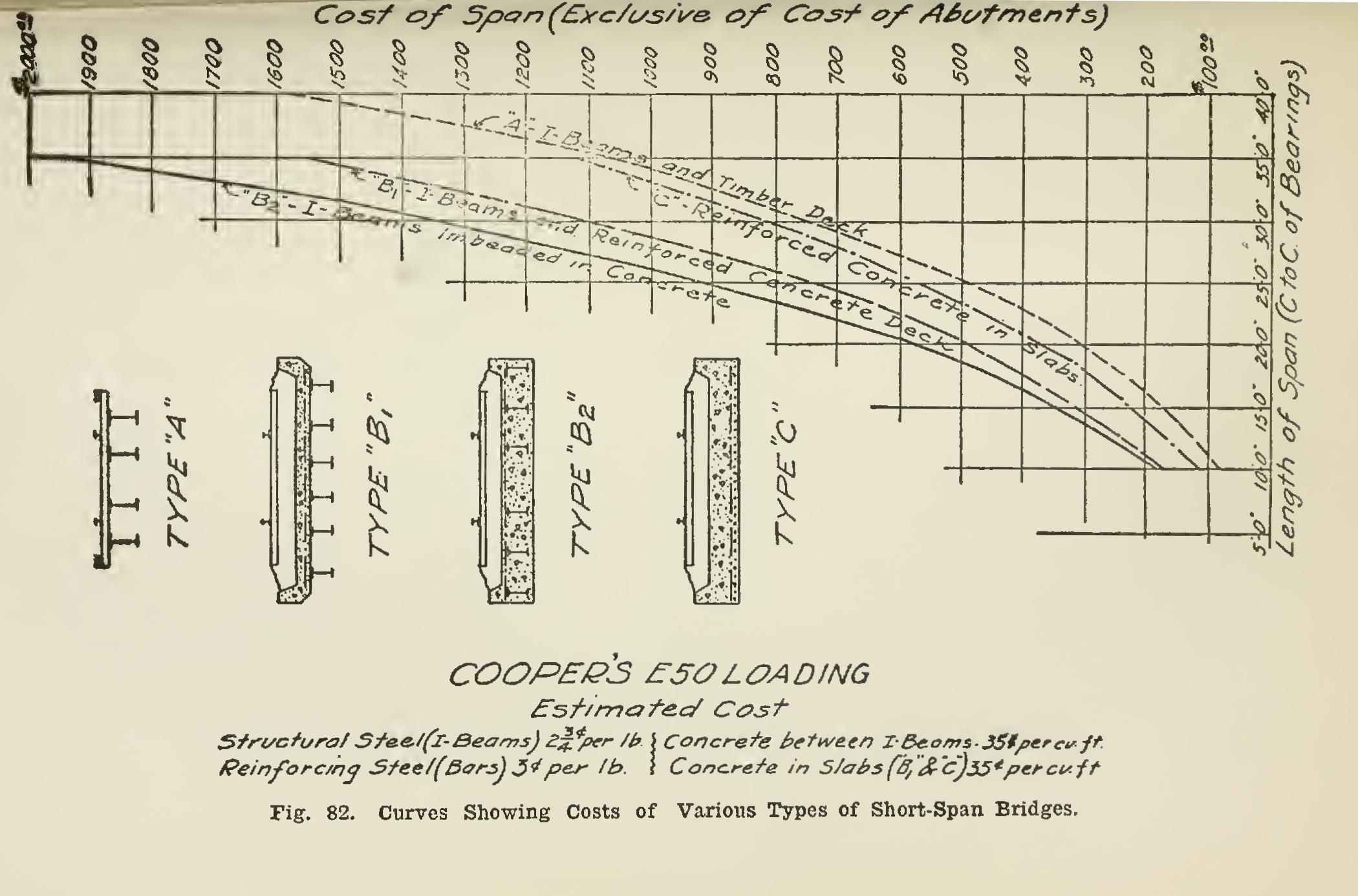
The depth of a floor is usually an important consideration in short-span bridges, the shal lowest floor allowing the greatest waterway. The concrete slabs compare favorably with the other spans in the depth of the floor. For ex ample—for a 20-ft. span, the distance from the base of rail to the lowest point of the bridge is as follows: Type A, 2 ft. 6 in.; Types B-1 and B-2, 3 ft. 9 in.; Type C, 3 ft. 7 in.
Many advantages of the ballast floor make the Type A construction less desirable than any of the other types. Amongst the ballast-floor bridges, Type B-2 and Type C are to be pre ferred, because in these bridges the steel is not exposed to the action of the elements. Type
B-2 is not adapted for economical construction, as it does not utilize the concrete in carrying the load; and it is not to be recommended from an engineering standpoint, because it is question able whether the load will be distributed equally over all the beams, and whether the concrete and steel will remain in contact.
In conclusion it may be said: 1. The Type C construction of reinforced concrete slabs has the lowest first cost of all the ballast-floor types, and is nearly as cheap as the open-floor steel span.
2. The reinforced concrete slabs take up as little headroom as the other ballast-floor types.
3. The reinforced concrete slabs can be built in place, built alongside and moved in, or built at a distance and lifted in, while the other bal last-floor types cannot be so readily handled.
4. The reinforced concrete slabs are more permanent than the Type B-1 spans with ex posed beams, and afford better protection for the steel than in Type B-2, where it is question able whether the concrete will remain in contact with the beams.
Table VI will be found of value as an actual record of the cost of various classes of concrete work as carried out during the year 1907 by a prominent contracting company for one of the large Eastern railway systems in the United States.