Combination Squares
square, bevel, tool, blade, angle, try, series and steel
COMBINATION SQUARES The ordinary steel square, fully treated of in the first part of this work, is, as has been clearly demonstrated, a constructive tool of wonderful possibilities in the hands of the skilful workman. The labor-saving tables and scales stamped upon the blade and tongue, as we have seen, furnish the workman with an ever-ready solution to almost any problem that may arise in roof fram ing or in laying out hoppers and hopper bevels. But modern requirements have demanded even a more effective tool than this; and these requirements have been met by the ingenuity and inventiveness that have become proverbial as characteristic of the intelligent American workingman. The original steel square has been improved upon. Success in the builder's art to-day depends not so much upon the skill of the artisan as upon the superior quality of the tools he works with. Ingenious inventors, avail ing themselves of this fact, have placed at the disposal of American workmen certain improved forms of the steel square, with various time and labor-saving devices attached. These per fected tools are commonly known as "Combi nation Squares." Some of them do more than furnish the workman with a constructive tool of the highest excellence, seeming in fact liter ally to furnish him even with brains and an in 181 creased number of hands, correspondingly en hancing the quality and quantity of his work. Every workman, therefore, who uses the Steel Square, should be informed as to the latest types of these time and labor-saving tools. Descrip tions of the more important of them, together with the inventors' directions for their use, are here given.
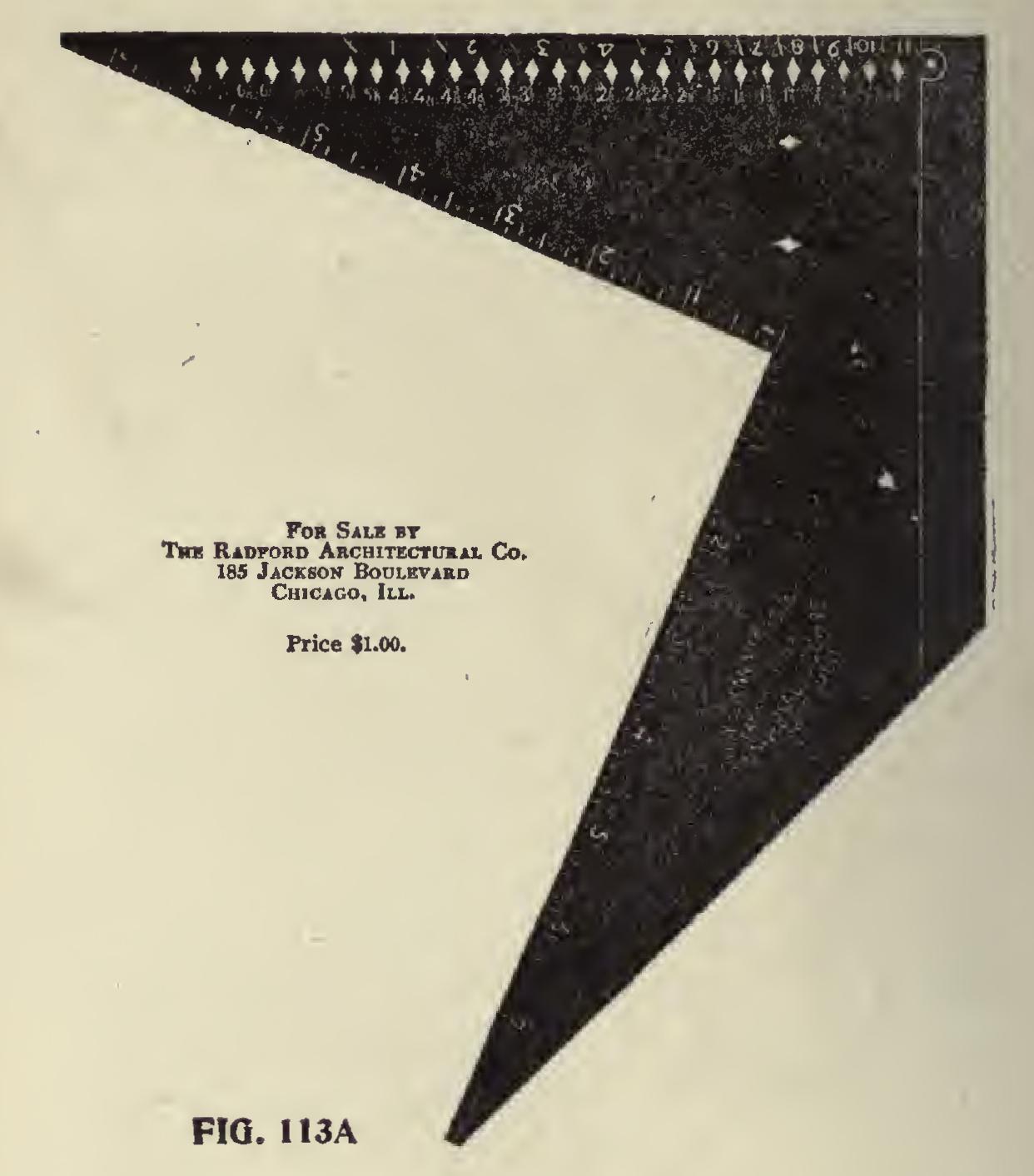
Universal Square.—This tool is shown in Fig. 113a. It is a combination square for the use of carpenters and other mechanics, and can be used as a try-square, bevel square, pitch-cut square, hip and valley-cut square, and miter square. To operate, you simply reverse it from side to side.
It marks r on one side, and if on the other. It takes the place of many tools, and is always ready for any use, there being nothing to adjust or change about it.
Hight's Union Combination Square.
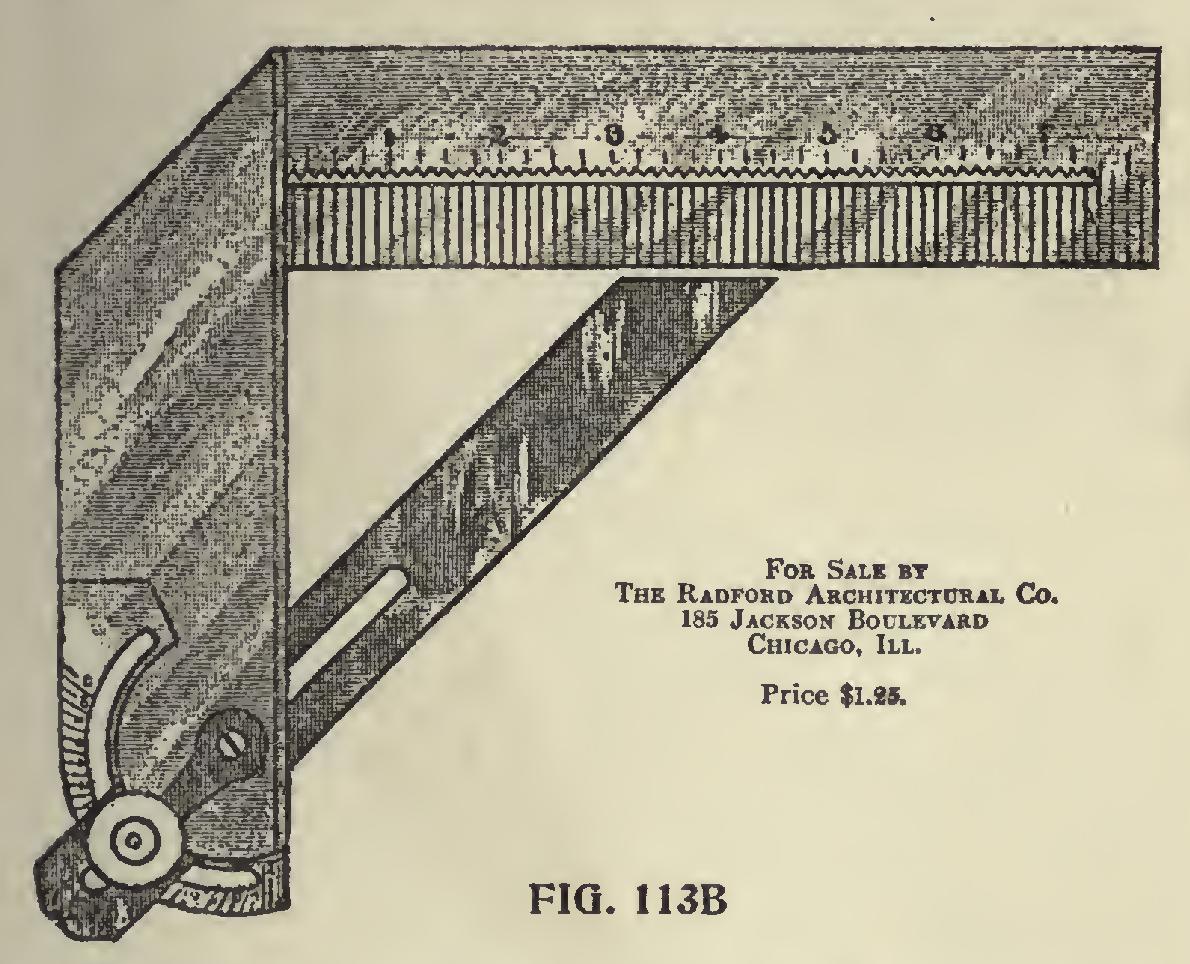
This is the name given to the tool illustrated in Fig. 113b. All the combinations of this tool are available at the same time. The notches in the edge of the slot in the blade are of an inch apart, and are to enable it to be conveniently used as a gauge. To use the bevel, loosen the clamping bolt, thaw the protractor out to the angle required, and clamp in place. Set the protractor by the scalemarked on the circular segment. This scale is marked to indicate the angle expressed in inches rise for twelve inches base, when set on the figure 6, in the first series. The angle is one which will give rise of six inches in twelve, or the angle for the bottom of rafter / pitch. Set on the 6 in the second series and you have the angle for the top of the rafter for the same pitch. So with all the figures in the first two series. The first series is from 1 to 12, the second from 12 to 1. The third series is for convenience, when it is not con venient to turn the tool over to get reverse angle. The circular segment is laid off in degrees on the lower side, which will readily show you the figures on a square with 12 required to cut any desired number of degrees. The notch in the end of the protractor will enable the tool to be used for a gauge to get in corners, guaging for setting hinges and beveling edges, etc.
Ideal Bevel Try=Square.
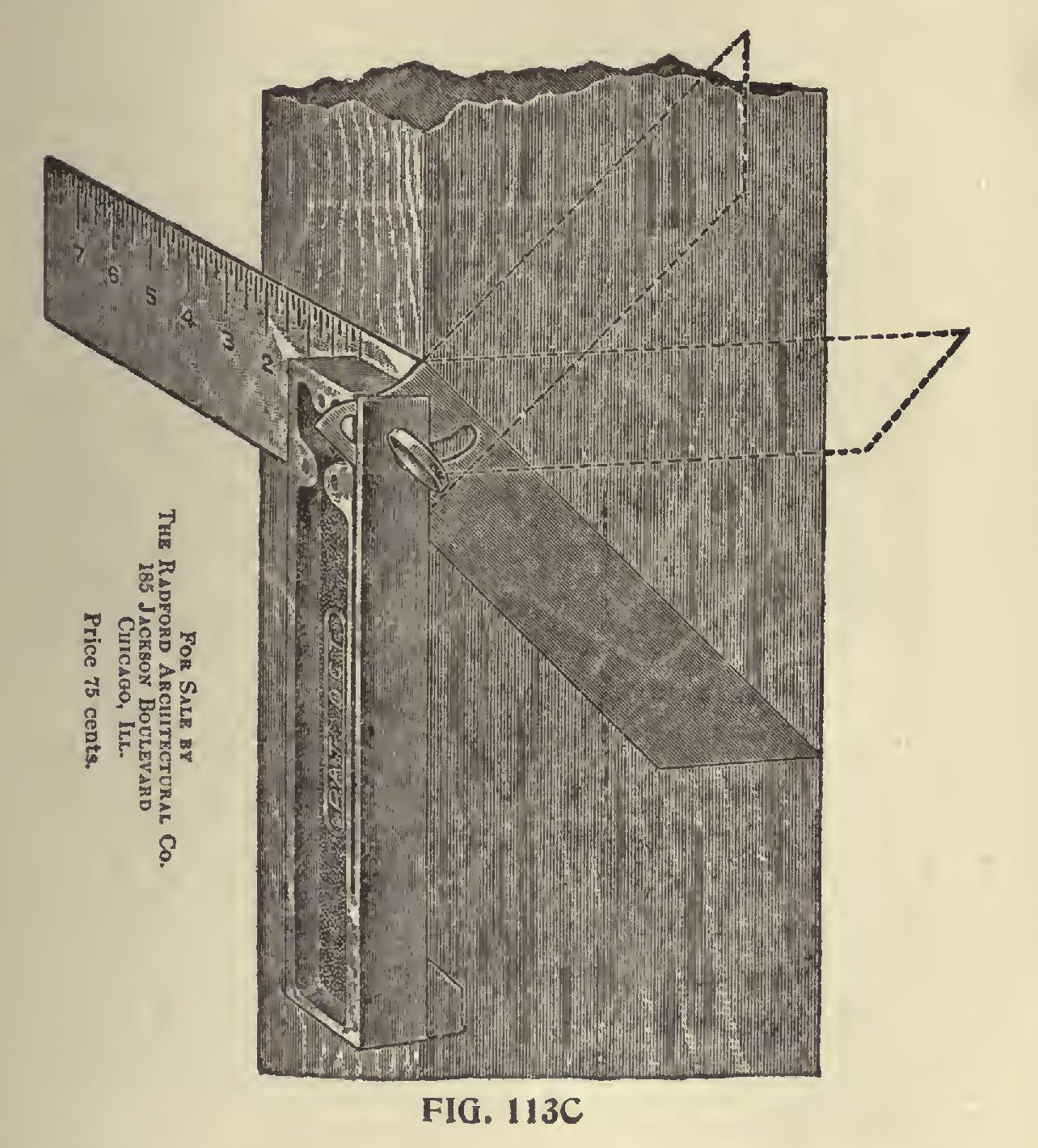
This tool, shown in Fig. 113c, is a combination of a bevel and a try square. The inventor of the tool claims that by using it a carpenter can accomplish more than ordinarily in laying off work. (1) He can mark the square and bevel cut with one continuous stroke of pencil without having to change square.
(2) It is easy to change the bevel blade to any angle, as the slot in the bevel blade will allow shifting so it will always come to corner of square blade. (3) By setting bevel at right angle to Try Square blade, both marks can be obtained without changing the position of square. (4) For beveling a board on edge, swing bevel blade over to back of handle, which gives a straight surface on handle. (5) When bevel blade is not needed, close same in handle, and you then have a regular Try Square. (6) The Try Square blade is graded in eighths, and the figures are stamped very plain. All parts, it is claimed, are made of the best steel, except the handle, which is of a composition metal that will not rust.
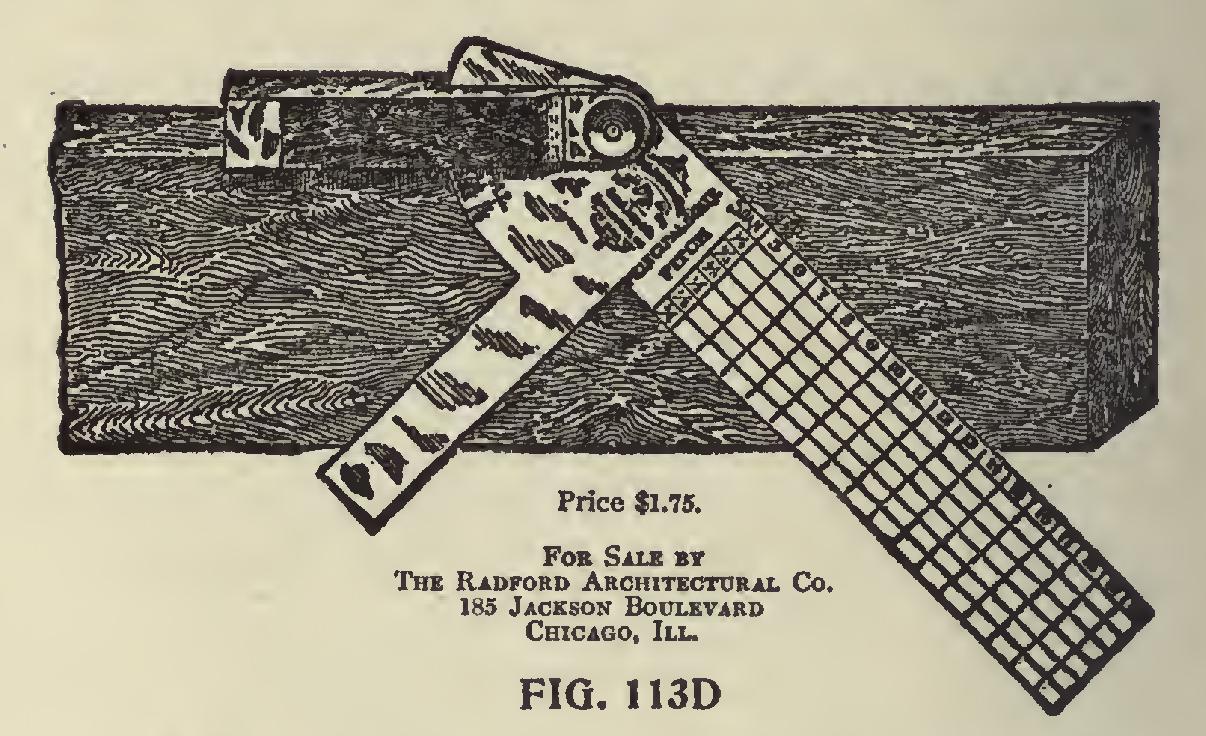
Topp's Framing Tool.—Is a very ingenius com bination square, consisting of a T square, a try square, and a bevel square. It gives all the cuts for different pitches on all kinds of rafters, and the lengths of same, for any plan. Fig. 113d shows the manner in which this tool is used when marking out rafters.