Ventilation
air, floor, shaft, heating, flue, ventilating, foul, method and coil
How Ventilation is Secured. In discussing the methods for securing ventilation, we shall not here describe at length the mechanical devices used in large buildings, except to say that by means of a fan or blower, air-washer, etc., it is now possible to furnish a supply of pure, humid atmosphere within any building, regardless of how densely occupied or of the condition of the air outside. We can truly claim that we are now able, with modern ap pliances, to furnish any condition of climate for any sort of purpose.
It is the ventilation of homes that we wish more particularly to discuss, urging upon our readers the importance of following what sug gestions we have to offer for accomplishing results in this respect. A large part of our life time is spent in the sleeping room—probably one-third of each twenty-four hours—and hence all rooms devoted to this use.• should be well ventilated.
In all efforts exerted to secure ventilation in a room, two things are necessary—first, the admission of pure air; and second, the removal of foul air. The accomplishment of the former result is an easy proposition; of the latter, a comparatively hard one. All modern dwellings are so constructed with archways of large doors between principal rooms that one indirect radiator, as shown in Fig. 75, placed under the central hall, and one or two others located under the principal rooms, will admit plenty of fresh, pure air to the first floor of the dwelling.
For second-floor rooms, or those in isolated locations, direct-indirect radiators may be in stalled, as shown in Fig. 74, as a means to secure the desired service.
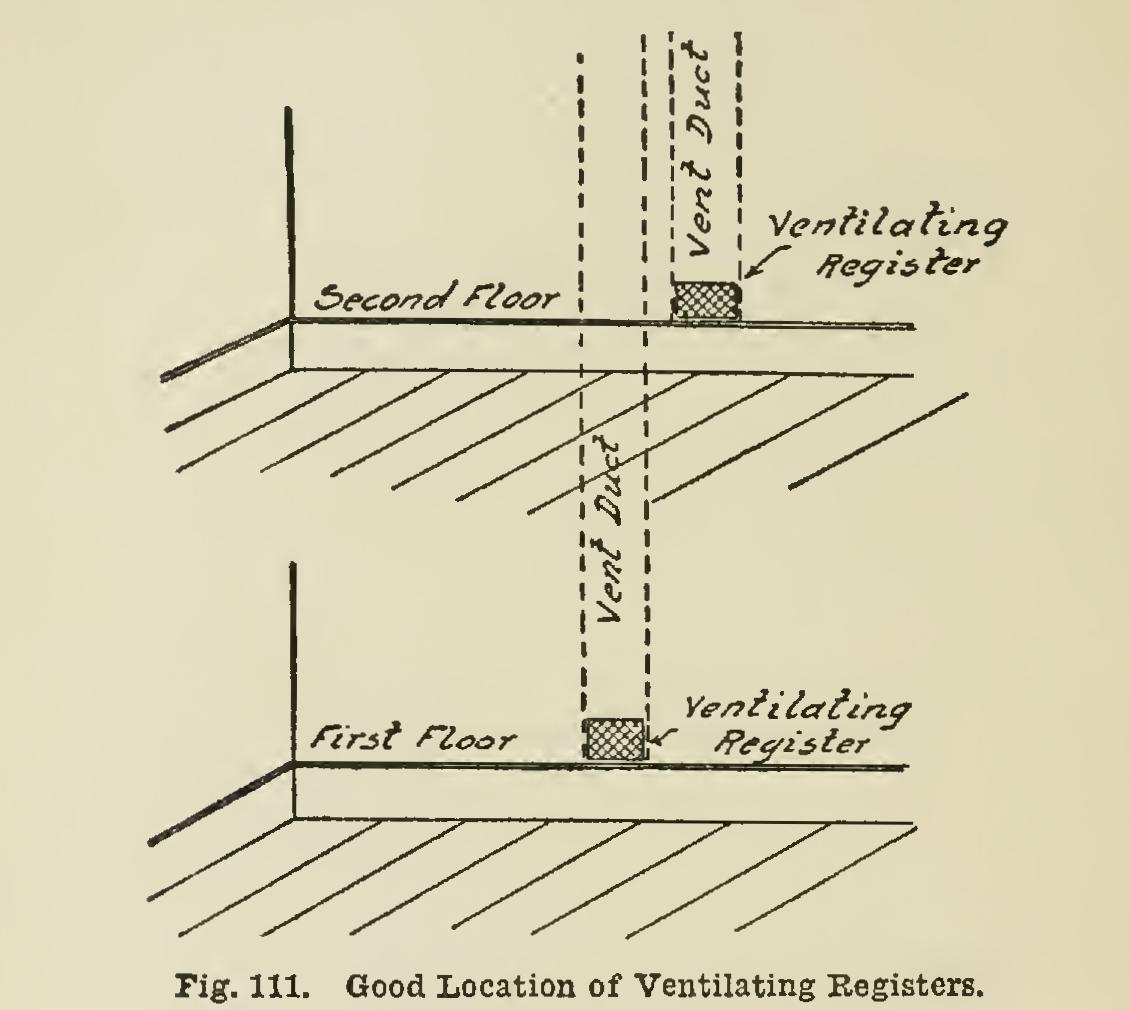
It is a difficult matter to exhaust the foul air unless suitable flues are provided for this pur pose while the building is in course of erection. It is a good plan, in building, to erect Ventilating flues in pairs—one of the two extending down to the floor of the second-floor rooms, the com panion flue reaching to the first floor. Registers should be placed in the flue in each room, near the floor. A good location is at a point just above the baseboard, as illustrated in Fig. 111. These flues should extend upward to the atmosphere.
The warm, pure air admitted to the room through the radiator is light and buoyant, and rises to the ceiling, settling gradually below the breathing-line to the floor as it becomes heavy during the process of cooling. This supply below the breathing-line is the foul or con taminated air, and must be removed at or near the floor-line.
A cold shaft or chimney is of no use what ever for ventilating purposes, as it is open to the atmosphere and has the pressure of the outside air (14.7 lbs.) constantly pressing down upon its contents. To create an upward draught or cur
rent in the flue, in order to overcome the atmospheric pressure, it is necessary to heat or expand the air in each flue, and the warming of this supply may be accomplished in various ways.
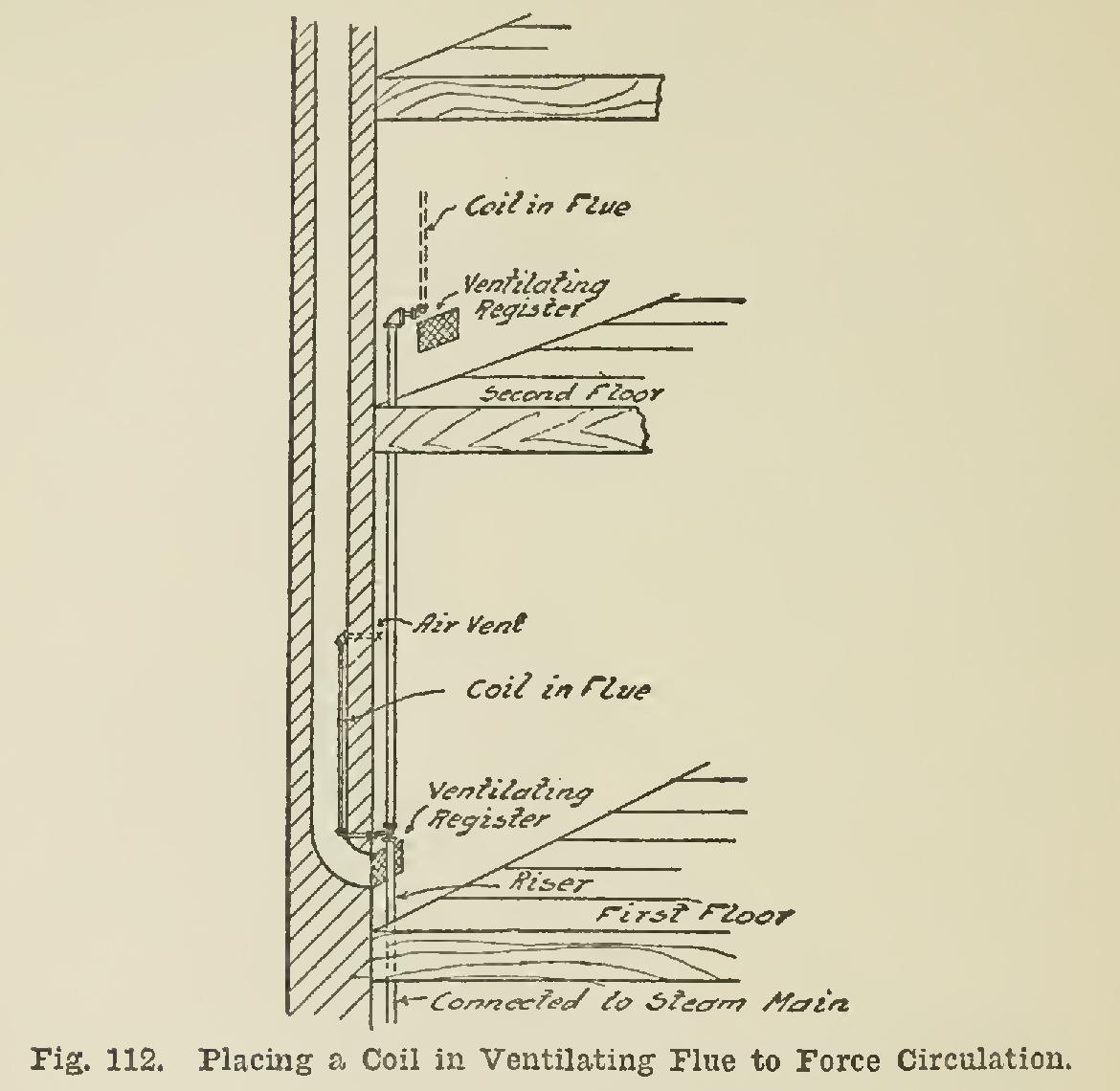
Probably the simplest method in connection with a steam or hot-water heating apparatus is illustrated in Fig. 112. A pipe riser is carried up near to the flue, and a branch on each floor run to a small coil or line of pipe inserted in the flue above the register. A small air-pipe leading from the top of the coil into each room terminates at an air-vent through which the air in the coil is removed. When the heating ap paratus is in operation, this arrangement will be found to afford a very satisfactory method for securing ventilation.
Another method, which may be adopted in a dwelling with a large attic, involves having the ventilating flues terminate just above the attic floor, where they are connected by galvanized ducts into a large ventilating shaft opening through the roof, this shaft being supplied with a sufficient amount of heat to expand the air.
The construction for the heating of the air may be in the form of a large radiator or coil. A further advantage derived from the usage of this method is that ventilation may be secured in summer months when the heating apparatus is not in use, simply by the introduction into the shaft of a fan, electrically connected, for exhausting the foul air to the atmosphere. If desired, this fan arrangement can properly be used all the year round, and the pipe coil in the flue omitted.
Still another method which may be practiced with success in compactly erected residences, requires the building of a large brick shaft through the center of the house. A smoke-pipe for the heating apparatus—made of iron or steel, or of terra-cotta pipe with tightly cemented joints—is carried through the center of the shaft, furnishing the heat to expand the air in the shaft, this provision producing an upward current. All ventilating ducts are then connected into this shaft, either directly on each floor, or are carried to the attic for connection.
One benefit included in the use of either of the latter two methods is that the ventilating ducts may be constructed of tin and inserted in the partitions in quite the same manner as would be the hot-air riser pipes for furnace heating work.
As a rule, dwellings are easier to heat when provision is made for exhausting the heavy, foul air within. This is particularly true in furnace or hot-air heating, as it is impossible to circulate warm air into or through a perfectly tight room from which no supply can escape.