Butterflies and Moths
wings, butterfly, body, antennae, chrysalis, moth and scales
BUTTERFLIES AND MOTHS. A poet has prettily called butterflies "stemless floating flowers." Scientists know them as a large group of insects, which with their cousins the moths make up the order Lepidoptera, mean ing "scale wings." They are so named because the wings of both butterflies and moths, as well as cer ., tain portions of their bodies, are covered with a very fine soft glistening dust, which if examined under a compound microscope is seen to be made up of mil lions of little scales, of very pretty outlines. Some of these scales are very much like little feathers, some like fans; and all have a tiny stem by which they are fastened.
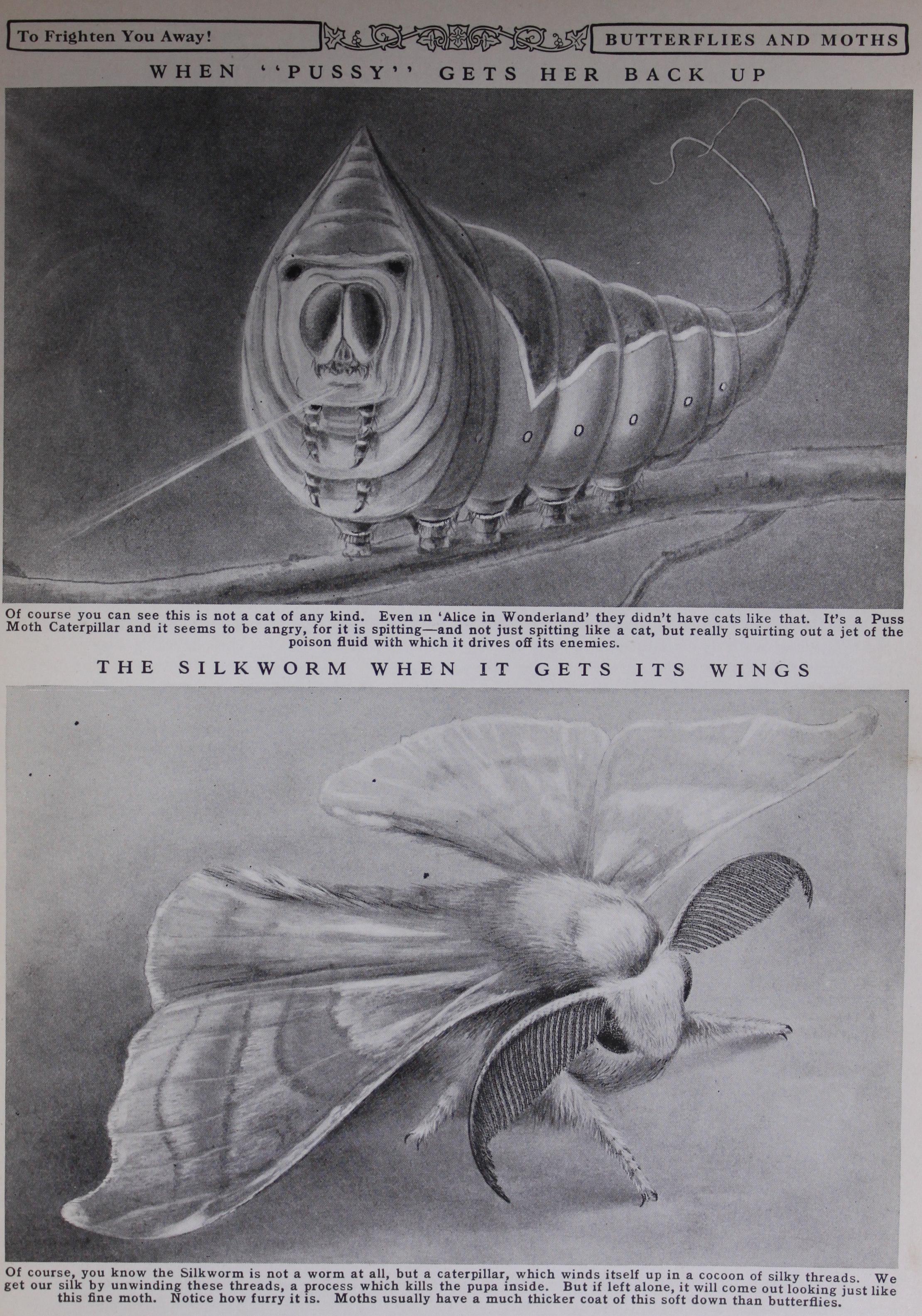
Most of the butterflies fly during the daytime and sleep during the night; with the moths it is often just the reverse. A good way to distinguish between the moths and the butterflies is by the shape of the antennae or feelers. The an tennae of the butterflies are t hin and have their ends rounded into little clubs or knobs, while the antennae of the moths are not tipped by these knobs.
Many of the antennae of moths are shaped like tiny feathers.
In addition the butterflies usu ally hold their wings vertically over their backs when at rest, while the moths let them lie flat open.
It is a mistake to think that the moths are all plain and sombre in color, while the butterflies are more brilliant.
Some of the most beautifully colored members of the whole order are moths. One of our commonest moths, the tuna moth, is a beautiful green color with a transparent center or "eye-spot" on each wing and long curved hind wings, and is surely as handsome as any butter fly. There are many more species of moths than there are of butterflies.
In North America north of Mexico there are about s,000 of the former and only about 700 of the latter. The butterflies, however, probably because they are more active in the daytime, are the best known to most people.
They fly about from flower to flower and are often as prettily colored and fashioned as the blosAoms they visit.
A butterfly has a long slender body, two long thread-like antennae or feel ers on the front of the head, and six slender and fragile-looking legs. Upon
its thorax, the middle section of the body, are two pairs of broad wings, covered with the tiny dustlike scales.
It is these scales, indeed, that give the wings their beautiful colors. The front pair of wings is usually larger than the hind pair. The mouth consists of a long slender sucking tube which, when not in use, the butterfly keeps coiled up like a delicate watch spring.
With this long tube it probes deep into the nectaries of flowers, where the liquid is stored, and drinks up this substance for its food.
The life history of the butterfly and the moth is almost identical. The female butterfly or moth lays a great many eggs. and from these hatch out tiny worm-like grubs, called caterpillar larvae (see Cater pillars). These grow rapidly, and shed their skins several times. Caterpillars crawl about among the leaves of plants and fee.; on them. They are very greedy creatures indeed, and do nothing but eat and fill their stomachs as full as they will hold. This food is stored up in the body in the form of fat, and is used to build up wings, legs, sucking tubes, etc., when the caterpillar turns into a butterfly or moth later on.
When the caterpillar feels within itself that the time has come for it to turn into a butterfly, it spins a button of silk, to which it clings. Hang ing head down, it sheds its cater pillar skin, and then appears in compact form, a naked pupa called a chrysalis, which clings to the button of silk by a sharp spine at the end of the body.
Some species spin a halter of silk as well as a button and thus suspend the middle of the chrysalis. The caterpillars of the moths spin themselves cocoons for the chrysalis stage.
For some time (weeks or months) the pupa or chrysalis sleeps, and dur ing its sleep it changes until it finally comes out a butterfly. When it first emerges from the chrysalid skin it sits still for some hours, in order to let its thin, moist, crumpled wings spread out. Then it waves them backwards and forwards slowly, to dry them, and finally flies away in search of nectar producing flowers and its mate.