Butterflies and Moths
larvae, trees, yellow and plume-moth
Among the butterflies of the United States the tiger swallow-tailed butter fly is one of the largest and most beautiful. The common small yellow butterflies that one sees about road sides are the roadside species and in cabbage patches the white species is called the cabbage butterfly. Some of the butterflies, like the " mourning cloak," live through the winter under leaves or in sheltered places. They may often be seen flying about during some of the very warm days during thaws.
Many of the butterflies and moths which live in tropical countries are brilliant in color and very large. Some of the biggest of these measure as much as eight inches from tip to tip of the spread wings.
and are as large as or larger than our winter wren.
Some butterflies are shaped and colored so as to resemble parts of the plants on which they rest. The dead leaf butterfly of India, when perching on a twig with its wings closed, looks almost exactly like a dead leaf. This is to hide the creature and to protect it from its bird enemies.
Among the best-known moths are the silkworms, whose cocoons supply the silk of commerce. The caterpillars of some of the smaller forms of moths are very destructive to furs, woolen cloths, and other fab rics. Many larvae are de structive to crops and trees, annually causing great loss.
The army-worm, cotton worm, tobacco-worm, cut worms, and tent-caterpillars are larvae of moths ; the codling-moth, sphinx-moth, grape-berry-moth, grape leaf-folder, plume-moth, tussock-moth, and others work much ruin.
The sphinxes or hawk-moths are very beautiful, but many of them are also very baneful. They are large and narrow-winged, visit flowers at dusk and frequently are mistaken for humming-birds. One member of the group is called the " death's head" moth, from the pale yellow markings on the thorax which look like a skull. The larvae of some forms, which are very large, work much havoc on the grape-vine, feeding upon the leaves; it is said that a single larva may strip or kill a small grape-vine in two or three days. The moths appear in July, laying their eggs underneath grape-leaf or leaf of Virginia creeper. The plume-moth is an other enemy of the grape. Often one sees young grape-leaves curled up in little balls, examination of which will disclose the greenish yellow larvae of the plume-moth.
The vines should be examined daily, and the larvae picked off and destroyed.
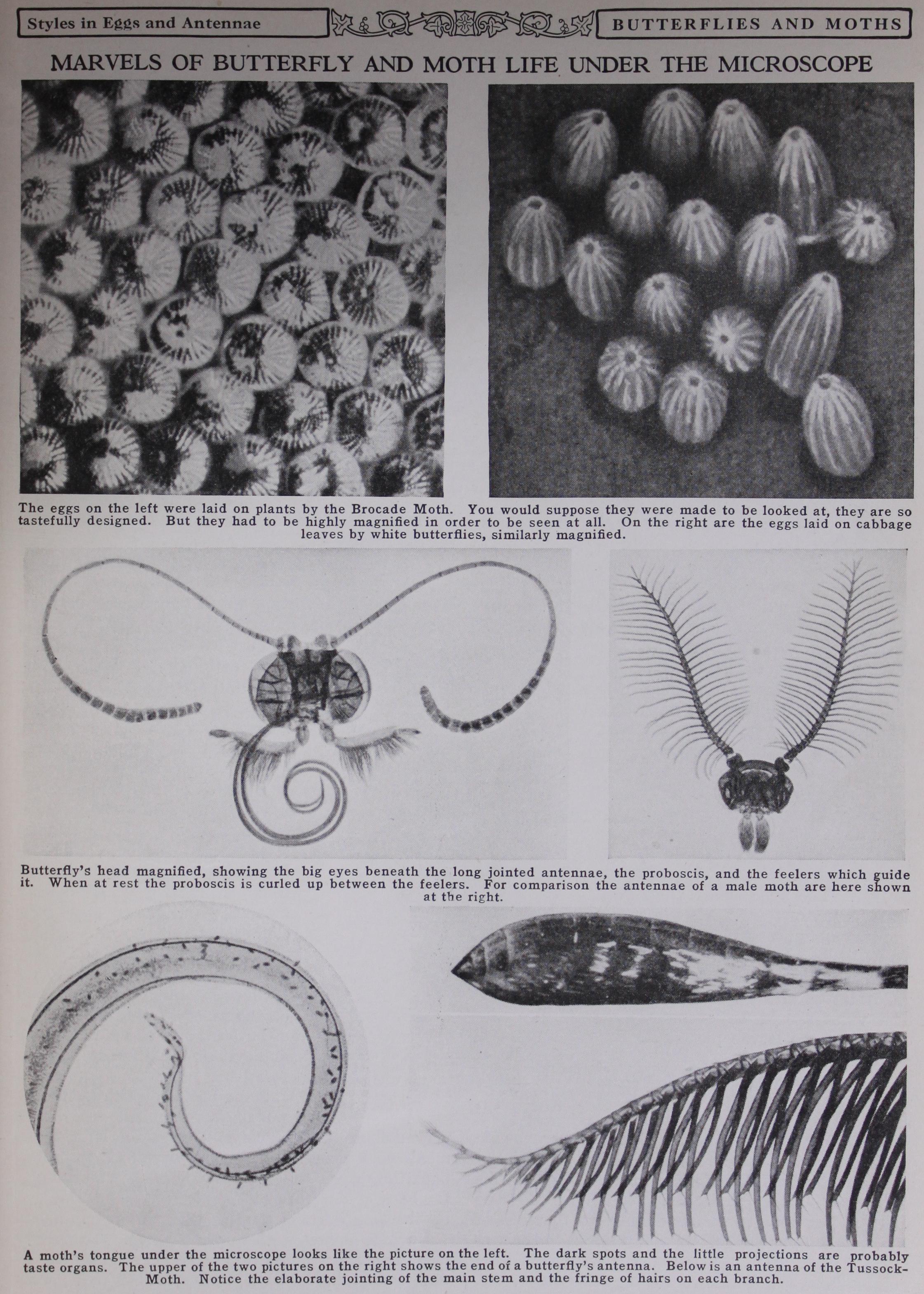
The white-marked tussock moth works much ruin on shade and fruit trees, stripping them of foliage. There are two broods a year. The cocoons are made in the trees, and the eggs are laid in a white frothy mass. These eggs are conspicuous, and should be destroyed. The gypsy-moth, introduced from Europe in 1869, has done enormous damage to the trees of New England, as has also its near relative, the brown tailed moth. State and national governments have spent millions of dollars in combating these insect pests.