Ny Buffalo
concrete, plants, steel, cement, buildings, pressure and underground
The firmest foundations are pillars of concrete that go clear down to bed-rock. The exca vation is made under or in pneumatic caissons under great air pressure, and the caissons are filled with reinforced concrete which is allowed to harden. Many of the buildings of Chicago, where the soil is soft, rest on a forest of wooden piles driven deep down, or a "platform" foundation. For a platform foundation, an excavation is made many feet below the surface covering the entire area of the building. In this is built a bed of iron rails or timbers and cement to support the columns. The general practice today, however, is always to sink caissons to bed-rock.
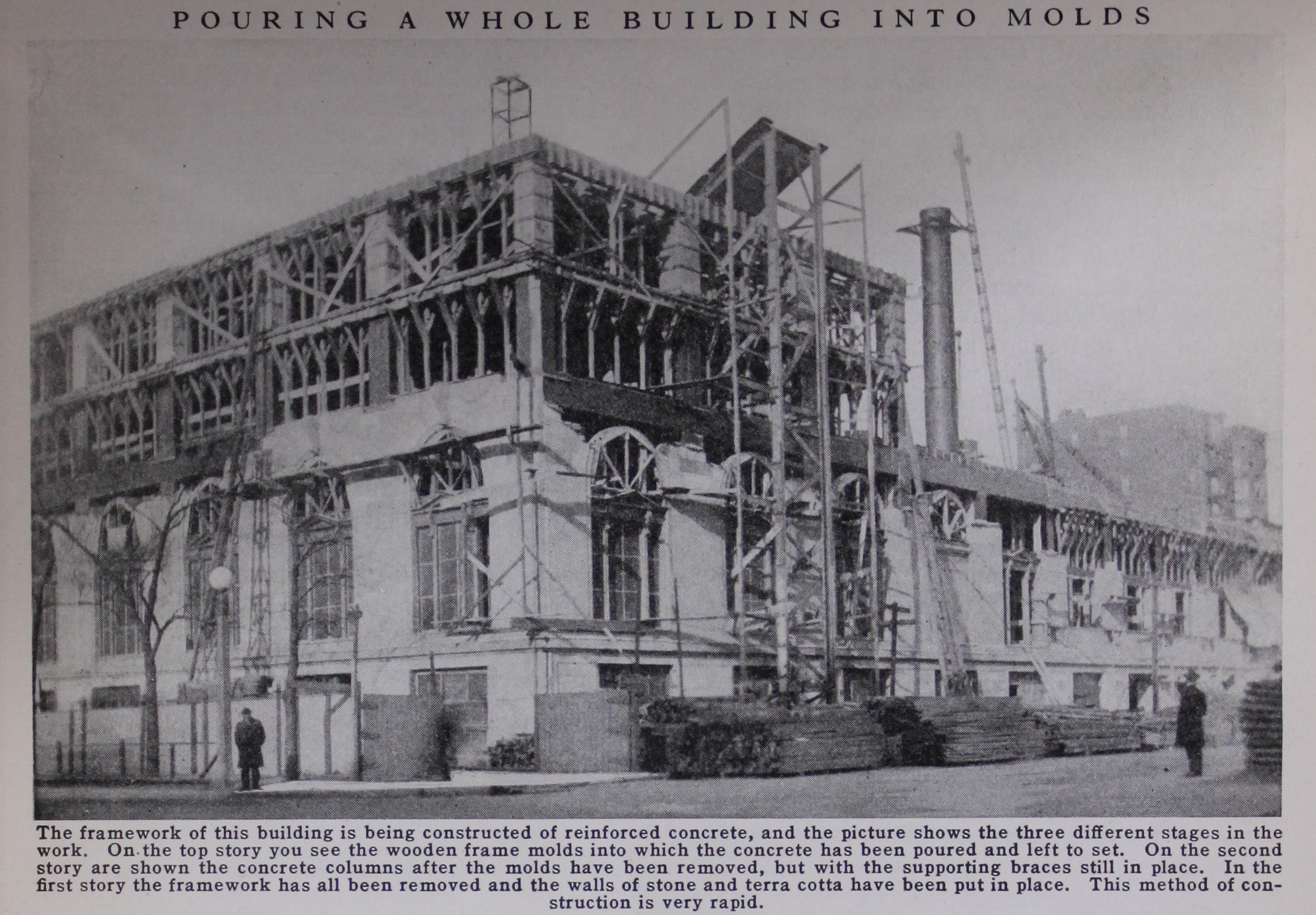
For the walls, cornices, and decorative features stone, brick, concrete, terra cotta, or tile are used, singly or in combination. Every effort is made to employ fire-proof materials to the greatest practicable extent. The floors usually are constructed of hollow tile arches placed between the floor beams, covered with concrete and surfaced with any desired flooring.
For the inside partitions fire-proof hollow tile is often used; a netting of wire fastened to an iron framework at times takes the place of laths. The roofs usually consist of a number of thicknesses of heavy felt imbedded upon a smooth portland cement surface and covered with a roofing cement, on which are laid vitrified tiles, with joints thoroughly filled, practically forming a pavement. This is known as actinolite.
Architectural terra cotta has been developed to a very large extent in the past few years. This is a hard clay product nearly fire-proof and is very largely used in these big buildings for the interior of the walls as well as the superstructure. It can be glazed and made in almost any color and shape.
Special care is taken to enclose the steel parts in a non-combustible substance, for if one column of steel is twisted out of shape the whole building is in danger.
Terra cotta is generally used for this purpose, because of its insulating qualities and light weight. Concrete is considered the ideal fire-resisting material, although nothing has been found that will successfully endure a long fierce fire. While the wood finishes used in most buildings for interior finishing catch fire easily, these fires can generally be confined to the room in which they start.
The recent development in the use of concrete is of no less importance than the invention of the steel skeleton method. Up to certain heights reinforced
concrete is almost as strong and durable as steel, and it has the added advantage of being far cheaper.
By reinforced concrete is meant concrete in which steel rods are imbedded to give the strength, which ordinary concrete lacks, to resist a side pressure or a pull. Concrete resists great vertical pressure, but it yields to side pressure and pulls apart easily. In the construction of columns a sort of frame of iron rods is imbedded in the concrete to give it the neces sary strength, and floors are made rigid by using two layers of rods, one crossing the other at right angles.
Since the cement in the concrete shrinks and expands slightly with extreme changes in temperature, cracks soon appear in large buildings unless expansion joints If you look closely at a crocus " bulb," you will see that it is different from the tulip or onion bulb. All the scale-leaves are thin and papery, and the food is stored in the stem itself, which is swollen to a white rounded lump. A bulblike stem of this sort is called a corm, and the familiar crocus, as well as many wild plants such as the Jack-in-the-pulpit, is thus provided.
Still other plants store food for the coming season's growth in tubers and rootstocks, which are much thickened underground stems of various forms.
You will notice that in the potato, which is our most familiar tuber, the scale-leaves are tiny little things, with the buds in their axils. If you cut off a piece of a potato containing a bud— or eye, as we call it — and plant it in the ground or keep it in a warm place, it will sprout and begin to form a new potato plant. The iris, bloodroot, man drake, various kinds of grasses, and many other plants grow from root stocks, which look like large thick roots, but are really underground stems, because they have scale-leaves.
Plants which have such underground structures enabling them to pass through summer drought and winter cold, and to develop with great rapidity during the favorable season, are called "geophytes" or geophilous plants. Nearly all the typical spring flowers belong to this class, doing all their growing between the first coming of spring and the development of the heavy forest foliage which shuts them off from the sun's direct light.