Cabinet
cable, cables, ocean, laying and miles
Less than three months later, however, the messages grew gradually feebler and finally ceased. The wires had been burned out by the use of too strong currents, and the whole gigantic task had to be begun anew.
Field and Bright were still undaunted, but public confidence was gone. The breaking out of the Civil War in America contributed to prevent further attempts for seven years. Meanwhile Lord Kelvin had perfected his delicate receiving instrument, and Field was tireless in his attempts to raise new capital.
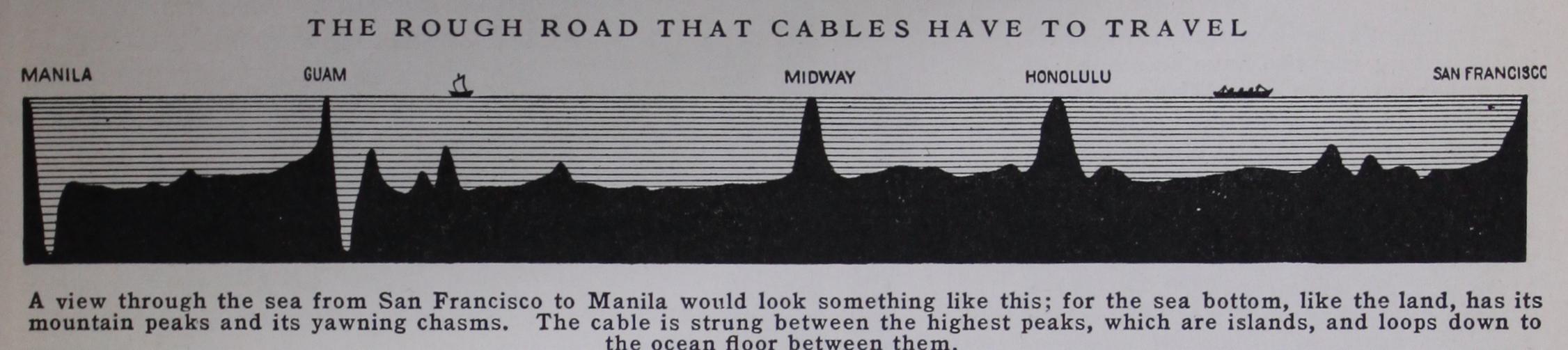
Though he was desperately seasick whenever he Island is 3,600 miles, making it the longest continuous section of cable in the world. The other Pacific cable was completed the following year, from San Francisco to Manila, at a cost of $12,000,000. It touches at Honolulu, Midway Islands, and Guam, and has been extended to Japan. These wonderful cables cross mountains and valleys of the ocean bed, and in some places they lie six miles beneath the ocean surface.
went to sea, Field crossed the Atlantic 64 times to promote this enterprise.
At last, in 1865, Field and Lord Kelvin loaded a new cable on the Great Eastern, the largest ship then afloat. When half the j ourney had been made the cable parted and sank. The next year saw the same two men once more on the giant ship, laying a new cable. This time success at last crowned their efforts.
The ship then turned about, and with improved grappling tackle succeeded in raising the cable that had been lost the year before. A new section was spliced on and the ship returned to shore, completing the second cable between Europe and America.
Improvement in the making and laying of cables continued, and other cables were soon in operation.
A Ready-made Bed for Cables Fifteen cables now span the Atlantic, nine of them in working condition. Most of these stretch along the same high plateau of the ocean bed where the first cable was laid. This is called the " Telegraph Plateau" because it is comparatively level, with a greatest depth of about two miles, and is covered with a soft ooze favorable to the successful laying of cables.
The task of laying these cables would have been immensely more difficult if the existence of this plateau had not been known, making it possible to use a much shorter and lighter cable than would be necessary to stretch over the alp-like surface of other parts of the ocean bed. Matthew Fontaine Maury and other naval officers of the United States and England discovered this plateau by their patient labors in charting the ocean bottom, and thus deserve a place among the men whose labors have made the transatlantic cable a success.
Cable laying in the Pacific is much more difficult than in the Atlantic because of the greater distance and greater depth. The first Pacific cable was laid in 1902, connecting Vancouver, Canada, with Aus tralia and New Zealand. It is about 8,000 miles long, and one span from Vancouver to Fanning Cable tolls are necessarily expensive, as a result of such costly equipment; but the tariff for messages from New York to London has been as low as 12 cents a word, compared with the charge of $5 a word in the early days. All persons or firms who habitually employ the cable use codes in which one word does the duty of 10 or 15. Newspaper messages are " skeletonized," that is, cut down by the omission of all but the most important words.
In time of war international law sanctions the cutting of cable lines to the enemy's territory. So, during the World War of 1914-18, all of the Atlantic cables to Germany were put out of service by the Allies.