Cairo
feet, world, lies, hundred, pyramid, earth, kings, tombs, time and sand
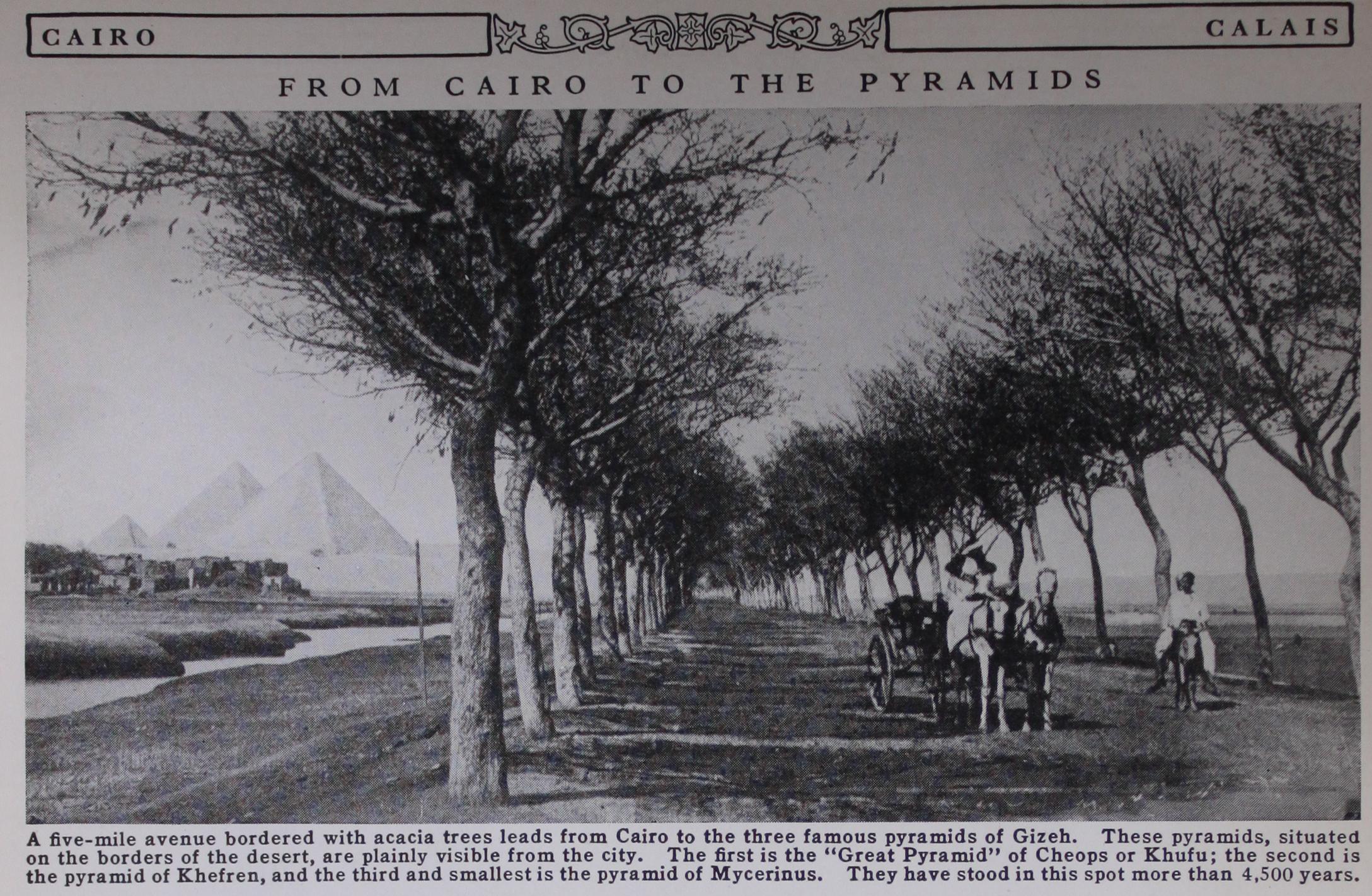
The Great Pyramid is the greatest monument ever set up on the earth, and the only monument on the face of the earth which looks today, at any rate from a distance, al most exactly as it must have looked 6,000 years ago. It is less useful in the world than a pin; it has no inspiration to give us; it is simply the most terrible heap of stones that has ever been piled up by human hands. And yet we sit in the sand and gaze at it with wonder, for it speaks of a time that can never come again in the world, of a time when a man could chain a hundred thousand men and drive them to labor like beasts of the field.
For 20 years a hundred thousand slaves worked to build this single pyramid, the greatest of the three that rise from the sand near Cairo; and they made this pyramid, which was merely to hold the dead body of a king, nearly three times as big as St. Peter's in Rome, and 50 feet higher. Its foundations are set in 13 acres of sand, and the stone it contains is nearly 90,000,000 cubic feet, or enough to make a nar row pathway, a foot wide, two-thirds of the distance round the earth! A few miles across the sand lies Cairo, and through Cairo runs the Nile. Six hundred miles up the is the great Assuan Dam, over a mile long, 90 thick at the bottom, 90 feet high, and 20 feet thick at the top; and this huge Nile dam, holding up enough water to make the desert of Egypt blossom as the rose, has just about a quarter of the quantity of stone great temple of Karnak. He flings his guide-book down as he gazes on these vast remnants of an empire which was great before Greece and Rome were born.
It is nothing that this courtyard is 400 feet long, that that is piled up in this great pyramid! Somebody has reckoned that if the pyramid could be made to slide on its base it would need a hundred million men to drag it along.
Inside this monstrous thing lies the tomb of the builder of it; so useless is this massive monument— as useless as the ugly Sphinx near by. It is not these things that stir the traveler who sees Egypt for the first time. It is when he takes the train from Cairo at half-past six in the evening, and steps out of it at Luxor, 400 miles to the south, at half-past eight next morning, that the traveler really feels that he is in another world.
The Dead Empire Buried under the Sands of Time Under his feet lies ancient Thebes, buried beneath mud huts and desert sands. The thud of a hundred axes, the tread of camels with their burden of earth, the incessant plodding of an army of excavators digging up spadefuls of history, come to him like an echo from the lost city that was once the capital of an empire. Before him rise the impressive columns of the temples of Luxor, from which, 3,000 years ago, an avenue of sphinxes over a mile long led to the .J those columns weigh a hundred tons each. It is everything that here sat Rameses II, that here came Alexander, that here was the heart of the world in an age of which his mind cannot even think, that the stones rising to the sky from his feet were placed there by the greatest builders that the world has ever known, thousands of years before the church of St.
Paul was set up at the top of Ludgate Hill in London! Who shall describe the glory of the Tombs of the Kings? Surely nowhere in the world is the sublime so near to the ridiculous as these mountain tombs of Thebes to the donkey-boys who walk to them daily and see no marvel there.
"They think we are mad," said one who knows them well, when I asked him what the donkey boys think of American excavators and travelers at Thebes. "They would sell us any fragment of any tomb, any carving from any wall, any head of any figure, any scarab or mummy or vase 50 centuries old, for five piasters (about 25 cents), or, if we pro tested that it was too dear, for three. And yet these tombs are like nothing else in the whole earth. The Pyramids are ordinary, Westminster Abbey is a child's toy, compared with these amazing chambers of the dead." In the Valley of the Tombs Crossing the Nile from Luxor, an hour's ride in the desert reveals the valley of the tombs. For hours, for days, perhaps, we may ride over them and not take the same road twice. From their heights we look down on the great statues of Amenhetep; the Rameses urn, with the statue of Rameses weighing a thousand tons; the beautiful temple of Medinet Abou; Luxor ; Karnak itself—all seen in miniature as though through the wrong end of a telescope. Deep down in the heart of these mountains, in spacious chambers fit for kings to live in, the kings of Egypt lay in their coffins.
Think of the most impressive place where all that remains of a king of men can be laid—of the heart of Livingstone, in the heart of his own Africa; of Cheops, in the terrible loneliness of his great Pyramid; of Cecil Rhodes, at the summit of the mountain from which he looks down upon a continent; of Mohammed at Medina; of Washington, of Napoleon, of Nelson, of Wellington, under the very pavements of their country's capitals! And none of these resting-places of immortal men can be likened, for an impressiveness that is thrilling and overwhelming, for a great silence that can be felt, for an imagination that has in it poetry and music and terror and prayer and strength and wonder, to the graves of the dead kings of Egypt, opened up for us to see by the enthusiasm of philanthropy and love of knowledge of an American citizen, Mr.
Theodore M. Davis.
Hundreds of feet deep in the mountains, through chambers cut in the solid rock, within sculptured walls bearing the history of their lives, as rich in color as if the paint had dried upon them yesterday, Amenophis II lies in his coffin as his people left him there 3,000 years ago. In a smaller chamber, among the dust on the ground, lies a beautiful woman, her black hair falling over her shoulders, who played, we are sure, with the princes in the king's palace 1,500 years before Jesus Christ was born. And as we gaze upon her face, forgetting that thousands of years have passed, we wait for her to turn in her sleep and kiss the boy who lies beside her.
So it is everywhere in Egypt—wonder piled on wonder, age-old ruin and age-old splendor at our feet! The whole wide world has nothing to compare with this strip of fertile earth that runs along the Nile.