Camping
fire, pound, camp, ground, little, waxed and paper
All the romance of camping is concentrated in the evening camp fire, the consummation of a "perfect day," a send-off to a night of sleep such- as no city dweller ever knew.
You gather around the fire, your appetites appeased, the dishes washed and garbage buried, a little tired with the million activities of the day, at least willing to sit quiet for a space. The fire blazes up. You gather closer with a sense of nearness each to the other which day never brought. This is the hour of comradeship. Around the fire you talk and laugh and recount the day's adventures, discuss the mor row's plans. You sing songs, a little off the key perhaps, but with a right good will. Somebody spins a yarn, while the rest of you listen and watch the sparks fly up to heaven. Camping is good, all of it; but this hour around the camp fire is the best of it, the essence of the whole experience, the heart of its magic.
For breakfast next morning the charred remains can be collected to make a " Chinook" fire, as good Fire is the forest's worst enemy, and a single live coal may smolder on for hours, to be whipped into a disastrous forest fire by a puff of wind. When you leave a camping place, pour water or heap earth on your fire—lots of it, until nothing is left to start a blaze.
When a woodsman builds a fire he carefully selects a place where the wind will not carry the flames into dry leaves or bushes. If the ground is covered with leaves, he scrapes a place bare and builds a little rampart of stones to keep the flames from spreading.
If the ground is wet or covered with snow, he lays a little platform of small logs to keep the embers from sinking in. Before he lights his match—and one match is all a good camper needs—he sees that he has plenty of fuel cut and stacked for the particular sort of fire he needs; for you know there are several kinds of fires, and the fire that is good for one purpose is useless for another.
Dry leaves and twigs picked off the ground make good tinder to start a fire; but if things are wet, you must at times break off small sticks from the under branches of a soft-wood tree and whittle them into little cones of shavings, leaving the shavings attached to the stick. The
resinous bark of the birch tree is far and away the best kindling.
The king of camp fires is the backlog fire. Cut two 2-inch stakes of some green hard wood about four feet long, and drive them into the ground about two feet apart, leaning away from the front of the tent and eight to ten feet distant. Against these pile five logs, three feet long and four or five inches in diameter.
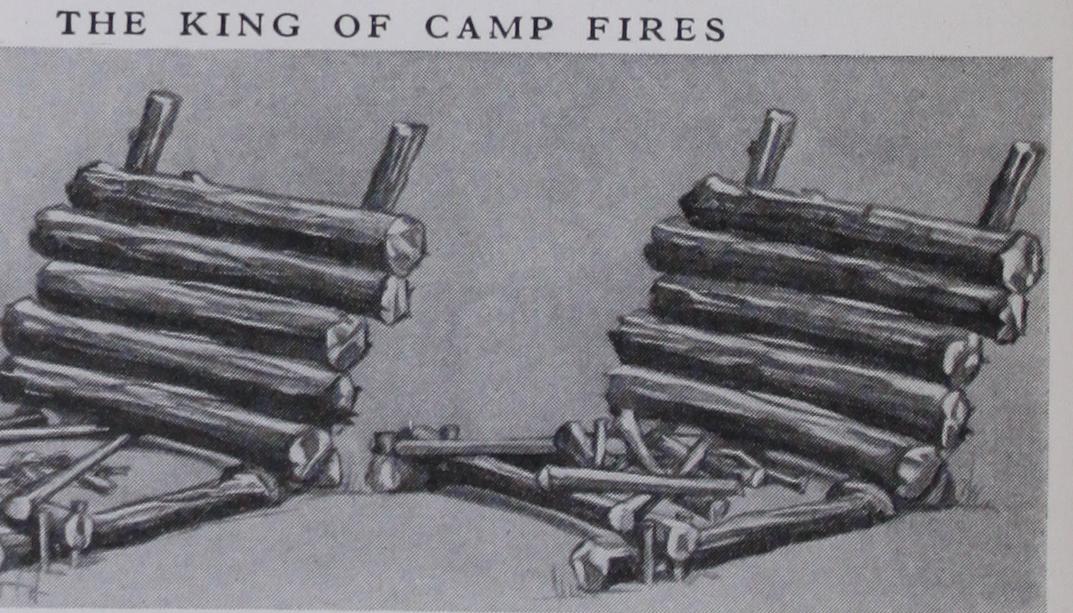
a breakfast fire as anyone ever devised. Probably three of the backlogs will be only half charred through.
Lay one of them over the andirons for a forelog and put the other two side by side a little farther back.
Now build a fire underneath, using birch to give it life and maple or hickory to make long-lived coals.
Hang your coffee pot at the end of a sapling resting in the crotch of a stick and pegged down at the other end, or on a cross-bar lashed to two sticks driven into the ground. Your frying pan rests on the two rear logs, and if you want to bake bread, you can scoop out a hollow under the blazing forelog, fill it with Here is Kephart's list of hiking rations for four boys, three meals: Four pounds breadstuffs, in bag or waxed paper; one pound bacon, sliced thin, without rind, in waxed paper; one pound cheese, in waxed paper; one dozen eggs, in carton; one can evaporated milk, not sweetened ; one-half pound butter, in tin ; one-half pound sugar, in bag; one-half pound dried fruit, in waxed paper, or lemons; one-fourth pound ground coffee, in bag; one can jam; one-sixth pound salt, in joint of bamboo, corked; pepper, in waxed paper.
It is hardly necessary to tell an ordinary boy or girl what to do in camp. The day will not be long enough to get in all the things one wants to do in the woods, especially if the camp is on a river or lake.
Rowing, canoeing, fishing, swimming, hiking, nature study, stalking wild life with a camera, and hosts of other alluring pursuits will make one grudge the time that must be set apart for cooking, dish-washing, wood-gather ing, and keeping the camp in order.