Canadian History and Government
canada, british, dominion, house, sir, power, party and conservative
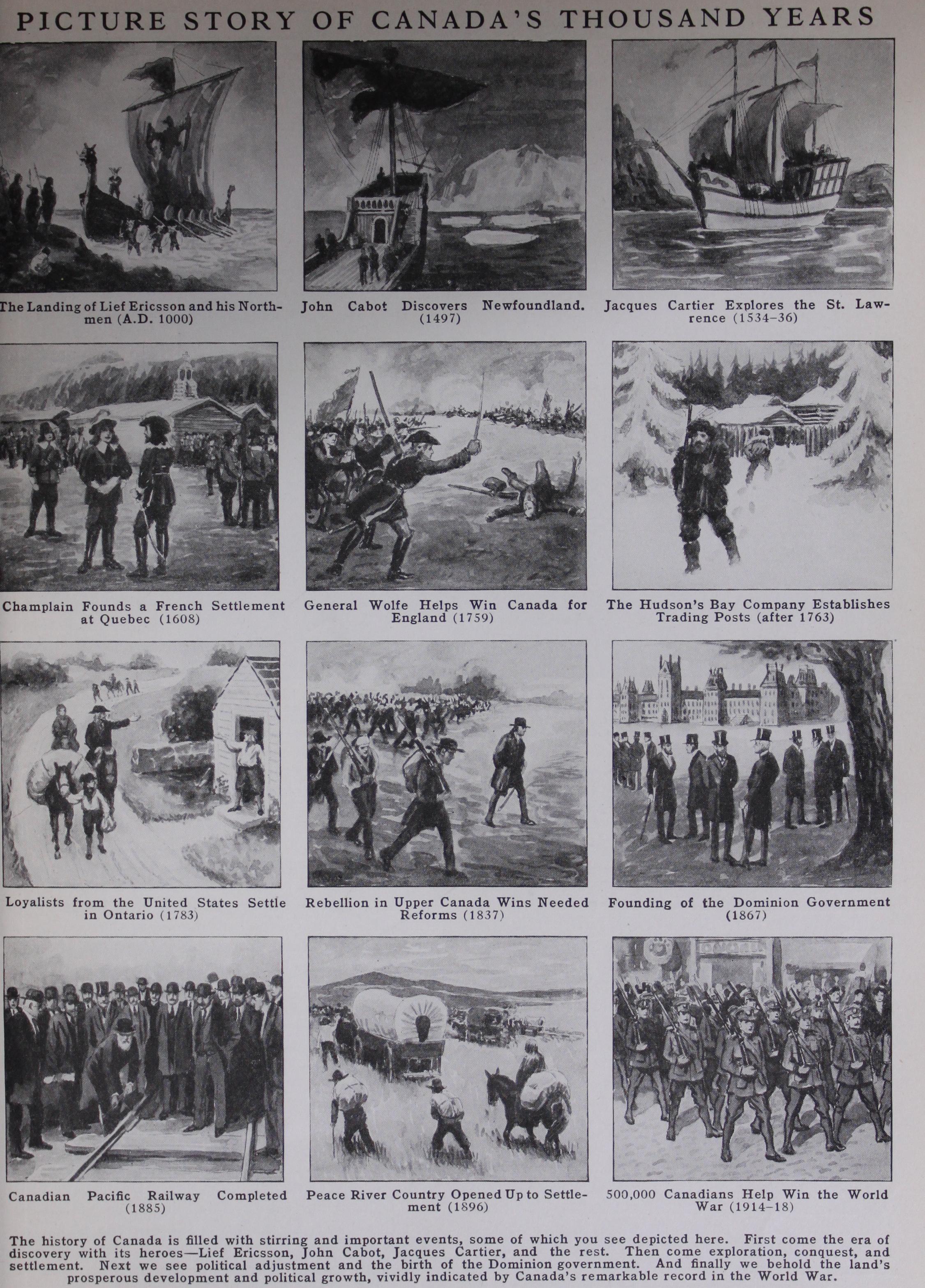
An act establishing the Dominion was passed by the British Parliament. Since 1867 the growth of the Dominion has been phenomenal. In 1869 it acquired by purchase the vast territories of the Hudson's Bay Company; and out of these there was carved in 1870 the province of Manitoba, and in 1905 the provinces of Saskatchewan and Alberta. In 1871 British Columbia, on the Pacific Coast, came into the Dominion; and in 1873 Prince Edward Island, which had refused to come in in 1867, repented of its decision, and followed British Columbia's example.
Thus, within a few short years, Canada grew into a serried row of self-governing provinces stretching from the Atlantic to the Pacific. Newfoundland also still remains outside the Dominion.
Alongside these outstanding features of Canadian history, the details of the political history of the Dominion since 1867 are of only secondary impor tance, but they deserve perhaps a brief description.
The first administration of the Dominion was that of Sir John Macdonald, a Conservative statesman who was one of the most outstanding of the Fathers of Confederation. In 1873, Macdonald was driven from power as a result of the "Pacific Scandal"--a scandal in connection with the building of the Canadian Pacific Railway. He was succeeded by Alexander Mackenzie, the leader of the Liberal party, who held office until 1878. In that year Macdonald was re turned to power on a high protectionist platform known as "the National Policy," and he remained in power, the most loved and most hated of Canadian politicians, until his death in 1891. For five years the conservative government he had headed then strug gled on without him, under a suc cession of prime ministers; but in 1896 it was driven from power by the Liberals under Wilfrid (afterwards Sir Wilfrid) Laurier, a French-Canadian Roman Catholic.
Laurier remained in office until 1911, when he was de feated on the issue of reciprocity in trade with the United States. A Conservative ad ministration was then formed by Mr.
(now Sir) Robert Borden; and it was this administration which guided the destinies of Canada in the first years of the World War.
The war effort which Canada made under Sir Robert Borden's leadership is perhaps the most glorious page in Canadian history. In 1917, in order to carry compulsory military service, Borden took into his cabinet representatives of the "conscription ist" wing of the Liberal party; and the "Unionist" government thus formed remained in power until after the close of the war. Most of the Liberal ministers,
however, left it, and Sir Robert Borden himself handed over the prime ministership in 1920 to Mr.
Arthur Meighen, one of his former lieutenants. The party which Mr. Meighen headed adopted the name of "National and Liberal-Conservative"; but its chief support was still derived from the old Conservative party.
How Canada is Governed To explain the system under which Canada is governed is not easy. Superficially, the government of Canada resembles that of the United States, on which it was to some extent modeled. In each case, two distinct sets of political machinery were set up, one central or federal, the other local or provincial, with a division of powers between them. Just as among the 13 original States of the American Union, so among the provinces of British North America local jealousies and interests prevented a complete union and compelled an arrangement under which each state or province would have control of its own local affairs. In each case, moreover, the federal senate or upper house was made the guardian of the rights of the smaller states or provinces, which were given in it especially gener ous representation.
But here the re semblance between the two systems ends. In its essen tial features, the government of Canada is modeled on that of Great Britain—a system so different from that of the United States that the peo ple of each country find it difficult to understand the political institu tions of the other.
This difference arises mainly from the fact that in Great Britain and Canada the execu tive government (that part of the government which carries out the laws) is directly responsible to the legislature (that part of the government which makes the laws); whereas in the United States it is not.
The political machinery of the Dominion is com posed of : (1) a governor-general, who represents the British Crown and is appointed by the British gov ernment; (2) a cabinet of ministers, headed by a prime minister, which corresponds almost exactly with the British cabinet; and (3) a legislature or parlia ment composed of two houses—an upper house termed the Senate, which is, like the British House of Lords, not elected, but appointed, and a lower house termed the House of Commons, which is modeled after the House of Commons at Westminster.