Canadian History and Government
cabinet, house, parliament, commons, senate, dominion, minister and prime
The governor-general, as the representative of the Crown, is the nominal head of the government. Yet —and this is the deceptive feature of the Canadian system—he has virtually no powers of his own. In his official capacity he can do nothing except on the advice of his Canadian ministers. He has no veto on legislation, like the President of the United States; even the speech he makes at the opening of parlia ment is written by the prime minister. He is, in fact, little more than a figurehead—except that, in some respects, he acts as a sort of ambassador from the British government.
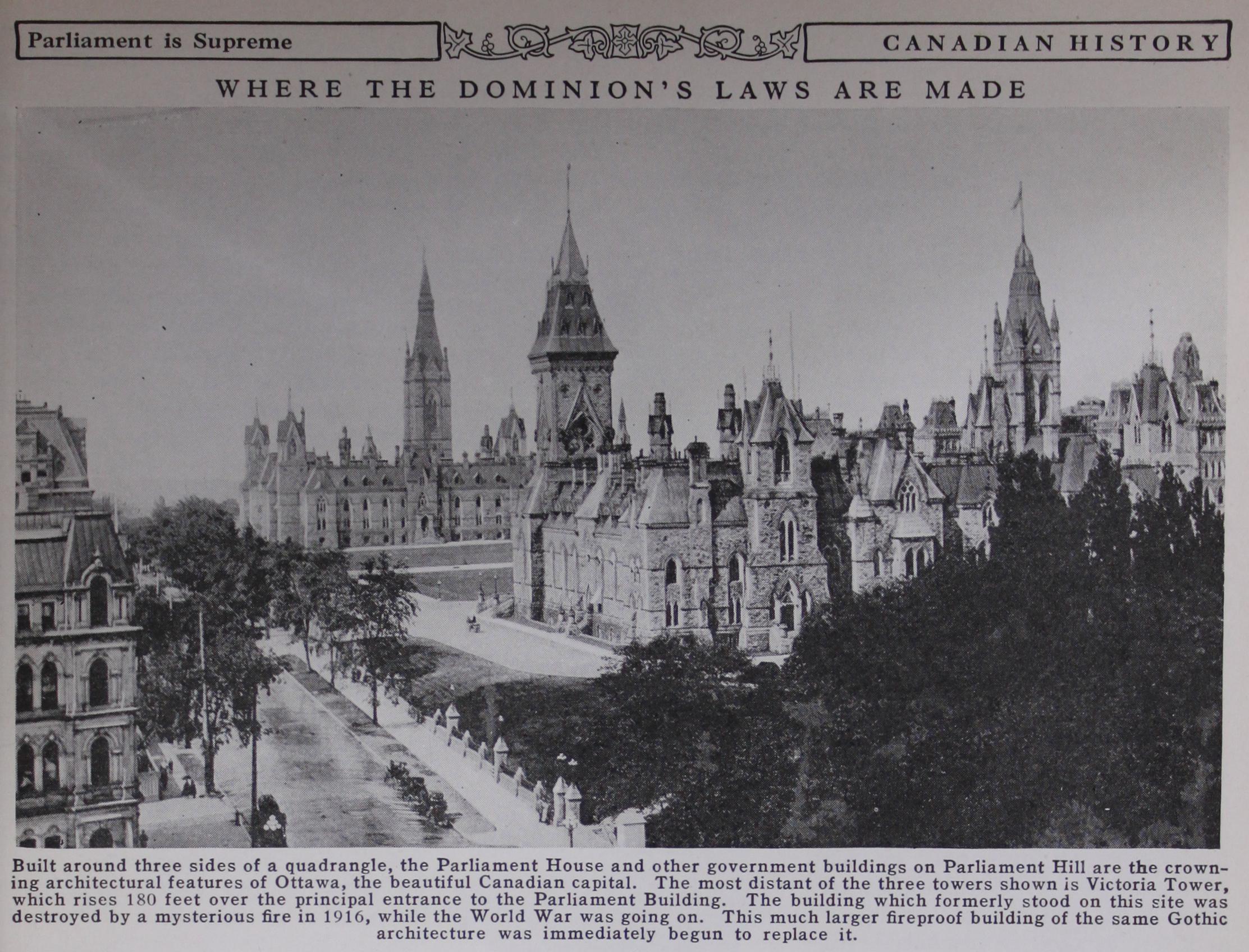
It is the prime minister who is the real head of the government. He not only chooses the cabinet of ministers, or heads of departments, and thus controls the carrying out of the laws; he also very largely directs the making of the laws. This is because he is, and must be, himself a member of parliament, who is in command of the confidence of the majority of the House of Commons, the branch of the legislature that enjoys the all-important function of voting money. He and his cabinet sit in parliament and there render daily an account of their stewardship.
The President of the United States and his cabinet do not sit in Congress, and during their term of office cannot be removed by Congress, except by impeach ment; but the Canadian prime minister and his cabinet can be forced to resign at any time merely by the passing in the House of Commons of a vote of want of confidence. On the other hand, so long as the Canadian cabinet continue to enjoy the con fidence of the House, they are practically masters of the situation; and the prime minister, as head of the cabinet, is little less than a dictator.
Great Power of the House of Commons Of the two houses of parliament, the House of Commons is by far the more important and powerful.
In it sit nearly all the cabinet ministers, and in it alone may bills be introduced which require the expenditure of public money. On its good will and support the very existence of the administration depends. The Senate, on the other hand, unlike the Senate of the United States, occupies in the constitu tion a distinctly inferior position. It was intended mainly as a revising chamber, in which hasty legisla tion passed by the lower house might be rejected or amended; but its action in this respect has been somewhat spasmodic. Owing to the fact that its members are appointed, virtually for life, by the government of the day, and that each government has been in the habit of appointing only its own par tisans, the Senate as a rule has been very subservient toward the House of Commons when the party in power commands a majority in both houses, and very obstructive when, as usually happens after the advent to power of a new government, the dominant party in the House of Commons is in a minority in the Senate. So unsatisfactory, indeed, has the Senate
proved that some observers have questioned whether it performs any useful function in the Canadian system; and there have been many proposals for its abolition or reform.
Within the sphere assigned to it, the Dominion parliament is supreme. Theoretically, the British government retains, under the British North America Act, which is the fundamental document of the Canadian constitution, the power of disallowli4 Dominion legislation; but this power has not beer exercised for many years, and it has now fallen into disuse. The British North America Act, it is true can be amended only by the Imperial parliament; bui this is now done, almost as a matter of course, on address from both houses of the Canadian parliament.
For all practical purposes, the only matters with which the Dominion parliament is not competent to deal are those reserved exclusively for the provincial legislatures. Powers not specifically conferred on the prov inces are reserved to the Dominion government.
The provincial constitutions are, some of them, survivals of the days before confederation. In each prov ince there is a lieutenant-governor, who represents the Crown in the province as the governor-general does in the Dominion; though these officials are appointed, not (as the governor-general is) by the British government, but by the Dominion government. In each case the lieu tenant-governor acts only on the advice of a provincial cabinet, headed by a prime minister or " premier," and the cabinet is responsible to the representatives of the people.
In two of the provinces, Nova Scotia and Quebec, the legislature is corn posed of two houses, a Legislative Council appointed, like the Domin ion Senate, by the government, and a Legislative Assembly elected by the people; but in all the other seven provinces there is now only a legis lative assembly, those provinces which formerly had an upper cham ber having discarded it.