1625-1649 Charles I
parliament, king, wished, public, religious, people, power and puritan
CHARLES I, 1625-1649, to whose unhappy lot it fell to occupy the throne in the days of the Puritan Revolution, at a time when new ideas of the rights of the people were coming into sharpest conflict with the old claims of royal right or prerogative, ended his reign in martyrdom on the scaffold. From his birth, in 1600, he was a weakly child, unable to speak until his fifth year or to walk until his seventh. He outgrew both defects, however, becoming active in outdoor sports and making himself an accomplished scholar. He was deeply religious and sacrificed every thing for his convictions. Yet he lacked the power of reading the temper of the times, and that gift of voic ing the feelings of his subjects which had made his Tudor predecessors so powerful. He regarded every one who differed from him as an enemy. While he prided himself on the legality of his measures, he failed to see that what had the sanction of the law might at times be the unwise thing to do. Much influenced by the few to whom he gave his confidence, he clung obstinately to any opinion he had once formed. Worse than all, he was secretive and evasive.
Many of his views were so at variance with public opinion that he sought to conceal them; he made promises which he found himself unable to keep, and sometimes even entered into engagements with mental reservations which would enable him to escape doing what he did not consider to be for the public good.
Charles had succeeded his father, the shrewd but uncouth James I, in 1625; and the same year he welcomed at Dover his little bright-eyed queen, the French Princess Henrietta Maria, whom he had married by proxy six weeks earlier. At first he was the mere tool of his dashing favorite, George Villiers, Duke of Buckingham. After the assassination of that noble, in 1628, Charles gradually submitted himself to the guidance of his wife, brought up at the court of an absolute monarch and distrusted by the people because she was a Catholic. Her influence, and that of other evil advisers, such as the Duke of Strafford and Archbishop Laud, was largely responsible for confirming the King in the course of action that led to his war with Parliament.
The issue was primarily whether the king of England was an absolute king, like the sovereigns of continental Europe, or whether his power in levying taxes, making laws, and the like, was limited by the powers of Parliament. Complicated with this, there was also a quarrel about religion. Many of Charles' subjects, known as " Puritans," wished to "purify" the church services by dropping out many ceremonies used by Roman Catholics. Charles on the contrary wished to retain as many as possible of the old ceremonies. He even went so far that he made people
fear that he wished to restore Catholicism. Conse quently Charles was opposed both for religious and political reasons.
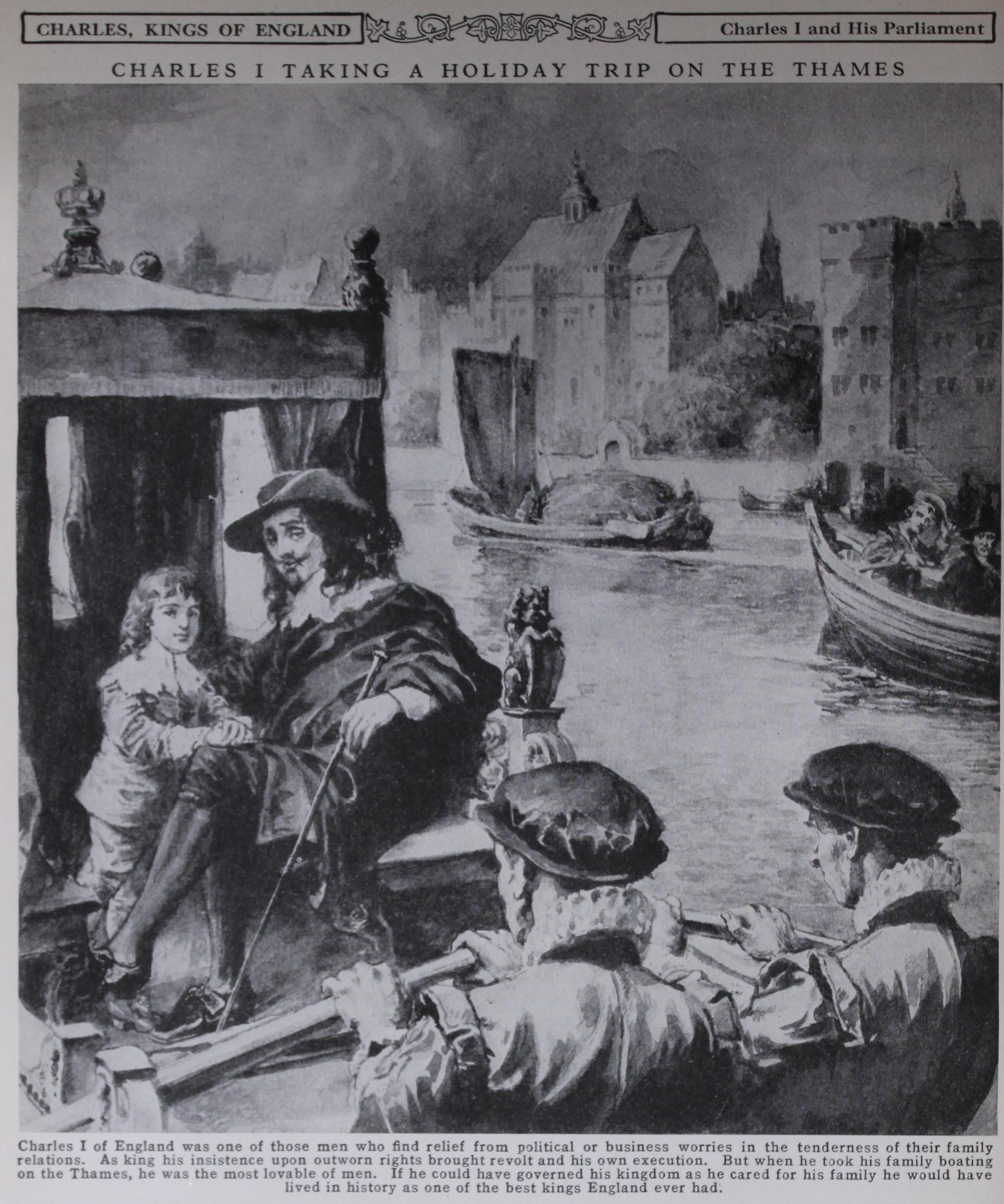
In the first four years of his reign Charles dis solved three Parliaments because they resisted his arbitrary measures. Then for 11 years he ruled without summoning a Parliament. His attempt to make the inland counties pay a "ship-money" tax was met by the resistance of courageous John Hamp den, and amused the greatest excitement. The foolish attempt to force the Scottish church to use English forms of worship arrayed his whole northern kingdom in arms against him also.
Charles was thus at last compelled to summon a Parliament (1640) which won fame as the Long Parliament.
This assembly compelled the king to sign laws doing away with all the extraordinary courts and as well as the south; and Naseby (June 14, 1645) completed the king's overthrow.
Charles surrendered to the Scots' army, who pres ently handed him over to Parliament. His escape and a brief Second Civil War (1648) sealed his fate.
Parliament decided that there would be no security for the liberty of Englishmen until "Charles Stuart, that man of blood" was dead. It accordingly caused him to be tried, condemned, and beheaded (1649) as illegal practices which had endangered liberty; he was even forced to sign the death warrant of his counselor Strafford. But Parliament split over the religious question, for some members wished to abolish bishops entirely while others did not. Civil war broke out (1642) when Charles attempted to arrest five leading members of Parliament. Most of the nobility, gentry, and clergy rallied to the King's party; but Parliament controlled London, the navy, and the taxing power of government.

Charles' dashing " Cavaliers" fought bravely; but the stern Puritan "Roundheads," aided by the Scots, and under the leadership of Oliver Cromwell, were finally victorious. The battle of Marston Moor (July 2, 1643) gave Parliament the north of England "a tyrant, traitor, murderer, and public enemy." Charles met his fate with dignity and composure.
"Nothing in his life became him like the leaving of it." So striking was his bearing that one of his foes, the Puritan poet Andrew Marvell, wrote: He nothing common did, or mean, Upon that memorable scene, But bowed his stately head Down as upon a bed.
Charles' faults were as a ruler. As a man, a husband, and a father, his record is spotless. It has been well said of him: " No man so good was ever so bad a king." A Charming but Worthless King