Castle
lord, walls, entrance, courtyard, towers, wall and enemy
CASTLE. Making our way up the steep road which leads to a medieval castle, we find outside its walls a deep ditch or moat, with a strong palisade of heavy stakes set in the ground at its outer edge. The outer wall (called " cur tain" or "bailey" wall) is of solid stone, 5 or 6 feet thick and 16 to 20 feet high. Along the top are frowning battle ments, and at intervals of a bowshot rounded towers jut out from the wall's face, with loopholes so placed as to flank its base from attack by mining.
Within these towers are circular stairs which lead from the battlements to the courtyard below. Be tween two larger towers is placed the intricately defended entrance to the castle enclosure.
If an enemy succeeds in crossing the draw bridges over the moat, he is confronted with a heavy wooden door which bars the entrance between the two towers.
After this has been battered down he must pass a heavy iron grating called the portcullis, which has been dropped in the narrow passageway to bar his passage. And beyond this, perhaps, are yet other barriers, with staunch defenders thrusting with spears, to the second story. If a siege is impractical, movable towers must be erected, battering rams used, stone hurling machines (catapults and ballistae) employed, blazing arrows shot at the roof and windows, and tunnels dug to undermine the walls. Even when an entrance is gained, there will still be fierce fighting in the narrow pas sageways, in the dark halls, and on the winding stairways in the thickness of the walls leading from one story to another.
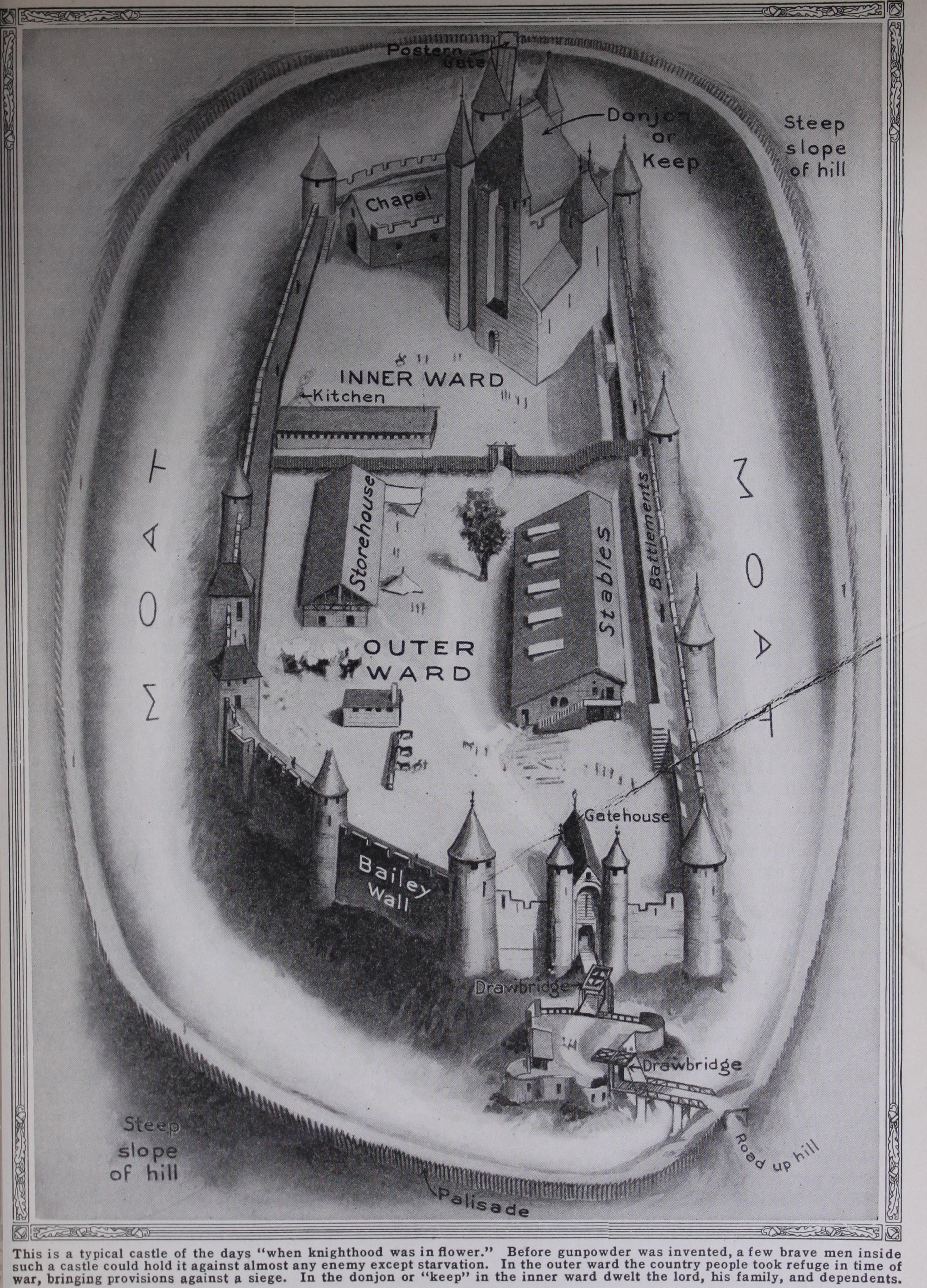
And even when all is lost, there still re main underground passages opening into the moat, and a postern gate in the rear, through which the lord and his garrison may escape to the surrounding woods, and so continue the battle another day.
"Comforts of Home" in the Middle Ages Perhaps you will inquire, Where do the lord and his family live in time of peace? Certainly there is not always war, though war is the chief interest of the lord.
Sometimes they live in the upper stories of the huge donjon, where arms and sup plies are kept. Because of its thick walls and narrow windows, the rooms are usually cold and dark in spite of the great fire that roars in the fireplace at the end of the hall. Before the 12th century there
were no chimneys, just as there had been none in the days of ancient Greece and Rome; and the smoke es hacking with sword and ax, and hurling missiles and melted pitch from vantage points above.
Why Castles
were Hard to Take The entrance to the castle is indeed well guarded.
And even after the portcullis has been pried up and the last barrier in the castle gate passed, the enemy finds himself only in an open courtyard. Here within the inclosure made by the bailey wall are the stables where the lord of the castle keeps his horses; here perhaps is the great brick oven in which bread is baked for the lord and all his villagers; and here too the vil lagers themselves seek shelter from the enemy. After this outer courtyard has been cleared of its defenders, the wall dividing the first and second courtyards must be carried before the second courtyard is reached.
Here again are a number of buildings used for dif ferent purposes. In one are the storeroom and cel lars, where provisions are stored to enable the dwellers in the castle to withstand a siege. Next to this is a curious jug-shaped building with a large chimney at the top, and smaller ones in a circle round about.
This is the kitchen in which the food is cooked for the lord of the castle and his whole household. In addi tion there is a small church or chapel in this courtyard, in which the castle inmates worship.
After this space has been cleared, the worn and weary enemy at last arrives at the tall " keep" of the castle, or the "donjon," as the French call it. In the lower part of this building are "dungeons" indeed for traitors and captured enemies. The walls of the keep are of stone and are eight to ten feet thick; and from the loopholes in its frowning sides peer skilled archers and crossbowmen ready to let fly their bolts and arrows at all below. A long siege will be necessary to starve out the defenders, for entrance can only be gained by a long causeway and drawbridge leading caped as best it might, as it still did in peasant cottages, through an opened window or a half-opened door.