Castor Bean
cat, cats, family, eyes, wild, felis and domestic
CASTOR BEAN. You have probably often seen the castor-oil plant as the center of a small circular flower bed, for although of tropical origin it is much used in northern countries for ornamental purposes. Given plenty of sunshine and a deep rich soil it will grow readily and lend a tropical appearance to your garden with its beautiful large leaves, even if it falls far short of the height of 30 or 40 feet attained by its cousins nearer the Equator. The castor plant is also grown developed, while others, such as taste and smell, are weak though not entirely wanting. The senses of sight, touch, and hearing are very acute in the cat.
Its ears are so sensitive that it can hear the creeping of a mouse at a dis tance of many yards. But white cats with pink eyes (albino cats) are nearly always deaf.
" Cat" is not only the name of our common household pet.
It is also the gen eral name of a large family • of carnivorous or flesh-eating mammals, which includes the lion, tiger, leopard, jaguar, panther, cougar, lynx, and a large number of smaller wild cats.
The preceding description applies to all the members of the cat family, with only slight modifications. The pupils of the eyes in the larger members of the family are round, and a few forms, particularly the lynxes, have short tails. One form, the Manx cat—found in the Isle of Man in the Irish Sea—is tailless.
The habits and characteristics of all cats are much alike. All— except the lion, tiger, and chee tah—are good climbers. All prefer to hunt at night, and their usual method is to stalk their prey, or lie in wait for it and spring upon it unawares. They generally hunt singly, but some times in pairs.
Members of the cat family in a wild state are found on every continent except Australia. The breeding habits are similar in all species. The mother cat seeks a secluded spot that is sheltered from the rain and cold, and while her young remain in it she guards them closely and does not hesitate to give her life in their defense. When danger threatens she carries the kittens to a place of safety, sometimes a long distance from the breeding den. The number of young in a litter is from two to seven, varying with the different species; lions rarely have more than two or three.
The young of some species are born with their eyes open, while others have them closed about nine days.
But Where Did Cats Come From? Scientists disagree on the question of the origin of the domestic cats. The earliest records on the subject are found in Egypt and indicate that the Egyptian cats were tamed 13 centuries before Christ.
The Egyptian cat is still found in a wild state over a wide area in Africa, and its resemblance to the domestic cat is sufficiently close to suggest a com mon origin.
The ancient Egyptians re garded the cat with superstitious awe and treated it as a member of their families.
When a cat died it was embalmed and buried like a human being, and the members of the family went into mourning.
To kill a cat was a crime punish able by death.
Mummified cats are often found among the ruins of ancient Egypt. The early Chris tians associated the cats with witches, and the devil was often depicted in the form of a black cat. Supersti tians about cats survive among many peoples even in civilized countries.
As a companion of man the cat is almost as universal as the dog. It is an exceedingly pretty, cleanly, and graceful creature. It likes to be fondled, and with gentle treat ment becomes greatly attached to its keeper, displaying its affection in many artful ways.
The cat is far more intelligent than is generally believed. It undoubtedly has profited by its association with man, keeping also its keen wild instincts.
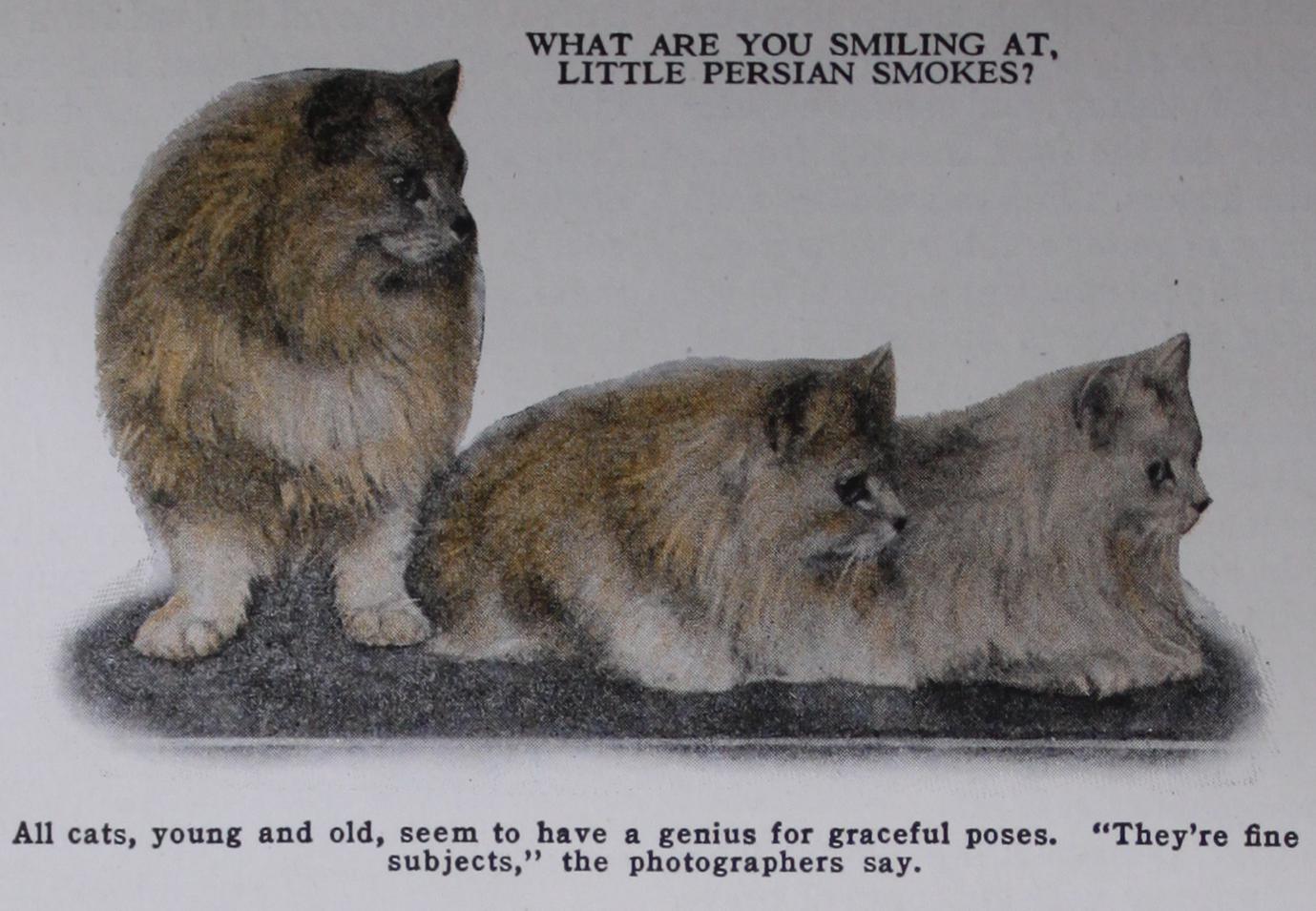
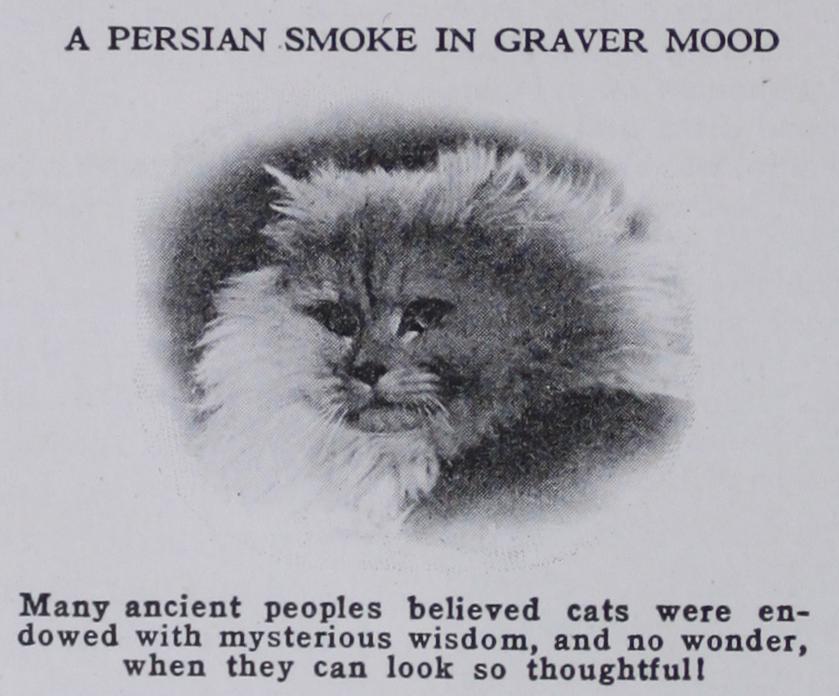
Different Types of Fancy Cats Among the different types of domestic cats a few are deserv ing of special mention. The Siamese royal cat is the rarest and commands the highest price. Its face, legs, and tail are brown; its body is cream-colored, and its eyes are light blue. The Angora, or Per sian, cat is distinguished by its large size, its long silky hair, and its flesh-colored lips and soles. The tortoise shell cat is very popular in Spain, and is especi ally noted for its intelligence. The Manx cat is the most ungainly-looking representative of the cat family.
Cats are very useful in destroying rats, mice, and other harmful rodents, but they have also won a bad reputation for killing birds.
Felis is the scientific name for cat. Domestic cat, Felis domesticus; Angora cat, Felis domesticus angorensis; Manx cat, Felis domesticus ecaudatus.