Castor and Pollux
examine, cats, people and pussy
CAS'TOR AND POL'LUX. These famous demigods of Greek myth were twin sons of Zeus, by a mortal mother. Pollux was renowned as a skilled boxer, and Castor was famed far and wide as a tamer of horses.
Sailors in storms prayed to them, and they became the patrons of travelers and of hospitality as well of public games. According to one story, Zeus set them among the stars after their lives on earth, and the con stellation of Gemini (" the twins") is named for them.
commercially in the United States, but the highest yield of oil is secured in the tropics, India having long been the world's chief source of supply.
Most people, especially children, know to their sorrow that the oil derived from the castor bean is a most valuable medicine; but many are not aware of the large quantities used for other purposes.
It is almost indispensable for lubricating airplane engines, for it is little affected by extremes of heat and cold in the varying altitudes. It is also used in the making of transparent soap, varnish, celluloid, arti ficial leather and rubber, sticky fly paper, and in the dyeing of cotton goods. Botanical name, Ricinus communis. (See Fats and Oils.) CAT. The next time you play with pussy examine her with care and learn a lesson in natural history.
Note particularly her large roundish head, the long slender body, rather short but muscular legs, and the long tapering graceful tail. Examine her feet and see how they are shod with soft pads so that her footsteps cannot be heard. Do not overlook her sharp strong claws, which may be drawn back or retracted into a sheath, so as to be out of sight and not easily felt.
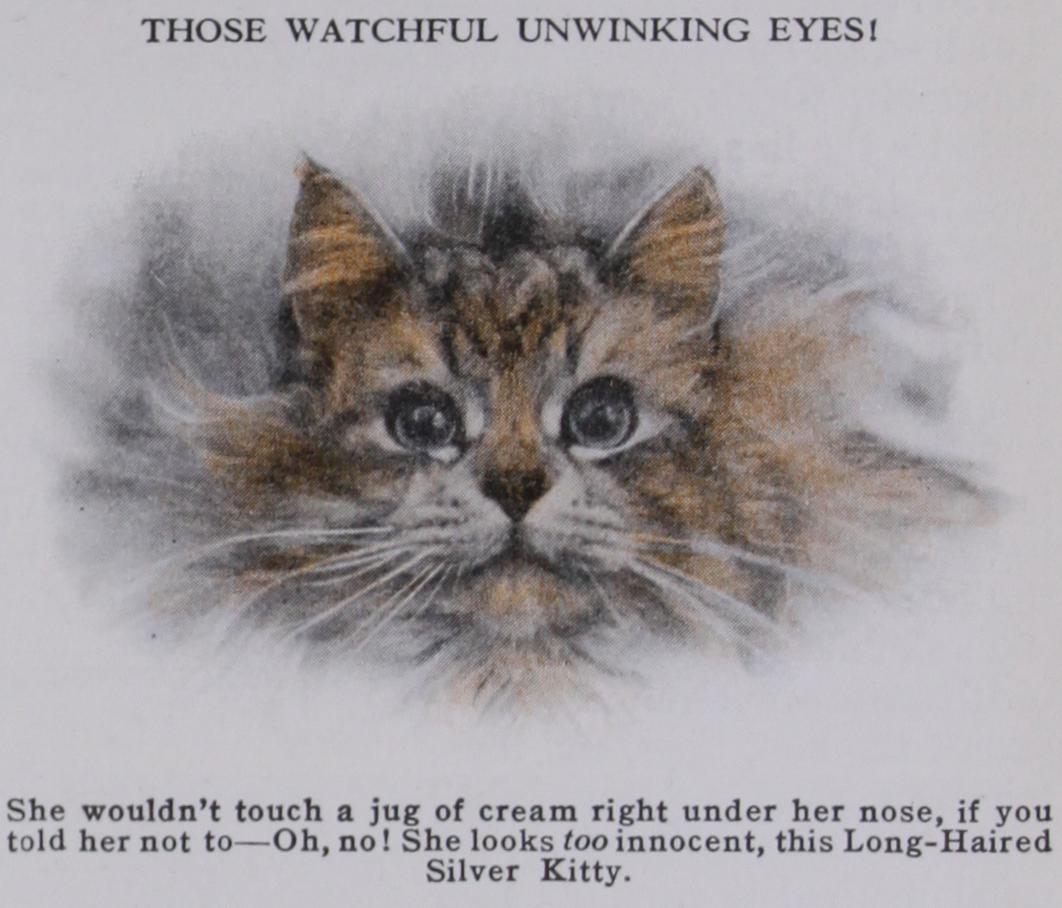
You may also observe that pussy can extend her claws at will and use them in catching and holding her prey.
Then examine pussy's eyes. The shape of the pupils is elliptical. In bright sunlight the pupils are reduced to narrow vertical slits, but in cloudy weather, or after sundown, they are round and large to admit more light. This enables her to see at night, when she does most of her hunting; but cats cannot see in absolute darkness as some people believe. They merely see with less light than is required by most animals and human beings. Those long stiff hairs on either side of the cat's nose are commonly called whiskers; really they are sense organs, or feelers, and are very useful to the cat. Without them she could not stalk her prey in the dark. They give her timely warning of obstructions in her path.
By close observation and a few experiments you may discover that some of the cat's sense organs are highly