Caterpillars
caterpillar, silk, called, body, butterflies, leaves, worm and life
CATERPILLARS. These little wriggling worm like animals are part of the wonderful life history of moths and butterflies. Hatched from a tiny egg-, they first appear as tiny creatures so small they can hardly be seen. But they have appetites all out of proportion to their size, and eat so prodigiously that they soon outgrow their original skins.
Before they can grow further, they have to molt, that is, shed their skins; and with the outer skin they leave behind the lin ing of their stomach.
Then the caterpil lar goes on eating until it again out grows its skin, and keeps on repeating the process of molt ing until it is full grown. Its only business is to eat and molt, so the quantity of food it consumes is amazing. The so-called American silk worm, which feeds on oak and other leaves, in the 56 days of its life as a caterpillar eats leaves to the weight of 86,000 times its own weight when it is first hatched.
Finally, after a month or two of life as a caterpillar, or even in some species from two to four years, these greedy little creatures, all plump and vigorous, are ready to make the cocoons in which they sleep as a pupa or chrysalis until they are ready to emerge for their few radiant days of life as moths or butterflies.
Just What is a Caterpillar? Other insects undergo similar changes of form (called metamorphosis), but only the larvae or young of butterflies and moths are called caterpillars.
Although caterpillars are soft-bodied and wormlike, yet they differ very much from the true worms such as the earthworm.
All caterpillars have three pairs of jointed legs, as do all insects, situated on the three segments behind the head. They also have several pairs of joint less legs, rather stout and fleshy, upon the abdomen. These are called pro-legs, and the hind one a prop leg; they disappear when the caterpillar transforms.
Caterpillars breathe by a system of air tubes, which open as little pores along the side of the body. These little air tubes, which branch again and again, and penetrate to every part of the body, are called tracheae. This is the way in which all insects breathe.
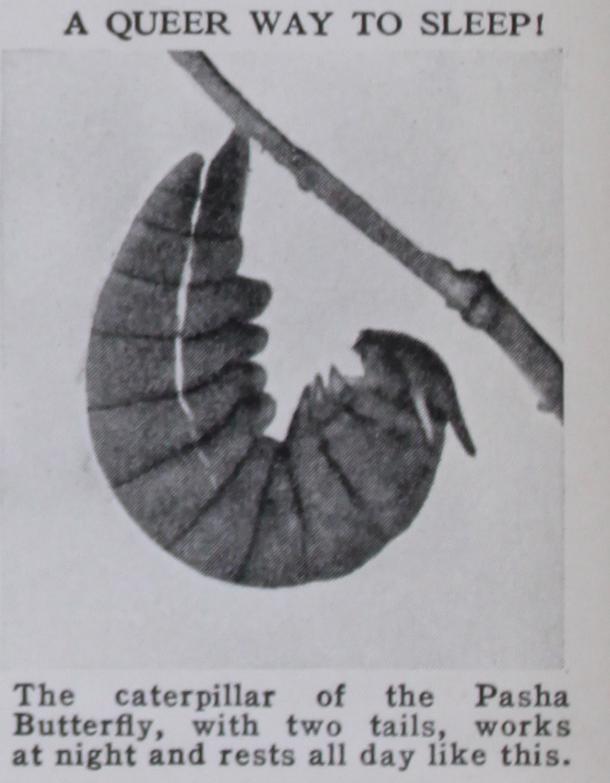
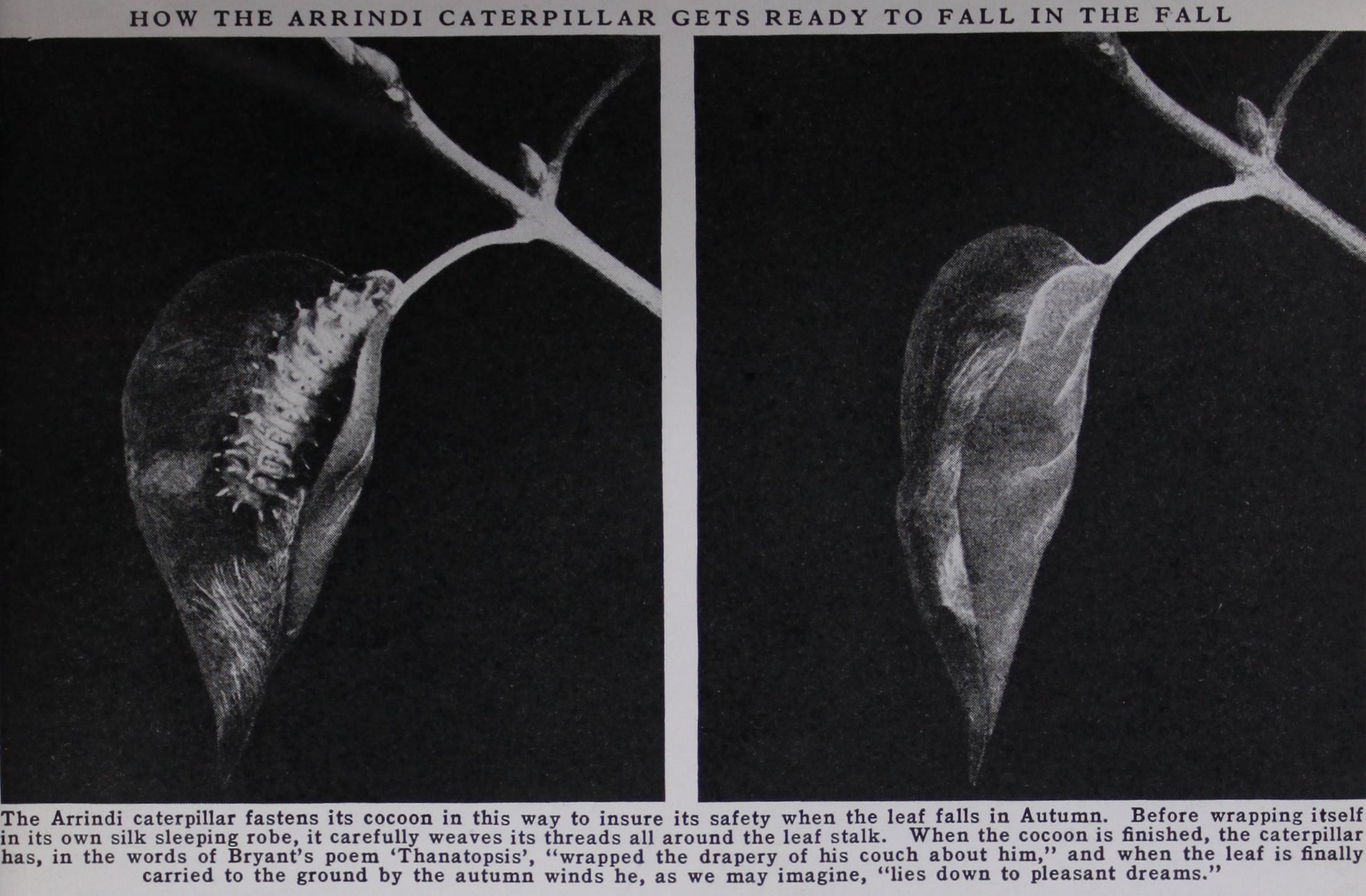
Caterpillars vary greatly in size, form, and in body stage spin about themselves cocoons of silk which is produced from glands in the body and is spun out of an opening in the lower lip. This comes out as a covering. Some are large and naked, and rather fierce looking (like the tomato worm), while still others are smaller and furry, like the common yellowish-brown "woolly bear" (the caterpillar of the tiger moth). Many are very brilliantly
colored.
Vegetable substances, such as green leaves or flowers, are their usual food; and in most cases each form prefers a certain kind of plant to feed upon, and will die unless they can find it.
While many caterpillars are harm less, the tent-caterpillar and some others do very great damage to trees by stripping them of their leaves.
Another caterpillar called the army worm is very destructive to grain, while the cotton-worm injures the cotton plants. Scientists estimate that more than 30 million dollars' loss has been caused by the cotton worm in the Southern States in a single year. Others, like the cater pillars of the clothes-moth and the carpet-moth, do enormous damage to textiles of nearly every sort—woolens, silks, etc.
Moth caterpillars when ready to go into the pupal sort of sticky fluid which hardens on exposure to the air. In the case of the silkworm this fiber is unraveled from the cocoon in long strands, which are twisted into threads to be used as silk thread or woven into cloth (see Silk).
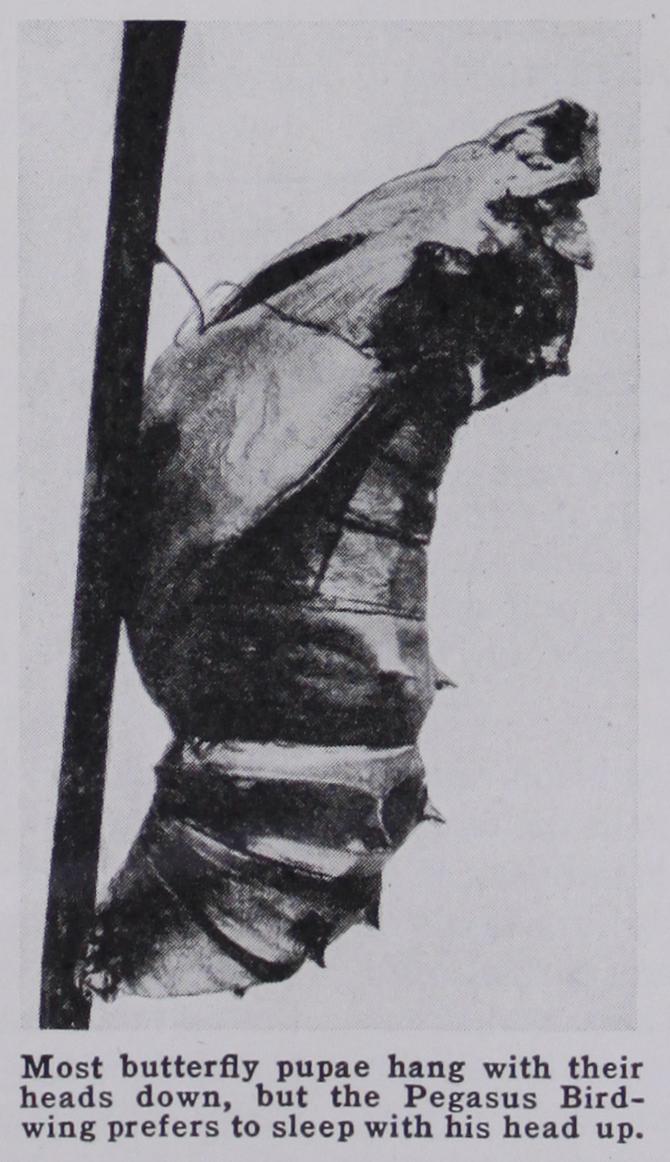
Some caterpillars make for them selves a cocoon of leaves, closely bound together by silk, and others, like the tobacco-worm, simply crawl into a hole in the ground, or under a log or stone, or into a crack in a fence-post or tree-trunk for protec tion during their pupal sleep. The caterpillars of butterflies make no cocoons of silk, but suspend them selves by a button of silk and pass this stage as a naked pupa called a chrysalis.
During the pupal sleep the entire body of the caterpillar undergoes a change. All the tissues are broken down and then rebuilt in the form of a butterfly or moth. Finally the creature emerges, no longer a crawl ing caterpillar, but a splendid crea ture with broad delicate wings.
Birds and other animals are very fond of cater pillars and destroy hosts of them. As a rule birds do not like the hairy kinds, nor the kinds with large spines. Some kinds of caterpillars are also provided with glands which pour out a very bitter fluid, and of course these escape being eaten. The oriole and the yellow-billed and black-billed cuckoos, however, delight in the hairy caterpillars, and sometimes the latter eat so many of them that the insides of their stomachs become coated with hairs, as though they were lined with fur. (See Butterflies and Moths.)