Cave
caves, caverns, stalagmites, france, world, stalactites, huge, noted, miles and underground
CAVE. Anyone who explores Mammoth Cave in Kentucky—the largest natural cave in the world— can easily understand why such great dark caverns in the earth have in all ages excited the awe and wonder of mankind. The rocky, arched walls of this abode Russia finally conquered the country in 1864. In order to govern the territory south of the mountains the Russians were obliged to construct a great mili tary road, connecting Stavropol and Tiflis by way of Kobi Pass and the deep chasm of the Davial Gorge.
The men and women of the Caucasus Mountains are often remarkably handsome, and the Georgians and Circassians are noted for their personal courage and love of music. The Turks carried off many of their women to the harems of Constantinople. The name " Caucasian race" is sometimes given to the white division or branch of mankind, because these mountaineers were supposed to be its most perfect and typical representatives. The rugs of the Cauca sus are as fine as any produced in the Orient.
Most of the commerce of this region passes through the seaports of Batum, Poti, and Novorossisk on the Black Sea, and Baku and Derbent on the Caspian. Batum and Baku of blackness rise in places 120 feet; and when the guide, holding a blazing torch above him, announces, " This is the Main Cave," his words echo and re-echo from the somber caverns in ghostly reverberations.
By the flickering torchlight one may explore the Rotunda, a mighty chamber one and one-half acres in extent; Audubon Avenue, an inky tunnel to whose walls bats cling in huge clusters; and then the Hall of Stalactites and Stalagmites.
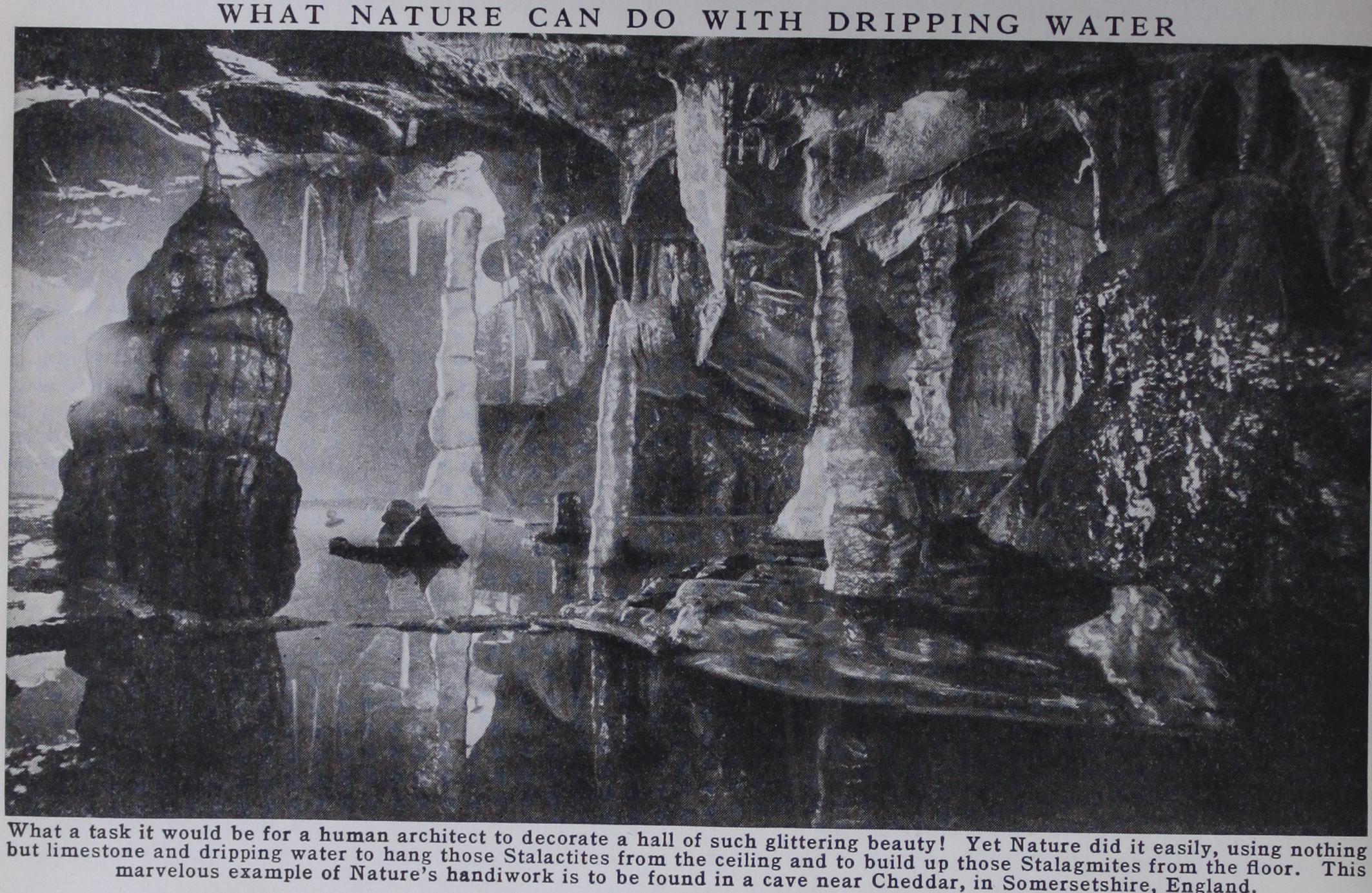
Stalactites and Stalagmites " Stalactites," the guide exjlains, " are these huge stony pendants hanging like icicles from the roof; stalagmites are similar forms rising in columns and cones from the floor. The water, seeping drop by drop through the limestone roof above you, falls and leaves behind particles of lime which it had in so lution. Thus a stalactite begins to grow from the roof downward. The drops deposit more lime as they splash on the floor, and so a stalagmite is formed. In some cases, stalactites and their stalagmites meet, forming massive pillars." Soon the explorer comes to Echo River, one of several streams which flow through the cavern. As he paddles along in flat-bottomed boats, now and then he sees a pale-colored fish about four inches long dart through the water. It is a blind fish, one of many species of blind creatures, whose ancestors have exist ed so long in darkness that they have lost their eyesight. Among them are sightless beetles, spiders, crayfish, and salamanders.
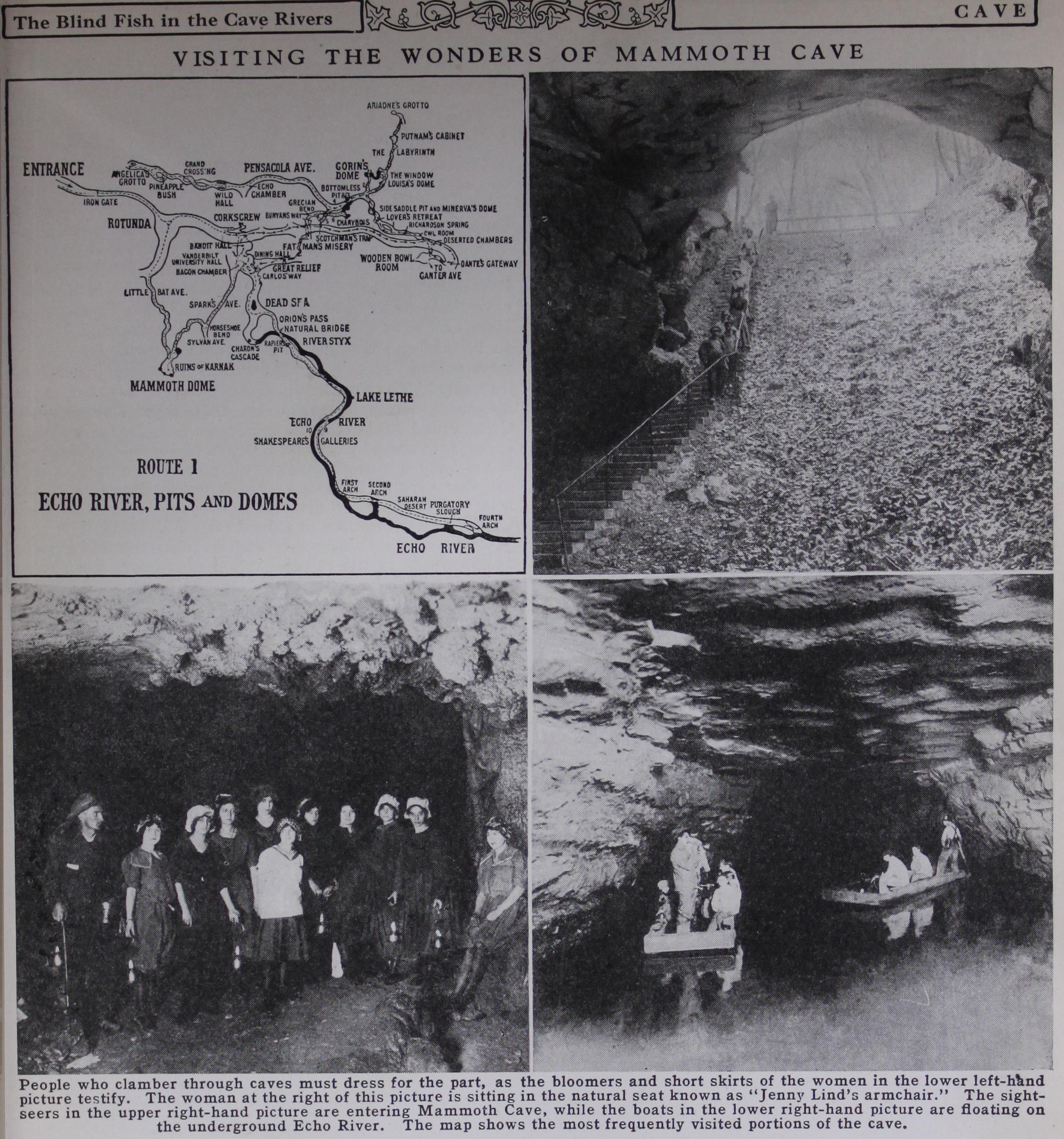
One might wander about for days in Mammoth Cave. meeting wonders at every turn. for it extends for ten miles or so underground. It is made up of many passageways and chambers, whose total length would be many times ten miles.
After such a trip one dan see why legends and super stitions have centered around caves in all ages, as in the Fairy, Dragon's, and Devil's caves of France and Germany, and the cave-palaces in the Harz Moun tains, where the " Little Men" were supposed to have lived long after they forsook the forests and glens. Caves were the abode of the sibyls and
nymphs in Roman mythology, and in Greece they were the temples of Zeus, Pan, Pluto, and Dionysus, as well as the seat of the Delphic and other famous oracles which attracted visitors from all the world.
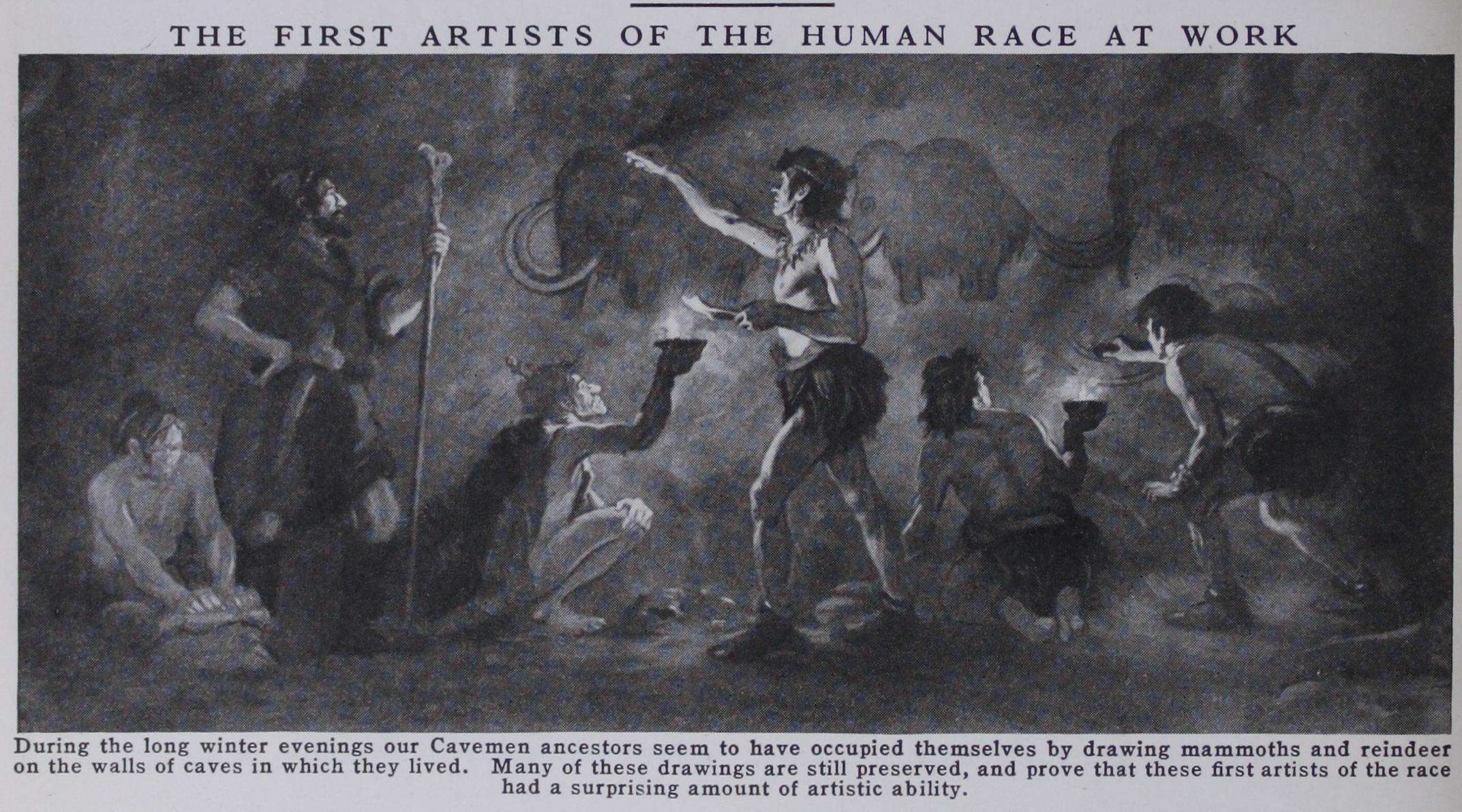
More interesting than the legends, however, is the fact that from the remotest periods of history animals and men have inhabited caves, and from the remains they left men of science have been enabled to read the early chapters in the history of human and animal life. (See Cave Dwellers).
The Cave Dwellers of Today Even today thousands of human beings live in caves in various parts of the Old World. In early times great numbers of tunnels and chambers were cut in the hillsides of England, Flanders, and France to serve as refuges for entire communities in time of invasion. Some of these are still so numerous as to form underground villages like the village of Troo, about 150 miles south of Paris, most of whose in habitants still live wholly or in part underground.
Some of these huge caverns in northern France were used as shelters for entire regiments during the World War of 1914-18. Other such rock villages have been found in Spain, Italy, Sicily, China, India, Egypt, and especially in Syria.
Caves always have been favorite haunts of smug glers, bandits, and other fugitives. They have even been used as tombs and places of worship. Many marvelous cave temples exist in India, and the rock hewn tombs of Palestine and of Egypt, and the Cata combs of Rome probably owe their existence to the ancient practice of burial in hollows in rocks.
One of the grandest natural caverns is Fingal's Cave, on the island of Staffa on the west coast of Scotland, whose sides are formed of ranges of basaltic columns which are almost as regular as hewn stone. Among famous stalactitic caves are Madison's Cave, and Luray Cavern, in Virginia; Wyandotte Cave, in Indiana; and a number high above the sea in the Rock of Gibraltar, where remains of Neolithic cave dwellers have been found. Wind Cave in the Black Hills of South Dakota is noted for its size and beauty.
In Iceland and Hawaii are many caves formed by the lava from volcanoes, and in France and Switzerland are huge ice caves. The Ozark region of Missouri is noted for its numerous caves, particularly Onandaga Cavern. The Cumberland Mountains in Tennessee contain some curious caverns, in one of which, at a depth of 400 feet, a river was found with a current sufficiently powerful to turn a mill.
Another cave in the same state is named Big Bone Cave, from mastodon bones discovered there. Caves in northern California are also rich in animal remains.
Caves are principally met with in limestone and gypsum as the result of the solvent action of water. Lava caves appear to have been produced in many cases by the expan sion of steam and gases. Sea waves sometimes hollow out caves in the cliffs along shores.