Charlemagne
charles, europe, west, history, church, kingdom and italy
CHARLEMAGNE (sheirTe-man) (742— 814). The coronation of Charles the Great, in Rome, on Christmas Day in the year 800 A.D., was the central fact of the Middle Ages. As Charles, "in shape and gesture proudly emi nent," his yellow locks tinged with gray, his cheeks furrowed with the toil of 20 campaigns, felt the crown placed upon his head, a new era began in the world's history.
Since the fall of the Roman Empire in the West more than three centuries before, Europe had been drifting toward the abyss of anarchy, disunion, and barbarism. Only the strong hand of Charles could check this fatal course and restore to Europe the ideas of unity, order, and centralization which had been the legacy of the Romans. Only he could bring about the fusion of the barbarian vigor of Northern Europe with the ancient traditions of Imperial and Christian Rome.
And so the shout of the people in the old church of St. Peter's, "To Carolus Augustus, crowned by God, mighty and pacific emperor, be life and victory," marked one of the few events which we may say changed the history of the world. The cloak of Augustus fell upon the shoulders of a Frank ; the West split with the East, and modern Europe began. But although Charles was already emperor of the West in fact though not in name, and although he was certainly looking forward to the as sumption of imperial authority, the time and manner of the coronation were not of his choosing. Unexpect edly the pope placed the crown on his head as he knelt in prayer, and we are told that Charles later declared he would not have set foot in the church that day if he could have foreseen the pope's design.
The man on whom this honor was thrust had ruled the kingdom of the Franks for more than 30 years. He was the son of Pepin the Short, the bold and able "mayor of the palace" who had seized the throne of the Frankish kingdom from the " do nothing" Merovingian puppet kings. He was the grandson of Charles Martel, who in 732 had saved Christendom from the onrush of the Saracens at Tours. At 26 Charles had inherited the kingdom of the Franks, with his brother Carloman. Three years later, in 771, Carloman had died and Charles had been left sole ruler of all the Franks.
A dark outlook had confronted the young king.
Europe was torn by dissensions. T h e Roman church was striving to assert its power in Italy against the Lom bards on the one hand, and the claims of Constan tinople on the other. The north ern half of Europe was still in pagan darkness. Igno rance, superstition, greed, treachery, and violence blocked the way.
The new ruler need ed all the courage he had inherited from his grand father, and all the strength and as tuteness of his father, to meet the situation which confronted him.
With the sword in one hand and the in the other, Charles set out to bring order to an entire continent. He launched in 772 a 30 years' cam paign which at first and then Christianized t h e heathen Saxons in the North. He subdued the bar barian Avars on the Danube. He compelled the rebellious Bavarian dukes to submit to his rule. He crushed Desiderius, the treacherous king of the Lom bards, and confirmed the pope's temporal possessions in Italy. He carried his sword to the very borders of the Moorish domain in Spain.
Aided in his later campaigns by his three sons, Charlemagne (as he came to be called in French history) had at the time of his death in 814 extended his dominions over approximately the same territory which, exactly a thousand years later, was held in the shortlived grasp of Napoleon Bonaparte. From the Baltic Sea to the Spanish marches, and from the tip of Brittany to the lower Danube, the Emperor of the West held sway.
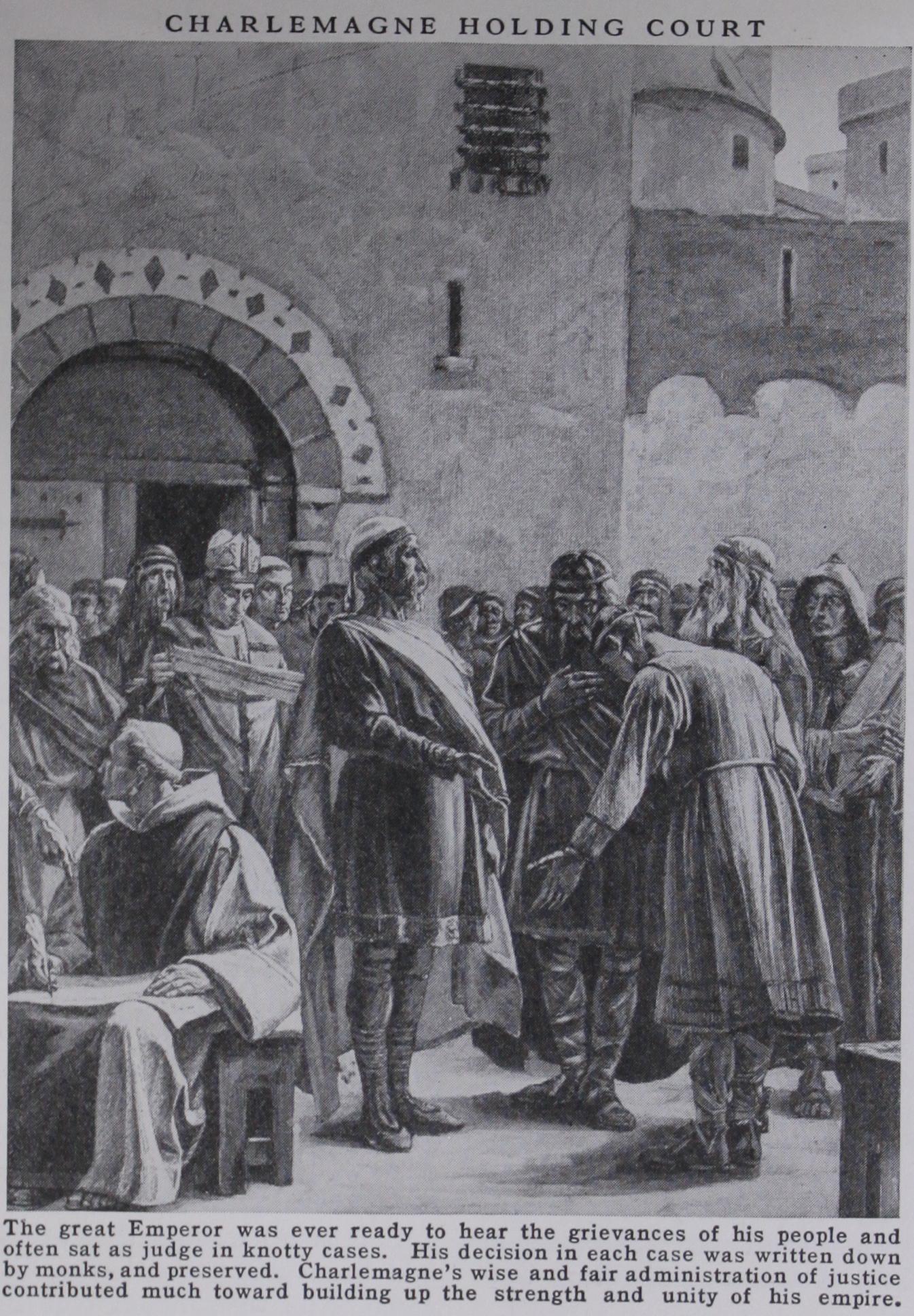
But, unlike
Napoleon, Charlemagne was able hold his vast domain together. Everywhere tianity, commerce, agriculture, schools, and a ju administration of civil and church laws had fc lowed in the wake of the Frankish armies.
Scarcely less m mentous for t h history of civiliz, tion than the gi of political unit was the work Cha lemagne did in fo tering educatic and the arts When he came t the throne even th tradition of lean ing had well-nig perished from west ern Europe. H himself learne Greek and Lath and he founde schools in the mon asteries and bish ops' cathedrals tl instruct the youth From the learner centers of Italy Spain, and othe lands he brough great scholars ti his court, notabl: the English mon] Alcuin.