Charles Martel 688-741
north, swedish, battle, frankish, europe, russia and power
CHARLES MARTEL' (688-741). By the year 732, exactly 100 years after Mohammed's death, the flood-tide of the Saracen armies had swept west from Arabia across northern Africa, had conquered Spain, and was rolling irresistibly northward through France.
The sword of Islam was striving to convert the world to Mohammedanism by the effective method of exterminating unbelievers. Sixteen years before, the Saracen hordes, sweeping northward at the eastern end of the Mediterranean, had been stayed at Con stantinople, and Christendom had withstood un shaken the first great hammer-blow of the Moslem power. Now the fate of Europe again hung in the balance, as the green banner of the Prophet stood before Tours, within striking distance of Paris.
The defeated leaders of Southern Gaul were send ing up a despairing cry for help. Suddenly out of the North a Frankish host headed by Charles, mayor of the palace for the Merovingian puppet-king at Cologne, fell upon the invaders between Poitiers and Tours. A terrible battle followed. The wild riders of the desert dashed hour after hour in ceaseless charges against the solidly compacted infantry of the North; they came on like the leaping waves of the ocean, to be scattered backward like its spray. The folds of the eastern turban afforded slight protection against the huge swords wielded by the stalwart arms of the Frankish veterans, while the scimitars of Damascus glanced harmlessly from the stout helmets of steel and thick leather corselets of the Franks. Finally the Moslem chief was killed and the foe was sent flying back to the Pyrenees. Europe was again saved to Christianity and Charles had earned his title " Martel" (the Hammer).
Charles Martel, as conqueror and virtual ruler of the entire Frankish kingdom—though he never assumed the crown—prepared the way for his son, Pepin the Short, to gain the throne. Together they laid the foundation for the future world power of Pepin's son, Charles the Great (Charlemagne).
handicap, in a short time the untrained Russians were in wild flight, leaving all their supplies behind.
His Victories and Fatal Obstinacy In one way this battle of Narva, often called the most glorious engagement of Swedish arms, was a had thing, for after it Charles re fused to listen to any talk of peace.
The good-natured youth had become a severe reserved soldier, who disregarded all advice contrary to his own desires. His reckless
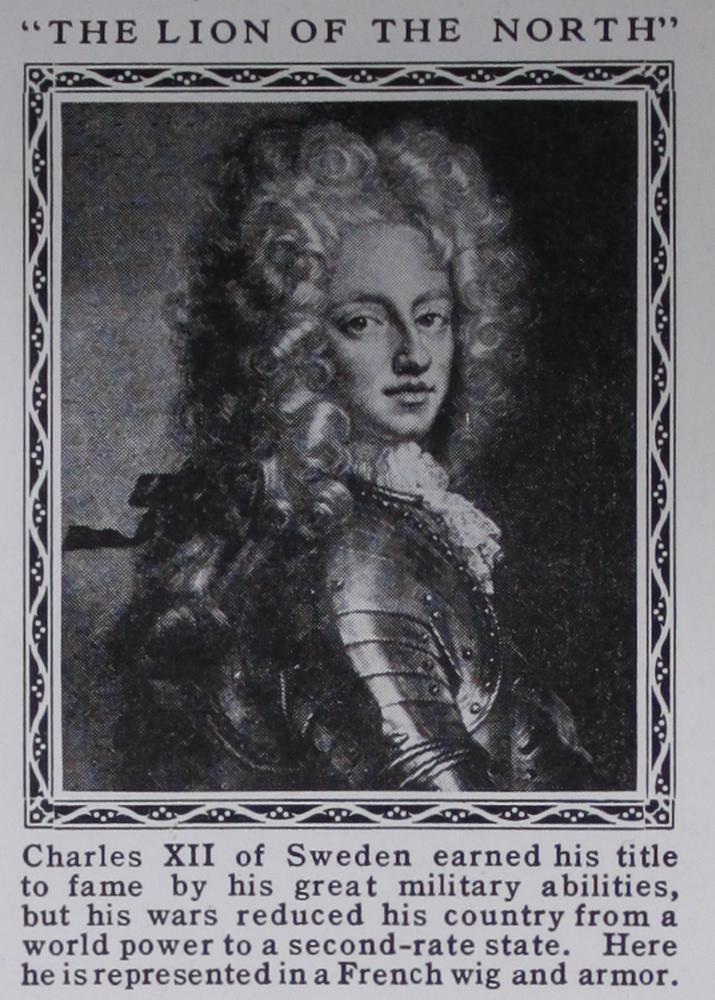
ambition and fatal obstinacy finally grew to such a pitch as to gain for him the name of " Madman of the North." From Narva Charles invaded Poland, whose king also had attacked his territories. At the end of five years Charles was com pletely victorious and placed a king of his own choosing on the Polish throne. But meanwhile Peter the Great had conquered the Swedish provinces about the Gulf of Finland.
Charles now (1707) invaded Russia and this proved his undoing as it proved that of Napoleon a hundred years later. The Russians used the same tactics in both cases, refusing to fight and retreating into the interior. Failing to capture Moscow, Charles lay siege to the fortified city of Poltava, nearly 800 miles from the Baltic, in southern Russia. To the ad vice that he retreat while there was yet opportunity, he replied, "If an angel should descend from heaven and order me to depart from here, I would not go." In the end the Swedes soon found themselves outnum bered two to one by the well-organized army of Peter the Great. In the battle which followed Charles' army was defeated and almost entirely destroyed, and he himself escaped with difficulty to Turkish soil.
Death of "The Lion of the North" When the Sultan refused to aid him against Russia, Charles behaved like one insane. At last he was ordered to leave Turkey, and with but two corn panions he returned through hostile lands to his own country. He found his outlying possessions almost entirely lost, and the Swedish power in ruins.
Four years later, while foolishly attempting the conquest of Norway, his adventurous life was ended at the siege of the petty fortress of Friedrichshall.
The Lion of the North was gone, but not until he had brought Sweden down from one of the great powers of Europe to the rank of a second-rate state, from which it has never since been able to rise.
Of other Swedish kings named Charles, we can only mention Charles IX, 1600-1611, the father of Gustavus Adolphus; Charles X, 1654-1660, nephew of the great Gus tavus; Charles XI, 1660-1697, son of the preceding and father of Charles XII; and Charles XV, 1859-1872, the last of that name.