Dwellers
stone, scientists, caves, cave, cro-magnon, ancient and race
DWELLERS. What sort of people were the an cient cave dwellers of the Old Stone Age who lived at the dawn of civilization in southwestern Europe? Scientists tell us that they were not only tall and strong with well-formed features, but that their skulls were larger than those of many savage tribes of today. This last is important, for we measure the intelligence of peoples roughly by the size of their brains. Probably these Stone Age men belonged to what scientists today call the Mediterranean race. (See Races of Mankind.) Because the first remains of these old cave dwellers were found at a spot called Cro-Magnon on the Vezere River in southern France, they are called the Cro Magnon race, and the first skeleton discovered is known throughout the world as the " Old Man of Cro-Magnon." This old man was evidently one of the most intelligent men of his day. We are told that if he had had the advantages of modern educa tion he might easily have been a scientist, statesman, or captain of industry.
But as it was, his manners were rough. Indeed, the skull of a woman found near his skeleton, and who is presumed to have been one of his wives, has a hole in it, evidently made by a blow from a flint hatchet. But women in those days were hardy, like the men, and the growth of the bone indicates that she recovered from this blow.
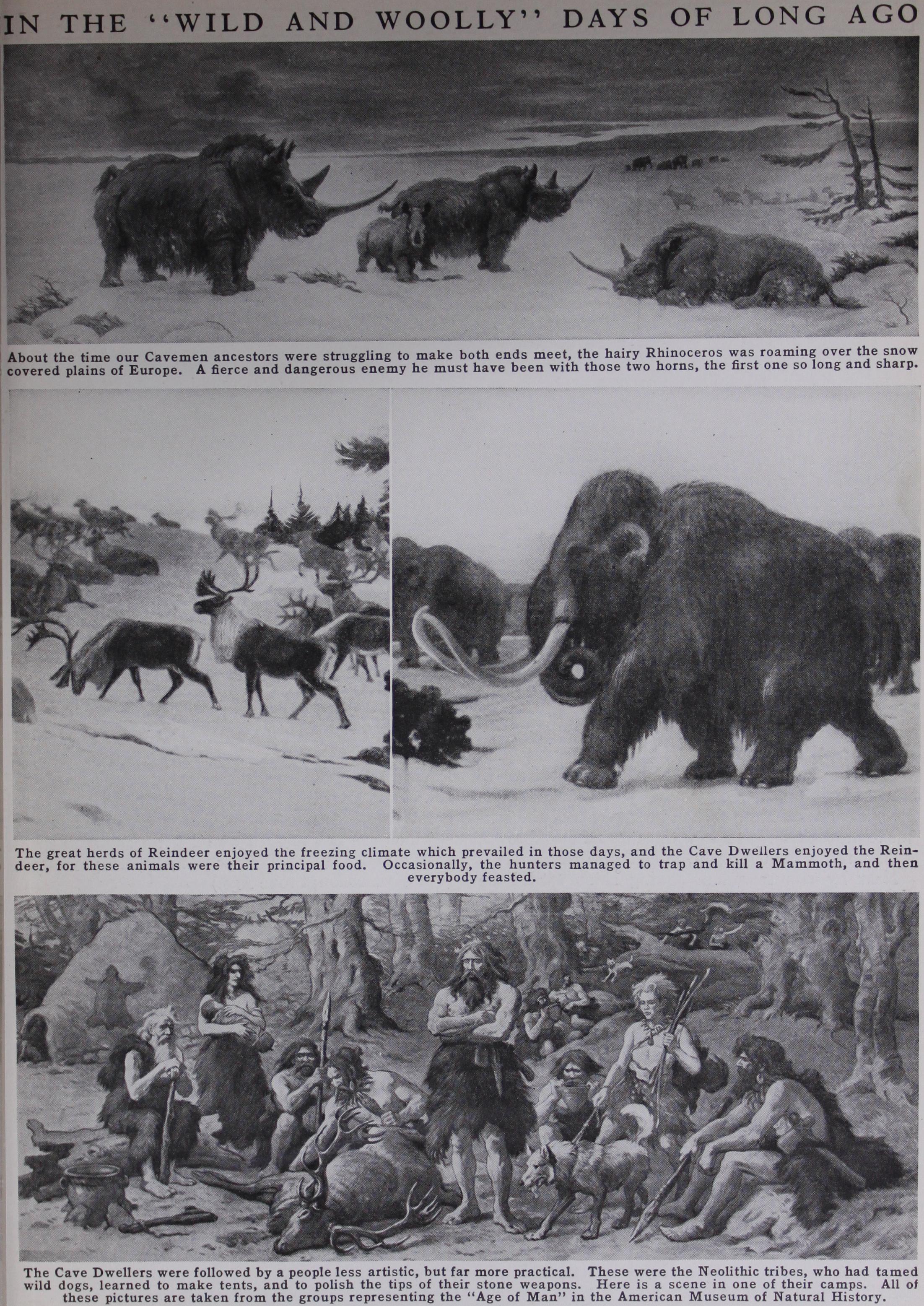
Such manners were nat ural in the midst of the hard life the cavemen led. They were surrounded by beasts, who threatened their lives every minute they were away from the shelter of their caves. While hunting the reindeer, the wild horse, and the bison, they were themselves hunted by the lion and the cave-bear, who then inhabited Europe.
They were constantly run ning a race for their lives with an angry mammoth, a woolly rhinoceros, or a pack of fierce wild boars.
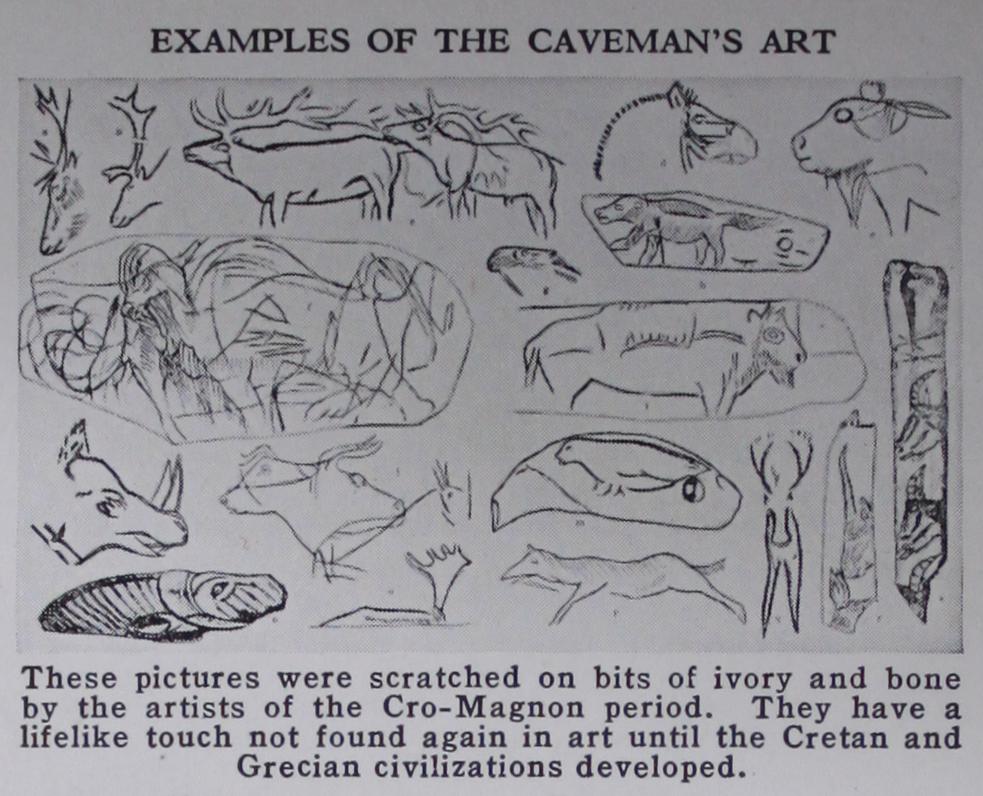
Yet these early men found time in the midst of their perils to draw excellent pictures, many of them very much better than most men can draw today.
The walls of the old caves throughout France, Spain, and Italy are covered with finely carved and painted sketches of the animals the cave dwellers hunted.
How the Oldest "Old Masters" Worked in Their Caves We may picture a Cro-Magnon artist at work on these walls in the long evenings. A friend holds a
lamp, made of a bowl of rude clay filled with melted grease, in which floats a burning wick of plant fiber.
While the wolves howl outside, the artist tries to remember just how that wounded bull looked when the spear struck him. When he has caned the out line in the rock, he fills it in with colors made of brown, yellow, red, or black earth, mixed with oil.
Near by sits a woman sewing skins with bone needles, while a baby sleeps on a bed of leaves in a corner. What would they think if they realized that 20,000 years later scientists would carefully copy the lines and colors of those first masterpieces and print them in thousands of books? The Cro-Magnons were not the first cavemen.
Thousands of years earlier, races even more savage, with sloping foreheads and monkey-like faces, occupied these same caves. And thousands of years later the peoples of the New Stone Age replaced the Cro M a gn ons . Indeed, these caves are among the earliest books in which scientists read the history of man.
They dig into the earth floor and there find the bones and stone weapons of one race, buried by the mud of ancient floods and the wash of sand and earth from the damp walls. They dig farther and find another layer of bones and weapons, telling of a still more ancient people. In these layers they find the remains of strange animals, long since disap peared. And out of all this the story of the cavemen is woven together bit by bit by the patient scientists who bring these wonderful relics to light.
The barbarian races who replaced the cave dwellers had no art, but had learned to tame the wild cattle and herd them with the aid of a wolf-like creature— first friend," the dog. In time these peoples learned to practice agriculture and to use copper and tin. Still later they gathered into cities and built great buildings like the ancient pyramids of Egypt —which are not ancient at all if we compare them to the Old Man of Cro-Magnon, 20,000 years ago.
(See Civilization; Stone Age.)