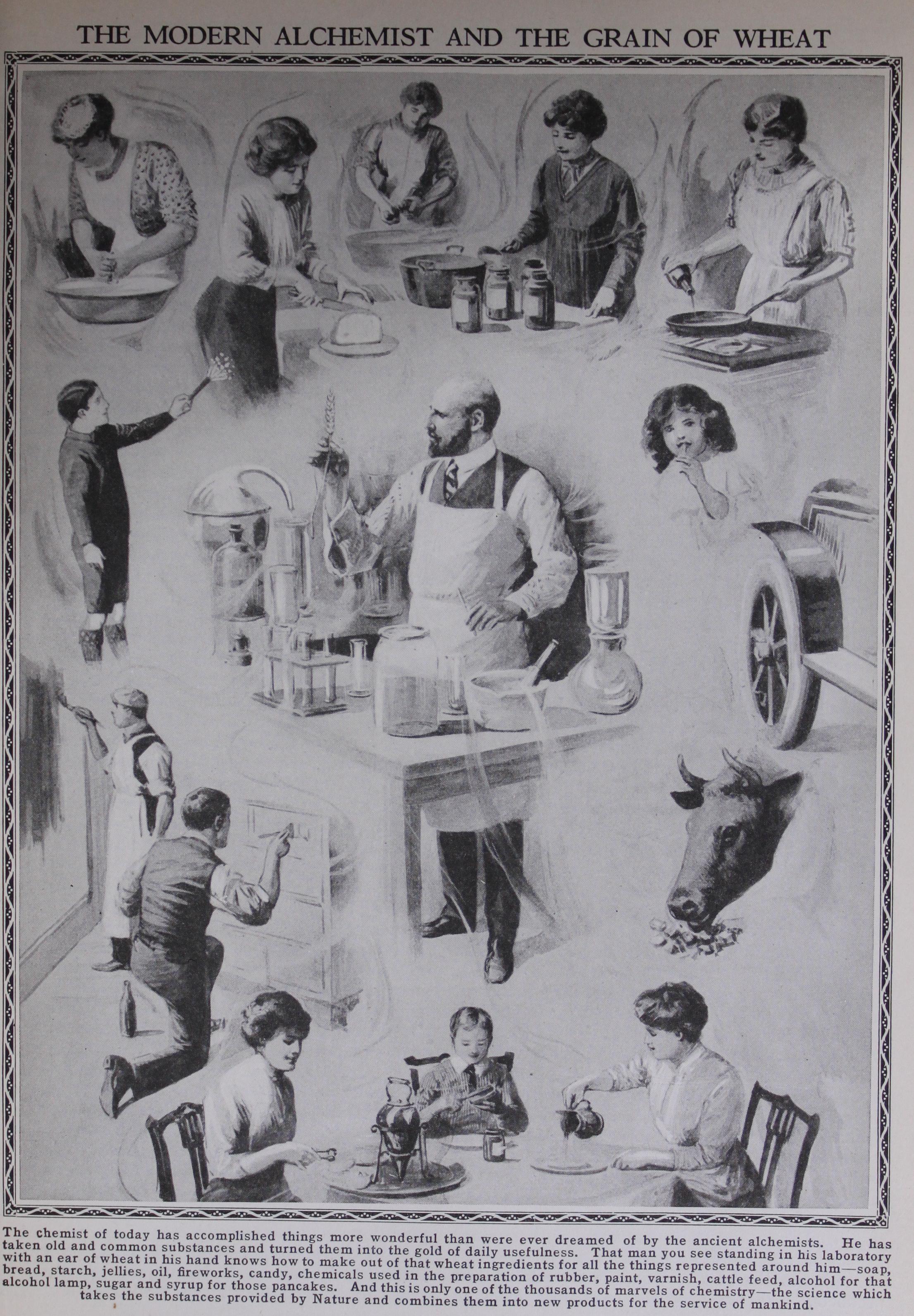
Chemistry
iron, force, mixture, elements, salt, chemical and remain
But taking the earth as we know it, with its soil and rocks and mountains and sea and rivers, why is it that we do not see the iron and aluminum and other elements? It is because they are combined in such a peculiar way that entirely different materials are formed—different in color, in form, in properties.
They are not merely mixed, be it understood, but chemically combined.
One of the great facts of chemistry, indeed the outstanding fact, is the fundamental difference such substances as metals everywhere—in the air and in the ground. Further, he discovers that the com monest metal in the world is not iron or copper or zinc or tin, but aluminum. Yet less than a hundred years ago this metal was not even known. Out of every 100 parts of the earth's crust 8 are aluminum, whereas only 6 are iron.
Of all the different elements that form the crust the most abundant is a substance which we cannot see—the invisible gas, oxygen, which comprises half between a mixture and a compound. You take some finely ground salt and sugar and shake them together, and they become so inextricably mixed that only by an elaborate and tedious process could they be separated again. Yet they remain salt and sugar, and even if you dissolved them in water, they would still remain salt and sugar, each retaining its own peculiar qualities of color, taste, and so forth. They form merely a mechanical mixture, and not a chemi cal compound.
But take some powdered sal ammoniac and mix it with powdered soda. At once you smell ammonia.
A strange change takes place. The soda and sal ammoniac no longer remain, but when mixed they combine chemically to form entirely new substances which have quite different properties from soda and sal ammoniac.
Take another ex ample. Mix pow dered sulphur and iron filings together and they remain sulphur and iron, a mere mechanical mixture. You could separate them easily by drawing out the iron filings with a magnet. But now apply heat to the mixture and at once the two sub stances combine to form a black ma terial called iron sulphide, which is neither iron nor sulphur and has no resemblance to either. The new substance is a chemical com pound and the force which makes various elements combine into corn pounds is known as chemical attrac tion, the mightiest force in all nature.
It is this force which leads to the production of all the myriad sub found in the world, yet, as chemistry shows us, all made up of about 90 elements. All the
beauty of sense and taste is produced by it.
Chemical attraction—the strange affinity which certain elements have for certain other elements so that they combine to form new substances—is a marvelous force, for sometimes it acts with the malig nant violence of the earthquake and volcanic erup tion, bringing terror and disaster in its train; while at other times its movement is as gentle as the rain and as quiet as the still small voice.
No one can explain its operations, but the chemi; has shown us how to harness and use this might force. It can be used for good or for evil. All that worth having of material welfare in our life woul be impossible without it, and yet all the horrors of war high explosive: poison gas, flam throwing, and so o —are due to thi force.
Take a well known example its power. Yoi mix charcoal, salt peter, and sulphu together and thi three ingredient are distinct. Thy mixture is harmles and can be kep indefinitely with out anything hap pening. If, how ever, you raise th( temperature b3 setting fire to um mixture, there is tremendous explo sion. The sub stances seemed at first t( have no attraction for one another have suddenl3 rushed together No longer is then any charcoal, salt.
peter, or sulphur but instead various gases, bearing nc resemblance what• ever to any of these three sub• stances, have beer produced in a mo ment, and, needing room to spread themselves out have blown every thing before them. The mixture of these three substances we call gunpowder.
But the force of chemical attraction is not always so uproarious in its action. As an instance of its silent working we may take the rusting of iron. The oxygen of the air combines chemically with the iron to form ferrous oxide, popularly known as red rust, and it is all done quietly without any dramatic outburst.
To get some idea of how mysteriously this force army of chemists employed in finding ways of using their waste products, until waste has almost disap peared. Soap-makers have chemists to keep their soaps uniform. Wholesale grocers use them to find the best temperature for roasting coffee. Farmers learn from them how best to fertilize their soil.