Ill Chicago
city, worlds, south, world, lake, quarter and center
CHICAGO, ILL. The visitor who approaches Chi cago from the lake front finds it difficult to realize that less than a century ago there was only a dreary swamp where now rises the mountainous skyline of the business district. He sees a city curving along the shores of the lake for nearly 25 miles, and con tinued to the north by beautiful residential suburbs, and to the south by manufacturing cities. Lincoln Park in the north and Jackson Park in the south show as vivid patches of grass and trees, with the great open space of Grant Park, the city's "front yard," 4n the center—all bordering on Lake Michigan.
Pr
If the visitor soars over the city in an airplane, he sees the Chicago River with its two branches dividing the city like a " Y," the mouth or entrance from the lake being at the base. Most of the great business buildings cluster in a tiny rectangle running seven blocks north and south, and five blocks east and west.
This is the famous " Loop," girdled by a steel belt of elevated railways. Within this district, not more than a quarter of a square mile in area, a quarter of a million people work, and perhaps a million and a quarter more come every day to shop, transact busi ness, and " see the sights." A Spider-Web of Railways Radiating from three sides of the Loop is a bewil dering maze of railway lines, expanding into great yards" and terminals. These are the barriers of steel which unite with the barriers of water to crowd central Chicago into an area far too small, constitut ing one of the chief problems with which the city now has to grapple. As the plane circles farther out from the Loop, great parks and a host of playgrounds are seen dotted here and there over the whole 200 square miles occupied by the city.
Such is the metropolis of the Mississippi Valley, which has grown within the memory of persons now living from a hamlet of less than 100 souls to be the second city of the United States and the fourth city of the world.
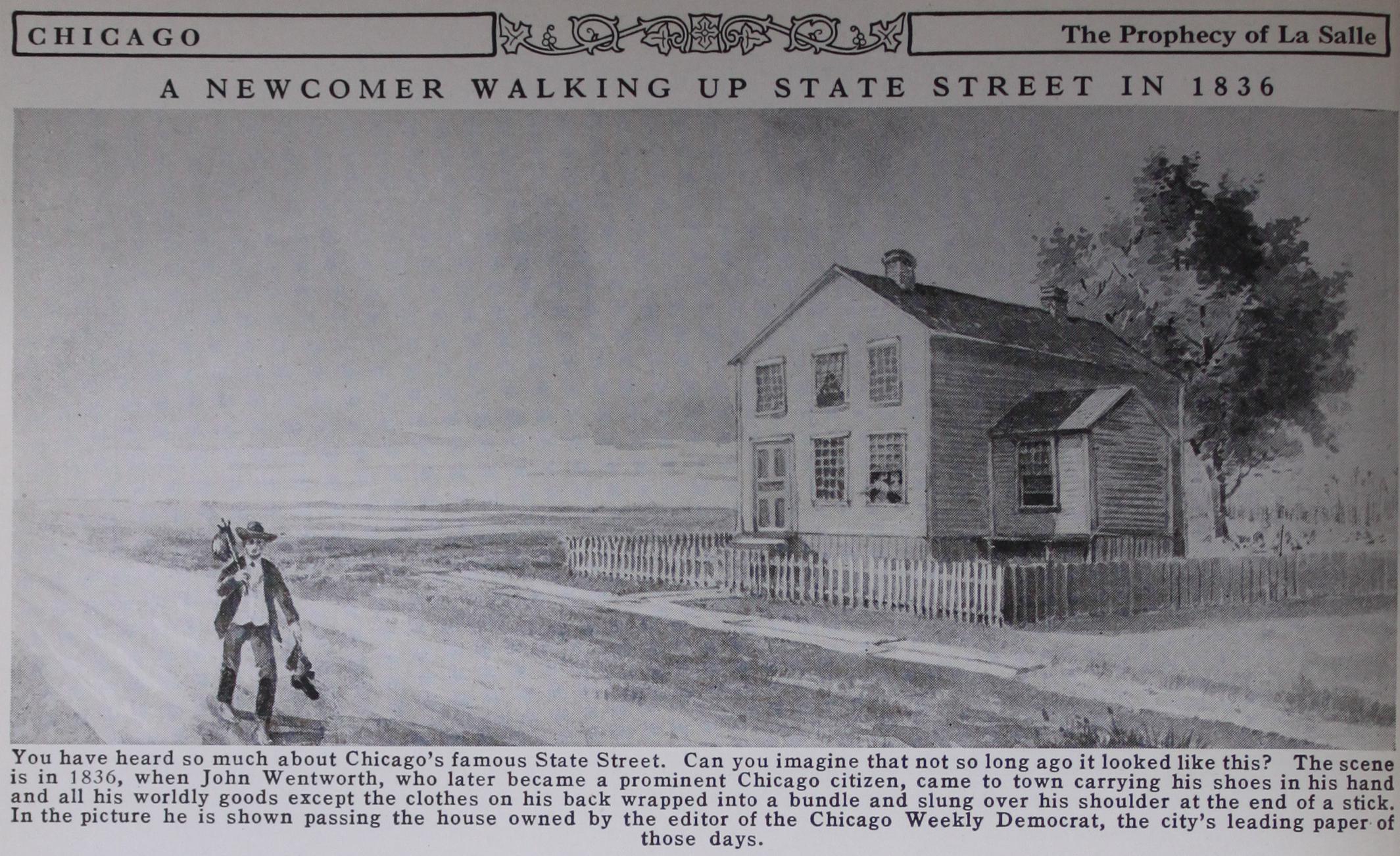
i In 1830 Chicago was a cluster of log cabins in the 1 midst of a marsh, huddled for protection close to the stockade of Fort Dearborn. Today Chicago is the world's greatest railway center, the terminus of nearly 30 lines, whose combined mileage is half that of the whole railroad system of the United States.
It is the world's greatest live stock market and packing center, producing more than a quarter of the entire meat output of the country. It is one of the most important grain markets of the globe, arid the prices paid for wheat on the Chicago Board of Trade largely determine the price of the world's bread.
Chicago a Great Port The port of Chicago is the second port in the United States. It receives a greater volume of shipping than any but a few of the greatest world ocean ports, and more tonnage ascends the narrow Chicago River than passes through the Suez Canal.
Seventy per cent of the world's supply of hides is used or distributed in the Chicago district; and this same district handles more lumber, makes more machinery, builds more railway cars, and manufac tures more furniture than any other place on the globe. It is the center of the agricultural implement industry which has revolutionized the farming methods of the world. It is the greatest distributing center in the country for dry goods, foodstuffs, clothing, pianos, household requisites, and general merchandise. For Chicago, besides leading the world in certain indus tries, has greatly diversified interests, and is among the most important centers for the manufacture of automobiles, baking powder, boots and shoes, brass, copper, tin, and sheet-iron products, bakery products, carriages and wagons, confectionery, electrical ma chinery, foundry products, iron and steel, paints and varnishes, soap, tobacco, and a host of other things.
To appreciate fully the bewildering vastness of this young city, one must remember that it has more miles of streets than some states have of roads; that it has more telephones than all Asia, Africa, and South America combined. It handles more freight and spends more money for governmental purposes than some European nations. Its post-office handles eight times as much mail as all Norway. It has more people than any of 36 states, and more churches than any of 13. The busiest street corner on the globe, the largest department store, and one of the largest art schools are all found in Chicago.