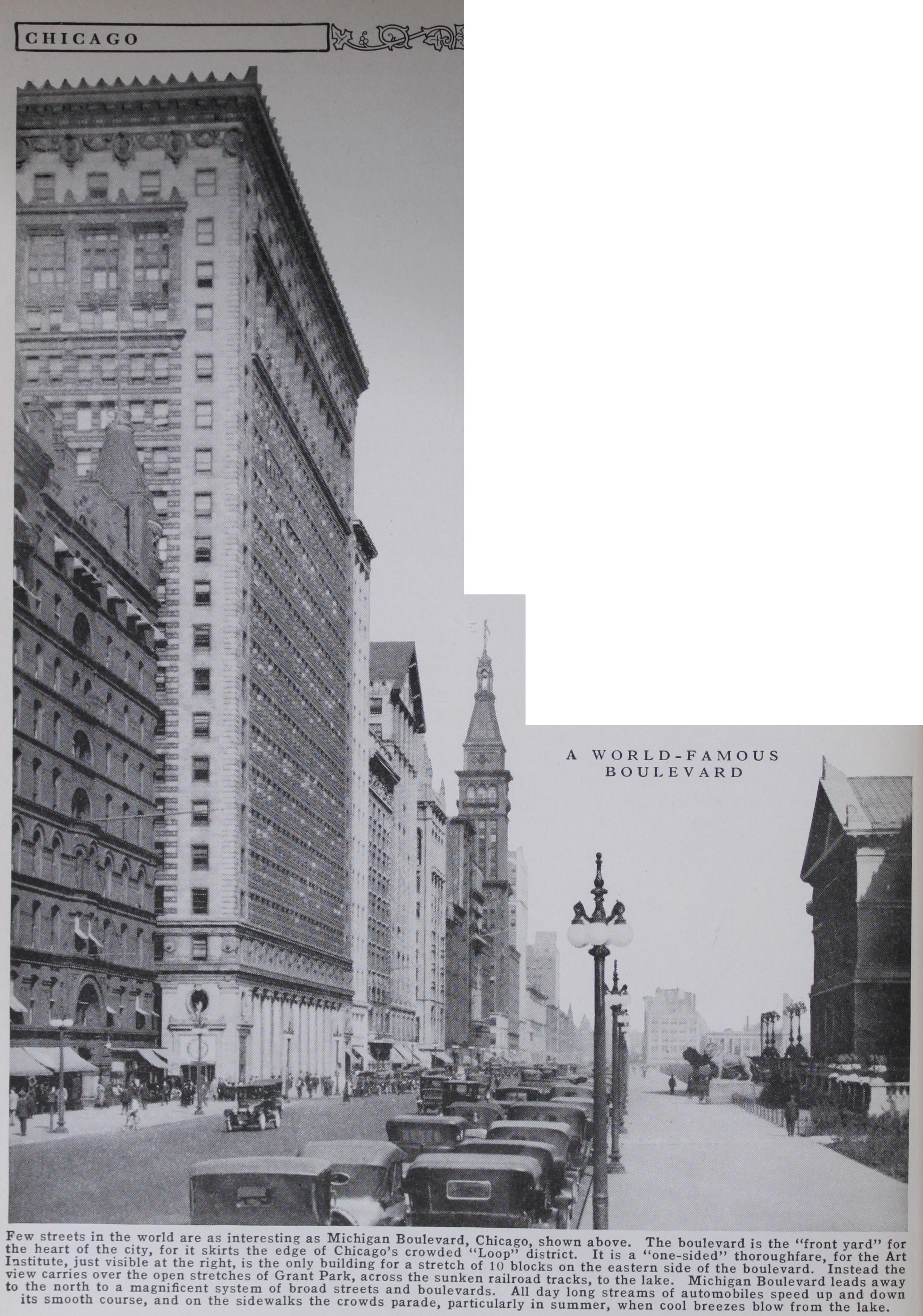
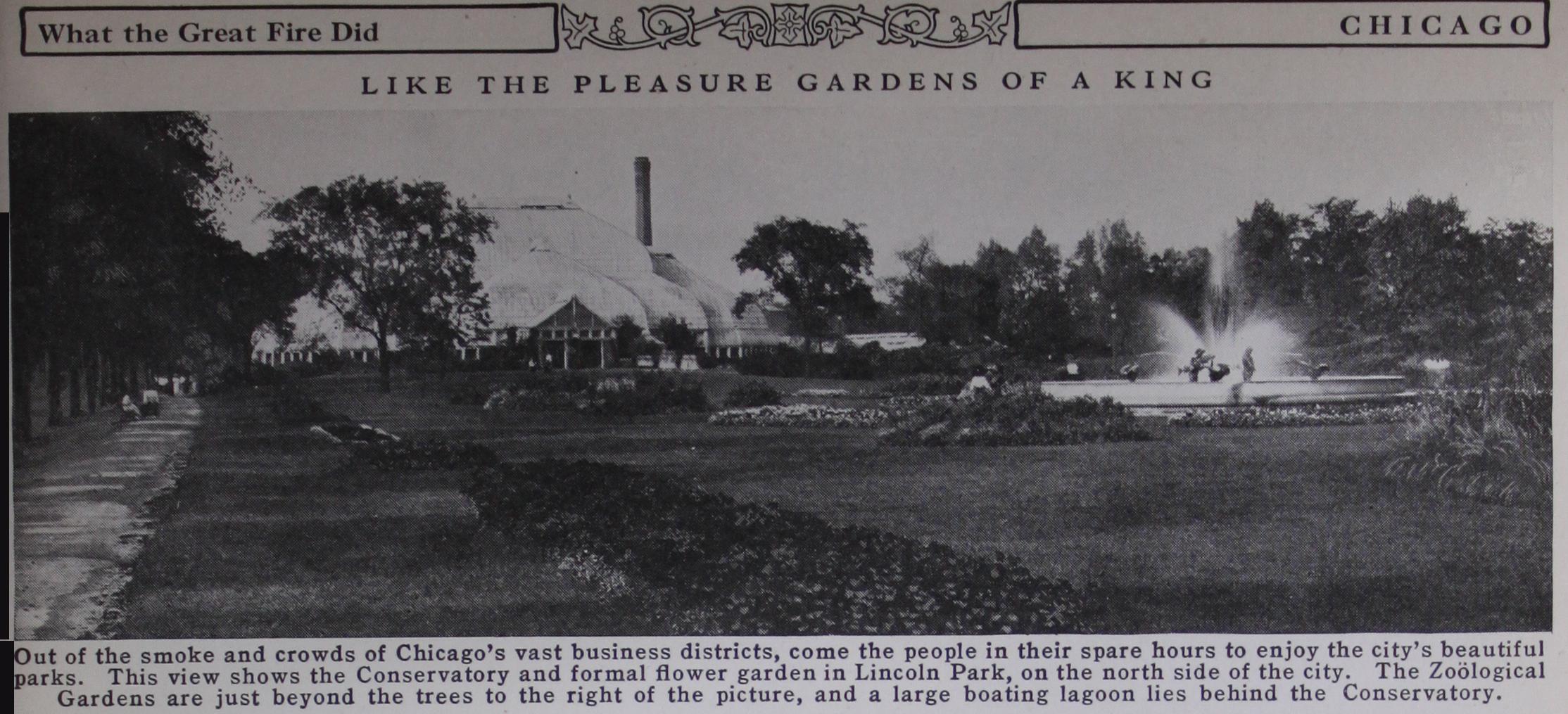
Ill Chicago
water, lake, city, river, worlds, mississippi and natural
The population is as varied as the industries. No less than 35 distinct nationalities have gone to the city's making, and 1,700,000 of its more than 2,700,000 inhabitants are of foreign birth or descent. Every important racial group in Europe is represented here, notably the northern nations—Norway, Sweden, Russia, Denmark, the Netherlands, Germany, and Austria—whose people find the climate of Chicago especially congenial. Chicago has therefore become the country's greatest clearing-house for labor.
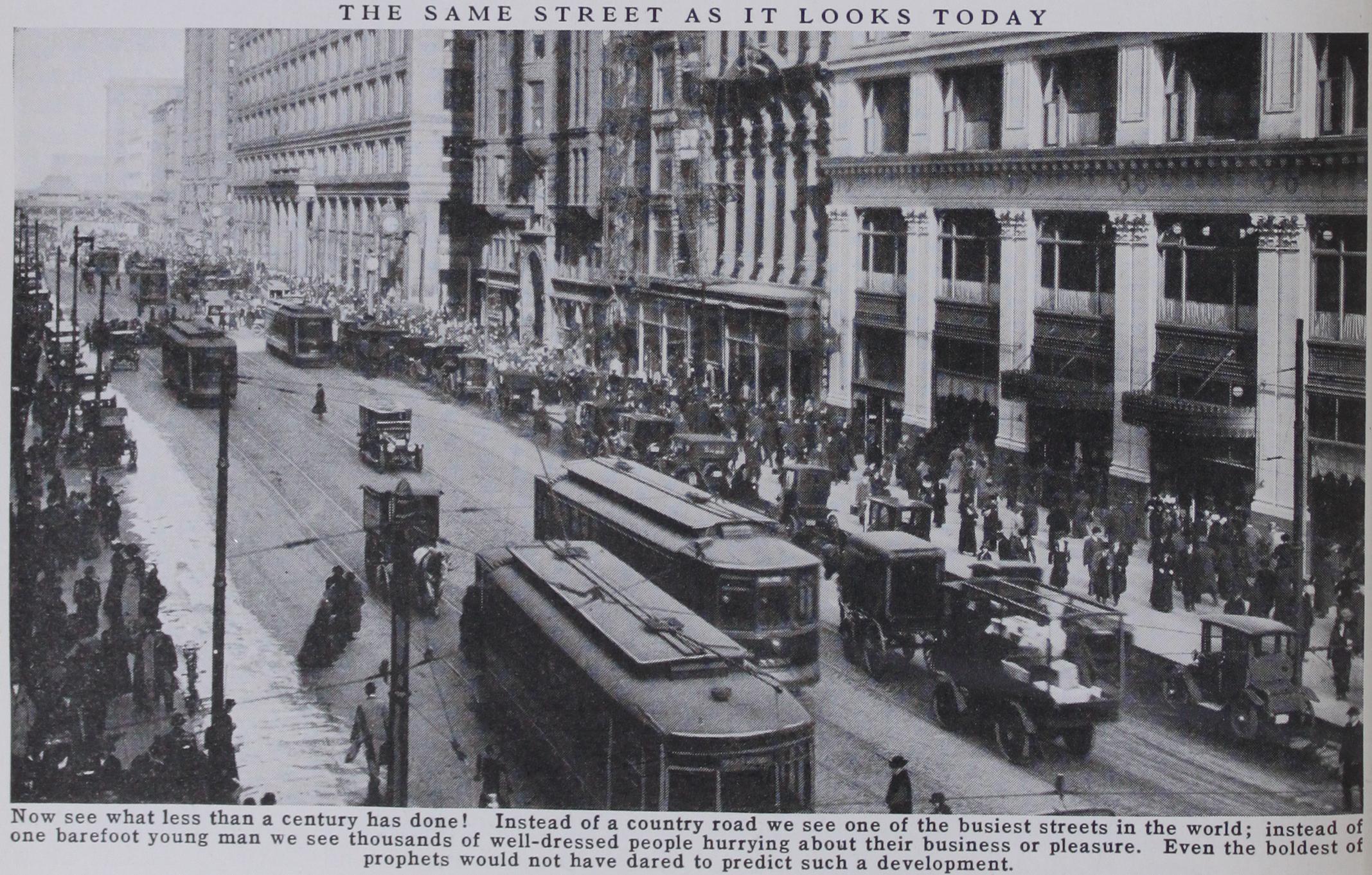
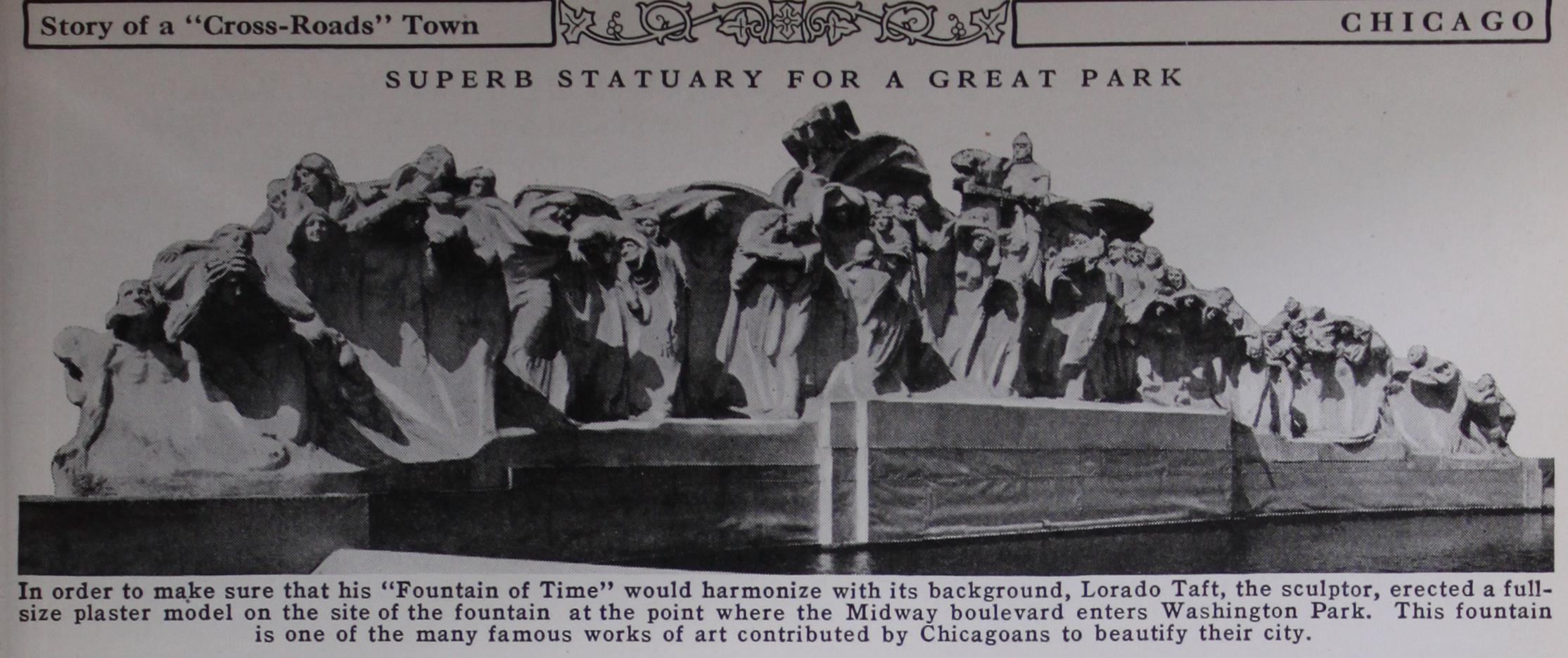
Chicago has verified the prophecy uttered by La Salle, one of the first white men to view its site, who said : " This will be the gate of empire, this the seat of commerce." The keen eye of that explorer saw the natural advantages that have made Chicago what it is. For Chicago did not "just happen." Its site was marked out from the earliest days to be the inland metropolis of America.
How the "Crossroads" Made Chicago Situated at the foot of the Great Lakes, where the long arm of Lake Michigan thrusts far down into the heart of the Middle West, it has a commanding posi tion as a point of trans-shipment between water and land transportation. It is the terminus of a water route to the St. Lawrence which reaches through to the Atlantic seaboard. It lies astride of the natural land routes between West and East, which are forced by the sprawling length of Lake Michigan to bend around its southern end and thus to converge at this point. As a result, every railway which enters this between the ore-producing North and the cotton growing South. It is the natural commercial focus of the great Mississippi Valley, with its stretch of marvelously fertile soil as large as half Europe and its prosperous population of 50,000,000 people.
The extensive coal mines of Illinois and Indiana furnish it fuel, while the cheapest water transporta tion in the world brings iron ores from Lake Superior.
Steel is made here more cheaply than at Pittsburgh.
Lumber and copper come from the same nearby sources. Lead, zinc, and other minerals reach Chi cago in abundance from the Southern states.
An inexhaustible water supply lies at its door.
New York has to bring water from sources 50 and 100 miles distant, but Chicago needs only to erect pumping stations. It has thus become the home of heavy manufactures which use great quantities of water. With less than half as many inhabitants as
New York, Chicago uses more water than that city.
The combined length of its water and sewer mains region naturally makes Chicago its terminus, so that the city today is like the hub of a wheel with railways radiating in every direction.
Chicago is thus the gigantic " crossroads" through which the products of the industrial East and the manufacturing West must pass; it is also the gateway is longer than the combined length of the Ohio, Mississippi, and Missouri rivers.
Why Chicago Turned Her River Around The problem of sewage disposal is more difficult.
Formerly Chicago emptied its sewage into the lake and drank the contaminated water. The result was a high typhoid rate. But true to its motto, Will," Chicago found a way out. It reversed the course of the Chicago River, which formerly flowed into the lake, and made it flow out of the lake through a drainage canal into the Illinois River, and thence into the Mississippi and the Gulf of Mexico. This reversed river now carries the sewage of Chicago.
The drainage canal, which is 36 miles long, cost nearly $70,000,000; but it cut 90 per cent from the city's typhoid rate and is one of the chief factors which gives Chicago the lowest death rate of any of the world's great cities. It may also become an impor tant link in a waterway leading to the Gulf of Mexico.
Chicago is still a city in the making. Its growth has been so prodigious that the city has never been quite able to catch up to itself in facilities for taking care of its enormous population and its enormous business, and on the aesthetic and artistic side of civic life. Since the World's Fair in 1893—the most important event in the history of Chicago—much has been done to make the city a beautiful, con venient, and noble place to live in. The exquisite beauty of the World's Fair grounds and buildings, built by Daniel H. Burnham and other eminent architects, opened the eyes of the leading citizens to the city's possibilities for beauty. The out come has been the development of the amaz ing dream of city-building known as the " Chicago Plan." This contemplates the ex penditure of millions of dollars to make Chicago as beautiful as it is prosperous.