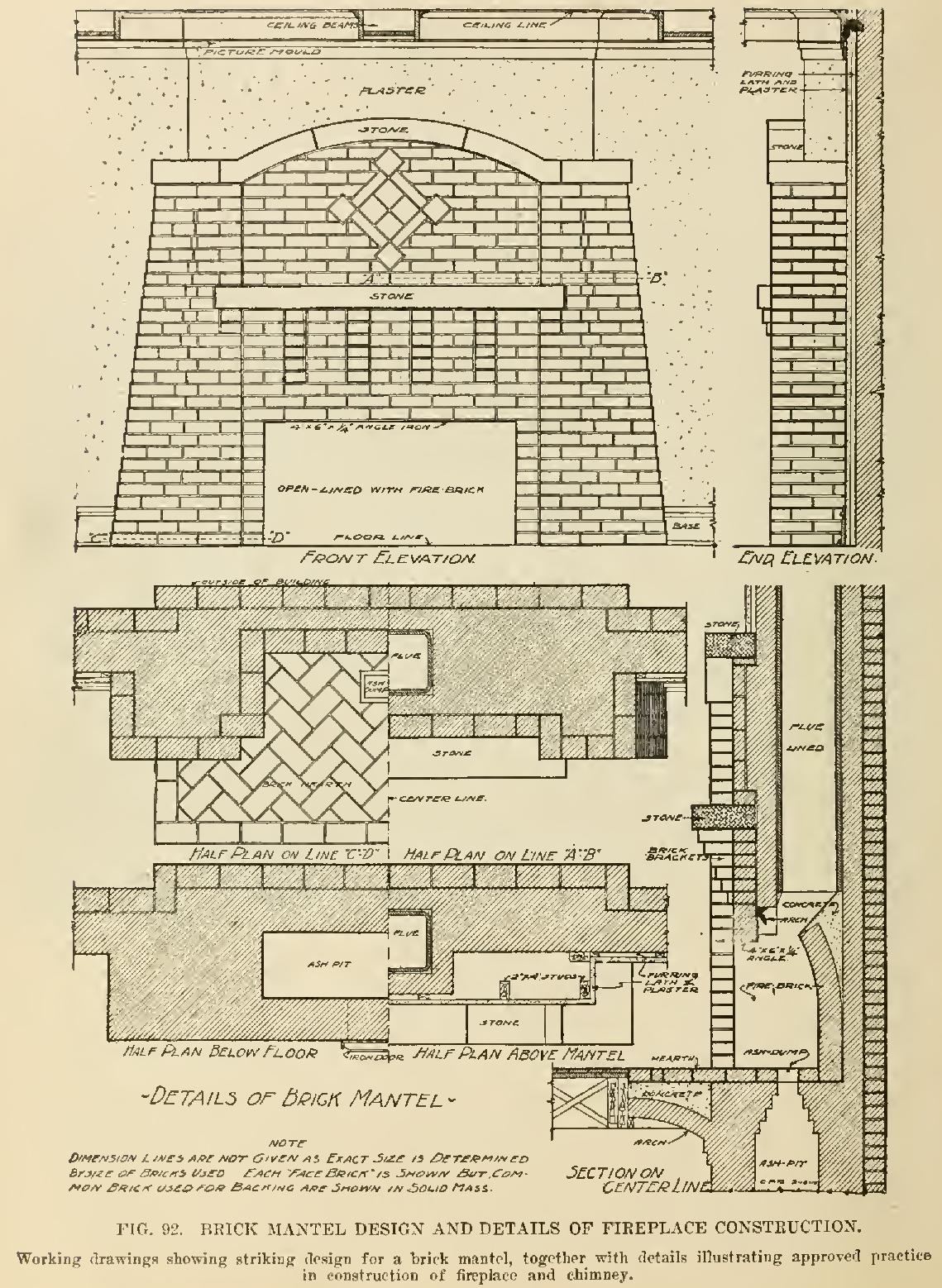
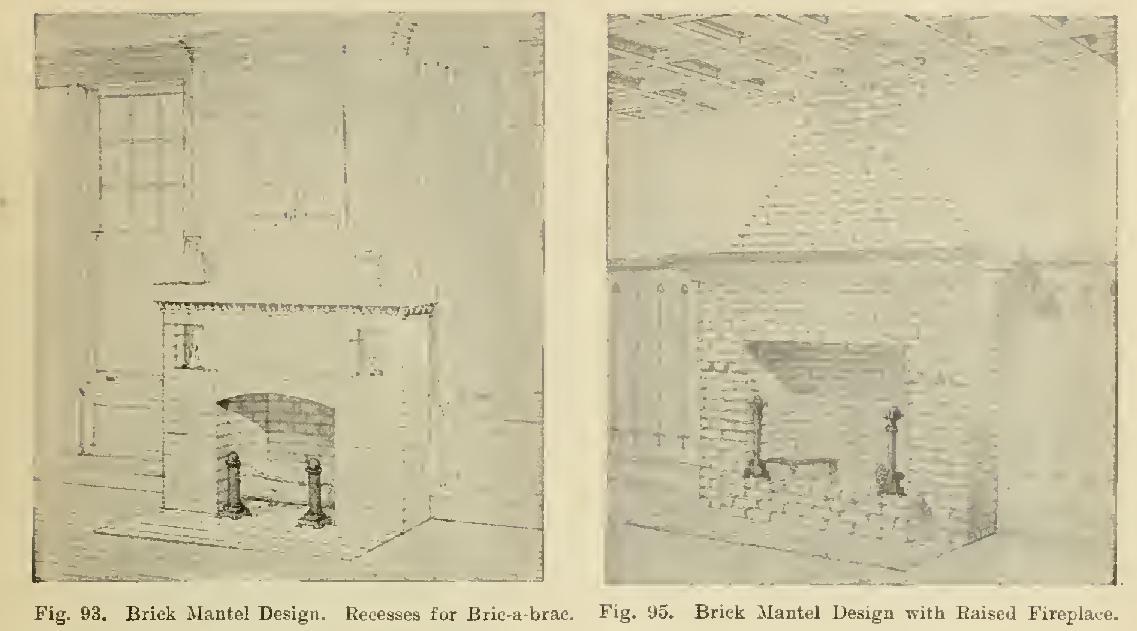
Brick Fireplaces
fireplace and shown
BRICK FIREPLACES The introduction of hot-air, steam, and hot-water heating systems for a time threatened the fireplace with extinction. A fireplace however, has always been a domestic altar of content. Man is always at heart a fire-worshiper, and modern buildings have increasingly generous provision for the wood, coal, or gas-log fireplace. As will be seen from the illustrations, brick fireplaces of great beauty of design are offered to the home-builder, and the purchaser is able to select from a great variety of color combinations. Most of these fireplaces are constructed with firebrick linings, tile facings, and hearths.

In construction, the hearth is first leveled with brick or concrete, and the hearth and "under-fire" are laid. The metal frame- for the opening is then placed, and the lining and backing for the tile facing are made. The tile facing is then laid. Glazed tile, the most beautiful productions of the American potter, are generally used for facings and hearth; and they are set in rich Portland cement mortar.
A bevel of about three inches to the foot should be given to the side linings; and the back of the fireplace should be inclined inward at the top, as shown in the illustrations, so as to form the throat. This should be about 3 inches in width. Its proper proportioning is important to secure a good draft. The opening should be provided with a damper-for draft regulation, and also to close up the opening when the fire is not needed, and to avoid heat losses.
Where buildings have wooden floors, the hearths of the fireplaces are supported by the trimmer-arch, shown in the illustration. The brick are turned on a wooden center, one end resting on a projecting brick course in the chimney, and the other supported by the joist-header. All fireplaces should be provided with ash-flues leading to an ash-pit in the basement. The ashes are pushed through a small pivotswung ash-dumping plate of east-iron, saving considerable labor and dirt.
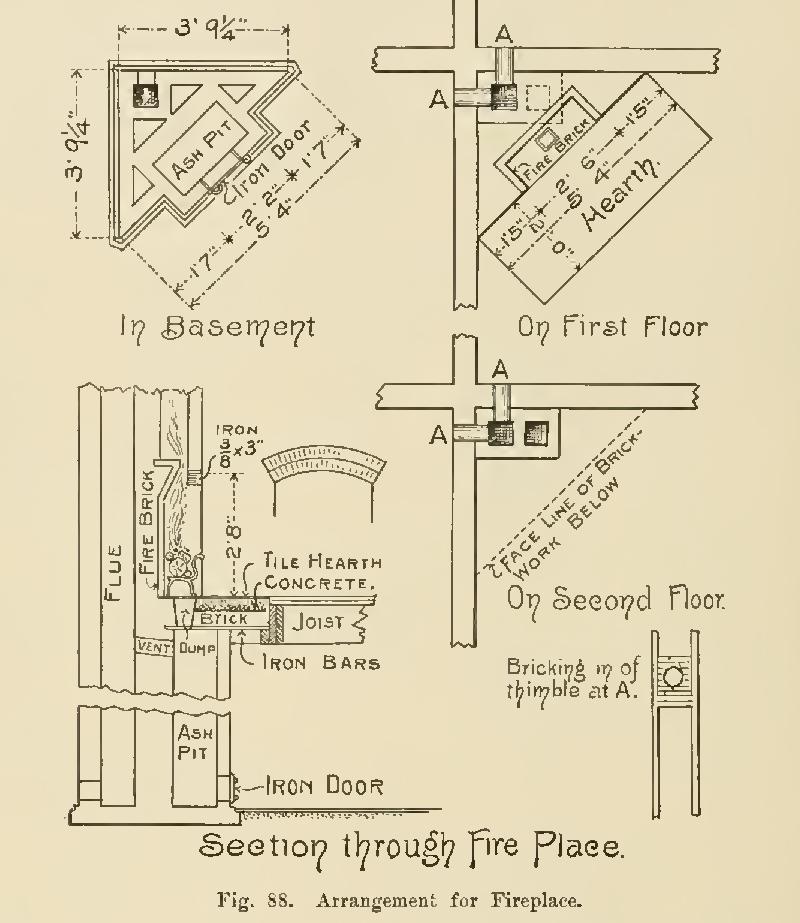
Framing for a Fireplace. In Fig. 88, two flues are shown, one to extend to the basement floor, and they are for use of stoves in adjoining rooms. When
thimbles are put in to make connection with adjoining rooms, the brickwork should be corbeled out to the full thickness of the wood partition, and a long thimble used to extend through the brickwork, being careful not to let the thimble protrude into the flue space. At sketch A, another way of widening the brickwork at the thimble is shown, which is simply to cut in a cross-piece between the studding, and on this build the extra brickwork with all joints well filled with mortar. In all cases the thimbles should be set at the time of building the chimney, being careful that all joints are well filled and mck-pointed on both sides; and in addition to this, it would be well to plaster on the inside of the flue from bottom to top.


In the illustration we have shown an ash-pit beneath the fireplace, where the ashes may he dumped and taken out later. This pit should have a vent into the flue, so that when the ash dump is opened a downward draught will be created which will prevent the ash dust from flying back into the room. For supporting the hearth, use iron bars made of nit by 2-in. iron; and on this lay brick edgewise, leaving a space of 3 or 4 inches for concrete on which to lay the tile hearth. The fireplace should be lined with firebrick, with the upper part of the brick slanted toward the top of the opening, as shown in the crosssection. The arch in front should be supported on a segment made of by 3-inch wrought iron, set back from the front so that it will not show. If a straight-top opening is desired, then use a 3 by 3-inch angle iron, with the flange on the inside of the brickwork.
The dotted lines show the position of the flue for the fireplace, and will require the opening or throat to draw over to it; but it should start straight from the fireplace, and gradually draw over to its position as shown. The face of the brickwork should carry up to the ceiling of the first story; and this gives ample space to matte the proper bend. in the flue. The flues should be independent of other openings.