Classification of Brick
bricks and paving
CLASSIFICATION OF BRICK Bricks are classified (1) according to the manner of moulding; 42) according to the place they occupy in the kiln during burning; and (3) according to their shape or the use to which they are to be put.
(1) When distinguished according to the manner of moulding, bricks are named: Soft-mud brick, made of very wet mud; Stiff-mud brick, made of mild with less water; Dry-pressed brick, made of clay containing 4 to 6 per cent of moisture; Re-pressed brick, made by re-forming partially dried brick made of soft mud, or brick made of stiff mud; mostly applied to the stiff-mud product.
(2) In the old-style kilns the bricks were not all burned alike. Those adjacent to the fire were over-done; those farthest away from the fire were underdone; and only intermediate portion were satisfactory. This condition led to the adoption of the names: Arch-brick, or those forming the top of the firing-place of the kiln.
Soft or salmon brick, or those named from the lack of color or hardness; Body brick, or those taken from the middle of the kiln.
Mercantile brick are brick well burned, but not graded as to color or degree of hardness.
Hard kiln-run brick are meant to be all suitable for outside work.
In the kilns of modern design, the heat is well distributed throughout the whole mass, and the above terms are not now so appropriate as formerly.
(3) The form and the use for which the brick are intended make the following terms suitable: Face brick, or those of best appearance as to uniformity of color and dimension, and thus suitable for outside walls. The term is especially used to designate pressed or re-pressed brick.
Ornamental brick are nearly always made by the dry-press process; and this is the name given to all brick differing from the standard shape.
Compass brick, or those having one edge shorter than the other. They are used in building curves on which the length of the brick is a part of the circumference.
Feather-edge brick, or Voussoir brick, those similar to compass brick, but having one edge thiumer than the other. They, also, are used in building
arches.
Paving brick, or vitrified blocks, usually larger than ordinary bricks, used in paving streets.
Sidewalk brick are extra hard-burned brick from good clay, or small paving brick.
Sewer brick, or common brick of better grades, so regular in form as to be suitable for building, sewers. They must also be low in absorption.
Sizes and Weight of Brick. The sizes of clay brick are bound to vary, owing to the nature of the material from which they are made. Hard-burned brick shrink more than soft-burned brick clueing their burning; the quality or the character of the clay in the bank will vary through the season, during its horizontal or vertical working; also the wear of molds and dies during the season will tend to vary the brick-size. The leading brickmakers of the country have established a standard of sizes to which they endeavor to conform their products. (See Table Table II Standard Sizes of Bricks Building brick, 8V., x4x2y in Pressed brick. 8% x 4 x 2% in. Paving brick, 31/2 x 4x 21/2 in. Homan brick, 4 x in Norman brick, 12x 4 x 2% in. Paving block, 9 s 4 0 3 in.
In actual practice, common brick in the Eastern States average by 3% by in.; and in the Western States, the average is 81/2 by by 21/2 in.
In the same kiln, there will be a variation, due to shrinkage, of from to 1/2 in. between the hard-burned and the soft-burned brick.
The weight of bricks varies according to their size and the kind of clay from which they are made. Common bricks average from to 5 lbs each. Pressed bricks weigh from 5 to lbs. Paving bricks measuring S by 4 by in. weigh 7 lbs. Re-pressed pavers by 4 by weigh lbs. Paving blocks by 4 by in. weigh approximately 91A lbs. each.
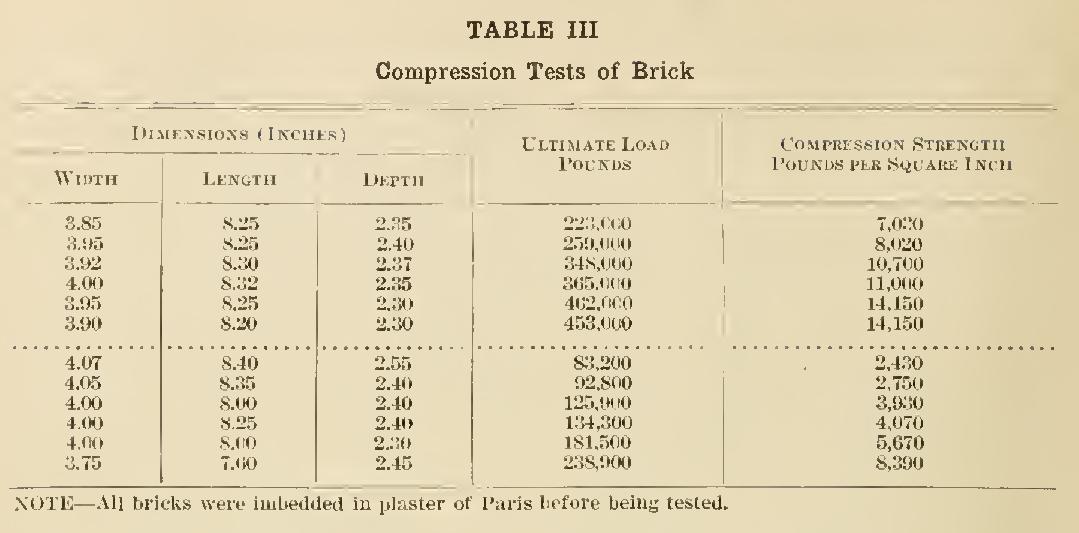
Bricks weigh from 100 pounds to 150 pounds per cubic foot, according to density. Counnon bricks weigh about 125 pounds per cubic foot.