Classification of Brick
strength and water
Specifications for Good Brick. The following specifications for brick are intended as general rather than specific: (a) A good brick should possess plane faces, parallel sides, and well-defined edges and corners. In sharpness of outline, dry-pressed brick excel. Following in order of merit in this regard, are re-pressed brick, stiff-mud brick, and soft-mud brick.
(b) A good brick should be uniform in its structure, and should he free from cracks, cheeks, pebbles, and nodules of lime.
(c) A good brick should give a clear ringing sound when struck with another brick or with a trowel or hammer. Such a brick is strong enough and durable enough for all ordinary Building construction. By "strong enough" we refer to its general strength-distribution, not crushing strength only. Crushing strength in brick is valuable only in comparing different brands. Any wellburned brick will have compressive strength far beyond any strain to which it may be ordinarily submitted in wallcompression. The strength of brick masonry depends more on the quality of its mortar bond than the compressive strength of its brick units. MOst cities demand a crushing strength of from 2,000 to2,500 lbs. per sq. ht. The range of averages of hundreds of tests is from 2,700 to 5,000 lbs. per sq. in. In a wall the transverse strength is usually of more importance than the crushing strength.
(d) A brick should not absorb more than one-tenth of its weight of water. It seems to be well established that brick with high absorption are most readily affected by the action of water and frost. As a rule, hardburned brick absorb the least water, and brick absorbing little water are more durable in walls and foundations. Under-burned soft brick, used for backing will absorb from 20 to 30 per cent of water, while brick of high quality will not absorb more than 4 or 5 per cent. A brick absorbing only one-tenth of its weight of water may be called "good." (e) The compressive strength of good-quality brick should be not less than 2,500 pounds per square inch for building brick, and 4,000 pounds per square inch for piers and heavy work.
(f) The modulus of rupture of brick should be not less than 750 pounds per square inch.
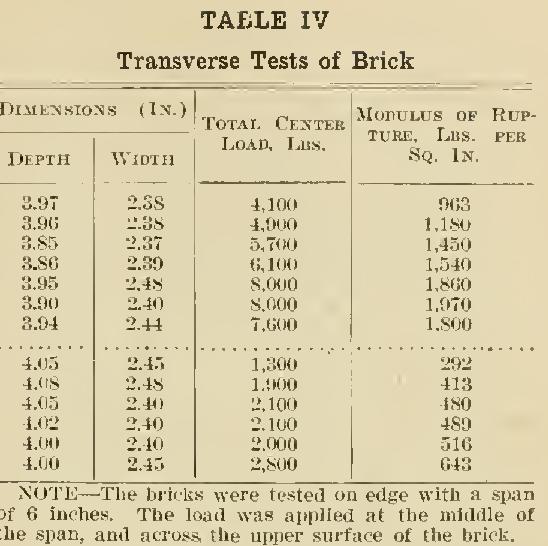
Tests of Brick. Tables III and IV show the results of some recent tests of shale building brick made in central Illinois. The higher results are from selected hard-burned brick; and the lower, from samples which were soft and under-burned.