Framing for Brick Houses
veneer and wall
FRAMING FOR BRICK HOUSES.
Various types of masonry veneer construction have frequently been employed in many parts of the country, especially in the East, and have gained much popularity. Brick veneer has been most used, though of late years concrete blocks and tile have come into use for veneering purposes to some extent. The advantages of any of these systems over the solid masonry wall, for residence work, seems to be a lower first cost and a drier wall; while, as compared with all-frame construction, the veneer is warmer, more durable, and presents a more dignified appearance.
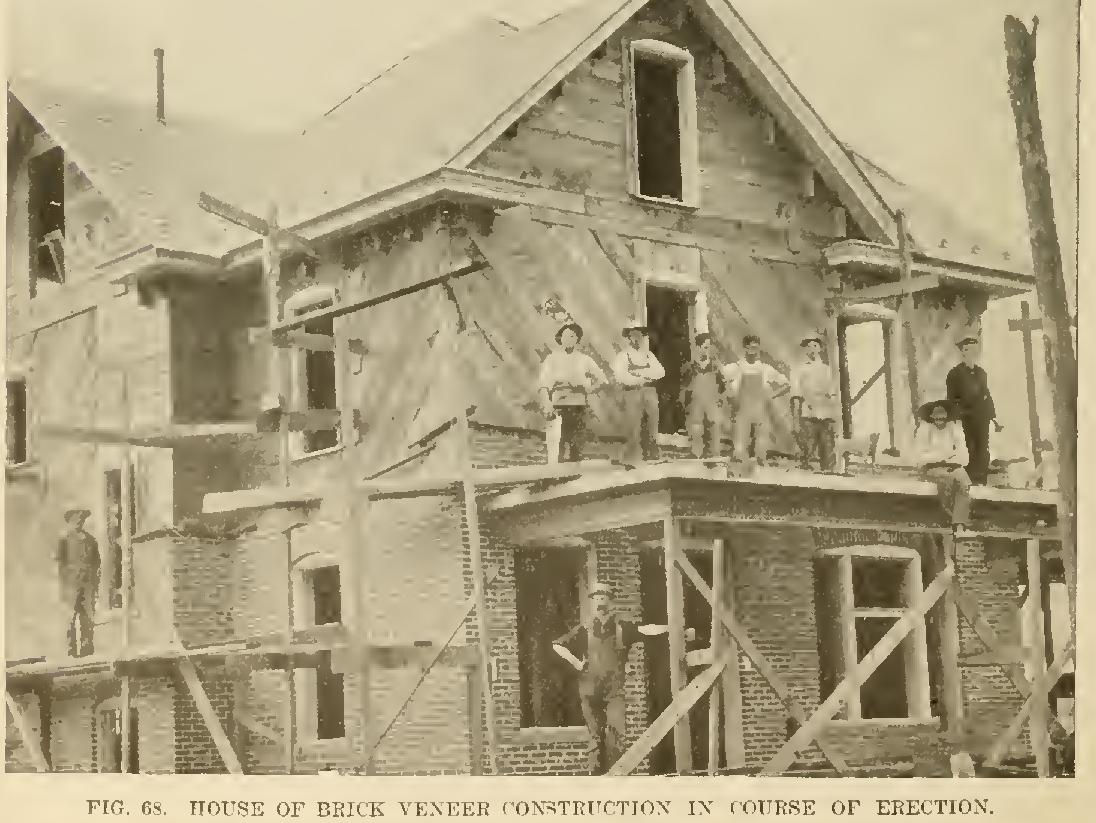

Brick Veneer Wall Construction. In the main, the timber framing to be used with brick veneer construction is identical with the best practice for all-frame houses. A number of points, however, require special attention. The relation of the masonry veneer coat to the studding, and the proper bonding of the masonry and framework., one to the other, is one of these points.
Consider a house which is to be constructed of a wooden frame, sheathed diagonally with inch boards and finished with a brick facing of veneer of 4 inches. In order properly to veneer the wooden or timber work, it is necessary that the frame should be kept at least 6 inches from the outside face of the foundation wall. A water-table course of stone should be carried around above the cellar, absolutely level, in order to support the upper structure of brick. Therefore the foundation wall must not be less than 20 inches thick.
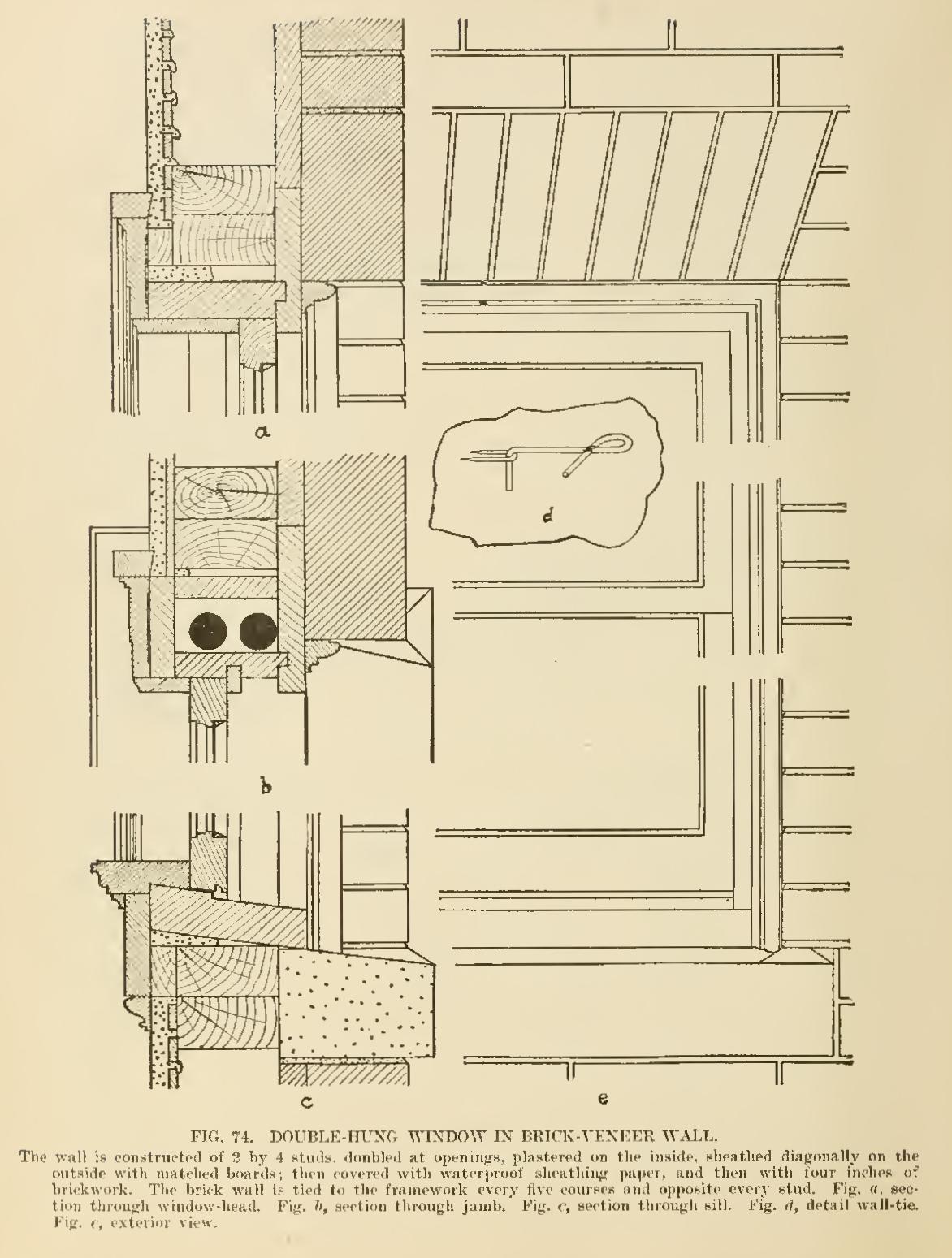
The water-table having been set, and the frame erected to the exact measurements, the first five courses of brick may be laid all the way around, as shown in the elevation, Pig. 69. After this is done, wire wall-anchors of the shape indicated upon the plan (which, by the way, can be purchased at any hardware store) are driven into the sides of the studdings 16 inches apart, and laid flat on the top of the bed recourse so as to tie the brickwork firmly to the wooden frame. At the corners, the anchors should be plentifully used.
Should it not he desirable to use the anchors and it be found necessary to make a stronger wall, a course of brick headers, English bond, may he introduced on the sixth course, allowing the headers to pass through the thickness of the studdings and filling up the space between them, as at AB and CD, with the rough brick. This method gives practically all 8-inch wall, and makes a warmer house, as old brickbats can be used to great advantage. Should a Flemish bond of headers and stretchers be employed, then the bricks should be placed as indicated by the dotted lines shown in the plan. The thickness of the anchors desired must not be in excess of the brick mortar joints.
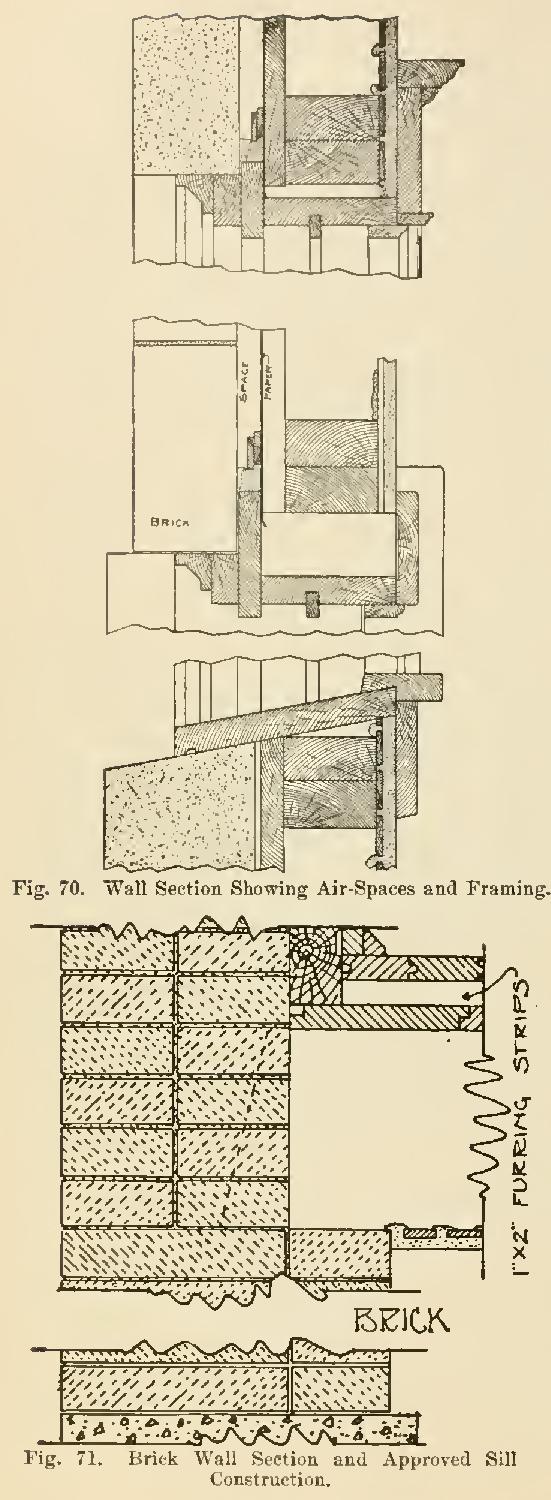
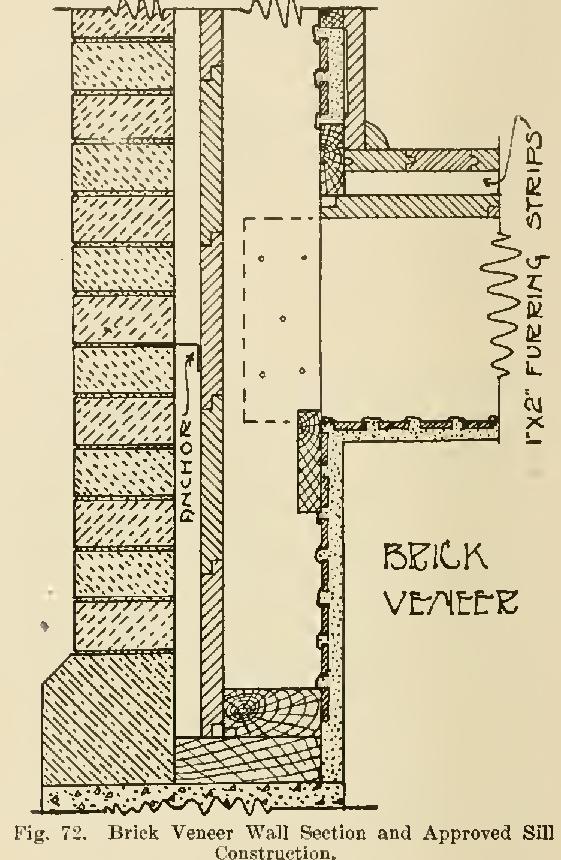
Should the building be of concrete, veneered with brick, it will be necessary to lay up the brickwork first, before backing-up of the concrete. All measurements must be carefully watched so that the sills, lintels, bond courses, etc., may be at their proper heights and levels. The same rules apply to backing-np with rough rubble stonework; but it is better to build the stonework first, and, by driving hook anchors into the variegating joints, obtain a fastening in the brick veneer.
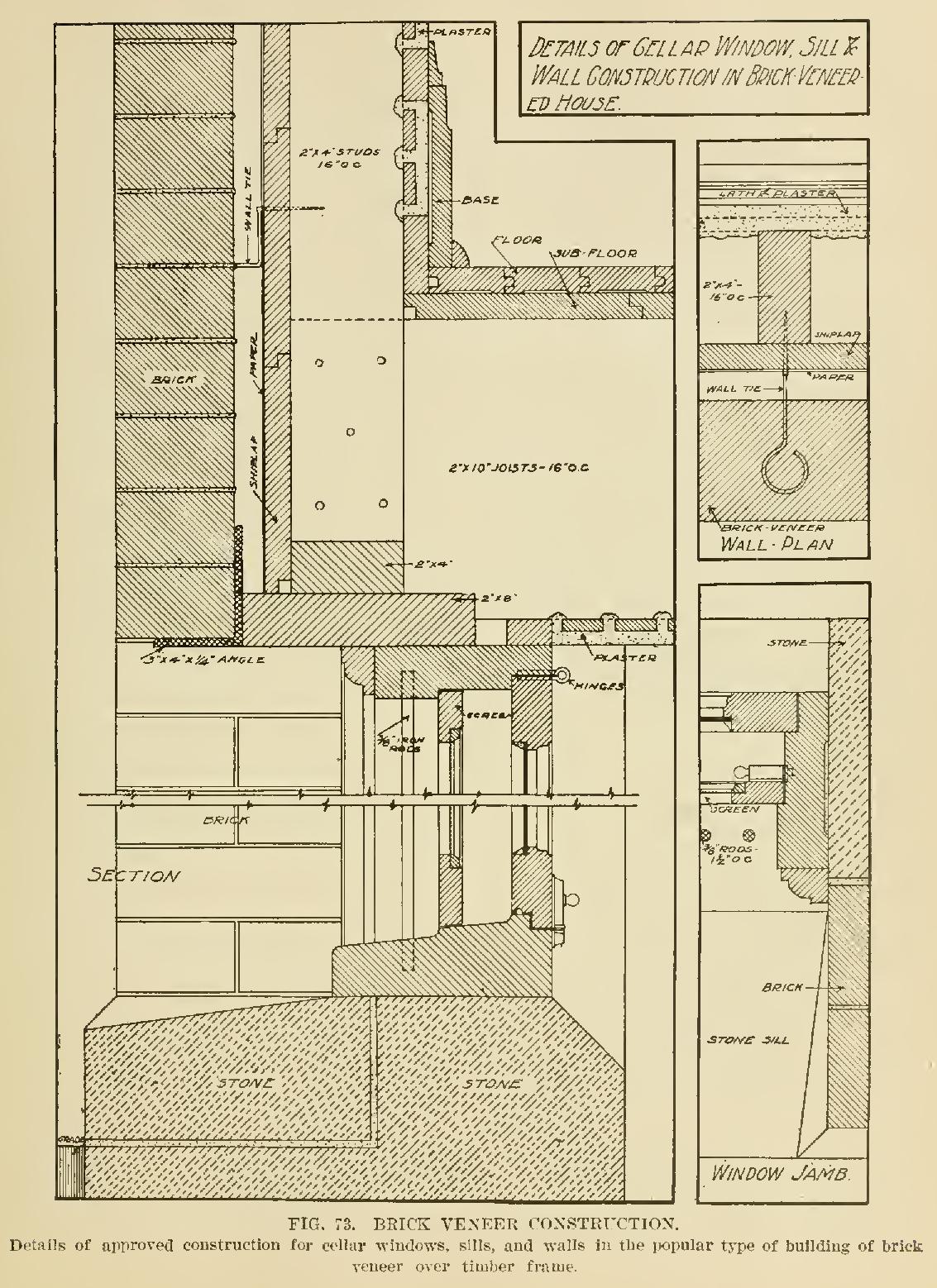
Air-Spaces and Bonding.
One of the principal boasts made for the brick veneer type of house is concerning its warmth and dryness. This collies from the ample dead air-spaces. A double air-chamber is made by leaving an airspace between the brick and the sheathing.
Fig. 70 shows ill sectional detail how this is done. It is a good idea not to crowd the brick close to the sheathing; better set off an inch or the thickness of the blind stop, and make the same wide enough to lap onto the sheathing. However, the building paper should be put on first; and then, after the windowframes are set, it is a good idea to nail a couple of lath an inch or so back of the blind stop, and fill in with mortar, pressing the same in firmly. This can be done at the time the brick are being laid, with practically no loss of time.