Outline of Indirect Division or Mitosis Karyokinesis
chromosomes and nucleus
OUTLINE OF INDIRECT DIVISION OR MITOSIS (KARYOKINESIS) The process of mitosis involves three parallel series of changes which affect the nucleus, the centrosome, and the cytoplasm of the cell-body respectively. For descriptive purposes it may conveniently be divided into a series of successive stages or phases, which, however, graduate into one another and are separated by no well-defined limits. These are : (I) The Prophases, or preparatory changes ; (2) the Metaphase, which involves the most essential step in the division of the nucleus; (3) the Anaphases, in which the nuclear material is distributed ; (4) the Telophases, in which the entire cell divides and the daughter-cells are formed.
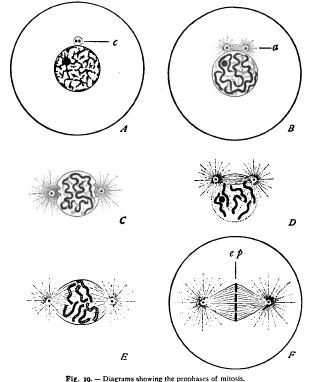
I. Prophases.—(a) The Nucleus. As the cell prepares for division the most conspicuous fact is a transformation of the nuclear substance, involving both physical and chemical changes. The chromatin resolves itself little by little into a more or less convoluted thread, known as the skein (Knauel) or spireme, and its substance stains far more intensely than that of the reticulum (Fig. 19). In some cases there is but a single continuous thread ; in others, the thread is from its first appearance divided into a number of separate pieces or segments forming a segmented spireme. In either case it ultimately breaks transversely into a definite number of distinct bodies, known as chromosomes (Waldeyer, '88), which in most cases have the form of rods, straight or curved, though they are sometimes spherical or ovoidal, and in certain cases may be joined together in the form of rings. The staining power of the chromatin is now at a maximum. As a rule the nuclear membrane meanwhile fades away and finally disappears. The chromosomes now lie naked in the cell, and the ground-substance of the nucleus becomes continuous with the surrounding cytoplasm (Fig. 19, .D, E, F).
Every species of plant or animal has a fixed and characteristic number of chromosomes, which regularly recurs in the division of all of its cells; and in a11 forms arising by sexual reproduction the number is A. Resting-cell with reticular nucleus and true nucleolus; at c the attraction-sphere containing two centrosomes. B. Early prophase ; the chromatin forming a continuous nucleolus
still present ; above, the amphiaster (a). C. D. Two different types of later prophases ; C. Disappearance of the primary spindle, divergence of the centrosomes to opposite poles of the nucleus (examples, many plant-cells, cleavage•stages of many eggs). D. Persistence of the primary spindle (to form in some cases the "central spindle "), fading of the nuclear membrane, ingrowth of the astral rays, segmentation of the spireme•thread to form the chromosomes (examples. epidermal cells of salamander, formation of the polar bodies). E. Later prophase of type C; fading of the nuclear membrane at the poles, formation of a new spindle inside the nucleus; precocious splitting of the chromosomes (the latter not characteristic of this type alone). F. The mitotic figure established; The equatorial plate of chromosomes. (Cf. Figs. i6, 21, a4.) even. .Thus, in some of the sharks the number is 36; in certain gasteropods it is 32 ; in the mouse, the salamander, the trout, the lily, 24 ; in the worm Sagitta, 18 ; in the ox, guinea-pig, and in man the number is said to be i6, and the same number is characteristic of the onion. In the grasshopper it is 12 ; in the hepatic Pallavicinia and some of the nematodes, 8 ; and in Ascaris, another thread-worm, 4 or 2. In the crustacean Anemia it is Under certain conditions, it is true, the number of chromosomes may be less than the normal in a given species ; but these variations are only apparent exceptions (p. 61). The even number of chromosomes is a most interesting fact, which, as will appear hereafter (p. 135), is due to the derivation of one-half the number from each of the parents.
The nucleoli differ in their behaviour in different cases. Net-knots, consisting of true chromatin, probably enter into the formation of the spireme-thread. True nucleoli seem to dissolve and disappear, or in some cases are cast out bodily into the cytoplasm, where they degenerate and have no further function. Whether they ever contribute to the formation of chromosomes is uncertain.