Outline of Indirect Division or Mitosis Karyokinesis
spindle and nucleus
(b) The Amphiaster. Meanwhile, more or less nearly parallel with these changes in the chromatin, a complicated structure known as the amphiaster (Fol, '77) makes its appearance in the position formerly occupied by the nucleus (Fig. 19, B—F). This structure consists of a fibrous spindle-shaped body, the spindle, at either pole of which is a star or aster formed of rays or astral fibres radiating into the surrounding cytoplasm, the whole strongly suggesting the arrangement of iron filings in the field of a horseshoe magnet. The centre of each aster is occupied by a minute body, known as the centrosome (l3overi, '88), which may be surrounded by a spherical mass known as the centrosphere (Strasburger, '93). As the amphiaster forms, the chromosomes group themselves in a plane passing through the equator of the spindle, and thus form what is known as the equatorial plate.
The amphiaster arises under the influence of the centrosome of the resting-cell, which divides into two similar halves, an aster being developed around each while a spindle stretches between them (Fig. 19, A—D). In most cases this process begins outside the nucleus, but the subsequent phenomena vary considerably in different forms. In some forms (tissue-cells of the salamander) the amphiaster at first lies tangentially outside the nucleus, and as the nuclear membrane fades away, some of the astral rays grow into the nucleus from the side, become attached to the chromosomes, and finally pull them into position around the equator of the spindle, which is here called the central spindle (Figs. 19, D, F; 21). In other cases the original spindle disappears, and the two asters pass to opposite poles of the nucleus (most plant mitoses and in many animal cells). A spindle is now formed from rays that grow into the nucleus from each aster, the nuclear membrane fading away at the poles, though in some cases it may be pushed in by the spindle-fibres for some distance before its G. Metaphase ; splitting of the chromosomes (e. p.); a. The cast-off nucleolus. 11. Anaphase ; the daughter-chromosomes diverging, between them the interzonal fibres (t. f), or central spindle ; centrosomes already doubled in anticipation of the ensuing division. I. Late anaphase Or telophase, showing division of the cell-body, mid-body at the equator of the spindle and beginning reconstruction of the daughter-nuclei. 7. Division completed.
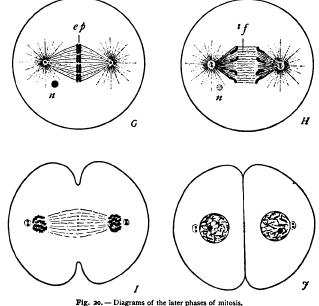
disappearance (Fig. 19, C, E). In this case there is apparently no central spindle. In a few exceptional cases, finally, the amphiaster may arise inside the nucleus (p. 225).
The entire structure, resulting from the foregoing changes, is known as the karyokinetic or mitotic figure. It may be described as consisting of two distinct parts ; namely, I, the chromatic figure, formed by the deeply staining chromosomes ; and, 2, the achromatic figure, consisting of the spindle and asters which, in general, stain but slightly. The fibrous substance of the achromatic figure is generally known as archoplasm (Boveri, '88), but this term is not applied to the centrosome within the aster.
2. Metaphase.—The prophases of mitosis are, on the whole, preparatory in character. The metaphase, which follows, forms the initial phase of actual division. Each chromosome splits lengthwise into two exactly similar halves, which afterwards diverge to opposite poles of the spindle, and here each group of daughter-chromosomes finally gives rise to a daughter-nucleus (Fig. 20). In some cases the splitting of the chromosomes cannot be seen until they have grouped themselves in the equatorial plane of the spindle ; and it is only in this case that the term " metaphase " can be applied to the mitotic figure as a whole. In a large number of cases, however, the splitting may take place at an earlier period in the spireme stage, or even, in a few cases, in the reticulum of the mother-nucleus (Figs. 38, 39). Such variations do not, however, affect the essential fact that the chromatic network is converted into a thread which, whether continuous or discontinuous, splits throughout its entire length into two exactly equivalent halves. The splitting of the chromosomes, discovered by Flemming in 188o, is the most significant and fundamental operation of cell-division ; for by it, as Roux first pointed out ('83), the entire substance of the chromatic network is precisely halved, and the daughter-nuclei receive precisely equivalent portions of chromatin from the mother-nucleus. It is very important to observe that the nuclear division always shows this exact equality, whether division of the cell-body be equal or unequal. The minute polar body, for example (p. 131), receives exactly the same amount of chromatin as the egg, though the latter is of gigantic size as compared with the former. On the other hand, the size of the asters varies with that of the daughter-cells (cf. Figs. 43, 71) though not in strict ratio. The fact is one of great significance for the general theory of mitosis, as will appear beyond.