Structural Basis of Protoplasm
structure and portion
STRUCTURAL BASIS OF PROTOPLASM As ordinarily seen under moderate powers of the microscope protoplasm shows no definite structural organization. A more precise examination under high powers, especially after treatment with suitable fixing and staining reagents, reveals the fact that both nucleus and cytoplasm possess a complicated structure. Regarding the precise nature of this structure opinion still differs. According to the view most widely held, one of its essential features is the presence of two constituents, one of which, the ground-substance, cytolymph, or enchylema, is more liquid, while the other, the spongioplasm or reticulum, is of firmer consistency, and forms a sponge-like network or alveolar structure extending everywhere through the more liquid portion. At the present time it seems probable that the more solid portion is the more active and is perhaps to be identified as the living substance proper, the ground-substance being passive ; but the reverse of this view is maintained by Leydig, Schafer, and some others. The most elaborate and painstaking investigation has moreover failed to determine with absolute certainty even the physical configuration of the network.
Butschli and a considerable school of followers among both zoologists and botanists regard protoplasm as essentially a liquid, or rather a mixture of liquids, which forms a foam-like alveolar like an emulsion, in which the firmer portion forms the walls of separate chambers, filled with the more liquid substance (Fig. 8). By Fig. 8. —Alveolar or foam-structure of protoplasm, according to Biitschli. [BOTscHLI.] A. Epidermal cell of the earthworm. B. Aster, attraction-sphere, and centrosome from seaurchin egg. C. Intra-capsular protoplasm of a radiolarian (Thalassicolla) with vacuoles. D. Peripheral cytoplasm of sea-urchin egg. E. Artificial emulsion of olive-oil, sodium chloride, and water.
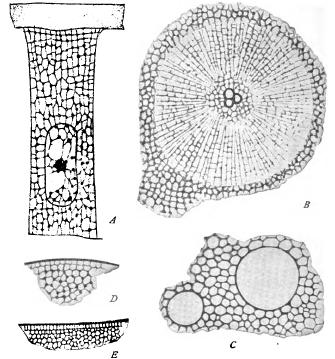
special local modifications of this structure all the parts of the cell are formed. Biitschli has shown that artificial emulsions, variously prepared, may show under the microscope a marvellously close resemblance to actual protoplasm, and that drops of oil-emulsions suspended in water may even exhibit amceboid changes of form.
Opposed to Butschli's conception is the view, first clearly set forth by Frommann and Arnold (65—'67), and now maintained by such authorities as Flemming, Van Beneden, Strasburger, and perhaps the greater number of contemporary investigators, that the more solid portion consists of coherent threads which extend through the groundsubstance, either separately or connected by branches to form a meshwork like the fibres of a sponge (Figs. 7, 9).
In the present state of the subject it is difficult, indeed, impossible, to decide which of these opposing views should be accepted ; for the evidence is very strong that each expresses a part of the truth. It is generally admitted that such an alveolar structure as Butschli describes is characteristic of many unicellular forms, and occurs in many higher forms where the cell-substance is filled with vacuoles or with solid inclusions such as starch-grains or deutoplasm-spheres. In the latter case the structure has been termed " pseudo-alveolar " (Reinke); but it remains to be seen whether there is any real distinction between this and the true alveolar structure described by Butschli. On the other hand the evidence of true fibrillar or reticular structure in many tissue-cells, especially during cell-division, is very convincing ; and my own observations have led me to regard this structure as the more typical and characteristic. For descriptive purposes I shall accordingly adopt the terms of the fibrillar or reticular hypothesis, designating the more solid portion of protoplasm as the thread-work or reticulum ("Gerustwerk," " Fadenwerk " of German writers) in contradistinction to the more liquid g-round-substance. It should be clearly understood, however, that these terms are used only as a matter of convenience, and are not meant to exclude the possibility that the " fibres " or the " reticulum " may in many cases be open to Butschli's interpretation.