Structural Basis of Protoplasm
cell and units
From a theoretical point of view the finer structure of the network is a question of very great interest and importance. The earlier investigators, such as Virchow and Max Schultze, failed to observe the thread-work, and described protoplasm as consisting of a clear homogeneous basis in which were embedded numerous granules. Even at the present time a similar view is held by a few investigators, more especially among botanists (e.g., Berthold, Schwarz), who regard the thread-work either as an artificial effect produced by reagents, or, if normal, as an inconstant and hence unimportant feature. The best and most careful recent studies on protoplasm have, however, yielded very convincing evidence that, whatever be the precise configuration of the protoplasmic reticulum, it is not only a normal structure, but one of very wide occurrence.
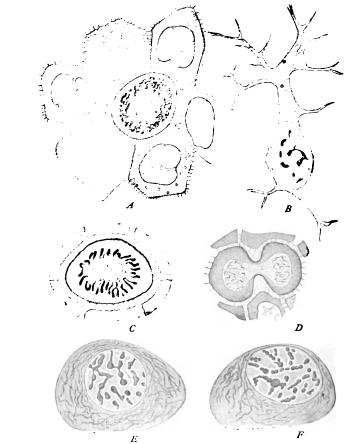
Fig. 9.
— Living cells of salamander-larva. [FLEMMING.] A. Group of epidermal cells at different foci, showing protoplasmic bridges, nuclei, and cytoplasmic fibrill:e; the central cell with nucleus in the spireme-stage. B. Connective C. Epidermal cell in early mitosis (segmented spireme) surrounded by protoplasmic bridges.
D. Dividing-cell.
E. F. with cytoplasmic fibrillae (the latter somewhat exaggerated in the plate).
These studies have raised interesting problems regarding the significance of the granules described by the early observers. Many of the granules, especially the larger and more obvious of them, are unquestionably inert bodies, such as reserve food-matters, suspended in the meshwork. Others are nodes of the network or optical sections of the threads. But there is some reason to believe that, apart from these appearances, discrete living particles may form a constant and essential structural feature of the protoplasmic thread. These particles, now generally known as are embedded in the threads of the network, and are sometimes so closely and regularly set as irresistibly to suggest the view that they are definite structural elements out of which the thread is built. More than this, their behaviour is in some cases such as to have led to the hypothesis long since suggested by Henle (41) and at a later period developed by Bechamp and Estor, by Maggi and especially by Altmann, that microsomes are actually organic units or bioblasts, capable of assimilation, growth, and division, and hence to be regarded as elementary units of structure standing between the cell and the ultimate molecules of living matter. And thus the theory of genetic continuity expressed by Redi in the aphorism "otnne vivum ex vivo," reduced by Virchow to "omnis cellula e cellula," finally appears in the writings of Altmann as "omne granulum e granulo!" 2 Altmann's premature generalization rests upon a very insecure foundation and has been received with just scepticism. That the cell consists of more elementary units of organization is nevertheless indicated by a priori evidence so cogent as to have driven many of the foremost leaders of biological thought into the belief that such units must exist, whether or not the microscope reveals them to view.
Among those who have accepted this conception in one form or another are numbered such men as Spencer, Darwin, Beale, Haeckel, Michael Foster, Nageli, De Vries, Wiesner, Roux, Weismann, Oscar Hertwig, Verworn, and Whitman. The modern conception of ultracellular units, ranking between the molecule and the cell, was first definitely suggested by Brucke only, however, to be rejected as without the support of facts, though this eminent physiologist insisted that the cell must possess a more complicated organization than that revealed by the best microscopes of his time. It was soon afterwards taken up by Herbert Spencer, and elaborated into the theory of physiological units by which he endeavoured to explain the phenomena of regeneration, development, and heredity. Darwin 1 Hanstein ('82).
2 Die Elementarorganismen, Leipsic, 1894, p. 155.
For a review of speculations in the same direction by Buffon and other early writers see Yves Delage ('95).
too, in his celebrated hypothesis of pangenesis, adopted a nearly related conception, which as remodelled by De Vries twenty years afterwards ('89) forms the basis of the theories of development maintained by such leaders of biological research as Weismann and Hertwig. The same view appears in a different form in the writings of Nageli, Wiesner, Foster, Verworn, and many other morphologists and physiologists.' An hypothesis backed by such authority and based on evidence drawn from sources so diverse cannot be lightly rejected. We are compelled by the most stringent evidence to admit that the ultimate basis of living matter is not a single chemical substance, but a mixture of many substances that arc self-perpetuating without loss of their specific character. The open question is whether these substances are localized in discrete morphological bodies aggregated to form the cell somewhat as cells are aggregated to form tissues and organs, and whether such bodies, if they exist, lie within the reach of the microscope. Altmann's identification of the "granulum " as such a body is undoubtedly premature ; it is certain that his description of cell-structures from this point of view is often very inaccurate ; it is extremely doubtful how far the granules or microsomes are normal structures, and how far they are artefacts produced by the coagulating effect of the reagents. It is nevertheless certain, as will be shown in Chapter VI., that at least one part of the cell, namely the nucleus, actually consists of self-propagating units of a lower order than itself, and there is some ground for regarding the cyto-microsomes in the same light.