Morphological Composition of the Nucleus
chromosomes and units
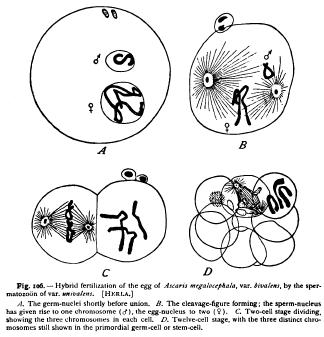
Finally Victor Herla's remarkable observations on Ascaris ('93) showed that in Ascaris not only the chromatin of the germ-nuclei, but also the paternal and maternal chromosomes, remain perfectly distinct as far as the twelve-cell stage—certainly a brilliant confirmation of Boveri's conclusion. Just how far the distinction is maintained is still uncertain, but Hacker's and Ruckert's observations give some ground to believe that it may persist throughout the entire life of the embryo. Both these observers have shown that the chromosomes of the germinal vesicle appear in two distinct groups, and Ruckert suggests that these may represent the paternal and maternal elements that have remained distinct throughout the entire cycle of development, even down to the formation of the egg ! When to these facts is added the evidence afforded by Brauer's beautiful observations on Artemia, no escape is left from the hypothesis of the individuality of the chromosomes in one form or another, even though we admit that Boveri's statement may have gone somewhat too far. The only question is how to state the facts without introducing obscure conceptions as to what constitutes an " individual." It is almost certain, as pointed out beyond (p. 221), that the chromosomes are not the ultimate units of nuclear structure, for they arise as aggregations of chromatin-grains that have likewise the power of growth and division. The fact remains — and it is one of the highest significance— that these more elementary units group themselves into definite aggregates of a higher order that show a certain degree of persistent individual existence. It may be said that the tendency to assume such a grouping is merely a question of nuclear dynamics, and is due to a " formative force " innate in the chromatin-substance. This is undoubtedly true ; but it is only another form of expression for the facts, though one that avoids the use of the quasi-metaphysical term " individual." Whether a chromosome that emerges from the resting nucleus is individually the same as one that entered into it can only be determined when we know whether it consists of the same group of chromatin-granules or other elementary bodies. It must not be forgotten, however, that in the case of the egg the chromosomes may persist without loss of their boundaries from one division to another, since no reticulum is formed (cf. p. 193).
(b) Composition of the Chromosomes.—We owe to Roux 1 the first clear formulation of the view that the chromosomes, or the chromatin-thread, consist of successive regions or elements that are qualitatively different (p. 183). This hypothesis, which has been accepted by Weismann, Strasburger, and a number of others, lends a peculiar interest to the morphological composition of the chromatic substance. The facts are now well established (I) that in a large number of cases the chromatin-thread consists of a series of granules (chromomeres) embedded in and held together by the linin-substance, (2) that the splitting of the chromosomes is caused by the division of these more elementary bodies, (3) that the chromatin-grains may divide at a time when the spireme is only just beginning to emerge from the reticulum of the resting nucleus. These facts point unmistakably to the conclusion that these granules are perhaps to be regarded as independent morphological elements of a lower grade than the chromosomes. That they are not artefacts or coagulation-products is proved by their uniform size and regular arrangement in the thread, especially when the thread is split. A decisive test of their morpholog
ical nature is, however, even more difficult than in the case of the chromosomes ; for the chromatin-grains often become apparently fused together so that the chromatin-thread appears perfectly homogeneous, and whether they lose their individuality in this close union is undetermined. Observations on their number are still very scanty, but they point to some very interesting conclusions. In Boveri's figures of the egg-maturation of Ascaris each element of the tetrad consists of six chromatin-disks arranged in a linear series (Van Beneden's figures of the same object show at most five) which finally fuse to form an apparently homogeneous body. In the chromosomes of the germ-nuclei the number is at least double this (Van Beneden). Their number has been more carefully followed out in the spermatogenesis of the same animal (variety bivalens) by Brauer. At the time the chromatin-grains divide, in the reticulum of the spermatocyte-nucleus, they are very numerous. His figures of the spiremethread show at first nearly forty granules in linear series (Fig. 92, B). Just before the breaking of the thread into two the number is reduced to ten or twelve (Fig. 92, C). Just after the division to form the two tetrads the number is four or five (Fig. 92, D), which finally fuse into a homogeneous body.
It is certain, therefore, that the number of chromomeres is not constant in a given species, but it is a significant fact that in Ascaris the final number, before fusion, appears to be nearly the same (four to six) both in the oogenesis and the spermatogenesis. The facts regarding bivalent and plurivalent chromosomes (p. 6i) at once suggest themselves, and one cannot avoid the thought that the smallest chromatin-grains may successively group themselves in larger and larger combinations of which the final term is the chromosome. Whether these combinations are to be regarded as " individuals " is a question which can only lead to a barren play of words. The fact that cannot be escaped is that the history of the chromatin-substance reveals to us, not a homogeneous substance, but a definite morphological organization in which, as through an inverted telescope, we behold a series of more and more elementary groups, the last visible term of which is the smallest chromatin-granule, or nuclear microsome beyond which our present optical appliances do not allow us to see. Are these the ultimate dividing units, as Brauer suggests (p. 79) ? Here again we may well recall Strasburger's warning, and hesitate to identify the end of the series with the limits reached by our best lenses. Somewhere, however, the series must end in final chromatic units which cannot be further subdivided without the decomposition of chromatin into simpler chemical substances. These units must be capable of assimilation, growth, and division without loss of their specific character. This I believe is an absolute logical necessity. It is in these ultimate units that we must seek the " qualities," if they exist, postulated in Roux's hypothesis; but the existence of such qualitative differences is a physiological assumption that in no manner prejudices our conclusion regarding the ultimate morphological composition of the chromatin.