
GEORGIA, popularly called the "Empire State of the South," is a southern State of the U.S.A., and one of the 13 original States. It is situated between 3o° 31' 39" and 35° N. and be tween 81° and 53' 38" W. Georgia is bounded on the north by Tennessee and North Carolina, east by South Carolina and the Atlantic ocean, south by Florida and west by Alabama. The extreme length and width of the State are 320m. and 254m. re spectively. Its total area is 59,265 sq.m.
Georgia is also notable for the variety of its soils. In the Cum berland plateau and Great Valley regions are a red or brown loam, rich in decomposed limestone and calcareous shales and sandy or gravelly loams. In the Piedmont plateau and Appalach ian mountain regions the surface soil is generally sandy, but in large areas the sub-soil is a red clay derived largely from the decomposition of hornblende. By far the greatest variety of soils is found in that part of the coastal plain region extending from the "fall-line" as far south as a line bisecting Early county in the west and passing through Baker, Worth, Dooly, Dodge, Laurens, Johnson, Jefferson and Burke counties ; a sand, forming what is known as the sand-hill region ; red clay derived from silicious rock in the red hills; and grey, sandy soils with a sub-soil of yellow loam. South-west of this belt is the lime sink region. The soft limestone underlying this region is covered, in the uplands, with grey, sandy soils, which have a sub-soil of loam; in the low lands the surface soils are loams, the sub-soils clays. Adjoining the lime sink region are what were formerly known as the pine barrens. Here the prevailing soils are grey and sandy with a sub soil of loam, but they are less fertile than those of the regions mentioned above. The coast counties of the south-east and gener ally those on the Florida frontier, are not suitable for cultivation, on account of the numerous marshes and swamps.
present Constitution, which was adopted in 1877 and subsequently amended, provides for a system of gov ernment similar in general to that of the other States of the Union. An amendment to the Constitution may be proposed by a two-thirds vote of the legislature, and comes into effect on receiv ing a majority of the popular vote.
The State executive officers are a governor, secretary of State, controller-general and treasurer, all elected for a term of two years. Other elected administrative officials are the State superin tendent of education, the attorney-general, a commissioner of ag riculture, a commissioner of commerce and labour, a prison com mission of three members, and a public service commission of five members. There are also numerous appointive officers and boards such as the Board of Control to carry on the administra tive work. In case of the governor's "death, removal or disabil ity" the duties of his office devolve, in the first instance, upon the president of the Senate, and in the second upon the speaker of the house of representatives. The governor's power of veto ex tends to separate items in appropriation bills, but in every case his veto may be overridden by a two-thirds vote of the legislature.
The legislature, consisting of a Senate and house of representa tives, meets in regular session at Atlanta, the capital, on the first Monday after July fourth in odd-numbered years. The Senate consists of 51 members, elected from senatorial districts for a term of two years. Representatives, 205 in number, are likewise elected for two years. They are apportioned one to each county, except the eight more populous, which have three each, and the 30 of next greatest population, which have two each. The judicial power is vested in a supreme court, a court of appeals in two divisions, 33 circuit courts, about 8o city and county courts, a court of ordinary and probate for each county, and a justice of the peace for every militia district. All judges are elected: those of the supreme court and the court of appeals, for six years; all others, for four years. Each judicial circuit has a solicitor general elected for a term of four years. The counties, 159 in number, are the chief units of local government; and their more important affairs are managed as a rule by boards of commis sioners, though each county normally elects also a clerk of court, a coroner, a sheriff, a tax collector, an ordinary, a county agent, a board of education, and a county school superintendent.
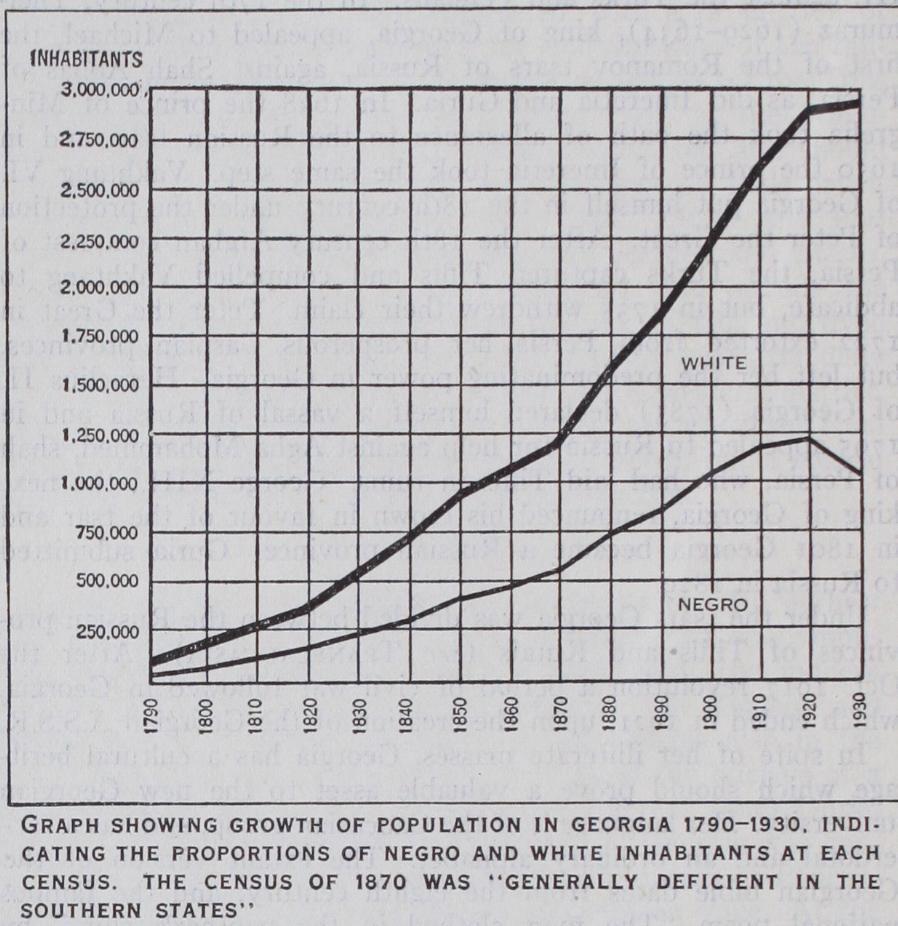
Before 1909 there was no constitutional discrimination aimed against the exercise of suffrage by the negro ; but, in fact, the negro vote had in various ways been reduced. By a constitutional amendment adopted by a large majority at a special election in Oct. 1908, new requirements for suffrage, designed primarily to exclude paupers and illiterates, especially illiterate negroes, were imposed, the amendment coming into effect on Jan. 1, 1909. As the result of a general campaign against child labour, an act was passed in 1906 providing that no child under ten years of age should be employed or allowed to labour in or about any factory, under any circumstances. This law was soon amended, raising the age and conditions of employment, and by an act of 1914 the employment of children under 14 years of age was prohibited. Factory inspectors were provided in 1916 and in 1920 an Em ployer's Liability Act, which provided for compensation for in dustrial accidents, became operative. By another act of the same year, rehabilitation of persons disabled in industry or otherwise was undertaken by the State, with Federal aid. On June 8, 1937 were ratified 26 constitutional amendments, which liberalized the powers of the legislature particularly with respect to State co-operation in the social program of the New Deal.
To encourage the consolidation of small schools, the legislature appropriated (1919) $100,000, from which the State offered to pay annually a bonus of $50o to any county which combined small schools into larger ones, and where a four year high school was provided, an additional bonus of $1,000 was authorized. This fund was later increased to $400,000. The number of con solidated schools increased from 209 in 1918 to 882 in 1926. An Illiteracy commission was established (1919) to make a study of adult illiteracy, and in 1920 local taxation for the support of schools for adult illiterates was authorized. Noteworthy progress has been made in the eradication of illiteracy, the percentage being reduced from to 9.4% during the census interval, 1920-1930. Enrolment in the public schools in 1934 was 764,865 as compared with 713,290 in 1930, and the average daily attend ance in 1934 was 589,297. Private and parochial school enrol ment fell from 14,030 in 1920 to 9,539 in 1934. The number of public school teachers in 1934 was 20,035 as against 19,071 in 1930. Expenditures for the public schools rose from a total of $18,677,000 in 1930 to a total of $19,33o,000 in 1934, but the amount per capita of enrolment declined from $26.o5 to $25.18. Teachers' annual salaries dropped from $69o(1932) to $64o(1934).
In addition to the public schools, the State also supports the University of Georgia and its numerous branches. The limiting clause of the Constitution of 1877, restricting State appropriations to elementary schools and the University of Georgia, caused all subsequently established schools to be, in law, members of the university system. The more important branches of the parent university at Athens listed in the State auditor's report for are the Georgia school of Technology (Atlanta), Georgia Nor mal and Agricultural college (coloured, Albany), Georgia South western college (Americus), Georgia State Medical college (Au gusta), West Georgia college (Carrollton), Middle Georgia col lege (Cochran), North Georgia college (Dahlonega), South Georgia State College (Douglas), State Teachers and Agricul tural college (coloured, Forsyth), Georgia Experiment station, (Griffin), Georgia State college for Women (Milledgeville), Georgia Industrial college (coloured, Savannah), South Georgia Teachers college (Statesboro), Abraham Baldwin Agricultural college (Tifton), Coastal Plain Experiment station (Tifton), Georgia State Women's college (Valdosta). Outside the State system are: Agnes Scott college (Decatur), Berry college (Mount Berry), Bessie Tift college (Forsyth), Emory university (near Atlanta), Lagrange college (Lagrange), Mercer university (Macon), Oglethorpe university (Oglethorpe), Piedmont college (Demarest), Shorter college (Rome), Wesleyan college (Macon).
The chief product is cotton, to which about one-fourth of the cultivated land was devoted in 1926. It is grown in all counties of the State except Rabun, Towns and Fannin in the extreme north ern part of the State. Georgia has at times ranked second only to Texas as a cotton producer; but in 1935 with 1,059,000 standard bales, its rank was third among the States of the Union. This crop was equalled in quantity by that of Alabama, but in value it stood slightly above the latter. Georgia's cotton and cotton seed production in 1935 was worth $73,015,000.
The principal cereals cultivated are Indian corn, wheat and oats. In 1935, the 4,619,000ac. devoted to Indian corn produced 48,500,00o bu., -valued at $29,585,000. The cultivation of wheat, formerly remunerative, declined on account of the competition of the western States. The product in 1935 was 1,56o,000bu., valued at $1,591,000. In 1935, 378,000ac. planted in oats produced 7,182,000bu. ($3,878,000). Both white and sweet potatoes are produced; the latter, in 1935, amounting to io,668,000bu., worth $7,468,000. The sugar-cane crop declined in value after 189o, and each year more of it was made into syrup. In 1935, 5,890,000 gallons of syrup were produced from a total of 38,00o acres of cane. Tobacco and peanuts have been the most remunerative of the new crops. The tobacco crop in 1935 was 69,00O,000 pounds, worth $13,033,000—more than twice the value of the crop for the preceding year. The acreage (7 79,000) devoted to peanuts in 1934 yielded a crop of 467,00o pounds, worth $14,956,800. Truck farming and the cultivation of orchard fruits have long been lucrative occupations. The Georgia peach crop of 5,891, 00o bushels in 1935 was exceeded by California only. Pecan nuts are an increasingly important crop. The gross income from all farm crops in 1935 was $133,1o0,o0o; while live stock and live stock products brought a gross income of $58,300,000. The live stock on Georgia farms, Jan. i, 1936, consisted of 24,00o horses, 331,00o mules, 1,012,000 cattle (all kinds), 34,000 sheep and lambs, 1,235,00o swine.
The forests of Georgia, next to the fields, furnish the largest amount of raw materials for manufactures. The yellow pines of the southern part of the State yielded in of turpentine and 909,407 5oolb. barrels of rosin, a product not ex ceeded by any other State. From the same source was derived most of the 476,000,00o board feet of lumber cut in The chief features of the State's industrial activity are its early beginning and steady development. As far back as 185o there were 1,522 manufacturing establishments (35 of which were cot ton-mills) in the State, whose product was valued at $7,082,o75. In 1933 there were 2,223 industries giving employment to 128,736 wage-earners with a product valued at $386,210,906. The chief product of the factories was cotton goods, which had a value in 1933 of $126,301,007. In the quantity of cotton consumed Georgia was exceeded by North Carolina and South Carolina only. This growth in cotton manufacturing is due to various causes, among them being the proximity of raw material, con venient water-power, favourable taxation and an abundance of cheap labour. Other important manufacturing industries and their products in 1933 were as follows: food products, knit goods, $14,468,155; clothing, $12,642,628; cotton-seed oil, meal, and cake, $8,962,592; fertilizer, $8,826,861; construction and repair in steam railway shops, $8,507,016; printing and publishing newspapers and periodicals, $7,756,126; lumber and other timber products, $6,950,436; non-alcoholic beverages, bags other than paper, $4,309,578; printing and pub lishing books, music, etc., $3,732,561; foundry and machine-shop products, $3,639,869; stone products, $3,367,173.
The mineral resources of Georgia are varied, but because of the absence of petroleum and coal in great quantities the total product is relatively low. In 1934 minerals were produced to the value of $6,365,000, an amount which gave Georgia the rank of 35th among the States of the Union. Stone, clay products, cement and Fuller's earth were the principal mineral products in the order of their value. Of the stone products, granite and marble are the most important. The output of the quarries in was tons of granite, valued at $1,099,196; and 48,95o tons of marble, valued at $1,404,875. Stone mountain (1,686ft.) in Dekalb county, near Atlanta, is a remarkable mass of light-coloured mus covite granite, having a circumference at its base of 7 miles. Stone mountain granite is extensively used as a building material in Georgia and other southern States. It is on the face of this mas sive piece of granite that the gigantic Confederate memorial is being sculptured. Georgia white marble, first quarried on a large scale in Pickens county in 1884, was used in the capitol buildings of Georgia, Rhode Island, Mississippi, Minnesota, in the Corcoran Art Gallery, Washington, D.C., and in other well-known buildings. Other colours than the snowy white are found in the main marble belt of the State, which runs from Canton, Cherokee county, 6om. generally north to the northern boundary of the State. The an nual marble production of Georgia is exceeded by that of Vermont only. Approximately one quarter of all the barytes produced in the United States comes from Georgia, chiefly from Bartow county. Clay products, principally brick and tile, had in a value of $1,27o,8I2. The coal-fields of Georgia are situated in the Allegheny region in Dade and Walker counties; in 1933 the value of the coal mined in the State was $77,000 (41,382 short tons). Iron ore, bauxite, gold, manganese, talc and sand and gravel are other products of commercial importance.
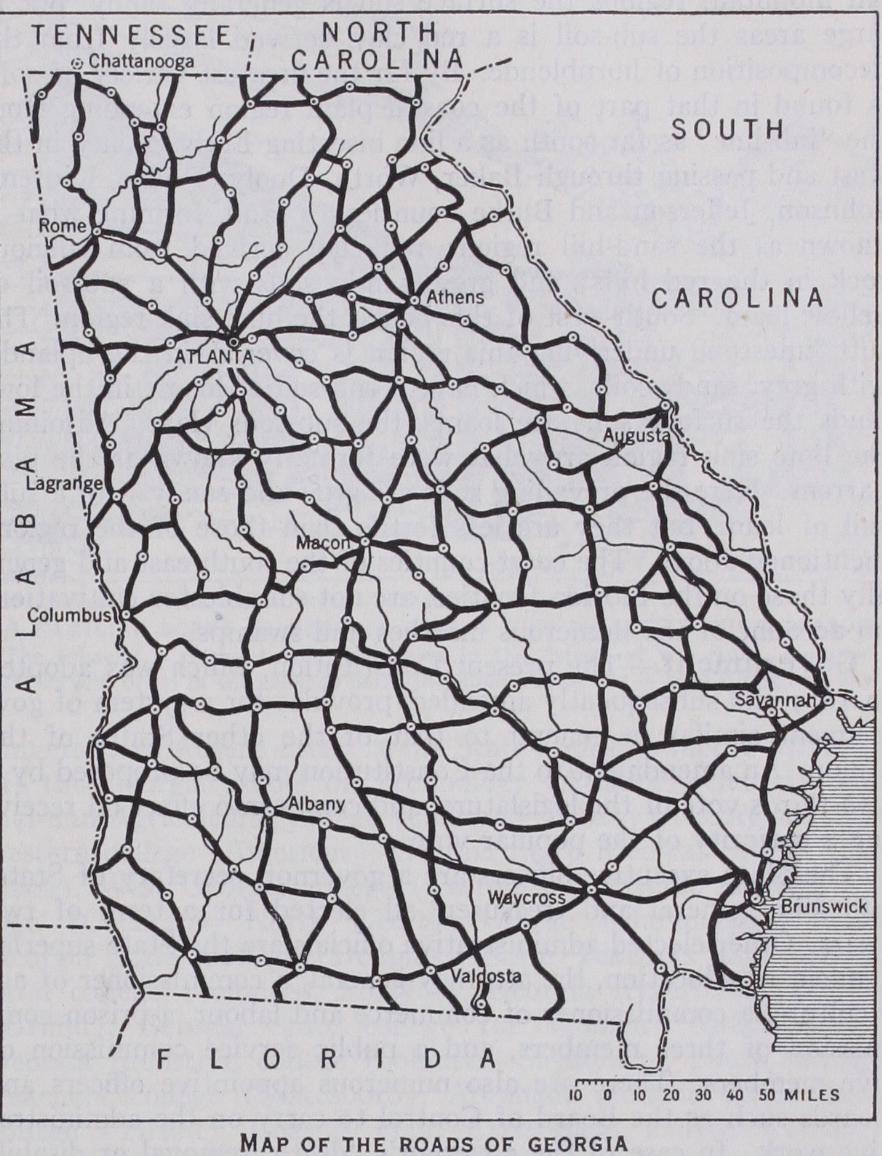
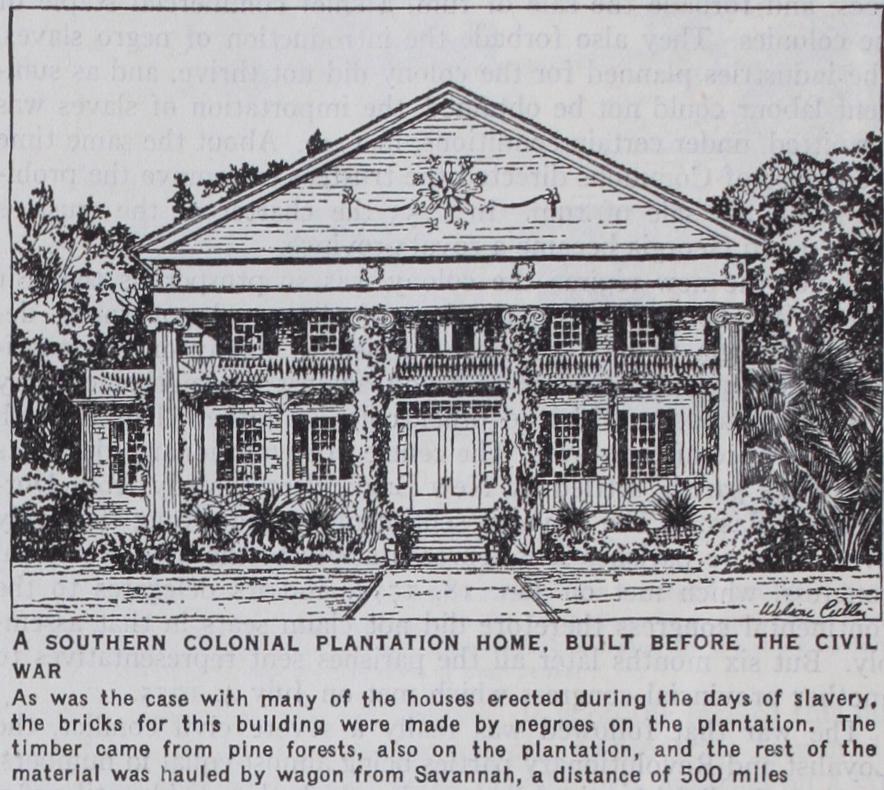
Means of transportation are furnished by the rivers, which are generally navigable for light-draught boats as far north as the "fall-line"; by ocean, steamship lines which have piers at St. Marys, Brunswick, Darien and Savannah; and chiefly by rail ways, whose mileage on Dec. 31, 1934 was 6,464, a decline from the 7,427m. in operation in 1915. The most important of the railways are the Central of Georgia, the Southern, the Atlantic Coast Line, the Seaboard Air Line, the Georgia and the Georgia Southern and Florida. In 1932 the mileage of electric railways in operation was 36o as compared with 46o in 1925. The State highway department, created in 1916 and reconstituted in 1919, had under its control on Dec. 31, 1934, 9,o31m. of roadway. The total motor vehicle registration for 1935 was History.—Georgia, the last to be established of the English colonies in America, derived its name from King George II. of Great Britain. Its formation was due to a desire of the British Government to protect South Carolina from invasion by the Span iards from Florida, and by the French from Louisiana, as well as to the desire of James Edward Oglethorpe (q.v.) to found a ref uge for the persecuted Protestant sects and the unfortunate but worthy indigent classes of England. A charter was granted in i 73 2 to "the trustees for establishing the colony of Georgia in Amer ica," and parliament gave £io,000 to the enterprise. The first settlement was made at Savannah in 1733 under the personal supervision of Oglethorpe. The early colonists were English, German Lutherans (Salzburgers), Piedmontese, Scottish High landers, Swiss, Portuguese and Jews ; but the main tide of immi gration, from Virginia and the Carolinas, did not set in until 1752. As a bulwark against the Spanish the colony was successful, but as an economic experiment it was a failure. The trustees de sired that there should be grown in the colony wine grapes, hemp, silk and medical plants, for which England was dependent upon foreign countries ; they required the settlers to plant mulberry trees, and forbade the sale of rum, a chief commercial staple of the colonies. They also forbade the introduction of negro slaves. The industries planned for the colony did not thrive, and as suffi cient labour could not be obtained, the importation of slaves was permitted, under certain conditions, in 1749. About the same time the House of Commons directed the trustees to remove the prohi bition on the sale of rum. In 1753 the charter of the trustees expired and Georgia became a royal province.
Under the new regime the colony was so prosperous that Sir James Wright (1716-85), the last of the royal governors, de clared Georgia to be "the most flourishing colony on the conti nent." The people were led to revolt against the mother country through sympathy with the other colonies rather than through any grievance of their own. The centre of revolutionary ideas was St. John's parish, settled by New Englanders (chiefly from Dor chester, Mass.). The Loyalist sentiment was so strong that only five of the 12 parishes sent representatives to the first provincial congress, which met on Jan. 18, 1775, and its delegates to the continental congress therefore did not claim seats in that assem bly. But six months later all the parishes sent representatives to another provincial congress which met on July 4, The war that followed was really a severe civil conflict, the Loyalist and Revolutionary parties being almost equal in numbers. In 1778 the British seized Savannah, which they held until 1782, meanwhile reviving the British civil administration, and in they captured Augusta and Sunbury; but after 1780 the Revolu tionary forces were generally successful. Civil affairs also fell into confusion. In 1777 a State Constitution was adopted, but harmony was not secured until 1781.
Georgia's policy in the formation of the U.S. Government was strongly national. In the Constitutional Convention of 1787 its delegates almost invariably gave their support to measures de signed to strengthen the Central Government. Georgia was the fourth State to ratify (Jan. 2, 1788), and one of the three that ratified unanimously, the Federal Constitution. But a series of conflicts between the Federal Government and the State Govern ment caused the growth of States rights theories. First of these was the friction involved in the case, before the U.S. Supreme Court, of Chisolm v. Georgia, by which the plaintiff, one Alex ander Chisolm, a citizen of South Carolina, secured judgment in 1793 against the State of Georgia (see 2 Dallas Reports, 419). In protest, Georgia resolved that any Federal marshal who should attempt to execute the court's decision would be "guilty of felony, and shall suffer death, without benefit of clergy, by being hanged." No effort was made to execute the decision, and in 1798 the 11th amendment to the Federal Constitution was adopted, taking from Federal courts all jurisdiction over any suit brought "against one of the United States by citizens of another State, or by citizens or subjects of any foreign State." The position of Congress and of the Supreme Court with refer ence to Georgia's policy in the Yazoo frauds also aroused distrust of the Federal Government. In 1795 the legislature granted, for $500,000, the territory extending from the Alabama and Coosa rivers to the Mississippi river, and between 35° and 35° N. lat. (almost all the present State of Mississippi and more than half of the present State of Alabama) to four land companies, but in the following year a new legislature rescinded the contracts, on the ground that they had been fraudulently and corruptly made. In the meantime the U.S. Senate had appointed a committee to enquire into Georgia's claim to the land in question, and as this committee pronounced that claim invalid, Congress, in 180o, es tablished a territorial government over the region. The legislature of Georgia remonstrated, but expressed a willingness to cede the land to the United States, and in 1802 the cession was ratified, it being stipulated, among other things, that the United States should pay to the State $1,250,000, and should extinguish "at their own expense, for the use of Georgia, as soon as the same can be peace ably obtained on reasonable terms," the Indian title to all lands within the State of Georgia. In 1824 the State remonstrated in vigorous terms against the dilatory manner in which the National Government was discharging its obligation, and the effect of this was that in 1825 a treaty was negotiated at Indian Springs by which nearly all the Lower Creeks agreed to exchange their remaining lands in Georgia for $5,000,000 and equal territory beyond the Mississippi. But President J. Q. Adams, learn ing that this treaty was not approved by the entire Creek nation, authorized a new one, signed at Washington in 1826, by which the Creeks kept cer tain lands west of the Chattahoochee. The Georgia Govern ment, under the leadership of Governor George M. Troup (178o— 1856), had proceeded to execute the first treaty, and the legis lature declared the second treaty illegal and unconstitutional. In reply to a communication of President Adams, early in 1827, that the United States would take strong measures to enforce its policy, Governor Troup declared that he felt it his duty to resist to the utmost any military attack which the U.S. Government should think proper to make.
There was similar conflict in the relation of the United States and Georgia with the Cherokees. In 1828 the legislature extended the jurisdiction of Georgia law to the Cherokee lands. Then President Jackson, holding that Georgia was in the right on the Indian question, informed the Cherokees that their only alterna tive to submission to Georgia was emigration. Thereupon the chiefs resorted to the U.S. Supreme Court, which in 1832 de clared that the Cherokees formed a distinct community "in which the laws of Georgia have no force," and annulled the decision of a Georgia court that had extended its jurisdiction into the Chero kee country (Worcester v. Georgia) . But the governor of Georgia declared that the decision was an attempt at usurpation which would meet with determined resistance, and President Jackson refused to enforce the decree. The president did, however, work for the removal of the Indians, which was effected in 1838. On account of these conflicts a majority of Georgians adopted the principles of the Democratic-Republican Party, and early in the 19th century the people were virtually unanimous in their polit ical ideas. Local partisanship centred in two factions; one, led by George M. Troup, which represented the interests of the aris tocratic and slave-holding communities ; the other, formed by John Clarke (1766-1832), and his father Elijah, found support among the non-slave-holders and the frontiersmen. The Troup faction, under the name of States Rights Party, endorsed the nullification policy of South Carolina, while the Clarke faction, calling itself a Union Party, opposed South Carolina's conduct, but on the grounds of expediency rather than of principle. On account, however, of its opposition to President Jackson's hostile attitude toward nullification, the Troup Party affiliated with the new Whig Party, while the Clarke Party was merged into the Democratic Party led by Jackson. The anti-slavery and national istic views of the Whig Party during the '5os caused its members in Georgia to shift to the Democratic Party.
The activity of Georgia in the controversy was important. As early as 1835 the legislature adopted a resolution which asserted the legality of slavery in the Territories, a principle adopted by Congress in the Kansas-Nebraska bill in 1854, and in 1847 ex Governor Wilson Lumpkin (1783-1870) advocated the organ ization of the Southern States to resist the aggression of the North, but his views were considered untimely by many of the party leaders. Popular opinion at first opposed the Compromise of 1850, and some politicians demanded immediate secession from the Union. Others contended that the Compromise was a great victory for the South, and in a campaign on this issue secured the election of such delegates to the State convention (at Milledgeville) of 1850, that that body adopted, on Dec. io, by a vote of 237 to 19, a series of conciliatory resolutions, since known as the "Georgia Platform." The approval in other States of the Georgia platform in preference to the Alabama platform (see ALABAMA) caused a reaction in the South against secession. The reaction was followed for a short interval by a return to approxi mately the former party alignment, but in 1854 the rank and file of the Whigs joined the American or Know-Nothing Party while most of the Whig leaders went over to the Democrats. The Know-Nothing Party was nearly destroyed by its crushing defeat in 1856 and in the next year the Democrats, by a large majority, elected for governor Joseph Emerson Brown (1821-94), who, by three successive re-elections, was continued in that office until the close of the Civil War. The Kansas question and the attitude of the North toward the decision in the Dred Scott case were arous ing the South when he was inaugurated the first time, and in his inaugural address he clearly indicated that he would favour se cession in the event of any further encroachment on the part of the North. On Nov. 7, following the election of President Lincoln, the governor, in a special message to the legislature, recommended the calling of a convention to decide the question of secession, and Alexander H. Stephens was about the only prominent politi cal leader who contended that Lincoln's election was insufficient ground for such action. On Nov. 17 the legislature passed an act directing the governor to order an election of delegates on Jan. 2, 1861, and their meeting in a convention on the 16th. On the 19th this body passed an ordinance of secession by a vote of 208 to 89. Already the 1st Regiment of Georgia Volunteers, under Col. Alexander Lawton (1818-96), had seized Ft. Pulaski at the mouth of the Savannah river, and now Governor Brown proceeded to Augusta and seized the Federal arsenal there. Toward the close of the same year, however, Federal warships blockaded Georgia's ports, and early in 1862 Federal forces captured Tybee island, Ft. Pulaski, St. Mary's, Brunswick and St. Simon island. Georgia had responded freely to the call for volunteers, but when the Confederate Congress had passed, in April 1862, the Conscript law which required all white men (except those legally exempted from service) between the ages of 18 and 35 to enter the Confed erate service, Governor Brown, in a correspondence with Presi dent Davis, offered serious objections.
In 1863 north-west Georgia was involved in the Chattanooga campaign. In the following spring Georgia was invaded from Tennessee by a Federal army under Gen. William T. Sherman ; the resistance of Gen. Joseph E. Johnston and Gen. J. B. Hood proved ineffectual; and on Sept. 1 Atlanta was taken. Then Sherman began his famous "march to the sea," from Atlanta to Savannah, which revealed the weakness of the Confederacy. In the spring of 1865, Gen. J. H. Wilson, with a body of cavalry, en tered the State from Alabama, seized Columbus and West Point on April 16, and on May 10 captured Jefferson Davis, president of the Confederacy, at Irwinville in Irwin county. In accord with President Andrew Johnson's plan for reorganizing the Southern States, a provisional governor, James Johnson, was appointed on June 17, 1865, and a State convention reformed the Constitution to meet the new conditions, rescinding the ordinance of secession, abolishing slavery and formally repudiating the State debt in curred in the prosecution of the war. A governor and legislature were elected in Nov. 1865, the legislature ratified the 13th amend ment on Dec. 9, and five days later the governor-elect was inau gurated. But both the convention and legislature incurred the sus picion and ill-will of Congress. Georgia was placed under military government, as part of the third military district, by the Recon struction Act of March 2, 1867. Under the auspices of the mili tary authorities registration of electors for a new State conven tion was begun, and 95,168 negroes and 96,333 whites were regis tered. The acceptance of the proposition to call the convention, and the election of many conscientious and intelligent delegates, were largely due to the influence of ex-Governor Brown, who was strongly convinced that the wisest course for the South was to accept quickly what Congress had offered. The convention met in Atlanta on Dec. 9, 1867, and by March 1868 had revised the Constitution to meet the requirements of the Reconstruction Acts. The Constitution was duly adopted by popular vote, and elections were held for the choice of a governor and legislature. Rufus Brown Bullock, Republican, was chosen governor, the Senate had a majority of Republicans, and in the house of repre sentatives by the close vote of 76 to 74, a Republican was elected speaker. On July 21, the 14th amendment was ratified, and as evidence of the restoration of Georgia to the Union the congress men were seated on July 25 in that year. In September of the same year the Democrats in the State legislature, being assisted by some of the white Republicans, expelled the 27 negro members and seated their defeated white contestants. In retaliation the 41st Congress excluded the State's representatives on a technicality, and, on the theory that the Government of Georgia was a pro visional organization, passed an act requiring the ratification of the 15th amendment before the admission of Georgia's senators and representatives. The War Department now concluded that the State was still subject to military authority, and placed Gen. A. H. Terry in command. With his aid and that of congressional requirements that all members of the legislature must take the test oath and none be excluded on account of colour, a Republican majority was secured for both houses, and the 15th amendment was ratified. Georgia was now finally admitted to the Union by act of Congress, July 15, 18 70.
The reconstruction period in Georgia is remarkable for its com parative moderation. The explanation lies in the fact that there were comparatively few "carpet-baggers" or adventurers in the State, and that a large number of conservative citizens, under the leadership of ex-Gov. Brown, supported the reconstruction pol icy of Congress. The election of 1871 gave the Democrats a majority in the legislature; Governor Bullock, fearing impeach ment, resigned, and at a special election James M. Smith was chosen to fill the unexpired term. After that the control of the Democrats was complete.
The recent history of Georgia has been one of social and eco nomic progress. In 1907 was passed a statewide prohibition law. Many reforms in the educational policy, additional appropriations and a constitutional amendment, adopted in 1926, providing for a fund of $3,500,000 to be expended for public school teachers' sal aries, have helped much to raise the State's educational standards. Laws seeking to protect labour in the State's growing industries are among the most notable measures adopted. To encourage further industrial development, a constitutional amendment was adopted in 1924 giving the electors of a county or municipality the power to exempt from taxation for a period of five years cer tain new industrial establishments.
Politically the State has stood firmly Democratic even in 1928. In 1932 Mr. Roosevelt's popular majority was 11 to 1, and in 1936 despite a local party rift it was nearly 8 to 1.