GERANIACEAE, in botany, a small but widely distributed family of Dicotyledons belonging to the Archichlamydeae, con taining about 65o species in II genera. It is represented in Britain by two genera, Geranium (crane's-bill) and Erodium (stork's-bill), to which belong nearly two-thirds of the total number of species. The same two genera are the only representa tives of the family in North America. The plants are mostly herbs, rarely shrubs, with generally simple glandular hairs on the stem and leaves. The opposite or alternate leaves have a pair of small stipules at the base of the stalk and a palminerved blade. The flowers, generally in a cymose inflorescence, are hermaphrodite, hypogynous, and, except in Pelargonium, regular. The parts are arranged in fives. There are five free sepals, over lapping in the bud, and, alternating with these, five free petals. In Pelargonium the flower is zygomorphic with a spurred posterior sepal and the petals differing in size or shape. In Geranium the stamens are obdiplostemonous, i.e., an outer whorl of five opposite the petals alternates with an inner whorl of five opposite the sepals ; at the base of each of the antisepalous stamens is a honey gland. In Erodium the members of the outer whorl are reduced to scale-like structures (staminodes), and in Pelargonium from two to seven only are fertile. There is no satisfactory explanation of this break in the regular alternation of successive whorls. There are five, or fewer, carpels, which unite to form an ovary with as many chambers, in each of which are one or two, rarely more, pendulous anatropous ovules, attached to the central column in such a way that the micropyle points outwards and the raphe is turned towards the placenta. The long beak-like style divides at the top into a corresponding number of slender stigmas.
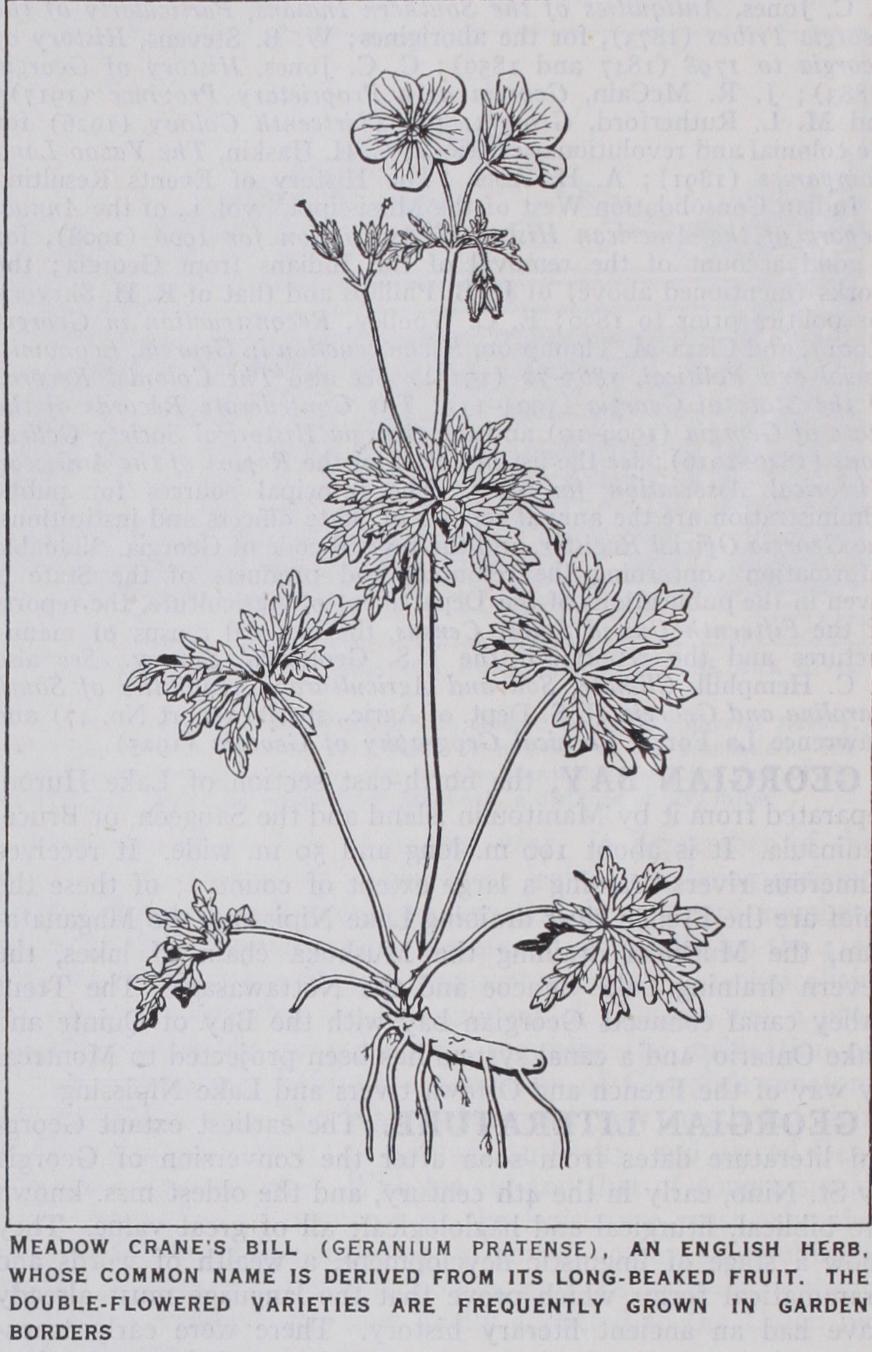
The larger-flowered species of Geranium are markedly protan drous, the outer stamens, inner stamens and stigmas becoming functional in succession. For instance, in meadow crane's-bill, G. pratense, each whorl of stamens ripens in turn, becoming erect and shedding their pollen; as the anthers wither the fila ments bend outwards, and when all the anthers have diverged the stigmas become mature and ready for pollination. By this arrangement self-pollination is prevented and cross-pollination ensured by the visits of bees which come for the honey secreted by the glands at the base of the inner stamens.
In species with smaller and less conspicuous flowers, such as G. molle, self-pollination is possible, since the divisions of the stigma begin to separate before the outer stamens have shed all their pollen ; the nearness of the stigmas to the dehiscing anthers favours self-pollination.
In the ripe fruit the carpels separate into five one-seeded portions (cocci), which break away from the central column, either rolling elastically outwards and upwards or becoming spirally twisted. In most species of Geranium the cocci split open on the inside and the seeds are shot out by the elastic uptwisting (fig. I) ; in Erodium and Pelargonium each coccus remains closed, and the long twisted upper portion separates from the central column, forming an awn, the distribution of which is favoured by the presence of bristles or hairs. The embryo generally fills the seed, and the cotyledons are rolled or folded on each other.
Geranium is the most widely distributed genus ; it has 300 species and is spread over all temperate regions with a few species in the tropics. Three British species—G. sylvaticum, G. pratense and G. Robertianum (herb-Robert)—reach the arctic zone, while G. patagonicum and G. magellanicum are found in the antarctic. Erodium contains 65 species (two are British), most of which are confined to the Mediterranean region and west Asia, though others occur in America, in South Africa and West Australia. Geranium is represented in eastern United States by II species, 7 of which are introduced. In this region Erodium is represented only by two species introduced from Europe. In the western United States there are 5 species of Geranium, and Erodium is represented by one native species which extends throughout the whole region west of the Rocky Mountains, where it is known as "pin-clover" and "pin-grass." Pelargonium, with 25o species, has its centre in South Africa; the well-known garden and green house "geraniums" are species of Pelargonium (see GERANIUM).