
GETHSEMANE (i.e., "oil-press"), the place to which Jesus withdrew with his disciples on the eve of the Crucifixion. The Greek terms used of it in the Gospels suggest that it was an en closed piece of ground. There was probably a house on it and pre sumably an oil-press. It lay east of Kidron and was a part of the Mount of Olives. The traditional site was secured by the Fran ciscans (168i), enclosed by them (1848), and laid out as an European flower garden. The "garden" of Christ's time was an orchard. The "Grotto of the Agony" was marked from the 4th century by a sanctuary which was later destroyed. Another church was erected on the site in the r 2th century. In 1920 when the church was being rebuilt on the site of the 12th century building, the floor of the 4th century basilica was laid bare, disclosing a dif ferent orientation. Plans were altered and re-erection proceeded on the site and along the lines of the primitive church. The Greeks have a garden called Gethsemane distinct from the Latins.
See J. M. Gibson, "The Gethsemane of the Fourth Gospel," Expos. Times, 3o (1918-19) , 76 seq.; B. Meistermann, Gethsemani; notices historiques et descriptives (192o) ; ib., New Guide to the Holy Land (1923) 223 seq.; G. Orfali, Gethsemani au notice sur l'Eglise de l'Ago nie . . . d'apres les fouilles recentes . . . 1909 et 1920 (1924) .
(E. Ro.) GETTYSBURG, a borough of southern Pennsylvania, U.S.A., 35m. S.W. of Harrisburg; the county-seat of Adams county. It is on Federal highways 15, 3o (the Lincoln) and 14o; and is served by the Reading and the Western Maryland railways. The population in 1920 was 4,439; it was 5,584. It lies in a valley 12m. wide, at an altitude of 52oft., surrounded by beautiful rolling country and fertile farmlands. In the national cemetery which was laid out soon after the Battle of Gettysburg (q.v.) are the graves of 3,747 Union soldiers; and the spot where Lincoln, at the dedication in November 1863, delivered his memorable "Gettysburg Address" is marked by a monument. The battlefield (25,000 acres) has been since 1895 a National Park. The lines of the battle have been laid out; miles of rifle pits and scores of lunettes have been preserved ; and details of the battle are com memorated by hundreds of monuments, markers and tablets. Five steel observatories provide views of the entire area. Gettys burg was settled about 174o, became the county-seat in 1800, and was incorporated as a borough in 18o6.
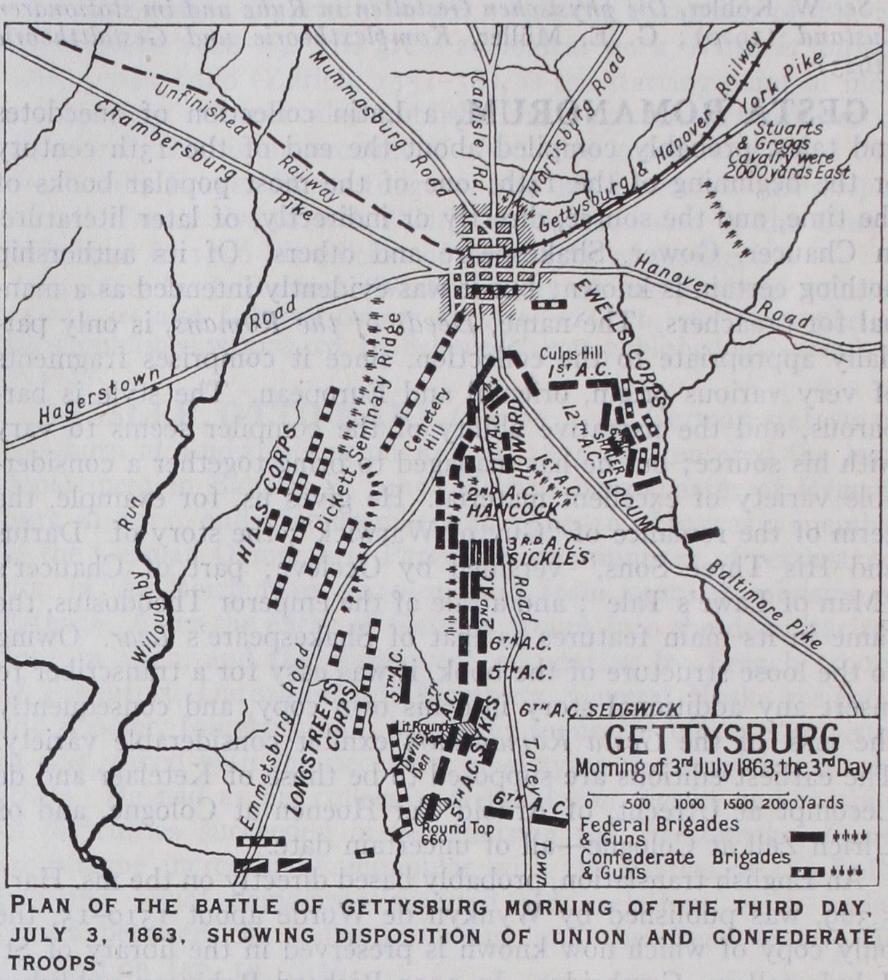
Owing, however, to misunderstandings between Lee and Long street (q.v.), the Confederates did not attack early on the morn ing of the 2nd, so that Meade's army had plenty of time to make its dispositions. The Federal line at this time occupied the horse shoe ridge, the right of which was formed by Culp's Hill, and the centre by Cemetery Hill, from which point the left wing stretched southward, the 3rd Corps on the extreme left, however, being thrown forward considerably. The 12th held Culp's, the remnant of the ist and 11th Cemetery Hill. On the left was the 2nd, and in its advanced position—the famous "salient"—which was occu pied contrary to Meade's orders, the 3rd, soon to be supported by the 5th ; the 6th, with the reserve artillery, formed the general reserve. It was late in the day when the Confederate attack was made, and valuable time had been lost, but Longstreet's troops advanced with great spirit. The 3rd Corps salient was the scene of desperate fighting; and the "Peach Orchard" and the "Devil's Den" became as famous as the "Bloody Angle" of Spottsylvania or the "Hornets' Nest" of Shiloh. While the Confederate attack was developing, the important positions of Round Top were un occupied by the defenders—owing to the 3rd Corps having taken• up its unduly advanced position. This omission was repaired only in the nick of time. The danger was perceived by the command ing engineer of the army, Gen. G. K. Warren, who at once sent word of it. Happily, even before his message could take effect, Vincent's brigade (of the 5th Corps) had marched up on its commander's initiative. The attack of a Confederate division on Little Round Top was, after a hard struggle, repulsed. The 3rd Corps in the meantime furiously attacked by troops of Hill's and Longstreet's corps, was steadily pressed back, and the Con federates actually penetrated the main line of the defenders, though for want of support Wright's brigade (Hill's corps) which achieved this was quickly driven out. Ewell on the Confederate left waited for the sound of Longstreet's guns, and thus no attack was made by him until late in the day. Here Culp's Hill was carried with ease by one of Ewell's divisions, most of the Federal 12th Corps having been withdrawn to aid in the fight on the other wing; but Early's division was repulsed in its efforts to storm Cemetery Hill, and the two divisions of the centre (one of Hill's, one of Ewell's corps) remained inactive.
That no decisive success had been obtained by Lee was clear to all, but Ewell's men on Culp's Hill, and Longstreet's corps below Round Top, threatened to turn both flanks of the Federal position, which was no longer a compact horseshoe but had been considerably prolonged, to the left ; and many of the units in the Federal army had been severely handled in the two days' fighting. Meade, however, after discussing the eventuality of a retreat with his corps commanders, made up his mind to hold his ground. Lee now decided to alter his tactics. The broken ground near Round Top offered so many obstacles that he decided not to press Longstreet's attack further. Ewell was to resume his attack on Meade's extreme right, while the decisive blow was to be given in the centre (between Cemetery Hill and Trostle's) by an assault delivered in a pseudo-Napoleonic manner —Napoleon would scarcely have launched his characteristic de cisive thrust with one fresh division against an "unstretched" line and strong front—by the fresh troops of Pickett's division, which belonged to the corps of Longstreet, who was put in charge of the central attack. Meade, however, was not disposed to resign Culp's Hill, and with it the command of the Federal line of re treat to Ewell, and at early dawn on the 3rd a division of the I2th Corps, well supported by artillery, opened the Federal counter-attack; the Confederates made a strenuous resistance, but after four hours' hard fighting the other division of the I 2th Corps and a brigade of the 6th, intervened with decisive effect, and the Confederates were driven off the hill. The defeat of Ewell did not, however, cause Lee to alter his plans. Pickett's division was to lead in the great assault, supported by the part of Hill's corps that had not already been engaged. Col. E. P. Alexander, Longstreet's chief of artillery, formed up one long line of 75 guns, and 65 guns of Hill's corps came into action on his left. To the converging fire of these 140 guns the Federals, cramped for space, could oppose only seventy-seven. The attack ing troops formed up before 9 A.M., yet it was long before Long street could bring himself to order the advance, upon which so much depended, and it was not till about I P.M. that the guns at last opened fire to prepare the grand attack. The Federal artillery promptly replied, but after 3o minutes' cannonade its commander, Gen. H. J. Hunt, ordered his batteries to cease fire in order to reserve their ammunition to meet the infantry attack. Ten minutes later, in response to an appeal from Alexander, Pickett asked and received permission to advance, and the infantry moved forward to cross the I, 20o–I,400yds. which separated them from the Federal line. Their own artillery was short of ammunition— hence Alexander's appeal; the projectiles of that day were not sufficiently effective to cover the advance at long ranges, and thus the Confederates, as they came closer to the enemy, met a tremendous fire of unshaken infantry and artillery.
The charge of Pickett's division is one of the most famous episodes of military history. In the teeth of an appalling fire from the rifles of the defending infantry, who were well sheltered, and from the guns which Hunt had reserved for the crisis, the Virginian regiments pressed on, and with a final effort broke Meade's first line. But the strain was too great for the support ing brigades, and Pickett's men were left without assistance. Han cock made a fierce counter-stroke, and the remnant of the Con federates retreated. Of Pickett's own division over three-quarters, 3,393 officers and men out of 4,500, were left on the field, two of his three brigadiers were killed and the third wounded, and of 15 regimental commanders ten were killed and five wounded. One regiment lost 9o% of its numbers. The failure of this assault practically ended the battle ; but Lee's line was so formidable that Meade did not in his turn send forward the army of the Potomac—a reluctance for which he has been severely criticized.
By the morning of July 5, Lee's army was in full retreat for Vir ginia. He had lost about 30,00o men in killed, wounded and miss ing out of a total force of perhaps 75,00o. Meade's losses were over 23,00o out of about 82,00o on the field. The main body of the cavalry on both sides was absent from the field, but a de termined cavalry action was fought on July 3 between the Con federate cavalry under J. E. B. Stuart and that of the Federals under D. McM. Gregg some miles east of the battlefield, and other Federal cavalry made a dashing charge in the broken ground south-west of Round Top on the third day, inflicting thereby, though at great loss to themselves, a temporary check on the right wing of Longstreet's infantry.
See "Petersburg, Chancellorsville, Gettysburg," Mil. Hist. Soc. of Mass. Papers, vol. v. (Boston, 1906) ; Abner Doubleday, -Chancellors ville and Gettysburg (1908) ; P. H. Dalbiac, The American War of Secession (191I) ; and Walter Clark, North Carolina at Gettysburg (192I).