
ARCHITECTURE, r8th and Igth Centuries) resulted from the fact that the revivalists took the form for the substance and forgot the essential Gothic qualities of growth, freedom and sincerity. It is the freedom of the Gothic spirit that has enabled it to be widely applied. Particularly in its later phases it was fecund in developing secular types. Town halls, city houses, barns, court houses, manors, hospitals, castles in all the countries of Europe bear witness to this vitality. Wherever the problem demands free composition, the grouping of many windows into one large element, high roofs or an emphasis on verticality, the Gothic style can furnish inspiration. It is thus much used in modern educational work and occasionally, in America, in high commer cial buildings. Historical Gothic architecture is, however, a style requiring rich carved ornament and sculpture, and the effect of mediaeval Gothic buildings is largely dependent upon exquisite ness of craftsmanship and that variety and personality in details which can only be produced by masons who are artists as well. For this reason it is, under modern conditions, a style extremely expensive in any but a much modified form, and as the mechan ization of the building trades progresses, it is more and more a style out of harmony with the loth century.
On the continent of Europe the last half of the r 2th century was everywhere a time of cultural rebirth. The dry hand of scholasticism was slowly lifting from contemporary thought. Feudalism was beginning to yield before the growth of towns and the gradual birth of a national feeling non-feudal in spirit. In the ecclesiastical world the dominance of feudal monasteries was passing and the importance of bishops and the secular clergy growing apace. Most important of all, a more settled civilization allowed and encouraged the secularization of culture. It is nificant that from this time on the designers, sculptors and masons at work on the great churches were increasingly laymen.
The pointed arch was a form well known in many of the Romanesque styles and especially common in the domed churches of Aquitania. Its application to the design of ribbed vaults was epoch making. In the oblong nave bay, by building the diagonal ribs as semi-circles, and pointing the shorter cross and wall ribs, the apexes could be brought to approximately the same level. Moreover, the pointed arch is, in essence, two sections of a. circular arch, each half of which is rigid and structurally safe if its ends are properly abutted. Thus in the ambulatory vault, not only could the arches be more or less pointed to regu late their height, but also the groin ribs, rising from the four supports of the wedge-shaped radiating bay could be built inde pendently and brought together to any desired point near the centre. This enabled the ridges of the ambulatory vault not only to be kept almost level, but also to follow graceful and simple lines, without the queer distortions produced by the round arches.
The problem of abutting the thrust of nave vaults still re mained. Its solution was the flying buttress by which the thrust of the vault was carried over the side aisles with struts formed of half arches to heavy buttress masses built upon the outside of the side aisles (see BUTTRESS). Elementary approximations of the flying buttress idea are found in certain Romanesque churches in Normandy such as the Abbaye aux Dames, Caen, c. I14o (date much questioned, perhaps earlier). But the accept ance of this form and its structural and decorative development was a distinctly Gothic movement.
The adoption of the pointed arch for structural purposes led almost immediately to its use as the controlling arch form. The 20 years from I 14o to I i6o saw the beginning of many French cathedrals in the design of which the pointed arch dominates, although round arches still spasmodically occurred, and by the last quarter of the century its use was common in England.
Ornament.—A change in carved ornament accompanied this change in structural forms. The dying Romanesque traditions were being replaced by a growing naturalism. Occasionally the designers turned direct to ancient Roman forms for inspiration, but this tentative attempt yielded to the universal use of natural istic plant forms. The grotesque feeling of Romanesque work almost completely disappeared and was replaced by works of a fantastic imagination in which there is little trace of the earlier neurotic cruelty. A fresh and spring-like spirit shows in the ornament of the early Gothic period like the spirit of small leaves just broken from the bud, which are its favourite forms ; the crocket (q.v.) form with its uncurling, vivid movement became common on capitals and corbels.
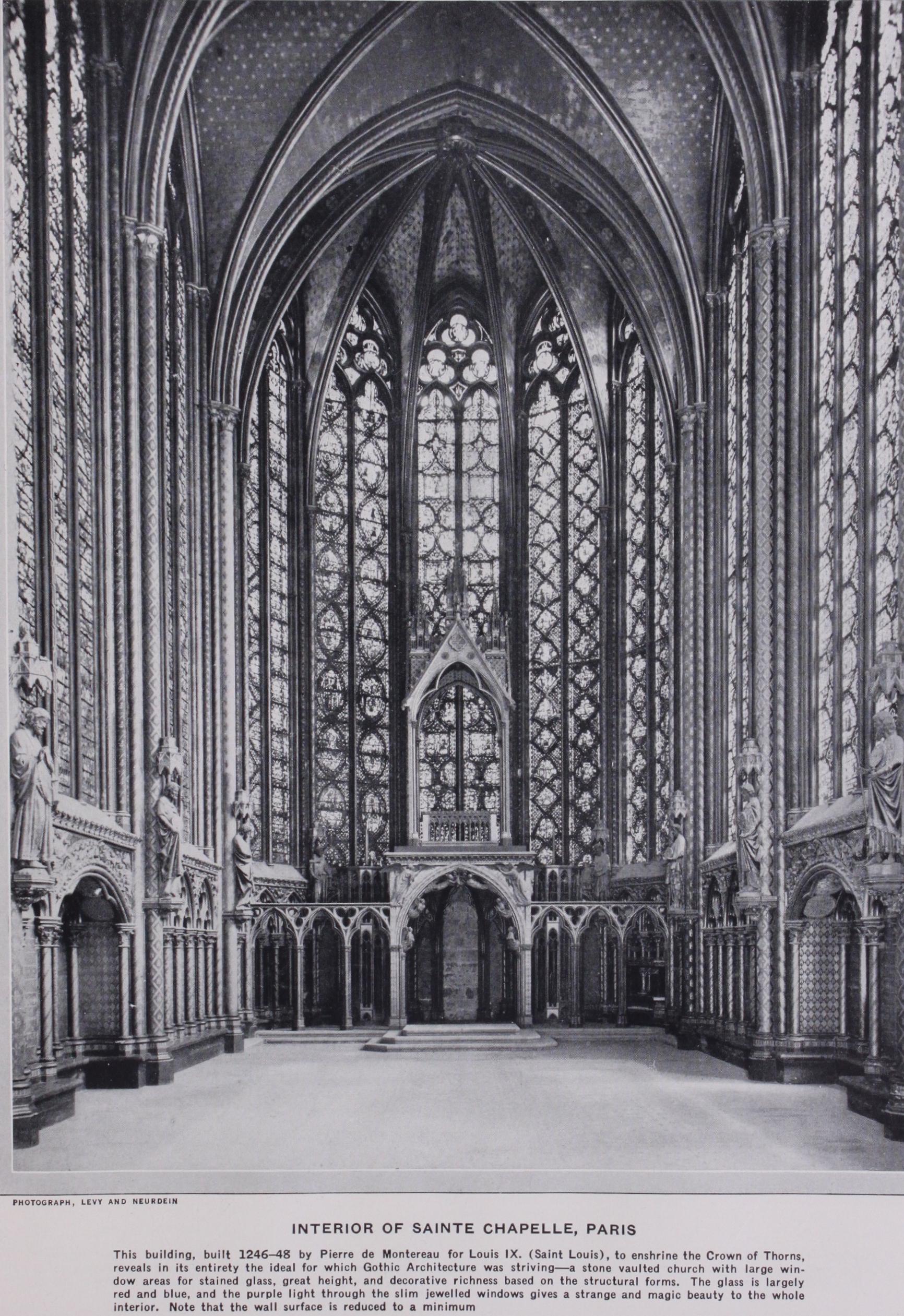
Towards the beginning of the 13th century another element of great importance was introduced. Romanesque architecture had made common use of double or triple arches under a single en closing arch ; it had occasionally used the cusp (pointed inter section between two curves). When the space between the outer enclosing arch and the smaller paired arches below is pierced, elementary tracery (q.v.) results. The earlier forms, known as plate tracery, consist merely of the piercing of such an area by many large and small holes which usually approximate a circle • in form and are often cusped. Such openings could be glazed as well as the arched openings below them. The clerestory win dows of Chartres cathedral (between 1194 and 1 2 1 2) show the richness possible by the use of such plate tracery. From work like this it is but a small step to bar tracery, in which the openings are not pierced in a section of a wall or a slab, but are bounded by thin bars of atone separating them. As the desire for large areas of stained glass increased, the size and complexity of windows with bar tracery increased as well; wall surfaces tended to become smaller and vaults higher, until the church approxi • mated a cage.
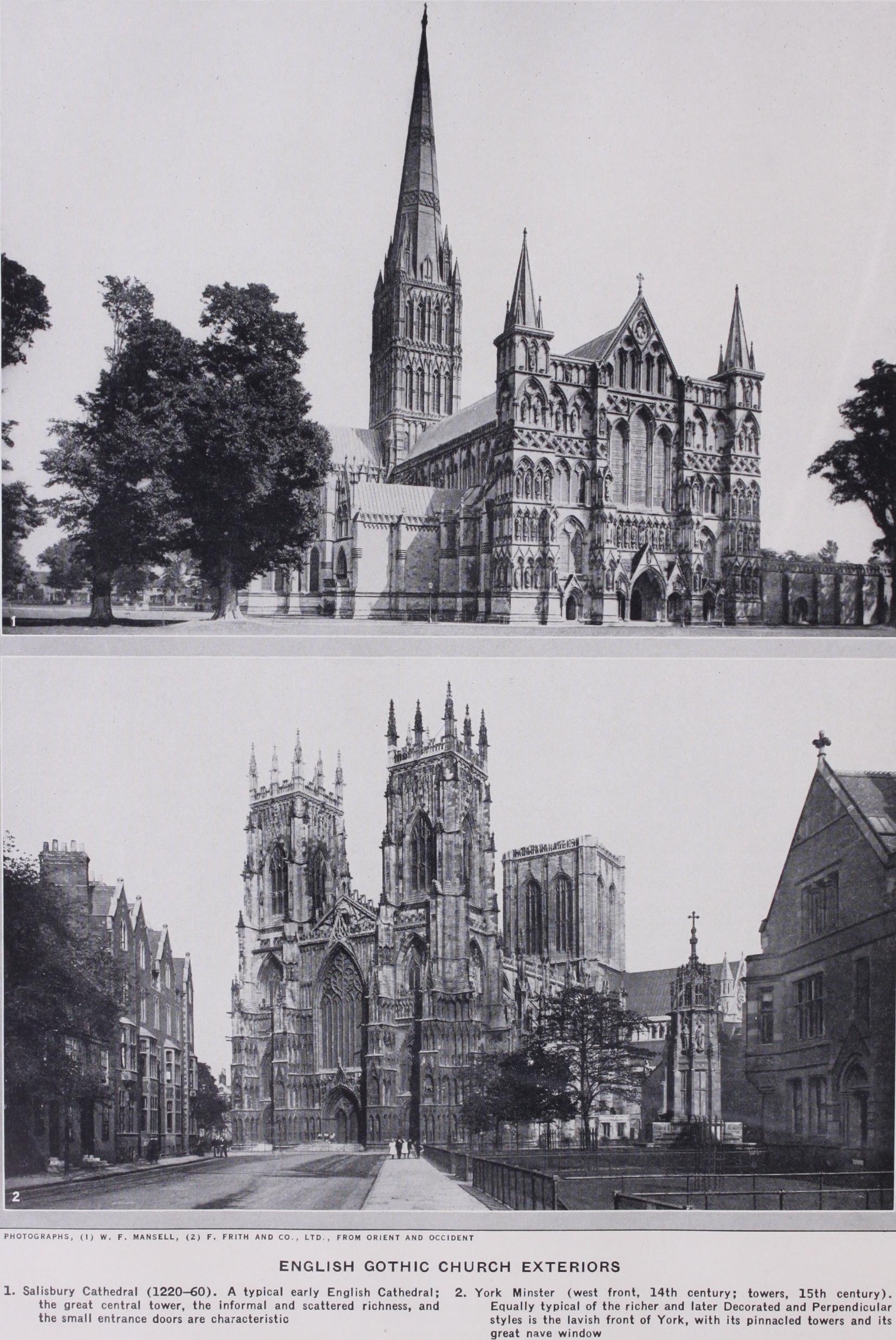
From this point, Gothic development was towards a greater freedom in the combination of these elements. Perfect technical mastery having been obtained, experimentation in the details was universal. Complexity of geometrical form, rectangularity, flow ing curves of reverse curvature, elaboration of cusping, all ap peared, and in the late Gothic there was a continual see-saw between a love of lavish and over-luxurious ornament and a tendency towards the elimination of superfluous ornament and unnecessary wall. Even though thus striving after conflicting ideals, the style retained its vitality late into the I sth century and into the 16th also, and outside of Italy profoundly affected the early Renaissance architecture that gradually succeeded it.