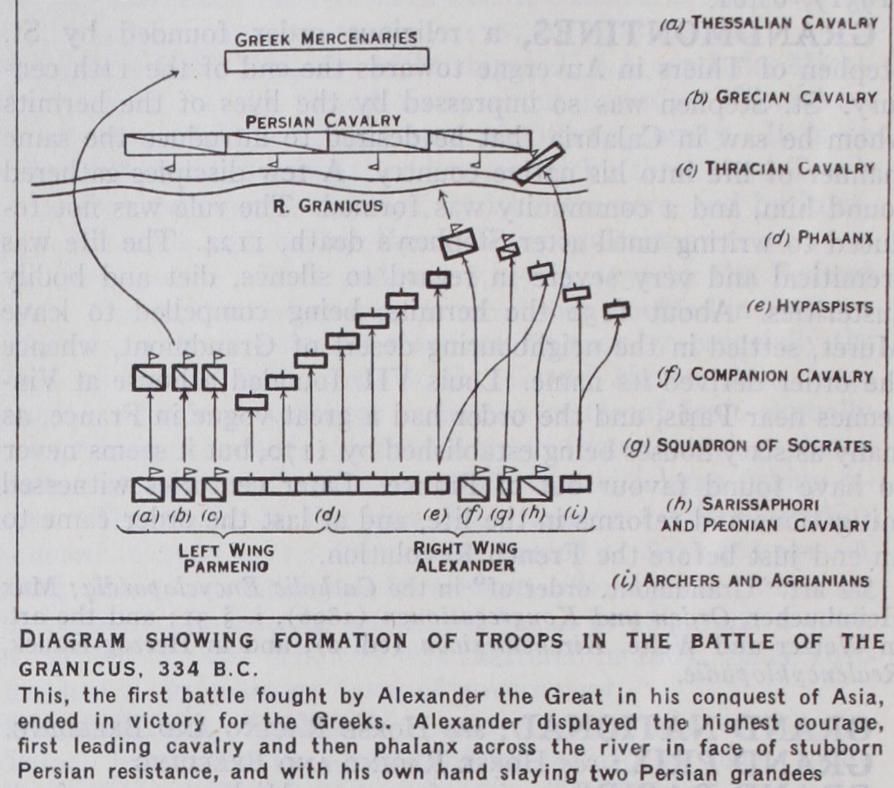
GRANICUS, BATTLE OF THE 334 B.c.). In the spring of 334 Alexander, having by various campaigns estab lished a secure base of operations in Greece, set sail from Sestos to Abydos to carry out the invasion of Persia. His army con sisted of about 30,00o foot and 5,00o horse, and it was accom panied by a siege train, a baggage train and a corps of engineers. Having visited Ilium to crown the tomb of his traditional ancestor Achilles, he moved northwards through Lampsacus and came upon the Persian army on the river Granicus (Bigha-Chai), an army which, according to Arrian, numbered 20,000 Persian cav alry and 20,000 Greek mercenaries under Memnon. Memnon, an able general, had suggested to Arsites and Spithridates, who were in joint command, that they should retire and lay waste the coun try, and then land an army in Macedonia and attack Alexander's base. This they refused to do, and in place drew up their cavalry on the northern bank of the river with Memnon's infantry in rear. Alexander, seeing this faulty distribution, determined on im mediate attack, and deployed his army as shown in the diagram. From the accounts of this battle as given by the classical his torians, it is obvious that Alexander's intention was to refuse his left wing, pivot his right wing on the phalanx, and rapidly moving this wing forward concentrate his main blow against the Persian left. In brief the action was as follows:— The Battle.—The battle opened by a charge on the Persian left by the right wing light cavalry, who, after a severe engage ment, were driven back. Under cover of this attack Alexander advanced at the head of the Companion cavalry and charged the left centre of the Persian horse, for it was here that their leaders had posted themselves. Little by little the Persians were pushed back until their left centre broke, whereupon both wings dis persed in flight. Alexander did not pursue them far, instead, he turned on the Greek mercenaries, and as Arrian says : "leading the phalanx against these, and ordering the cavalry to fall upon them from all sides," he soon completely surrounded them and cut them up. According to Diodorus, the Persians lost 12,000 in killed, and 20,000 were made prisoners. Alexander is said to have lost less than 1 5o killed; this figure is probably an understatement.