
DEFENCE: NAVY Historical.—For over i,000 years the Navy of Britain has written the history of a small island people who have developed, by virtue of their power upon the sea, into the senior partner of a great Empire. Details of the British Fleet of to-day are available in text books, but to obtain a true understanding of its traditions, its purpose and its strength, one must glance back through the chief historical events of the past ten centuries. The earliest sea fights in which English ships took part were fought in the years A.D. 833 and A.D. 84o, during the reigns of Ecgbert and Ethelwulf, the first kings of England. The invasions of the Norsemen forced the English people to defend themselves by some form of national organization and each shire was called upon to provide ships in proportion to its size and wealth. These ships were inferior to those of the vikings who held the upper hand until Alfred the Great (A.D. 8 71-90 i ), with his powerful newly built fleet, defeated them in A.D. 878. Alfred's ships, which were the first "King's Ships," were swifter, steadier and higher out of the water than those of the Norsemen and some had as many as sixty oars. The same means of providing a navy was employed by Alfred's suc cessors, that is a few ships which were the private property of the king were reinforced by the ships of the shires, and later by a feudal contribution from certain privileged coastal towns.
The number of the king's ships varied from time to time. In 1205, King John maintained a fleet of 5o galleys or "long ships" in various ports and William of Wrotham, Dean of Taunton, was appointed "keeper of the king's ships," the first record of any form of central administration of naval affairs. During the time of the Crusades in the i 2th and i3th centuries, the fighting ships, built solely for battle, still retained the form of the long, narrow, swift galley propelled by oars alone: or if rigged with a mast and sail these were removed before going into action. The larger and clumsier merchant ships of this period had a permanent mast and square sail and relied upon oars as a secondary means of propul sion. When prepared for war these ships were fitted with built up castles at each end from which missiles could be thrown into any ship alongside. In time the ships became rounder in shape with built-in fighting castles, and relied almost entirely upon an ele mentary form of sail, with only one mast. By the beginning of the reign of Edward III. (13 2 7) the fighting galley had almost disappeared from the English fleet, and the ships which defeated the French at Sluys in 134o and the Spaniards off Winchelsea ten years later were sailing ships only.
Gunpowder was invented in the beginning of the 14th century but it was not until the end of the century that guns began to be used afloat, and the first record of an English ship carrying guns is in a ship called the "Christopher of the Tower" in 1410. The guns were very small, designed as mankillers rather than to damage the structure of the ships, and they were mounted in embrasures in the forward and after castles. The necessity of carrying many guns led to an increase in the size of warships and some of the ships built by Henry V. were of nearly i,000 tons.
In spite of the troublous times of the Wars of the Roses, the English fleet maintained the command of the Narrow Seas and slow but steady progress was made in the construction and rig of the ships. By the end of the reign of Edward IV. (1461-83) the English ships had developed to the standard of those of the Mediterranean powers. They carried three to four masts and a bowsprit and set as many as six sails, but the hulls, though larger and better built, did not differ in shape from the ships of a century earlier.
Henry VIII. formed the first central navy office for the ad ministration of the fleet. His navy board, constituted by letters patent on April 24, 1546, consisted of a lieutenant of the ad miralty, a treasurer, a comptroller, a surveyor, a clerk of the ships and other minor officials. The Board was charged with the building and the upkeep of the ships and with the supply of stores, victuals and pay. The Lord High Admiral (or later the commissioners for executing that office) had complete political and military control over the fleet and issued commissions to its officers, but exercised only a nominal control over the navy board. This dual system of government of the navy remained in force, with the addition of various departments, until after. the close of the Napoleonic Wars. The records of the time are in complete, but as far as can be ascertained, the navy at the end of the reign of Henry VIII. consisted of 53 ships of a total of 11,270 tons, armed with 2,185 guns and manned by 3,00o men, more than half of whom were soldiers.
Two notable advances in organisation of the personnel marked this period. In 1582 a graduated scale of pay for officers and men was, for the first time, introduced and a fund was started for the relief of sick and wounded seamen. All men employed in the navy were subject to a small deduction from their pay which was paid into the famous "Chatham Chest." This fund was administered by the commissioner of Chatham dockyard and by four other commissioners elected by the seamen.
The Cadiz Expedition postponed the threatened Spanish Inva sion of England for a year and in 1588 the Great Armada sailed. It was composed, chiefly, of merchant ships which carried few if any guns. The Spanish ships were short, had tremendous free board and were probably little improvement upon Henry VII.'s "Regent" of 1 oo years before. The English fleet consisted of 34 "queen's ships" and a number of merchant ships, large and small, all more modern than the Spaniards. The superior speed and handiness of the English ships enabled them to choose their own range for their heavy guns and the Great Armada was severely handled during its disastrous week of sailing up Channel. Forced by fireships to move in panic, whilst at anchor off Gravelines the Spaniards were driven into the North Sea by a southwesterly gale. Unable to join the army of the Duke of Parma in the Netherlands, the Armada was chased by the English until their ammunition was exhausted ; scattered by wild weather in the northern seas, only a remnant returned to Spain to tell the sorry tale. During the last fifteen years of Elizabeth's reign the English fleet was uniformly successful and when she died her navy con sisted of 42 ships of 17,00o tons, manned by 8,000 men, more than three-quarters of whom were seamen.
At the death of Queen Anne, the material strength of the navy was 247 ships of 170,000 tons, manned by officers inured by ten years of successful war. The beginning of the Georgian era brought success to the country, but the navy was starved and im poverished. The personnel was neglected, the design of ships became careless and ships in the dockyards were poorly main tained. Parliament reduced the expenditure upon the navy to less than one half, at a time when English responsibilities were increas ing all over the world and the service suffered in all departments from the political corruption of the times.
In the few years of peace that followed Lord Anson continued his regeneration of the navy. The Naval Discipline Act was re vised and remained unaltered for over a hundred years. Many reforms were introduced, including the formation of the corps of Royal Marines in 1755. The navy office was compelled, for the first time to render accounts to the Admiralty, the dockyards were brought into a state of order and some, at least, of the rampant peculation was stamped out. Amongst the many improvements made in the design and fitting out of ships was the adoption of the practice of coppering the bottoms of the ships, which had a marked effect upon their speed and sea keeping qualities.
The peace proved to be but a breathing space and when Napoleon declared war in 1803, the British fleet at once assumed a dominant position at sea. Napoleon's vast preparations for invading England failed through lack of command of the sea. Wherever a French and later a Spanish fleet was in port, a British force waited patiently outside. Cornwallis commanded in the Channel, keeping a close watch upon Brest and Rochefort, Lord Keith guarded the Downs, Sir Robert Calder and Sir John Orde were stationed off Ferrol and Cadiz. In the Mediterranean, Nelson, with only eleven ships of the line, lacking in frigates and with no base to fall back upon, maintained for two years a watch upon Toulon and Cartagena. In these two years many single ship actions were fought the world over, but no clash between the main fleets took place until late in 1805. Then, at last, the French and Spanish fleets put to sea. Evading Nelson in a gale of wind, Villeneuve was chased to the West Indies and back to fight an indecisive action with Calder off Finisterre. The French fleet retired into Cadiz and the combined fleet put to sea in October and met Nelson and its fate off Cape Trafalgar. Once again a British victory at sea removed the terror of a French invasion, and although the war with France lasted for ten more years, the French fleet did not again dare to encounter the British navy.
The strength of the British fleet in 1914 is shown in the following table, with, for comparison, the other important fleets of the world at the time.
By the middle of 1914 the British fleet was at the highest state of power and efficiency that it had ever attained in its long his tory. The ships were all that the scientific knowledge of the time could make them, the administration was sound and highly efficient, the dockyards were in first class order and nothing was lacking to equip the fleet. More important still, the long service personnel, officers and men, were incomparable and had been trained in the belief that a great war was coming in their time. The high command at sea was in the hands of a band of great seamen who, when the test came, proved their worth. Under them, in 1914, the British navy calmly faced the uncertainties of the titanic struggle before it, and for its performance therein refer .ence must be made elsewhere (see WORLD WAR, NAVAL).
At the in November 1918, there were more than 1,3 5o vessels flying the white ensign, manned by 407,000 officers and men. Of this great number of ships 42 were battleships and battle cruisers, 786 were cruisers, destroyers, submarines and other small fighting craft and the remainder were trawlers, minesweepers and other auxiliary craft. With the coming of peace retrenchment became inevitable and in the first place, the building programme was rigidly curtailed. At the time there were 211 ships under construction : the building of 86, including 3 battle cruisers, 44 destroyers and 33 submarines was immediately abandoned. A great reduction in personnel resulted from the return to civil life of those who had served through the war in the naval auxiliary forces and by 192o the numbers of officers and men had been re duced to 176,00o and the ships in commission to 332. In 1921 by the Washington Treaty (q.v.) the Great Powers agreed to limit the numbers and size of capital ships and aircraft carriers and to restrict the size of cruisers to i o,000 tons and their guns to 8 inches. Under this Agreement, Great Britain sent no fewer than 20 modern capital ships to the shipbreakers' yards and there followed a reduction in the permanent personnel. A drastic scheme of retirement of officers and of elimination amongst the older men of the lower deck brought the total personnel down to 107,800 in 1923 and to 99,00o by the end of 1924. Since then the numbers have risen gradually to a peace complement of 103,000 officers and men.
The armistice did not immediately bring the warlike activities of the navy to an end. The minefields around the coast had to be swept clear and this hazardous task was accomplished, in the half year following the armistice, by a flotilla of over 700 vessels manned, chiefly, by British fishermen. Until the end of 192o the navy was engaged in the Baltic, the White Sea and in the Black Sea in supporting the unsuccessful opponents of Bolshevik Russia. In 1922, the presence of a strong British fleet at Constantinople facilitated the prolonged peace negotiations with Turkey and in other parts of Europe the presence of British warships had a pacifying and stabilizing effect.
Meanwhile seven cruiser squadrons have been formed for service in different parts of the world. One squadron is attached to the Atlantic fleet, two to the Mediterranean ; one is stationed at the Cape, one in the West Indies, one in the East Indies and one in China, where there are also two flotillas of river gunboats for duty on the Yangtse and Canton rivers and destroyer and sub marine flotillas. This organization permits of early reinforcement in any part of the world, as was demonstrated in 1927, when trouble broke out in China, and a cruiser squadron, a destroyer flotilla and an aircraft carrier were sent from the Mediterranean to strengthen the China Squadron. Upon each foreign station a number of small sloops are maintained to supplement the work of the cruisers in policing the trade routes and visiting the out lying parts of the empire.
After the armistice until the end of 1922, the construction of British warships practically ceased, work being confined to the leisurely completion of vessels that were too far advanced to be abandoned. No new ships were laid down, though the building of four improved "Hood's" was contemplated in 1921. These four ships were abandoned as the result of the Washington Treaty which left Great Britain with only one ship of post-Jutland design. The United States had three and Japan two, and in order to equalise the quota in this type, Great Britain laid down the two battleships "Nelson" and "Rodney" in 1922. These two ships, which conform to the agreed limitations of the Treaty, joined the fleet at the end of 1927 and the four "King George V." class battleships were broken up in their stead.
After the war Great Britain twice expressed her willingness to abolish the submarine as a naval weapon of war. Other nations could not agree to this, but for six years after the armistice, British submarine construction was confined to the completion of vessels already in hand and to experimental work. Only one submarine was completed in this period, the large ocean going submarine "XI." In 1925, with the laying down of the new "0" class, a submarine replacement programme was put in hand.
The British Army and Navy at the beginning of the World War in Aug. 1914 had separate administrative organizations for their air services which were the Royal Flying Corps and the Royal Air Service respectively. These were amalgamated early in 1918 and the Air Ministry was formed. It is a state depart ment and the Secretary of State for Air is the responsible Cabinet Minister. He is also president of the Air Council, whose functions are analogous to those of the Board of Admiralty and the War Council.
The department of the chief of the air staff includes the directorate of operations and intelligence and the directorate of staff duties and organization, which, in addition to the functions implied by its designation, controls the signalling branch. This branch deals with questions of wireless communication for both the Royal Air Force and civil aviation. The directorate of works and buildings is also under the chief of the air staff. The depart ment of the air member for personnel deals with the recruitment, discipline, general welfare and training of officers and other ranks of the Royal Air Force. The directorate of medical services forms part of this department.
The department of the air member for supply and research includes the following directorates: (I) the directorate of scien tific research and technical development, divided into branches which deal respectively with design, armament, instruments and scientific research; (2) the directorate of airship development ; (3) the directorate of aeronautical inspection, which is responsible for the inspection of all materials used in the construction of air craft and engines; (4) the directorate of equipment, which is responsible for the supply, storage and issue of all equipment for the Royal Air Force.
Units are divided into the following types :— The present organization of the Royal Air Force, full details of which appear in the Royal Air Force Monthly List is comprised of the following commands : Home. 1. The air defence of Great Britain which comprises all units and formations of the home defence force organized under three subordinate commands, viz., Wessex bombing area (regular bombing squadrons), fighting area (fighter squadrons), and No. r air defence group (cadre and auxiliary squadrons) .
2. The inland area which comprises all units in Great Britain with the exception of those units included in the air defence of Great Britain, the coastal area and the Cranwell and Halton Commands.
3. The coastal area which comprises all units serving at the following stations :—Calshot, Lee-on-Solent, Gosport, Cattewater, Donibristle, Leuchars and Felixstowe; headquarter units in air craft carriers in home waters ; flights embarked in such carriers; and all recruiting depots.
4. Royal Air Force Cranwell which comprises the cadet college and all units at Cranwell.
5. Royal Air Force Halton which comprises No. r School of technical training and all units at Halton.
Overseas. I. Royal Air Force Middle East which comprises all units in Egypt and the Sudan.
2. Royal Air Force Transjordan and Palestine which com prises all units in those countries.
3. Royal Air Force `Iraq comprising all units in `Iraq.
4. Royal Air Force India comprising all Air Force units in India.
5. Royal Air Force Mediterranean comprising units in Malta.
6. Royal Air Force Aden comprising units in Aden.
7. Royal Air Force China comprising units at Hongkong and embarked in Aircraft carriers.
In addition to the above commands there exist the following Establishments controlled by the Air Ministry : r I. The Royal Aircraft Establishment, South Farnborough.
2. The Royal Airship Works, Cardington.
3. The Marine Aircraft Experimental Establishment, Felix stowe.
4. The Aeroplane and Armament Experimental Establishment, Martlesham.
The approximate strength of the Royal Air Force in 1928 was: officers 3,45o; other ranks 28,500. (X.) British Finance After 1793.—The revolutionary and Napole onic Wars imposed such a strain on English finances as to throw all previous wars into the shade. The total cost is estimated to have exceeded £800,o00,000. War expenditure began gradually. By 1795 it had reached about L20,000,000 a year. At first no taxation worth mentioning was imposed; all was borrowed. In 1797 the restriction of cash payments by the Bank of England marked a new stage. By a great effort tax revenue was raised from L19,000,000 in 1796 to f32,500,000 in A notable novelty was the income tax. As imposed by Pitt in 1798, this tax (at the rate of 2/– in the pound) was based on personal declarations of income by the taxpayers. It was im possible to secure full and honest declarations or to check evasion, and the yield of about £5,500,00o a year was disappointing. The peace secured by the Treaty of Amiens in 1802, transitory though it turned out to be, was accompanied by the repeal of the income tax. On the other hand additional customs and excise duties were imposed and in 1803, when the war broke out again, the tax revenue reached £40,000,000.
Addington, who was then prime minister and chancellor of the exchequer, reimposed the income tax, but with an important and indeed epoch-making change. He established the system of tax ation at source. Incomes were to be declared so far as possible by those who paid them (such as the tenant of land or the borrower on mortgage) instead of by those who received them, and the tax collected accordingly. This proved to be the solution both of the problem of war taxation at the time, and of the prob lem of income taxation in the future. The rate of income tax, at first 1/– in the pound, was raised in 1807 to 2/–, and the tax at that rate regularly yielded from £ 12,000,000 to £ 14,000,000 a year.
The yield of taxation was swollen all round by an inflated paper currency and a high price level, and in the years 1813 to 1815 an average annual revenue of £79,000,000 was provided towards an average expenditure of £104,000,000. Customs and excise yielded an average of £44,000,000 and income tax £14,500,000. Indirect taxes had been constantly added to, and eventually at tained a degree of complexity and vexatiousness which has become notorious (and immortalised by Sidney Smith's witty description).
Though tax revenues had been thus drastically extended in the latter part of the war, the deficits still necessitated very heavy borrowing. The practice was followed of issuing stock far below par; 5% and 4% stocks were issued, it is true, as well as 3 per cents, but the 3 per cents predominated and were being plentifully issued even at times when 5 per cents could not be sold at par. In the whole period 1793-1816 the funded debt was increased by £566,600,00o net (stock redeemed out of the sinking fund and held by the National Debt commissioners being deducted). The net proceeds in money were only f368,600,000. The floating debt (which had been f 10,000,00o in 1792) had risen to £5o,000,000 In 1814 it had been £60,000,000.
Added to the pre-existing debt this made a total of f846,000,000, and the annual charge for interest was some L32,000,000, including terminable annuities amounting to £1,898,000, which were not represented in the capital of the debt. The difficulty of meeting this burden was increased when the Government was deprived by an adverse vote of the House of Commons in 1816 of the income tax. The years following the peace were a period of falling prices and depression. Rigorous economy (with which the name of Joseph Hume is associated as an indefatigable critic of Govern ment extravagance) brought down expenditure below f60,000,000 a year, and by 1834 even below £50,000,000. Yet the oppressive and vexatious system of indirect taxation had to be continued to make ends meet.
Some relief was soon obtained from the conversion of the debt. The Government had the right to repay the 5 per cents and the 4 per cents at par. In 1821 this option enabled them to convert the 5 per cents to 4 per cents (with an increase of 5 per cent in nominal capital). The stock converted amounted to L150,000,000 and the saving in interest was £1,200,000 a year. Two further conversions (1824 and 1830) reduced the 4 per cents to 31- and saved a further f r,000,000 a year. In 1844 the 31 per cents were in turn converted to a new stock bearing 3-1- per cent for ten years, and thereafter 3 per cent. Thus the funded debt had been reduced to a uniform 3 per cent. But the relief thus gainNI was restricted to the stocks which had originally yielded more than 3 per cent. The burden of the 3 per cents which had amounted in 1815 to £547,000,000 could be diminished in no other way than by the operation of the sinking fund, till the yield of gilt-edged securities at market prices fell below 3 per cent.
The sinking fund instituted by Pitt had become an absurdity; an enormous sum had to be applied every year to the redemption of debt, even when the requisite revenue was not forthcoming. Money was even raised by the creation of floating debt to redeem funded stock. After tentative amendments this ambitious but unpractical plan was swept away in 1829 in favour of a simple provision requiring the actual excess of revenue over expenditure in any year to be applied to the reduction of debt. This provision remains and is called the "old sinking fund." For zo years after 1815 there were as a rule moderate surpluses. In 1836 and 1837 heavy borrowing became necessary to provide £20,000,000 of compensation to the proprietors of slaves emanci pated in the West Indies.
It was a time of bad trade, and in the years that followed there were serious deficits, aggravated in 184o by the adoption of the penny post, which involved a loss of revenue of £i,000,000 a year. Financial difficulties were a contributory cause of the dis credit and fall of Lord Melbourne's Government in 1841.
The path to solvency was found in the revival of the income tax. At a rate of 7d. in the pound it yielded £5,000,00o a year. The deficit in 1841 had been £2,1oo,000, and the new tax provided a margin to admit of important reforms. It was the age of the classical economists and their championship of free trade. A beginning had been made with the mitigation of protective customs duties in 1825 by Robinson and Huskisson. Peel in his budget of 1842 made an important further advance. He repealed numerous vexatious duties which yielded comparatively little revenue, but which hampered trade. A further instalment of similar reforms came in 1845. The repeal of the corn laws in 1846 can hardly be regarded as a fiscal measure ; the slight loss of revenue counted for little in comparison with the major issues raised.
The traditions of Peel were carried on by the so-called Peelite party, the section of Conservative Free Traders who played a conspicuous part in politics till 1859, and thereafter contributed to create the modern Liberal Party. Peel's successor in finance was Gladstone, the outstanding figure in that sphere in the i9th century.
In the field of taxation development was in the direction of free trade. Customs duties came to be confined to products which either, like tea or tobacco, were not produced at all in this country, or, like beer and spirits, could be subjected to excise duties ap proximately equal to the customs duties, which eliminated all protective effect. The simplification of indirect taxation begun by Peel was carried out to the limit, and the number of corn modities taxed reduced to a minimum. From the repeal of the sugar duties in 1874 till their reimposition in 19oi the only com modities taxed were alcoholic liquors, tea, coffee, cocoa, tobacco and dried fruits.
The income tax had been intended by Peel to be a temporary expedient, and this was not forgotten. For long it was out of the question to dispense with it. But in 1874 Gladstone, finding it possible to reduce the rate to 2d. in the pound in the forthcoming budget, seriously proposed to repeal the tax altogether. His Government fell, and soon it became necessary to increase the tax. The prospect of repeal vanished and has never revived.
On the side of expenditure the tradition of severe economy begun in the period after 1815 was continued almost to the end of the i9th century. The instrument used for this purpose was the Treasury. The sanction of the Treasury is required to be given, in considerable detail, for the expenditure of all the other departments. Thereby the chancellor of the exchequer is enabled to impose any desired standard of economy upon them.
Progress with debt redemption was slow. In 1853, on the eve of the Crimean War, the debt amounted to £769,000,000, and the war (costing £69,000,00o in all) added £39,000,00o to this total. Apart from the rather fortuitous surpluses of revenue over ex penditure, there was no systematic sinking fund. Gladstone in 1863 started a new system of "terminable annuities" for the pur pose of redeeming debt. A sum of £5,000,000 3 per cents, in which savings bank deposits were invested, was cancelled, and in place of the interest the exchequer was made liable to pay an annuity for 22 years including instalments of capital sufficient to accumulate during that period to the equivalent of the stock cancelled. The system was further developed, and in 1875 the annuities amounted to £3,500,000.
It is the practice to legislate every year on the subject of revenue and debt (the annual Finance Act), and surpluses or portions of them have often been diverted by a special clause from the redemption of debt to expenditure more or less of a capital nature. The fixed debt charge was reduced to £26,000,000 in 1887, to £25,000,000 in 1890 and to £23,0oo,000 in 1899.
The last quarter of the i9th century was a period of exception ally low rates of interest, and the 3 per cents which had consti tuted the greater part of the National Debt since 1844 rose to par, and would have risen higher but for the Government's right to repay them at par. In 1888 the chancellor of the exchequer, Goschen, carried through a conversion scheme, £514,aoo,000 of 3 per cents being converted to a new stock (new Consols) which yielded z a per cent for 15 years and thereafter 21.
A turning point in financial policy was marked by the retirement of Gladstone in 1894. Though he was 84, his resignation was not entirely without political significance; the occasion for it was the insistence of his cabinet upon a costly naval programme. Ex penditure began to mount rapidly. Soon the Boer War 1902, costing £ z 23,000,000) added £ 159,000,00o to the debt (yielding £ 15 z,000,000 of cash) .
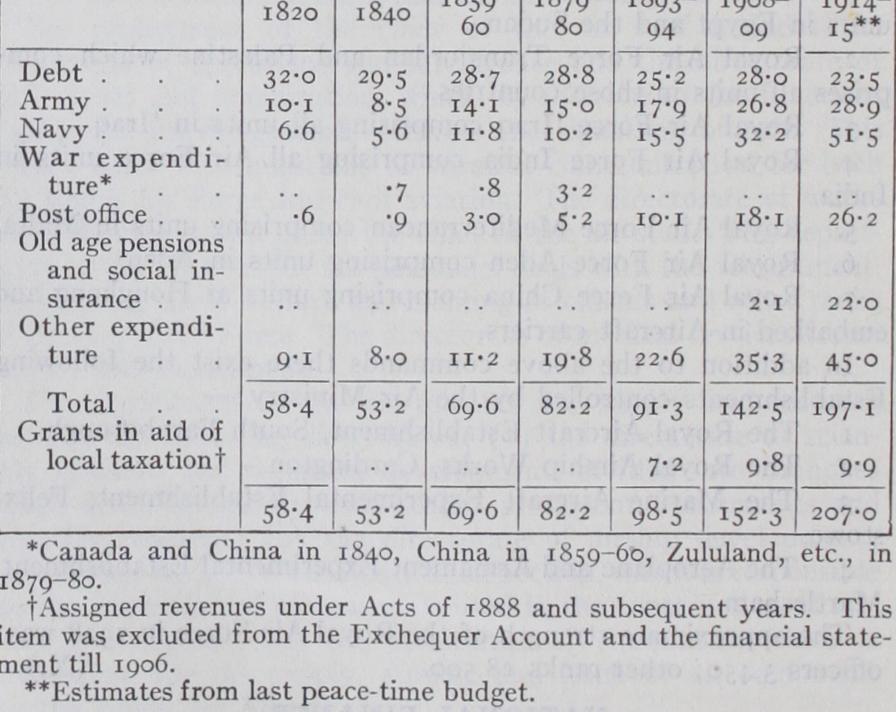
The growth of British expenditure is illustrated by the following table (in £ millions) : This increase in expenditure meant large increases in taxation. An important new departure was made at the outset by Sir Wil liam Harcourt, chancellor of the exchequer in the Liberal Gov ernment from which Gladstone retired in 1894. This was the application to the death duties of the principle of graduation according to the total value of the estate left by a deceased per son. A small estate paid 1 % or 2%, one of f i,000 to Li o,000 paid 3%, while at the top of the scale one above £i,000,000 paid 8 per cent.
With expanding trade and revenue no further taxation was re quired till the Boer War. Towards the cost of the war a sum of £71,000,00o was raised by taxation. Income tax and indirect taxes were increased and new taxes were imposed, an export duty on coal (1901), and import duties on sugar (1901) and wheat (1902).
The coal duty and wheat duty were repealed again in 1903. The wheat duty was noteworthy as being the first protective duty imposed since the days of Peel, and its repeal was due to the controversies which it threatened. Immediately upon it there followed Joseph Chamberlain's campaign in favour of colonial preference (see PROTECTION) .
In the early years of the Liberal Government which took office in Dec. 1905, good trade facilitated remissions of taxation and big repayments of debt. The debt charge had been raised by Austen Chamberlain to £28,000,00o and was temporarily further in creased. Income tax remained at i/– in the pound (as compared with 8d. just before the Boer War) but H. H. Asquith introduced a system of differentiation in favour of earned incomes below f 2,000 a year, which paid 9d. only.
In 1908, coincidently with a trade depression which reduced the productivity of the revenue, came new demands on the Exchequer. Asquith's Old Age Pensions Act of that year was soon followed by D. Lloyd George's projects for Health Insurance and Unemployment Insurance. The cost of the navy was still growing. In the budget of 1909 an enormous estimated deficit had to be provided for by heavy new taxes.
That budget became the occasion of a great constitutional crisis. The most contentious proposals were those for the taxation in various forms of "land values," especially the "unearned in crement" of economic rent. Heavy increases in public house license duties also evoked opposition. The graduation of the estate duties was made more severe. The duties on spirits and tobacco were raised. But the feature of greatest permanent im portance was the institution of a supertax, or additional income tax, on large incomes.
Incomes above £5,000 were taxed at 6d. in the pound on the excess over £3,000. At the same time the rate of income tax on unearned income was increased from is./– to Is./2d.
After a prolonged and stormy passage through the House of Commons the Finance Bill was rejected by the House of Lords. Since the 17th century it had been a constitutional convention that the House of Lords could not amend a money bill. But it could not be prevented from rejecting one. In 186o the House of Lords rejected a bill repealing the paper duties, and the Gov ernment (in which Gladstone was chancellor of the exchequer) retorted by putting all the budget proposals in a single Finance Bill. Since then it had been assumed that the rejection of the Finance Bill as a whole would never be practical politics, and that the power of the House of Lords over details of the budget had dropped into abeyance.
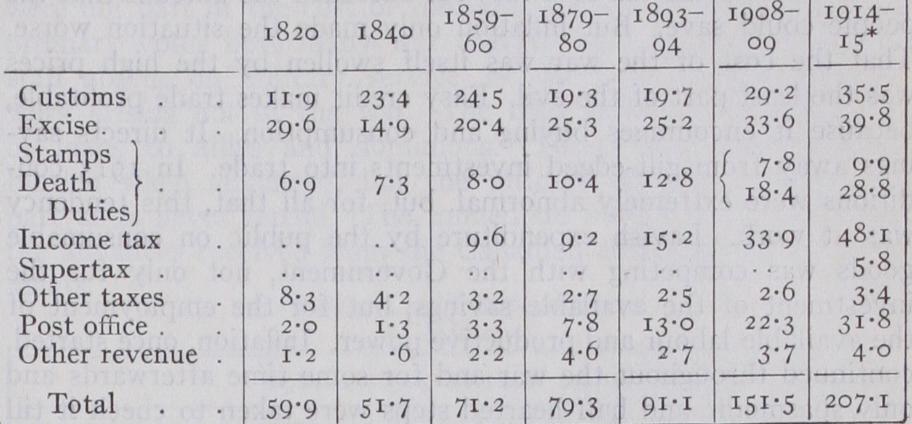
The following table shows the growth of taxation in the century preceding the Great War (in £ millions) : *Estimates from last peace-time budget.

The outbreak of the war threw first the stock exchanges and then the foreign bill markets of the world, but above all of Lon don, into utter disorder. The machinery of remittance to Lon don broke down almost completely and the London accepting houses found themselves faced with bankruptcy. The Govern ment was forced to step in and to proclaim a moratorium for debts, statutory power was taken for the Treasury to issue legal tender currency notes for f 1 and los. and the Government guar anteed advances by the Bank of England to acceptors to pay off pre-moratorium bills (see STOCK EXCHANGE).
It was in the midst of this state of confusion that the early stages of the war were financed. For the initial expenses, ad vances of £14,720,00o were obtained from the Bank of England on "ways and means" (i.e., under the powers annually conferred by the Consolidated Fund Act and Appropriation Act) . The war was costing about £I,000,000 a day. There followed half-a-dozen issues of Treasury bills of £ 15,000,00o at a time. In Nov. 1914 additional taxation was imposed and a loan of £350,000,000 (32% at 95, redeemable 1925-28) was decided on. By that time serious unsoundness was already developing in the situation. The issue of f 90,000,000 of Treasury bills did not in itself overstrain the market. But the advances made by the Bank of England for the pre-moratorium bills, with its advances to the Government and large imports of gold, destroyed the bank's power of controlling the money market. Bank rate had been reduced to 5% on the reopening of the banks on Aug. 7, but in Sept. it ceased to be effective and the market rate fell to 3%. In Nov. it fell below 3. Part of the 3% loan was taken by the banks, and in any case the loan was not applied to strengthen the position of the Bank of England. In Feb. 1915 the market rate of discount fell below 2%. The private deposits at the Bank of England exceeded L 130,000,000.
By that time the cost of the war had risen to L3,000,000 a day and exceeded one-third of the national income (even if this be assumed to have risen in proportion to prices, which were 25% higher than in 1913). This outlay (after deducting a modest con tribution from te tax revenue) far exceeded the amount that the people could save. But inflation only made the situation worse. That the cost of the war was itself swollen by the high prices was the least part of the evil. Easy credit makes trade profitable, because it encourages buying and consumption. It directs sav ings away from gilt-edged investments into trade. In 1915 con ditions were extremely abnormal, but, for all that, this tendency was at work. Lavish expenditure by the public on consumable goods was competing with the Government, not only for the investment of the available savings, but for the employment of the available labour and productive power. Inflation, once started, continued throughout the war and for some time afterwards and only spasmodic and half-hearted steps were taken to check it till 1920, when prices had risen to three times the pre-war level.
R. McKenna, in June 1915, brought out the second war loan (41% at par, redeemable 1925-45). It was for no specified total amount. The banks again undertook to subscribe for a very large amount, but the loan was planned much more for the ordinary in vestor and less for the money market than the 31% loan of No vember. It also remained open longer, and there was more propaganda. Subscribers were given the right to convert their holdings into any future long-dated war loan. Holders of 31 per cents or of consols were allowed to convert these securities into the new loan if they subscribed in addition a certain amount of cash to it. The loan yielded £587,000,000 of cash, but £200,000, 000 came from the banks and the balance was but a modest contribution from genuine savings towards the growing expense of the war.
"Pegging" the Exchange.—While the loan was still being subscribed, ominous signs of weakness began to appear. The rise of prices was resumed. The exchange on New York fell below $4.80 to the Li sterling; at the end of Aug. it dropped to $4.50. The Government sought a remedy in the sale of gold and securi ties in New York. Gold received in 1914 and deposited at Ottawa, gold displaced from circulation by currency notes, gold extracted from the precious reserves of France and Russia, all were drawn upon. The total net imports of gold into the U.S. in 1915 were $420,000,000, of which two-thirds came in the second half of the year. The British Government collected American securities from British holders, and either sold them or pledged them in America. There was also direct borrowing in America, starting with the Anglo-French loan of Oct. 1915 ($500,000,000, five-year 5 per cents at 98).
By means of these resources it became possible to "peg" the exchange at $4.761. That measure made inflation more ruinous to the country than before. Inflation creates an excess of im ports, which can be corrected, if the gold standard is abandoned, by an adverse movement in the exchanges. If the Government prevents that adverse movement by undertaking to sell foreign currencies to all comers, the excess of imports continues, and the Government has to pay for it. There were obstacles to imports in 1916 (especially lack of shipping), but the burden assumed by the Government was still a formidable one. The British Gov ernment also had to supply the necessary resources for pegging the French franc.
What was needed above all was the cessation of inflationary finance. The 41% war loan had been of some assistance. In Aug. 1915 the lowest rate for Treasury bills was fixed at 41%. In Sept. new taxation was imposed calculated to yield over £ 100,000,000 in a complete year, and in May 1916 further in creases brought the revenue for the year 1916-17 above L500,000, 000. But the cost of the war had risen to 14,500,000 a day and the rise of prices above the peace-time level exceeded 50%. In Dec. 1915 five-year 5% Exchequer bonds were put continuously on sale, but yet in March 1916 the floating debt (Treasury bills and ways and means advances) was almost 1600,000,000.
In July 1916 bank rate was raised to 6%, and the Treasury bill rate to 51. The effect of bank rate on borrowing depends on the profits of trade; 6% is by normal standards a very high rate but in face of the profits promised by an orgy of inflation it counts as low. At any rate it was not high enough to have much effect in 1916. The sale of five-year Exchequer bonds (raised to 6% in Oct. 1916) continued till Jan. 1917. A. Bonar Law, who had become chancellor of the exchequer in Dec. 1916, then decided on a third World War loan.
This took two forms: 5 per cents at 95 (redeemable 1929-47) and income-tax free 4 per cents at par (redeemable 1929-42). A "depreciation fund," equal to i% per month, was to be applied to buying up stock in the market whenever it was below the issue price. The amount asked for was unlimited, and the zeal of the public was stimulated by intensive propaganda. It was wisely decided to ask for no direct subscriptions from the banks. The cash raised was £816,000,000, and Treasury bills subscribed amounted to L124,000,000. In addition holders of 42% war loan and of the Exchequer bonds since issued were entitled to convert into the new stock. The total amount created was L2,067,000,000 of 5 per cents and £52,000,000 of 4 per cents.
Even after this great effort the floating debt at the end of the financial year (March 31, 1917) amounted to L680,000,000. Prices were almost double the peace-time level. Growing difficulty was experienced in providing resources for the support of the American exchange. The vast quantities of gold sent to the United States (whose net imports of gold from Jan. 1915 to March 1917 amounted to $1,192,000,000) not only paid for goods, but brought about a credit inflation and rise of prices there. Indeed otherwise the discrepancy in value between the pound and the dollar would have been far too great for any pegging operation to be feasible. But the effect of the credit inflation in America was to make borrowing there more difficult in face of the insistent demands of trade for all available supplies of capi tal. It was found possible to raise loans of $250,000,000 in Aug. 1916, $300,000,000 in Oct. 1916 and $250,000,000 in Jan. 1917, but the market was growing more and more reluctant.
After the 5% war loan, borrowing was effected through Ex chequer bonds, re-christened in Sept. 1917 "national war bonds." They were 5 per cents, but were repayable on maturity at a pre •mium (2% on the 5-year bonds, 3% on the 7-year and 5% on the and were convertible at the holder's option into 5% war loan at 95 (i.e., a £ioo bond would buy £I05 5s. 3d. of war loan) . There were also income-tax free 4% 10-year bonds, repay able at par, and convertible into 4% war loan. National war bonds were continuously on offer till the armistice and thereafter till May 1919 (those issued after Jan. 1919 having no conversion rights) .
Much attention had been given to the attraction of savings from the working classes. Special facilities were given for the purchase of the 41% war loan of 1915 in bonds of small de nominations. In 1916 a special issue of war savings certificates was started. The subscriber paid 15s. 6d. for a certificate entitling him to 11 after five years, and he could obtain repayment at any time at the sacrifice of a part of the accumulated interest. The interest accumulating, and not payable periodically, was not liable to income tax, and to prevent too extensive an evasion of income tax by well-to-do holders, the amount of certificates which could be held by any one person was limited to £500.
On March 31, 1919, the national debt amounted to £7,481, 000,000, an increase of since March 31, 1914. The external debt was £1,365,000,000, or, if certain items which could be set off against debts due to the British Government from Canada, France, Italy and Russia be omitted, £1,179,000,000. The internal floating debt was £ (exclusive of Treas ury bills amounting to £ 73,000,000, included in external debt [see Cd. 1648]) including £455,000,000 of ways and means advances; the latter included sums lent by Government departments (partly from the currency notes account, partly from trading accounts and many other sources). But a large part was money borrowed at call through the Bank of England from the money market, extra interest being paid for foreign-owned balances.
The indirect taxes imposed included import duties on motor cars, clocks and watches, musical instruments and cinema films —officially known as the new import duties, but more commonly called the McKenna duties. They are noteworthy as being the first protective duties imposed since the days of the Peelites, ex cept the ephemeral corn duty of 1902.
Civil departments drew on votes of credit for any expenditure in excess of their own votes, attributable to the war. Some items so met (e.g., for cost of living bonus to civil servants) were not part of the cost of the war. But on the other hand the ordinary votes bore many war charges such as the civil pay of staff absent on military service, or the cost of administrative work arising out of the war. The total includes £1,665,000,000 of loans to allies and dominions. These were an immediate burden when advanced, but the ultimate burden is only such part as is never repaid. The immediate burden was relieved by the advances received from the Canadian and American Govern ments.
The committee on currency and foreign exchanges after the war, presided over by Lord Cunliffe, had presented a grave and author itative report in Aug. 1918. The report urged the cessation of Gov ernment borrowing, but also the use of a high bank rate to protect the gold reserves. The foundation of all their recommendations was that "under an effective gold standard all export demands for gold must be freely met." "The conditions necessary to the main tenance of an effective gold standard in this country no longer exist, and it is imperative that they should be restored without delay." Unless the remedies approved by experience were applied, "there will be very grave danger of a credit expansion in this coun try and a foreign drain of gold, which might jeopardize the con vertibility of our note issue." The committee condemned pro posals for "a liberal supply of money at low rates," based on a further growth of the note issue, because "in the result the gold standard will be threatened with destruction through the loss of all our gold." In spite of these wise and emphatic recommendations, the gold standard was abandoned without an effort, as soon as the arrangement for supporting the New York exchange with Ameri can credits was brought to an end. A regulation under the Defence of the Realm Act, replaced in 1920 by the Gold and Silver (Export Control) Act, prohibited the export of gold (March 1919). The regime of cheap money continued. Burdened with heavy war commitments the budget for 1919-2o brought the prospect of a heavy deficit. In June a new 4% loan was offered for subscrip tion in two forms, the funding loan, at 8o, redeemable 1960-90; and the victory bonds, at 85, repayable by annual drawings at ioo.
During the war the issue of loans at a considerable discount had been avoided, the lowest price of issue being 95. This was a favour able contrast to the policy during the Napoleonic wars, which swelled the nominal amount of the debt and diminished the effec tiveness of the big conversion operations of the 19th century. The funding loan represented a change in that respect. It secured the investor against the reduction of his interest after 196o unless the market rate of interest had fallen by then below 4%. That is a very slight advantage to the investor, and any difference that it made in the price of the loan would not go far to compensate the Government for the loss of what might be a valuable option in the future.
The twin loans yielded £475,000,000, but £92,000,00o had been subscribed by banks, so that the real contribution towards sound finance was only £383,000,000. Moreover, the well estab lished but deceptive city tradition of fertilising a loan with cheap money had been followed. The sale of Treasury bills had been absolutely suspended, and the Government had borrowed at a low rate from the money market and so far as necessary from the Bank of England. The inflationary tendency, already serious, was accentuated. The sale of Treasury bills was resumed on July 14. In October came a change; the rate for three months' bills was raised from 3 i % to 4%—the first step towards a restriction of credit. In November the rate was raised to 5 2 % and bank rate to 6%. In December pursuant to a recommendation of the Cunliffe committee, a limit was imposed upon the currency note issue. A Treasury minute of Dec. 15, 1919 (a purely administrative instru ment without statutory validity) prescribed that the fiduciary issue of currency notes (those uncovered by gold or Bank of England notes) in any year should not exceed the maximum fiduciary issue recorded in the preceding year. The actual maxi mum recorded for 1919 was f 3 20,600,000, and accordingly this became the prescribed maximum for 1920. Under this rule the limit can decrease but cannot increase. The limit for 1928 was Inflation in Great Britain works through bank credits, but a limit on the supply of legal tender money, if really meant to be effective, was bound to react on the creation of credit. Neverthe less in the opening months of 192o inflation continued unabated. The price level (Statist index, 1913 being Ioo) rose from 217 in April 1919 to 313 in April 1920. The American exchange fell ohe third below par. In April 1920 the sales of Treasury bills at the fixed rate of 5 -% fell off, and f55,000,000 had to be borrowed from the Bank of England on Ways and Means. An abyss of infla tion seemed to be opening. The Treasury bill rate was thereupon put up to 61%, and bank rate to 7% (April 15).
The peril of inflation had vanished. It was excessive deflation that was now the trouble. But a contraction of credit, while it brings depression, bankruptcy and unemployment, nevertheless, after the first passing phase of stringency, causes a rise in the prices of fixed-interest securities and favours funding operations, just because it diminishes the profits of production and trade.
When the budget for 1921-22 was introduced in April 1921, little progress had been made with the floating debt, which still amounted to f 1,243,000,000. The loan issues of 1919, together with an issue of 5 4 % Exchequer bonds in Feb. 1920, had been mostly used up, in meeting a deficit of f326,o00,00o for 1919-20 and a large amount of maturing bonds. The surplus of f 230,000, 00o for 1920-21 had been needed partly to pay off external debt (including $25o,000,000 of the Anglo-French loan of 1915 matur ing in Oct. 192o), and partly to pay off bonds. Further heavy maturities were in prospect. By April 1922, f 138,000,000 of Ex chequer bonds would have to be met, and between Oct. 1922 and Feb. 1924 the 5-year national war bonds, amounting to f 574,000, 000. Certain securities also had the privilege of being used in payment of death duties and excess profits duty. The total amount so used had been averaging f 70,000,00o a year. The depreciation fund on the war loan of 1917 required over f 30,000,000. All these obligations had to be met if the floating debt was to be prevented from increasing.
In the budget statement in April 1921 was announced the issue of a new 31% conversion loan. It was to be a funded stock like consols, being redeemable only at the option of the Government (after 1961), and not at any fixed due date. A sinking fund of 2% per annum on the amount outstanding was to be applied so long as the price was below 9o. Cash subscriptions were not asked for, the loan being destined only to be exchanged for the 5-year and 7-year national war bonds. At that time gilt-edged stocks had not re covered far from the lowest levels of 1920. The 4% funding loan which had fallen to 66 in Dec. 192o, stood at 71. The 5% war loan had risen from 8r i to 88. The national war bonds (carrying a premium on redemption) were slightly below par. From f r6o to f 163 of 31% conversion loan was offered to the holder of f r oo of national war bonds. The stockholder was secured a return of about 53% on his money, and the interest could not be reduced be fore 1961, and even then only if the Government was able to bor row at less than 31%. By good fortune the loan was a failure. Only f I64,o0o,000 of national war bonds were converted, out of f 630,o0o,00o to which the offer applied, but even so the increase in the nominal amount of the debt was about f Ioo,000,000.
A year later, still months before the earliest maturities of national war bonds, the situation had been transformed by the trade depression. The 4% funding loan at 881, and the 5% war loan at 99 were well above their issue prices. The conversion .loan, which had been offered in April 1921 on terms corresponding to a price of 62, had risen to 77a. Treasury bonds to yield 52%, and then, as the market improved, 5% had been sold to an amount exceding f400,o00,000. In 1922 a further batch of £ 70, 500,000 of national war bonds were converted into 31% conversion loan on the basis of a price of about 75. When the bonds were above par it ceased to be profitable to use them in payment of duties. And now that the 5% war loan was well above the issue price, the option attaching to national war bonds of converting into it at the issue price became profitable, and in the two years 1922-23 and 1923-24 £210,000,00o were so converted. No difficulty was found in raising the money to pay off £96,500,00o in cash in the same period, and in addition the floating debt was reduced from 000,000 in March 192I to £774,000,00o in March 1924 (inclusive of £186,000,000 of advances from public departments).
In April 1921 the pre-war system of selling Treasury bills by public tender was reverted to. The change was an important one, because it meant that in respect of the discount rate the Treasury followed the market instead of leading it. So long as the Treasury sold all the bills that the market would buy at a prescribed rate and no more, the Bank of England was bound to lend to the Treasury if the sales of the bills did not produce enough. A bank rate appreciably above the Treasury bill rate could not be made effective. A bank rate below the Treasury bill rate would be equally unworkable. In fact the Treasury had usurped the place of the bank as regulator of credit. So long as bills are issued by tender in just sufficient amounts to meet the needs of the Treasury, the Bank of England can discharge its responsibilities undisturbed.
Of the 7-year national war bonds, maturing Oct. 1924 to Sept. 1925, the original total had been f62,000,000. Only f36,000,000 remained outstanding in April 1924 and no special measures were required for dealing with them.
Meanwhile the total of the great 5% war loan had been swollen by conversions from national war bonds to £2.100.000.
000, and in 1924 a new form of conversion loan, a 41% security redeemable in 1940-44, was offered to holders at 97 in order to make a start with conversion. The amount converted was f 148,000,000.
The period Oct. 1927–Feb. 1929 comprised the maturities of the ten-year national war bonds (i7o5,000,000 outstanding April 1926). To deal with these and some other maturities, a new funded stock, 4% consols, was issued in 1927, followed by a further issue of 31% conversion stock, and an offer of 5% treasury bonds convertible at the holder's option into 4% consols.
The loan had been till then in the form of an obligation pay able "on demand" and yielding interest at 5%. The agreement reduced the suspended interest to 41%, and fixed the future interest at 3% for 1 o years and thereafter at 31. The capital of the debt (including past interest) was rounded down by a small cash payment to $4,600,000,000, and was to be paid off by instal ments in 62 years, starting at 2 % ($23,000,000) and rising grad ually so as to keep the annual obligation for interest and principal together approximately fixed at about $161,000,000 for 1 o years and $I84,0oo,00o thereafter. Great Britain has the option of paying the debt either in "U.S. gold coin of the present standard of weight and fineness" or in gold bullion or in bonds of the United States and may postpone the payment of half of any instalment of interest. There was in addition a debt of $61,000, 000, being the balance of the advances of silver made for the benefit of India under the Pittman Act of 1918. This sum was paid off in 1923 in cash. (See DEBTS, INTER-ALLIED.) Sinking Fund.—The war debt made the fixed debt charge under the act of 1875 (reduced to £24,500,00o in 1910 and to 123,5o0,00o in 1914) obsolete. The "old sinking fund" remained in operation, and under the Finance Act of 192o a surplus of revenue over expenditure could be applied to debt redemption as it accrued, instead of being accumulated in Exchequer balances till the end of the year. The accumulation of a surplus of L200, 000,000 like that of 1920—I would have been an absurdity. The Finance Act of 1923 repealed the fixed debt charge arrangement, and established a new sinking fund. A sum of f 40,000,00o was to be included in the expenditure of the year for the redemption of debt in £45,000,00o in 1924-5 and f 5o,000,000 in 1925-6 and subsequent years. With the fixed debt charge the saving of interest went to increase gradually the amount applicable to debt redemption. Under the sinking fund of 1923 it goes in diminution of expenditure, the sum applicable to debt redemption remaining at £5o,000,000. Surpluses, however, remain, as before, applicable to debt redemption. Realized surpluses were as fol lows (in f millions) : I 1923-24 230.6 45' 7 1o1.5 3.6Repayments of principal of war advances to dominions and of relief loans are paid to the national debt commissioners for debt redemption, without appearing in the Exchequer account.
The years 1921-2 to 1924-5 were years of steady remissions of taxation. Excess profits duty was repealed (1921). Corpora tion profits tax was first halved (1923), then repealed (19241 Income tax was reduced from 6s. to 5s. (1922), to 4s. 6d. (1923) and to 4s. (1925). The duties on beer (1923), sugar (1924) and tea (1924) were reduced. The "McKenna" duties were repealed by Philip Snowden in 1924, but reimposed by Winston Churchill in 1925. The Safeguarding of Industries Act, 1925, imposed a number of protective duties, and in 1925 customs and excise duties were imposed on silk and artificial silk.
On the other hand the budgets of 1926 and 1927 were pro foundly disturbed by the conflict in the coal-mining industry. The subsidy granted to the coal mines in 1925 caused the year 1925-6 to end with a deficit of L14,038,000. In order to do something towards making this good, the sinking fund for 1926-7 was raised from £50,000,000 to f 6o,000,000, and this non recurrent burden was provided for by certain exceptional re ceipts (in particular a sum of £ 7,000,000 taken from the road fund) . Among the new taxes a betting tax was a novelty.
For 1926-7, the year of the actual coal mining stoppage, there was a deficit of £36,694,000, and the sinking fund for 1927-8 was raised to 165,000,000. Again some non-recurrent resources were found (a hastening of the payment of the beer duty, and schedule A of the income tax), and there were minor increases of taxation.
in debt charges, consequent on the establishment of the new sink ing fund and the beginning of the payment of the American debt. (See also FINANCE ; EXCHEQUER ; NATIONAL DEBT ; WAR FI NANCE; INCOME TAX; ESTATE DUTIES, etc.) BIBLIOGRAPHY.-Harvey Fisk, English Public Finance (192o) ; A. Bibliography.-Harvey Fisk, English Public Finance (192o) ; A. W. Kirkaldy and A. H. Gibson, British Finance During and After the War (1921) ; F. W. Hirst, and J. E. Allen, British War Budgets, (1926) . See also the Annual Finance Accounts and the Parliamentary debates reported in Hansard. (R. G. H.) Beginnings of British Banking.—The origins of British banking are still very obscure. (See BANKS, HISTORY OF.) His torical evidence on this point begins only after the Restoration of 166o, when, in London, there is to be found a group of gold smith-bankers, conducting deposit banking, then known as "keep ing running cash" and—apart from the discounting of commercial bills of exchange, dealing in bullion and foreign coin—in inti mate touch with the Government of Charles II., financing it on a large scale, and therefore dependent on the honesty of the Crown for the safety of the money entrusted to them by their depositors. The details of the evolution are, however, almost completely unknown. Certain it is that out of the "goldsmith's note," that is, his receipt for the cash entrusted to him, spring both the bank note and the modern cheque, both forms of cur rency developing very speedily. By 1677 the Little London Direc tory gives the names of 44 "goldsmiths keeping running cashes," of whom no less than 27 kept "shops" in Lombard street, still the centre of the British monetary world. Private banking thus antedates the foundation of the Bank of England by at least 3o years—probably a good deal more.
The Bank Act of 1844 made for ultimate peace by limiting for the future the right of note issue; as the banks grew in size their right of note issue became less important to them than the right of access to the money market, and thus the amalga mation movement, already in full swing, received a fresh impulse. The next step was the grant of limited liability to banks, which, after a period of experimentation, was fully sanctioned by the Companies Act of 1862, though it was not until after the dis astrous losses arising out of the failure of the City of Glasgow Bank in 1879 that a general desire to safeguard shareholders from the effects of unlimited liability led to fresh legislation and to a general adoption of the limited liability form of company organi sation by banks.
Thus we may regard 188o as the date when the specifically mod em period of English joint stock banking began, though it was not until almost the end of the century that the full implications of the amalgamation movement were realised. Scottish banking has always followed a course of its own. Its history begins with the foundation of the Bank of Scotland in 1695, which was fol lowed very much later by the establishment of the Royal Bank of Scotland in 1727. The British Linen Bank followed in 1746. Scottish banking, though it has also gone through a period in which small local joint stock banks and private partnerships were important, realised earlier than the banks south of the Tweed the advantages arising out of a combination of branch banking, combined with a small note issue and large scale joint stock management. The attachment of the Scots to their small notes was responsible for the victory won by Scottish banking over the desire of the British Government after the crisis of 1825 to withdraw the £ 1 note in Scotland as well as in England and Wales, and the main effects of the Bank Act of 1845 were, in this case, not to kill the note issues of the Banks, but to make it almost impossible for new joint stock banks to be set up at all. And, though the Scottish banks are now in part within the sphere of influence of London, Scotch banking is still governed by a law and a tradition of its own.
The amalgamation movement was now destined to take a double form ; that of a competition between five leading banks for absorption and control of the lesser but still very large insti tutions, as well as of the remaining smaller banks, and, at the same time, of an extension of the area of influence of the leading banks in foreign countries, the empire and the other portions of Great Britain. In this contest which reached its maximum inten sity in 1918 and 1919—the years of boom, when control over additional facilities was a matter of urgency to the banks, each of the leading five banks absorbed a member of the group im mediately below them in strength; Barclays absorbing the London Provincial and South Western; the Westminster taking over Parr's ; Lloyd's, the Capital and Counties; the Midland, the Lon don Joint Stock Bank; and the National Provincial, the Union of London and Smiths Bank. At the same time, the Bank of Liver pool began to form a new and powerful sixth group, by taking over a London Clearing Bank (Martins), the Halifax Commer cial Bank, the Palatine Bank and Cocks, Biddulph and Co., adding to its power in 1927 by absorbing the Lancashire and Yorkshire Bank. With the growth in size, came a simplification of name, giving the familiar titles of today.
Scotland was invaded by the Midland Bank, which took over the Clydesdale Bank and the North of Scotland Bank, by Bar clays, which controls the British Linen Bank, and by Lloyds, which controls the National Bank of Scotland: the Midland also took over the Belfast Banking Co. Barclays has now become an Imperial Bank through its control over Barclays (Dominion, Colonial and Overseas) Bank whilst Lloyds is represented in India and in South America, and the Westminster in Ireland and the Continent, whilst Lloyds and the National Provincial are joint owners of a European subsidiary.
Great concern was caused in business circles by these stupen dous developments, of which only the barest outline has been given here. In March, 1918, when the movement was in full swing, the Treasury appointed a committee to consider the whole problem of bank amalgamation. The committee was clearly impressed by the tendency, when banks of a national scale amalgamated, for a net reduction of competition to come about and gave cautious assent to the view that circumstances might produce something approaching a "money trust" at a compara tively early date. It therefore recommended legislation by which future amalgamations should be made dependent upon Treasury sanction. No such legislation has been passed, though Treasury sanction is obtained before amalgamations are carried into effect. But the degree of combination is now such that no very great difference would be made if the remaining smaller institutions should now be absorbed. An attempt to combine any of the "big five" would be a different matter and would, without doubt, bring the expediency of nationalisation to the fore-front of politics.
Two main causes have co-operated to calm the excitement aroused by the events chronicled. The monetary policy of the Government and the Bank of England has diverted attention from the joint stock banks to the gold standard, for it has become clearer since 1925 that the limits within which the price of accom modation can vary are narrowly set by the monetary standard. As important is the fact that the joint stock banks have not ceased to compete among themselves. In fact, in spite of trade depression and relatively stationary deposit figures, the rate at which new bank branches continue to be opened is a sign that the banks are above all anxious to tap fresh sources of deposits and acquire new customers. In part, the opening of new branches is an inevitable accompaniment of the shifting of the population to newer industrial and residential districts. But in part it is an endeavour of each of the banks to complete its network of branches in order to prevent its non-representation in any area where its competitors are represented. On balance, the public gains, but the fact that, anxious as the banks are to tap fresh deposits, they pay on deposits half per cent less than they did before the war, shows that the cost of this policy to the banks must be great. At the same time, they are faced with internal difficulties of no small importance. The tradition that the bank ing profession guarantees security subject to good behaviour means that the banks have large staffs paid on a considerably better scale than before the war, and this prevents them from introducing labour-saving devices to the full extent possible. Nor is it yet clear that the problems of staff promotion and esprit de corps have yet been solved. It is likely, therefore, that for some time to come the energies of the leaders of British banking will be absorbed by the problems of internal administration and consolidation.
Most marked since the World War has been the effort of British banks to attract as customers whole classes of people previously thought to be outside the account-owning class. Fa cilities such as home safes, formerly the domain only of savings banks, have been offered by banks to their smaller depositors, while even such factors as the small man's unwillingness to pay the twopenny revenue stamp on every cheque transaction have been considered. The attempt, in 1927, of a large London bank to devise a non-dutiable cheque form for small payments proved, however, abortive. But cheque payments in Britain are undoubt edly on the increase.
The following tables from the sixth Annual Report of the secretary for mines, p. 104, show the output of coal in Great Britain and its distribution for the years 1913 and 1925.
Since the end of the war bank figures have been affected pri marily by the inflation of 1918-2o, and then by the subsequent deflation. Since then there has been some rise in deposits and a considerable shifting of assets as between investments and loans, which would indicate that the banks are responding to the needs of trade by reducing their holdings of interest-bearing securi ties and of Treasury bills.
See also BANKS, HISTORY OF. (T. E. G.) Coal.—The actual quantity of the coal reserves of the United Kingdom have been variously estimated at different dates, the estimates tending to increase in optimism, as knowledge of the extent of the seams has become more accurate. The following table from the Report of the royal commission on the coal in dustry 1925 (Cmd. 2,600, p. 17) gives particulars of the more important estimates:— The royal commission estimated that if the present rate of working remained fairly constant and the working of levels deeper than 4,00o feet did not become possible, the coal at present known to exist would last for between four and five centuries. If, how ever, account was taken of probable and possible reserves, there should be enough coal to last seven centuries, and there would be a further extension if means were found of using the small coal now so largely wasted. For a discussion of this important matter see COAL AND COAL MINING.
There is no definite evidence of the use of coal in Great Britain till between A.D. 123o and 124o, when Northumbrian grants are extant of the right to take "sea-coal" probably coal eroded and washed up on the shore. Outcrop mining seems to have begun in the northern coal field at the end of the century. In the 14th century elementary shafts began to be sunk, but in 180o the pro duction was still only about 10 million tons, and it was not until the development of the steam engine that coal mining became important.
The coal fields of England are generally arranged in three groups, the Southern, Midland and Northern, comprising South ern, the South Wales, Forest of Dean, Somersetshire and Glou cestershire and Kentish fields; Midland, comprising the York shire, Nottinghamshire, Lancashire, North Wales, Staffordshire, Leicestershire, Warwickshire and some smaller fields; Northern, comprising the fields of Northumberland, Durham, Cumberland and Scotland.
An exhaustive study of the waterpower resources of the country was made by the water power resources committee, appointed by the Board of Trade, whose report was published in 1921. In their report this committee summarised the position as follows:— "In our examination of the potential water power resources of Great Britain, we have confined our inquiry to a consideration of specific schemes which have been investigated on our behalf or material dealing with which has been placed at our disposal by Government departments, local government authorities, and private firms and individuals, and to evidence concerning the power poten tialities of specific rivers. Moreover, although information concerning a number of small schemes has been secured, our investigations have been mainly directed to obtaining particulars of schemes capable of giving a large continuous output. It will therefore be appreciated that the following statistics are not to be regarded as in any way exhaustive or indicative of the distribution of water power resources throughout the constituent parts of Great Britain.
Leaving out of account the question of availability, the schemes in our possession relate to potential water powers of a total capacity in excess of 250,00o electrical kw. (continuous) . The aggregate power involved in the various parts of Great Britain is as follows:— Scotland 194,965 kw. Wales 35,90o kw. England 20,44o kw.
We consider that of this amount probably 210,000 electrical kw. (continuous) could be developed at an economic rate. This power operating for a year represents an output of about 1,84o million Board of Trade units, which is equal to slightly less than 4o per cent.
of the total units generated during the year 1917-18, in the 410 steam-power stations for electricity supply and for electric railways and tramways (but NOT private power plants) in Great Britain. We estimate that, in order to develop this energy in coal-fired steam plant, it would be necessary to consume nearly three million tons of coal per annum. This leaves out of consideration the quite appreciable amount of coal that would be used at the mines and on the railways in raising and transporting the coal to be used at the power stations.
We wish it to be clearly understood that the above figures relate only to certain specific water power schemes, and that they by no means represent the total available water power resources of Great Britain. The data in our possession are insufficient to enable us to make an estimate of this total." According to the census of production (1907), the total engine capacity in the United Kingdom in that year was about 1o•6 mil lion horse power of which nearly 1.7 per cent represented water power installations.
Prior to 1918 very little working had taken place, but in that year the Government commenced to carry out extensive investi gations. Petroleum has been found to exist in Derbyshire, Not tinghamshire, North Staffordshire, Yorkshire (near Rotherham), Cumberland, Lancashire, Shropshire and certain parts of Scotland. Many of these discoveries, however, were merely small seepages noted in the working of collieries, and none have hitherto proved of commercial importance.
Oil shale exists in large quantities in Dorsetshire, Somersetshire, Norfolk, Lincolnshire, Yorkshire, Midlothian, Linlithgowshire and Lanarkshire. The most important fields in England are at Kim meridge and Corton in Dorsetshire, the former covering 2,900 and the latter I,5oo acres, the total estimated tonnage being 23,000,000 and 32,00o respectively and the estimated total quantity of oil (imperial gallons) 455,000,000 and 442,000,00o. Only the Scottish deposits have, however, so far been successfully worked, the Scottish industry having been active since 185o. The Scottish Geological Survey has estimated the reserves of shale in that country as follows : Tons Midlothian . . . 163,500,00o Linlithgowshire 416,540,000 Lanarkshire . . . 16,630,000 BIBLIOGRAPHY.-Board of Trade Interim Report of water power Bibliography.-Board of Trade Interim Report of water power resources committee (Cd. 79, 1919) ; Board of Trade Final Report of the water power resources committee (1921) ; Sixth Annual Report of the secretary for mines; Resources of British Empire Series (Federa tion of British Industries) , "Fuel" by G. W. Andrew (1924) .
The figures for 1913 and the post war years show that the position of the industry has undergone a serious change. The posi tion is thus described in the Report of the royal commission on the coal industry (1925) Cmd. 2,600, pages 3 and 4: "That year (1913) up to the present, marks the climax of the industry's prosperity. Essentially dependent as it is on its foreign market, it was particularly susceptible to the disorganising influences of the war. For about five years it was under Government control ; exports were limited in order to conserve the necessary quantities of coal for our own essential needs; export prices rose to enormous heights ; markets were lost, and a sharp stimulus was given to the development of foreign coalfields and the use of substitutes. By 1920 output had fallen to 23o million tons and exports had been cut down to 43a millions or considerably less than half the pre-war rate. It was not until the advent of the trade depression at the close of that year that the approximation of the free export price to the controlled inland price made it possible to remove the restriction on exports.
It was not until July, 1921, that the industry was free to set about the task of recovering the export trade that is vital to it. In the circumstances, as we shall show, the degree of success that has been attained is remarkable. But this is partly because, until a year and a half ago, it has been singularly favoured by fortune. As was pointed out to us in evidence by Mr. Gowers, the permanent under secretary for mines, `ever since the end of 192o the depression that then overtook the other heavy industries has been lying in wait for the coal mining industry, but has been warded off by a series of acci dents. For the last half of 1921 the industry was busy filling the gaps made by the three months' stoppage in the summer of that year. In the first half of 1922 the depression actually laid its hand on the coal mining industry, but the great strike in the United States of America came to our rescue. After that came the French occupation of the Ruhr, and it is only during the last 15 months that the industry has not been helped by the temporary cessation of some normal sources of coal supplies. Without this its present difficulties could hardly have failed to come upon it four years earlier.' " This prolonged depression led to two serious disputes in the industry. The first took place in 1921 and lasted from April to July. It resulted in an agreement between the owners and the miners (backed by the promise of a Government subsidy up to a total of f io,000,000) which lasted till April, 1924, the miners having given notice to terminate it in January of that year. A further stoppage became imminent and the Government in August made another grant of a subsidy and appointed a royal commission under the chairmanship of Sir Herbert Samuel to survey the position. This body presented its report on March 6th, 1926, but its recommendations did not prove acceptable to either party and the workers ceased work on May 1st, 1926 (by which time the Government had expended I23,000,00o in subsidy), the stoppage continuing until November in that year. During and after the stoppage the Government passed various measures affecting the industry. The working day, which had since 1919 been fixed at seven hours, was increased to eight, and the Mining Industry Act, 1926, made various provisions to facilitate the combination of colliery undertakings, to remove restrictions on the physical ex tension of collieries caused by the holding up of mining rights, and to provide for the establishment of a welfare fund for the industry by means of a compulsory levy upon the owners of coal and mineral wayleaves. The close of the dispute was marked by the negotiation of fresh wage agreements in all districts, based on the eight hour day, but, after an improved period during the early months of 1927 due to shortage of stocks, the world demand for coal again proved less than the supply and a period of great de pression ensued, the total exports for the year amounting only to 40,000,00o tons.
At the end of 1927, however, there were again signs of improve ment in most districts, with the notable exception of South Wales. The close of this year was also remarkable for the initiation of schemes for co-operative marketing in the South Wales and York shire, Nottinghamshire and Derbyshire fields, while the extension of the latter scheme to Leicestershire, Lancashire and Cheshire was under consideration.
The following tables prepared by the Mining Association of Great Britain and Ireland illustrate the position of the coal export trade in 1913 and 1927 respectively :— Employment in the industry remained depressed, the average for the last three months of 1927 being only 979,000, while during the 12 months ending July 31, 1927 no less than 30,00o miners had found work in other industries. As the probabilities of ex pansion appeared remote, the Government on Jan. 6, 1928, ap pointed an industrial transference board to facilitate the transfer of workers, in particular of miners, for whom employment in their own trade or district was no longer available.
Tin Ore.—Tin ore is obtained almost exclusively from Corn wall. The fall in production has been accompanied by an increase in retained imports, which have been as follows:— I mports Year Long Tons Year Long Tons 1919 . . . . 35,119 1924 . . . . 1920 . . . . 3 2, 718 1925 . . . . 63,868 1921 . . . . 20,277 1926 . . . . 62,172 1922 . . . . 37,773 1927 . . . . 64,189 1923 . . . . 52,291 Lead.—The British output of lead has also heavily declined, while retained imports have increased. The most productive counties are Flint, Durham and Derbyshire. The ore found in the Isle of Man contains a considerable proportion of silver.
Imports Year Long Togs Year Long Tons 1919 3,794 19 23 . . . . 6,023 1920 . . . . 5,852 1924 . . . . 5,180 1921 . . . . 819 1925 . . 923 1922 . . . • 1926 . . 1,884 Copper.-Copper is found mostly in Cornwall. At one time the United Kingdom supplied almost three-quarters of the copper of the world. The output has, however, now become insignificant, the United States having become by far the principal producer.
The copper imports into Great Britain (for home consumption) have been: Year Tons Year Tons 1919 . . . . 30,326 1924 . . . . 1920 . . . . 28,560 1925 . . . • 1921 . . • 1926 . . . . 34,717 1922 . . . . 31,392 1927 . . • 40,077* 1923 • *Total imports, re-exports not available.
Zinc.-Zinc occurs mainly in North Wales, the north of Eng land, the isle of Man and the county of Dumfries. The falling off in production has been mainly due to the closing down of mines in Cumberland, which used to produce 7,00o tons of ore yearly. The import figures are: Year Tons Year Tons 1919 . . . . 78,302 1923 . . . . 6o,615 1920 . . . . 36,827 1924 . . • • 120,424 1921 . . . . 5,945 . . 121,571 1922 . . 94,755 1926 • • . . 97,178 China Clay (Kaolin).-This mineral is of great importance in the papermaking, bleaching and chemical industries. The whole British supply is derived from Cornwall . The follow ing figures give the production since 1913: Imports are negligible in quantity.
Fluorspar.-This mineral is of considerable importance in the manufacture of steel and other branches of metallurgy. The British production first became substantial at the beginning of the present century, since when the quantities produced have been as follows: Year Tons Year Tons Average 1903-1912 . 40,211 1924 . . . . 49,492 Average 1913-1922 . • 1923 . . . . 1926 . . . . BIBLIOGRAPHY.-Sixth Annual Report of the secretary for mines;Bibliography.-Sixth Annual Report of the secretary for mines; Resources of British Empire Series (Federation of British Industries), "Non-Ferrous Metals" by N. M. Penzer M.A., F.G.S., F.R.C.S. (1924) ; Report of the royal commission on the coal industry (1925, Cmd. 2600) ; and publications of the Mining Association of Great Britain and Ireland.
The Civil Wars laid the foundations of a long period of stable government-the development of the road system in the i 7th century, and of the canals in the i8th made the home market easy of access, the establishment of a colonial empire stimulated overseas trade.
These were favourable conditions for industrial develop ment, and this was helped forward by the Protestant refugees from Antwerp at the end of the 16th century, the Huguenot refugees after the revocation of the Edict of Nantes and by the Dutch immigrants who followed William III. By these were laid the foundations of our cotton, silk and other indus tries.
More important still was the existence of great coal supplies, which were made mobile by the development of the canal sys tem. It was British coal that made possible the creation of a large iron and steel industry, and the development of machine production and of the steam engine. But this development could not have been brought about without the existence of enterprise and imagination of a high order, and the i8th century was the period which saw the birth of those inventions which made the industrial system a possibility. James Watt's first patent was taken out in 1769 and by the end of the century the steam engine was in use in mines, foundries, cotton mills, etc. The iron industry, dependent during the 17th and early 18th centuries on charcoal, began to languish with the gradual exhaustion of Brit ish forests. Coal began to be used effectively in blast furnaces as early as 1709. The use of coal in forges was made effective about 1785, thus altering the whole aspect of the iron industry, and the introduction of the steam engine was the finishing touch. The output of pig iron rose from 2 5,00o tons in 17 20 to 68,000 tons in 1788; to 2S3,000 tons in 18o6; and to 1,347,00o in The cotton industry had a similar story. In spite of the excep tionally favourable climatic conditions in Lancashire, the English industry only consumed about 2,000,000 lb. of raw cotton annu ally during the early part of the 18th century. The invention of the flying shuttle for weaving in 1733 and of the spinning "jenny" less than 3o years later revolutionized the industry. Until 1785, however, the mills had to depend on water power. That year marked the introduction of the steam engine and the creation of the great cotton industry, which was to become the greatest exporting industry of the country, sending no less than 8o% of its huge annual production overseas. In 1833 this industry, which a hundred years before had used little more than 2,000,000 lb. of raw cotton annually, was importing no less than 300, 000,000 lb.
The woollen industry which was founded on native raw mate rials had a somewhat different history to that of cotton. Origi nally the great majority of the wool produced in the country was shipped abroad for manufacture, but various English kings took special steps to foster the development of the native industry, and by the end of the 17th century this was well established, workshops being scattered all over the country wherever the conditions of wool supply and running water for power purposes made the locality convenient. To this day the industry is very much more scattered than the cotton industry, although the great majority of it is now centred in the West Riding of Yorkshire whither it migrated when use of coal for power purposes began to develop.
Subject to the above differences, the woollen industry followed very much the same course as cotton.
The story of these great industries was repeated in others and it may be said that before the introduction of railway transport during the second quarter of the i9th century factory produc tion was established in every important branch of industry. The establishment of the railways was the crowning achievement enormously facilitating as it did the mobility of the working population, the supply of raw material and distribution of the finished commodities. With it the industrial system reached its characteristic form. The only further fundamental change was the introduction of the use of electrical power in the 1880's.
As to the general development of British industry, the first three-quarters of the i9th century saw a very rapid increase of production and export. In the middle of the century onwards, however, the rate of increase in exports of manufactured goods began to fall, while the rate of increase of imports was accel erated. This tendency has continued.
The census of production, 1907, and the preliminary reports is sued under the third census of production, 1924, enable an idea to be formed of the progress of the principal industries of the country during the present century. Previous to 19o7 no census of production had been taken in the country. A census of enquiry was commenced in 1912 but not completed owing to the war. Where, in the following statement particulars are given of values only, an approximate idea of the quantities involved may be ar rived at by diminishing the 1924 figures by 25% since, generally speaking, the increase in values since 1907 was about 50%.
British industry has been faced with peculiar difficulties owing to the development of plant in other countries behind tariff bar riers, and the freedom of the British market to competitors who have enjoyed the additional advantages of depreciated currencies and lower labour conditions, while Britain has passed through a period of currency deflation and relatively high selling costs. At the end of 1927 there was less foreign competition owing to the stabilisation of currencies, while British costs had fallen substan tially. The position of the industry was therefore more hopeful.
In the next table are given the Imports and Exports of Iron and Steel products for the years 1913, 1925 and 1927: Engineering.—The following are the relative figures of cer tain branches of engineering production: It is interesting to note that in the figures for 1924 is included for wireless apparatus, an industry not in existence in 1907.
The foreign trade position of the electrical industry is very satisfactory, Great Britain now being the chief exporting country in the world, her total exports for 1927 being valued at £18, 800,000 against £18,350,000 from the U.S.A. and £17,600,000 from Germany, who before the war easily led the world in exports, the figures for 1910 being Germany, £15,887,700, Great Britain U.S.A. £5,790,000. It is noteworthy too, that in Dec. 1927 the percentage of unemployment in the industry was only 4.3%• This was achieved in spite of severe competition overseas and some stagnation in the home market, owing to the delay in operating schemes under the Electricity Supply Act of 1926.
The imports and exports for the years 1913, 1925 and 1927 for electrical machinery have been as follows:— The average number of persons employed in electrical engineer ing establishments in 1924 was 156,5o8; the figures for 1907 are apparently not available.
Machinery.
The following figures show that the average factory value of the various products sold has declined during the period:— The average number of persons employed in these groups in 1914 was 209,419.
The imports and exports of machinery have been as follows :— This may in part be due to an increase in the demand for a lower-powered and less costly product, in the later years. But it is almost certain that there has been a real reduction in values, owing to improvements in manufacturing technique, resulting from production on a larger scale.
Persons Employed 1924 . . . . . . . . . . 200,272 1907 . . . . . . . . . 53 The very rapid increase in the demand for motor cars is shown by the increase in licensed vehicles during recent years, these having grown from 875,700 in 1921 to 1,729,000 in 1926.
The table shows imports and exports from 1913 and 1919: The steady growth of exports and recent decline of imports are remarkable. This industry has had the advantage of a protec tive duty, imported motor cars, motor cycles and accessories hav ing been liable to duty from Sept. 29, 1915, until Aug. 1, 1924, and on and after July 1, 1925. Imported commercial vehicles were exempt until April 3o, 1926, inclusive, but have been dutiable since May 1, 1926.
Shipbuilding.
sale and piece-goods made on commission in 1924 and 190 7 were I as follows:— Cotton Spinning.—No effective comparison can be made be tween the years 1924 and 1907, since no particulars were recorded in the latter year of the output of yarn used for manufacturing purposes by the spinning firms.
The figures for 1924 are as follows:— The exports of yarn for the years 1913, 1925, 1926 and 1927 have been as follows:— The industry has suffered much since the war, particularly in the American spinning section, from the tendency of cotton grow ing countries to install spinning machinery, and from the unsettled state of eastern countries. A number of firms have also been seriously embarrassed by the policy of recapitalisation at high prices adopted during the post-war boom, while in general the reduced purchasing power in foreign countries coupled with the high priced cotton has restricted markets.
The average number of persons employed during the years 1924 and 1907 in factories and workshops in the woollen and worsted trades were : 1907 2;5,926 259,560 Since 1924 there has been a progressive decline in employment and in July, 1927, the total number was only 249,180.
The total value of the output for 1907 was £5,176,00o.
The v'ry great difference in the two years is accounted for by the great development in the artificial silk industry which, in 1907, was at an elementary stage, such small amounts as were included in the census returns being included under the heading "spun silk yarn." The figures for 1912 show that the value of artificial silk produced in the United Kingdom in that year amounted to about half a million pounds sterling, and manufac tures of artificial silk amounting to about £110,00o are also shown.
The value of the output of artificial silk and manufactures specifically returned as of artificial silk in 1924 amounted to £10,443,000, to which must be added a substantial part of the sum of £2,549,000 which is shown in respect of articles of clothing of silk or of artificial silk. The total value of artificial silk and products thereof, formed not less than 50% of that of all goods produced by the silk industry for sale in 1924.
The imports and exports for the years 1920-1927 are as follows:— Artificial Silk (including yarn and manufactures thereof other than apparel) An interesting feature is the growth of mixed fabrics, including artificial silk. Exports of cotton and artificial silk fabrics were 60,416,222 sq.yd. in 1926 and 72,431,463 sq.yd. in 1927, while woollen and artificial silk manufactures increased from 1,581,045 Building Materials and Glass Trade.—The products for 1907 and 1924 are as follows:— Several items of interest are included under these headings.
Thus, Tar-paving and other Road materials in 1924 were valued at £3,539,000 (Gt. Britain) whereas the total for 1907 was only £308,000, including Ireland. This reflects the increasing wear and tear on the roads through motor traffic.
Another symptom is the heading of £1,649,000 for contract and job-work on roads in 1924 (including paving materials used) for which no counterpart is to be found in the earlier year, while Work done on Highways and Bridges totalled £48,489,000 in 1924 against £12,679,000 in 1907. Other items which increased ma terially owing to the development of new methods of construction were artificial stone and roofing felts.
In Glass there were substantial increases. Glass bottles and jars aggregated £5,315,000 in 1924, records for 1907 are not avail able, but the indications which exist suggest that the later year showed an increase of about 6o% in quantity over the earlier. This was, no doubt, due to the development of mechanical methods of production. Separate reports are not available for the different glass products shown in the 1924 returns, but here there was a striking increase amounting to no less than 186% in values.
The following are the import and export figures for the years 1913, 1925 and 1927:— Hosiery.—This term covers practically all knitted fabrics, and the figures for 1907-1924 were as follows :— China and Earthenware Trades.—The figures for the two years, including all branches, were as follows:— These figures show an increase in quantity in all branches. The increases in dyestuffs and drugs, etc., no doubt being partly due to the protective legislation passed after the war. The relatively small increase in miscellaneous products is due in some degree to differences in classification, perfumery products being included in the 1924 list.
Persons Employed 1924 . . . . . . . . . . 68,5 1907 . . . . . . . . . . . , The following are the import and export figures for the years 1913, 1925 and 1927.
For Chemical Manufactures and Products other than Drugs and Dyestuffs Non-ferrous Metals.—Copper and Brass Trades (Smelting, Rolling and Casting) .
1924 Total value of goods made and work done . . . 21,351,000 Other non-ferrous Metals (smelting, rolling and casting) 31,222,000 Comparable figures for 1907 are not available. It is believed, however, that there was an increase of more than 50% in volume, in products of brass and other" copper alloys. Also there was a substantial increase in the production of lead, tin, manufactures of tin, and also a large increase in the production of aluminium.
This industry has shown a continuous improvement in proc esses and technique since the war, some striking development having taken place notably in connection with dyestuffs, fine chemicals and the production of synthetic ammonia.
An interesting and important development was the formation in 1927 of Imperial Chemical Industries, Ltd., a combination of Messrs. Brunner Mond and Co., Ltd., The United Alkali Com pany, Ltd. and the British Dyestuffs Corporation, Ltd. This con cern with a capital of about £57,000,000 is evidently destined to play a dominant part in the British chemical industry.
Timber Trades Total value of goods made and work done, 1924 . . £29,663,000 Manufactures of timber . 25,600,000 Including sawmill products . . . . . . 15028,000 The comparable figures for 1907 are unobtainable, different products having been included under the various headings for that year, but the total value of the products then returned under those headings were 16,068,000 This probably shows that there has been some small decline in the volume of production of the trade as a whole.
Persons Employed 1924 . 68,638 1907 74,58o In regard to home-grown supplies of timber there are said to be 3,000,00o acres of private woodlands in Great Britain, but not half of this acreage is productive. We are actually utilising 55,000,00o cubic feet of this timber annually, and not much more than 1 2,000 acres are being planted annually. The consumption is therefore greatly exceeding replacement.
According to another calculation of the 119,47o square miles constituting Great Britain and Ireland, only 4,18o square miles or 4.3% is occupied by trees; of this only 3,86o or 3.2% is given as merchantable forest, distributed as follows: 2,290 sq. m. in England. 1,240 „ „ Scotland.
,, „ Ireland.
The Government in 1919 by the Forestry Act of that year established a forestry commission charged with the duty of de veloping afforestation and the production and supply of timber and made the commission a grant of f3,5oo,00o for this purpose. The policy decided on by this commission was to plant 15o,000 acres, but owing partly to the necessity of creating small holdings as an essential part of the scheme it is not expected that the money will avail for the planting of more than 140,00o acres in addition to bearing the cost of educational research work.
The import and • export figures for wood and timber are as follows:— The industry is about equally divided between companies and local authorities and very little change has occurred in this respect during the period.
Persons Employed 1924 108,421 1907 . . . . . . . . . 80,633 Generation of Electricity.—Electricity is generated in Great Britain by three main types of undertakings: I. Statutory undertakings generating for public utility pur poses.
2. Undertakings generating for use wholly or mainly in con nection with railways and tramways.
3. Power equipments maintained by industrial services.
All three classes were covered by the census of production in 1907 and 1924, the returns for the last section, however, though believed to be fairly representative, being less complete than those for sections (I) and (2).
The total amount of electricity generated by undertakings in class i during the two census years were in thousands of B.T. Units Gas Works Undertakings.—The products of the gas indus try for 1924 and 1907 are shown in the following table:— while the following table gives some general statistics of im portance for the same class of undertakings: The great changes at work in the industry are studied elsewhere in the article ELECTRICITY SUPPLY : Commercial Aspects. BIBLIOGRAPHY.-Census of Production (19o7) ; Third Census of Production (1924, preliminary reports) ; Board of Trade Annual Statement of Trade of the United Kingdom; and other publications referred to under separate headings.
British commerce received an enormous development after the first quarter of the 19th century. In 1826 the aggregate value of the imports into and exports from the United Kingdom amounted to no more than L88,758,678; while the total rose to in 1836 and to L205,625,831 in 1846. In 1856 the aggregate of imports and exports had risen to L311,764,507, in 1866 to and in 1876 to f631,931,305. Thus the commercial trans actions of the United Kingdom with foreign states and British colonies increased more than sevenfold in the course of fifty years.
The important fact in connection with the foreign commerce of the United Kingdom is that there has been a steady increase in imports, but there has been no corresponding steady increase in exports of British produce and manufactures. Many industries, which formerly were mainly in British hands, have been de veloped on the continent of Europe, in America and, to some extent in the East. The movement began in 1872. Up to that time the exports of British home produce had kept on increasing with the imports, although at a lesser rate, and far inferior aggregate value ; but a change took place in the latter year. While the imports continued their upward course, gradually ris ing from in 1872 to L375,154,703 in 1876, the ex ports of British produce fell from L256,257,347 in 1872 to L200, 639,204 in 1876. The decline in exports, regular and steady throughout the period, and with a tendency to become more pronounced every year, affected all the principal articles of British home produce.
The value of the cotton manufactures exported sank from L80,164,155 in 1872 to L67,641,268 in 1876; woollen fabrics from to L23,020,719; iron and steel from L35,996,167 to 120, 73 7,410, coals from L 1 o,442,3 21 to L8,904,463 ; machinery from L8,201,112 to L7,210,426; and linen manufactures from L10,956,761 to L7,070,149. The decline during the four years, it will be seen, was greatest in all textile manufactures and least in coal and machinery.
The external trade of the United Kingdom from 1875 onward is shown by the following tables, which are based on tables given in the Survey of Overseas Markets issued by the committee on industry and trade in 1925. The first table gives the values of net imports, exports and re-exports, first total and then divided into the three main classes, I. food, drink and tobacco, II. raw ma terials and articles wholly or mainly unmanufactured, III. articles wholly or mainly manufactured. The second table, which re lates only to the years from 1900 onward, shows the same items at the average values of 1913 and also the percentage variation, taking 1913 as I oo.
In connection with the following tables it should be noted that owing to changes which have occurred during recent years in the character of many descriptions of goods imported and exported and also by the fact that trade with the Irish Free State is now recorded as external trade, comparison of our overseas trade with that of 1913 is becoming more and more uncertain. The Board of Trade has therefore evaluated the foreign trade declared figures for 1925 to 1927 at 1924 average prices and therefore the figures for the years 1925 to 1927 inclusive are compared with those for 1924. Those figures from 190o to 1924 have been con verted to 1913 values and the index numbers are relative to 1913 as ioo.
in other countries, which thus become increasingly consumers of our coal and exporters instead of importers of manufactured articles. The figures for the post-war period show the tremendous inflation of prices in 1919 and 1920 when imports, exceeding by almost 21 and 3 times respectively the average value of the imports for the years 1910-13, represented really only about and 87.8 of the actual value of 1913 imports.
The post-war figures show an even greater relative increase in imports than the pre-war figures, imports for 1924 being of the 1913 volume, and exports 75.5% only, a somewhat dis quieting phenomenon, especially when it is observed that imports of food, drink and tobacco are 125% on 1913, of manufactured articles 105%, and of raw materials (the basis of British manu factures) only 90.1%.
The situation is not, however, without encouraging features. It will be seen that in volume our total exports of 1927 showed an increase, not only on those of the abnormal year 1926, but also on 1925 and 1924. The actual balance of trade was also more favourable than in any of the preceding three years. The Board of Trade estimate of the net balance for 1927 was £96, 000,00o as against a deficit of £ 7,000,000 in 1926 and surpluses of L54,000,000 and L86,000,000 in 1925 and 1924 respectively.
Another and more satisfactory feature, which is shown in the following table, is the relatively greater increase in out trade with our own empire than in that with foreign countries, though the volume of re-exports to the empire has fallen slightly.
The following table shows the geographical distribution of British trade for the years 1913, 1925, 1926 and 1927. Both the import and export trades with Europe have declined, though re exports have increased. Imports from all other divisions have increased in value, as have exports to Africa, North America and Australasia.
These figures show a steady upward movement in both Im ports, Exports and Re-exports up till the outbreak of the War, subject to a decline in the five years 1885 to 1889.
The sub-divided figures show a more rapid increase in imports than in exports of articles mainly manufactured, and conversely, a more rapid increase in exports of raw materials. These tendencies, no doubt, being both due to the gradual growth of manufacturing Interesting features of British European trade are the steady decline of business with Russia; the diminution of imports from Germany, accompanied by the actual increase in value of exports to that country. Heavy increases in imports from Italy, France and Belgium, the Netherlands and Scandinavia. Exports no where show any striking increase over 1913.
Turning to extra European countries, business with the United States shows a considerable growth, the recent fall in imports be ing due to a decrease in British purchases of raw cotton. Imports from Brazil have fallen heavily though there is a slight increase in exports. Imports from other South American countries show substantial increase. Imports from China are greatly in excess of 1913, but the 1927 figure for exports reflects the disturbed political conditions of that country.