
ECONOMIC AND SOCIAL DEVELOPMENT OF ANCIENT GREECE Life in Ancient Greece.—The conditions under which the men of the ancient world lived were so different from those of the life of the present day that it is difficult to realise, and per haps impossible to realise fully, even the main circumstances of an existence in which factors which are in some respects the chief determinants of modern life played no part; and this although life even in western Europe up to the end of the i8th century in many ways approximates in respect to its economics more closely to the life of the men of the fifth century before Christ than it does to that of the present day. The effect of rapid means of communication on the problems of material existence has been so great that the problems themselves have for the last hundred years ceased to be of that gravity which the men of previous centuries had every reason to recognise. Before that time individuals and states were largely concerned with devising means of securing a margin of safety in respect to material life, a margin which varied from age to age in accordance with the variations of race, time and geographical situation. If the Roman government at the height of its power, and at a time when means of communication had been greatly improved, showed anxiety for the food supply of that Italy which was dominant in the Mediterranean world, it may be imagined that in the period pre ceding the great economic organisation introduced by the Roman Principate the peoples of the Mediterranean region, peoples no one of which at the height of its power had controlled the visible food supply of the world so widely or so absolutely, had far graver cause for anxiety on the same subject, an anxiety such as would be, under ordinary circumstances, the main factor, or, even under the most favourable circumstances possible in those ages, a main factor, in moulding the life of the individual and the policy of the state.
The modifications introduced into the problem of the world's food supply by the introduction of steam power into communica tions by land and sea, and by the invention of the telegraph, can be best realised by a consideration of the facts of past, or even of contemporary, history. Within the memory of thousands now living a famine due to widespread failure of crops carried off hundreds of thousands of people in India, because the absence of adequate means of communication rendered it impossible even for a sympathetic government to supply the deficiency in time to save the lives of a large percentage of those suffering from the famine. The Chinese government, owing to lack of communica tions, has never been able to cope with the chronic famines in regions of that country; and the obvious impossibility of so doing seems to have led it to regard such disasters with apathetic in difference.
What must have been in antiquity the case of a people whose crops had failed—in ages in which, supposing that the scarcity affected only part of a political unit, government sympathy would be determined by political expediency, and the help of other members of the unit would be almost certainly restricted by the smallness of the surplus, if any, of their own harvest, and im measurably impeded by the badness and slowness of communi cation? And what would be the case when such a disaster fell on the whole of a political unit? Enough is known of the spirit and circumstances of antiquity to say that help from outside would not be forthcoming from other political units, which had probably but little food produce to spare from the annual yield, to a political unit which had probably no means of paying for that which could be spared, even supposing that supplies could be moved into the affected region in time to save any part of the situation.
But it is possible to illustrate the economic conditions of ancient life to an English-speaking reader by examples drawn from nearer home. A single case of starvation in the British isles evokes uni versal horror at the present day. Nearly all Englishmen and Americans know something of English history; but their interest is apt to be directed by preference to the stories of wars and battles, and by compulsion to the growth of English law and the British constitution. How many of them ever realise that in the period between the Saxon settlement and the end of the first half of the r4th century not merely thousands, but hundreds of thou sands, of English people perished of famine or of the terrible diseases which semi-starvation brought in its train—and this in a land in which the percentage of productive area was .far greater than in the lands of the Mediterranean region, and when the acreage under cereal cultivation was in the later centuries of the period considerably greater than at the present day? It is necessary to recognise brutal facts of this nature in order to realise the conditions under which the ancient world lived. It is also necessary to realise that variations in social and political conditions vary in direct ratio to the extent to which the hard ness of the conditions of physical life can or cannot be alleviated. Poverty in the widest sense is an impediment to the advance of civilisation.
In various recorded instances such invaders did not expel or massacre the population of the region they occupied, but con stituted themselves as a superior class which kept the original population in a position of quasi-serfdom as tillers of the soil. This was notoriously the case with the Dorian invaders of Greece. It was also the case with the Celtic invaders of Galatia, of Gaul, and of Britain, a fact which ancient historians recorded in the case of Galatia, and archaeology and ethnology have established in the case of Gaul and Britain. A successful invasion of this type placed the invaders outside the fear of starvation. They were free from the general anxiety with regard to daily bread; free to turn their thoughts to other things outside the problem of material daily existence. In other cases the invaders merged with the invaded. In many they expelled or exterminated them.
There can be little doubt that these movements, invasions and settlements were not inspired by mere lust of conquest for con quest's sake, but by the desire to solve or ease by conquest the problem of material existence : to banish that spectre of possible starvation which ever haunted the ancient world. The danger of failure of crops was ever present. Populations which were not militarily dominant in the land in which they lived could only supply the deficiency by either raiding the lands of neighbours whose crops had not failed, or by piratical expeditions to lands over sea. "For in early times the Hellenes and the barbarians of the coast and islands, as communication by sea became more common, were tempted to turn pirates, under the conduct of their most powerful men, the motives being to serve their own cupidity and to support the needy." (Thuc. i. 5.) A danger still greater, because on a larger scale, arose when the population of a region became greater than the home products of the land could support.
The First Civilisation.—These general circumstances must be taken into account in consideration of the beginnings and de velopment of any great civilisation, ancient or modern; and, as Greece was a land of peculiarly marked characteristics, their effect on the development of the civilisation of the Greek race is very marked and, consequently, easily traceable.
Starting with the major premiss that ease of existence is neces sary for the development of civilisation, and that that ease could in the ancient world be attained in only three ways : by a con quest which resulted in the conquering race being able to set itself up as a ruling and privileged class exploiting an inferior race as tillers of the soil: by raiding on land or by sea : by improving methods of cultivation and developing trade : it is plain that the last of these could only be developed in regions and at times un disturbed by racial movements. The former were the expedients of an unsettled world.
Greece and the Greeks passed through all these three phases. It is little more than fifty years ago that the discoveries of Schliemann revealed to an astonished world a civilisation which existed in Greece long before anything which can be called a historic period, a civilisation which by some strange caprice legend had forgotten, though it had preserved the name of that family which ruled at Mycenae while still the authors of this civilisation held sway in Peloponnese. Curiously enough tradi tion had preserved in the Mines legend a reminiscence of that Cretan civilisation which was the parent of that at Mycenae. But the Minos legend was regarded in modern times as a myth until when, a little more than thirty years ago, Evans disclosed to a still more astonished world the remains of the great palace at Cnossos (see CRETE), a few miles south of the modern Can dia. This appears to have been the main centre of this civ ilisation ; but other minor centres of it have been since discovered in various parts of Crete. Those best qualified to judge of it have come to the conclusion that the people who evolved it were not Indo-Europeans ; and Africa has been suggested as their original home. It was, relative to the time, an advanced civilisa tion evolved apparently in Crete itself, and not imported from abroad. It had won a footing at some unknown date on the Asiatic coast of the Aegean, and, seemingly in the first half of the second millennium before Christ, had established offshoots on the Greek mainland, first at Tiryns in the Argolid, and later at Mycenae, Sparta, in Boeotia, and in south-east Thessaly on the Pagasaetic Gulf. The most essential feature of the later Minos legend is that this Cretan monarch exercised a thalassocracy (sea-power) in the Aegean; and the sites where remnants of this civilisation have been discovered confirm the legel,d that it was that of a people in command of the sea. It was thus a civilisation due to the fact that the control of sea communications rendered those who evolved it more or less free from the anxieties of food supply. They found themselves in a position to develop those arts which are a part of material civilisation. It is significant for the Greece of later times that this Cretan people developed to a high degree the art of draughtsmanship and painting. In building and architecture too they must have been, judging from the re mains of their palaces, far in advance of any other Mediterranean race of the time except the Egyptians. This again is significant for later times.
Racial parricide brought their civilisation to a close in Crete. The final downfall of Cnossos, which took place about 1500 B.C., seems to have been the work of those Cretan colonists who had been settled at Tiryns, Mycenae and elsewhere on the mainland of Greece. (See AEGAEAN CIVILISATION.) The period of Mycenaean predominance and civilisation in Greece was brought to an end by a series of invasions from the north.
The Invasions.--The first of these invasions was that of the Achaeans. A branch of this people seems to have been settled in Thessaly from the very earliest times. But the invaders came in all probability from the lands to the north of Greece. They destroyed the power of the Mycenaean dynasts and Achaean chiefs took their place at such centres as Mycenae and Sparta. (Another theory founded on the very uncertain evidence at present available is that the Achaeans descended on the Pelopon nese as early as 2000 B.C. and formed a ruling minority among a population akin to that which had evolved the civilisation of Crete; and that some centuries after their settlement the civilisa tion of Crete made its way into Peloponnese, and was adopted by the Achaean dynasts.) The Homeric epics depict their life in the period during which they dominated Greece, the life of a dominant military minority which has taken over the material elements of a civilisation superior to their own, but has not adopted its usages or ideas. From this time forward for several centuries the daily life of the inhabitants of Greece was too hard and too anxious for them to have time to give thought to the attainment of the higher arts of civilisation. Several centuries of turmoil, settlement and unsettlement followed, in which the strong had to give their whole minds to battling for what they had got, and the weak to getting what they could get. If, as has been sug gested, the tradition of the Trojan War enshrines the historical fact that the Achaeans were seeking to free the passage of the Hellespont, then it is fairly certain that the question of food sup ply was pressing on the land, and relief was even thus early being sought from the rich corn region of the north Euxine.
The Achaean dominion in Greece may not have lasted more than a century. Thesprotian and Boeotian movements south wards disturb middle Greece. Achaeans driven from Thessaly evict the Ionian population of the northern fringe of Pelopon nese; and finally the great Dorian invasion overruns the whole of that peninsula, and so, somewhere about I I50 B.C. (or, accord ing to others, 1200 B.C.) brings to an end the Achaean dominion. The new race of still ruder civilisation than the Achaean, estab lishes itself as a dominant military caste in various of the south ern regions of Greece.
Food Shortage and Tyrants.—The social and economic de velopment of the next five centuries was slow. The aftermath of the storms of invasion took long to pass away. Of the details of what passed in the centuries which immediately followed the com ing of the Dorians nothing is known.
Greece was too small and too poor to support both its old population and the successive waves of new corners; and first Ionians, and later Aeolians and others sought a refuge on the Asiatic coast of the Aegean'. But even so the pressure of popu lation in Greece itself, a land of which only a little more than one-fifth is cultivable, seems to have been great. Even on the richer Asiatic coast the food situation does not seem to have been secure, for the Ionians of that region are resorting to the Euxine at a very early date. On the European side the new invaders, not originally sea-faring peoples, gradually develop some skill in navigation under the compulsion of circumstances; and one re sult of their activities and those of the Asiatic Greeks is that they gradually oust from the Aegean those Phoenicians who had stepped into the gap caused by the fall of the Cretan sea power. That the Phoenicians had various settlements on the islands and coasts of the Aegean is undoubtedly the case; but the Greeks of a later age were apt to attribute to their remembered presence various things which went back to the almost forgotten Myce nean age.
But living was precarious; and in Greece itself men's minds were so cumbered with the problem of the material that they had no time nor inclination to give thought to the intellectual life.
Experience in navigation led to the growth of trade, and with its profits some of the Greek states began to solve the food ques tion by getting the means to purchase supplies from abroad in stead of using the older method of piratical raiding. This must have relieved, but obviously did not cure, the economic evils of the age. The growth of a class which did not draw its living from the land in a country in which the land had been almost the sole source of livelihood was certain to eventuate in social and political changes. The landless man and the poor landholder now found an ally in the commercial class whose social and political jealousy of the dominant landed aristocracy made it quite ready to make common cause with other enemies of the aristocrat. The dynasts and nobility had owed their position to the necessity which the disorders of the past had imposed on the people gener ally of having leaders who could rally the population to resistance to the aggressor. But that time had passed away; and probably with its passing the aristocracy had declined in fighting power.
'Some put the Aeolian migration before the Ionian.
Moreover the tradition of later times ascribed unanimously to this period a growing demand on the part of the poorer classes for better conditions of life. The old aristocracies sought to save the situation by sending off the discontented to new settlements overseas, and thus in the earlier half of the 8th century began that system of colonisation which was to have so marked an in fluence on the cultural development of the Greek race. But even this could not save the old aristocratic system ; and kingdoms and aristocracies fell one after the other before the attacks of the discontented classes.
The newly acquired power of the many had to be consolidated if it were not to succumb once more to aristocracy; and so the leaders of popular movements found in many cases but little difficulty in concentrating in their own hands the control of the movement, and so establishing those tyrannies which the Greek democrat of later days regarded with even more dislike than the aristocracies which had preceded them. Yet many of these tyrants were enlightened men who, in a hard, practical and some times brutal way, did much towards the development of Greek life on those lines which made the great period of the fifth cen tury a realisable possibility. Many of them directed colonisation on lines which brought relief and profit to the states concerned.
As trade developed the Greek began to see more clearly where his profits lay. Manufactured articles, especially pottery and tex tile fabrics, brought much gain in a world where manufacture was in its infancy. The products of the vine and the olive were of peculiar value at a time when the cultivation of them was much more restricted than in later times. Of this side of Greek agri culture the history is only known in the case of Attica in the 6th century; but it may be regarded as fairly certain that the trading states of the 8th and 7th centuries, Corinth, Chalcis, Eretria, Sicyon, Megara and Corcyra, not to mention the Asiatic cities, began to find that the hillslopes were better adapted to vine and olive cultivation than to the growth of cereals.
No longer haunted by the spectre of want, afforded a certain leisure by the increase of wealth, men's minds turned to other than material interests, and a revival of art began. New essays in literature were attempted. The epics and sagas of the heroic age had gradually declined into a dreary balladry which concerned itself largely with the lineage of those noble families which sup ported a balladmonger. The old families were now passing into the background. Men wanted something more than the praise of families to which they did not belong; and so lyric poetry came from the country to the town, and was there elaborated by poetic genius. Composers of chronology anticipated the historians, and writers of route books the geographers of a later age.
It is evident that the last part of the sixth century introduced a new and troublesome factor into Athenian life, unemployment. The old historians refer to it in the fifth century; but it had its roots in the sixth in all probability. They never say, however, to what cause it was due ; but analogies from other periods in ancient history make it probable that it was due to the competi tion of slave labour, especially in manufactures.
In the great fifth century the economic, social and intellectual development is largely centred in Attica; though in this century, as in the last, the greatest intellectual movement of the time originated in the Greek world outside Greece itself. Previous centuries had solved two of the main factors in the question of food supply, sources and purchasing power. There remained an other, the safeguarding of the avenues from the sources. That was solved by the great Athenian fleet which the revenues from that empire formed in the period succeeding the Persian War of 480-479 rendered possible. The insecure passage to the Euxine was rendered safe from Persian or other interference. Of the literary development in this century enough is said elsewhere. But this fact with regard to it must be emphasised, that it was largely due to that security of economic conditions which had been attained gradually in previous centuries, and was greatly enhanced in the present one by the victory over Persia.
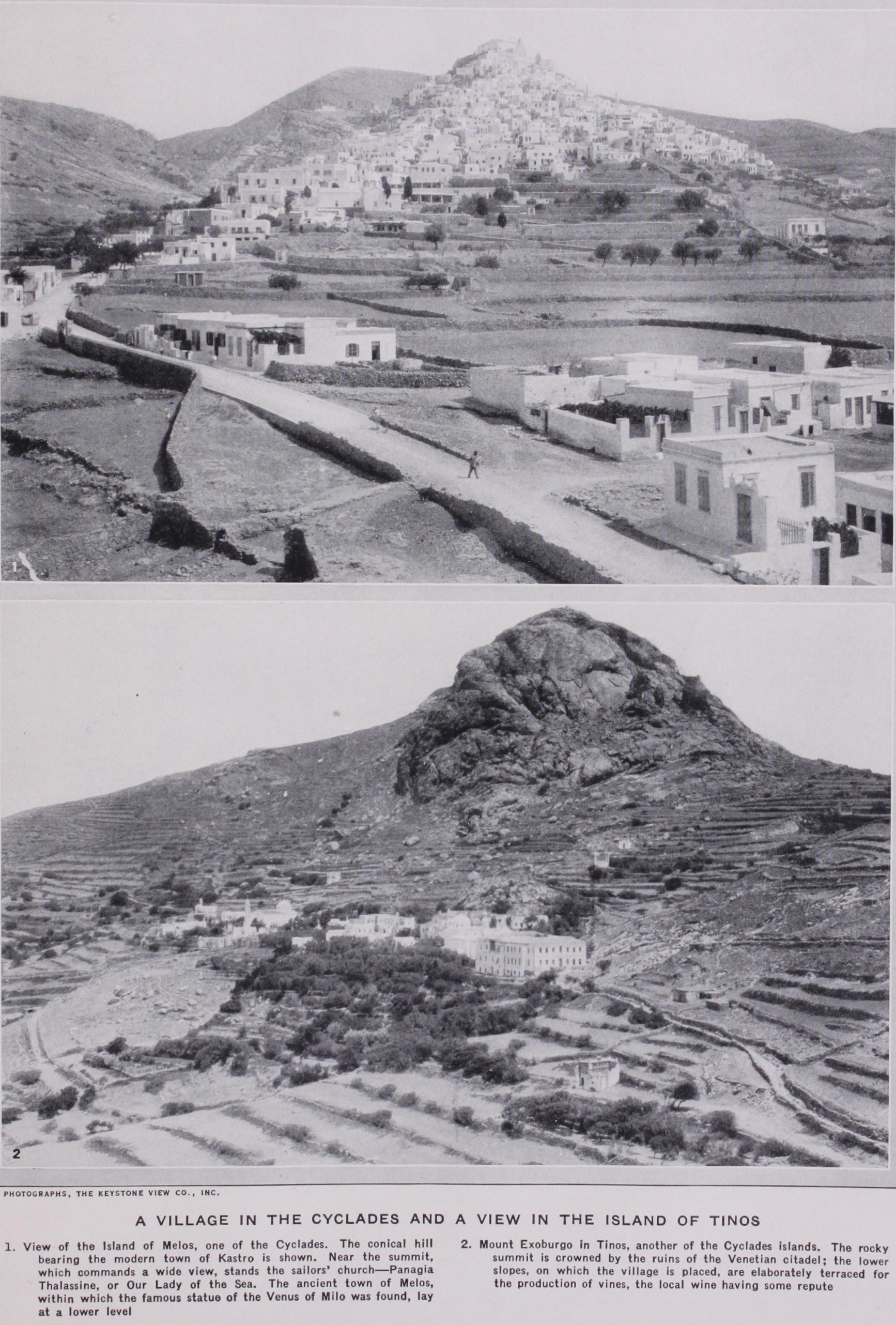
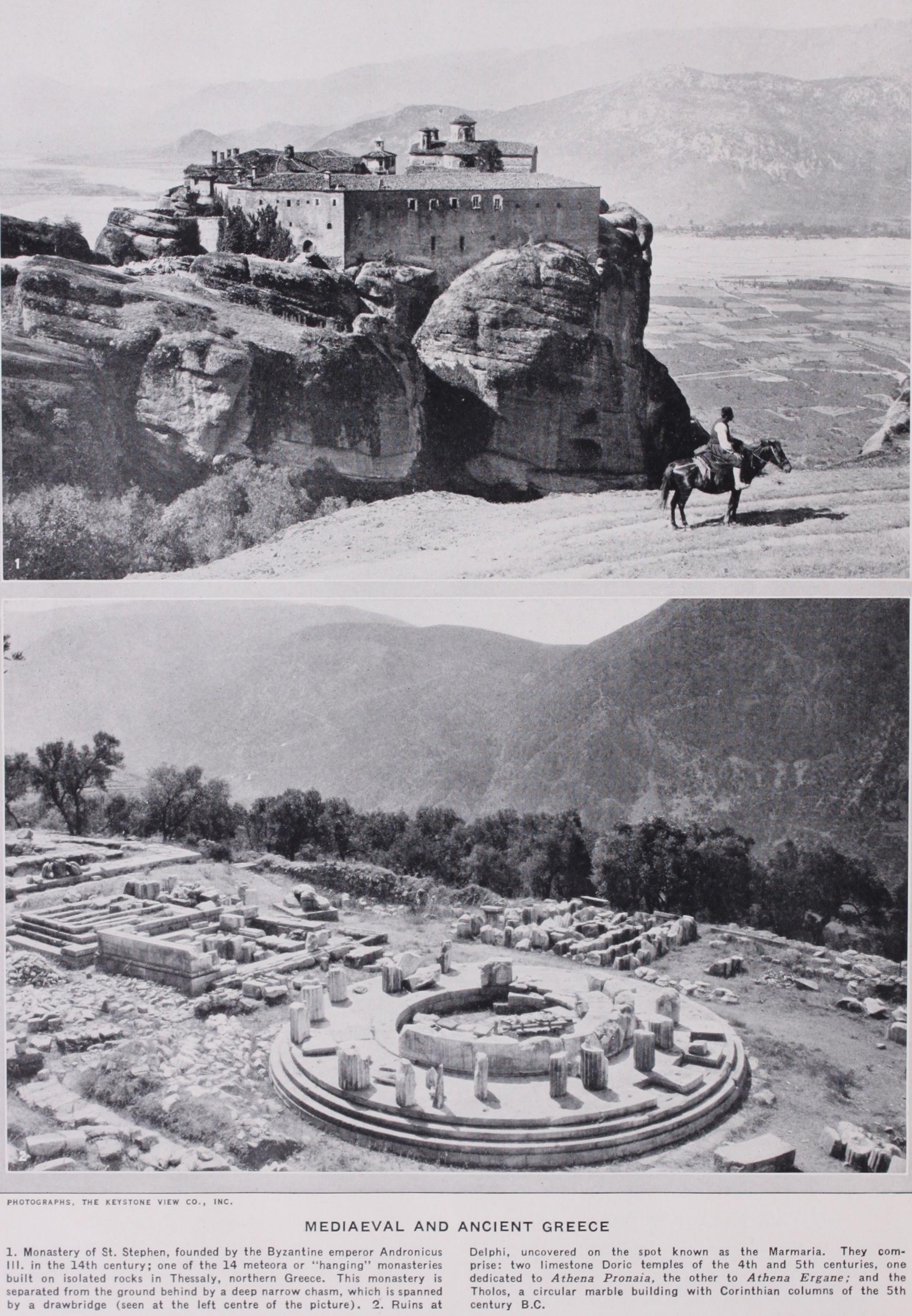
For the rest the people as a whole were very unsophisticated, very impressionable and very superstitious. Progressive in po litical ideas, they were singularly conservative of the supersti tions of religion, and quite ready to kill anyone who slighted, or seemed to slight, their age-old religious beliefs. They were more quick-witted than other races of the time ;'but, like other races of their type, had more capacity for conceiving the end than for de vising the means.
Imaginative writers of modern times have written Greek his tory in such a way as to convey the impression that Athens in this century was full of potential Aeschyluses and Pericleses. No century can produce many men of outstanding genius. The glory of the fifth century is that it produced more than any other cen tury in the long history of the old world. The idealised society of Thucydides' version of the funeral speech of Pericles has been taken as a true picture of social life in Athens in the latter half of the century, regardless of the very different picture implied in the contemporary plays of Aristophanes. Thucydides drew the picture of an ideal, not of an actuality.
The intellectual life of the time was lived by the learned few, the sophists or teachers, and those who had money enough and leisure enough to attend their lectures. The mass of the Greek people went meanwhile its own way : doing its daily work : getting as much enjoyment as possible out of life : but not worrying itself about abstract questions of a philosophical nature, the discussion of which it could not afford to hear. Only such intellectual mat ter as promised to bring some material gain appealed to the average man.
In the sixth century the Ionian cities of Asia had taken the lead in intellectual development. It was from Sicily that the next great movement came. Between 47o and 46o the states of the island passed from tyranny to democracy. Hitherto the Greek had left the art of persuasion to those who had the gift of elo quence. Certain clever heads in Sicily, however, conceived the idea that the art ran on certain lines which could easily be re duced to rules such as any man could learn under proper instruc tion. This was the beginning of rhetoric. It was naturally taken up keenly by those who had ambitions in the new democratic politics. But it was further recognised that underneath this prac tical science lay a more abstract science, that of Politics : so teachers of this arose. The sophists who taught it sailed with the wind, justifying Athenian imperialism by the dictum that the state existed by convention, the concession of the strong to the weak, and not by any divine ordering of nature, and flattering those who could afford to attend their lectures by laying down that only the wise should rule, that is to say, those who had studied politics under them.
The general result of the intellectual movement was that both the wise and the unwise sought political distinction by two differ ent roads, the wise by two abortive attempts at revolution, the unwise by a disastrous essay at world dominion. Socrates was the last great intellectual figure of the fifth century, teacher of doctrines which would have made the world and its people better had they only been able to interpret them aright. Some, like Critias, misinterpreted them to their own undoing, others, the mass of the Athenian people, to the undoing of the teacher.
The material life of the fourth century presents problems the solution of which is, in the absence of evidence, impossible at the present day. Despite the almost incessant warfare and po litical turmoil of the time the Greek states are in a better finan cial position than they were in the fifth century. They can face expenditure which would have ruined them in the previous age. Greek commerce must have expanded. Its decline begins with the gradual introduction of a gold standard into Mediterranean trade, rendered possible by the enormous mass of Persian gold which was let loose on the world by the conquests of Alexander the Great.
Scientific financial statistics can rarely be drawn from the records of ancient history; but there is good reason to believe that the ratios of value between gold and silver which in the fifth century had been io : i, had in the third century risen to i31 : i ; so something had to be done if Greek trade with its silver stand ard was to be saved. The success of the efforts at salvation was partial. The trading cities of the south Italian coast fell rapidly into commercial decline. Even the wealthy Sicily ceases to hold in the world the prominent position she had held in the fifth cen tury. In Greece Corinth alone maintained that impregnable trade position which her situation afforded her. For the rest the ten dency was for the centre of gravity of Greek trade to revert once more after several centuries to the east coast of the Aegean, especially to Rhodes. The position of that island on the route from Greece to the-Syrian ports, and on what was probably the most popular route to Egypt, had always promoted its trade development. The Athenian tribute lists of the latter half of the fifth century suggest that Rhodes was developing rapidly as a trade centre at that time, though it is not possible to say why. During the third century and the earlier part of the second she was by far the greatest trading centre in the Greek-speaking world, a position due to the fact that she maintained her inde pendence of the kingdoms of the Diadochi, and was at the meet ing point of the trade of the three great realms of the Macedonian kings, of the Seleucids of Asia and of the Ptolemies of Egypt. The importance of the Aegean as a centre of trade in the world of that period is shown by the eagerness of the otherwise self centred and, economically speaking, self-satisfied rulers of Egypt to get a footing in it.
Rhodes almost dominated the commercial world of the Levant until Roman political morality, debased by the growth of corn mercialism, established a rival centre at Delos, and thus with gross ingratitude impaired enormously the prosperity of a state which had been one of her most faithful allies. But Rhodes had already illustrated the connection between national prosperity and intellectual advancement by becoming one of the great schools of the world of the time.
A special and peculiarly puzzling problem of fourth century economics is the financial crisis in Sparta early in the century, brought about by the impoverishment of many of the Spartiate landholders. To such a state were they reduced that they were unable to pay their contributions to the communal life, and thus lost their privileged political status. This is one of the inexplicable enigmas among the many connected with the history of that enigmatic state. (See SPARTA.) Perhaps the most difficult problem of ancient economic life is the part which currency played in it. Dearness of money is a disturbing element even in the modern world where currency is relatively far more abundant than it ever was, even under the most favourable circumstances, in the world of Greece or even of Rome. The control of currency when coined money is scarce brings enormous profits to those who control it. The ancient world recognized this and disliked it. It regarded gain made by barren metal as contrary to nature. Currency did certainly at its first introduction into Mediterranean commerce create consider able economic difficulties. Some modern critics have ascribed to it the economic difficulties of Solon's time. But these were probably due to cruder causes. Currency had come to stay whether the thinkers of the ancient world disliked it or not.
The dominating position of Athens in the world of the fifth century may have been largely due to the fact that she controlled the two main sources of silver bullion accessible to the Greeks. The finances of the Athenian empire could not have been sup ported by the tribute alone ; and customs duties at Piraeeus brought in what was relatively but a small sum.
From the profits of Laureion alone she was, ere ever any tribute came to her, able to pay the expenses of the creation and upkeep of a fleet such as the Greek world had never known. When the mines of Thasos and the opposite mainland fell large ly, if not wholly, under her control, the profits of selling silver to a Greek trading world with a silver standard, and, in the main, a silver currency, must have been very great. In the fourth century and even later Attic coinage is circulating far beyond the bounds of the Greek world ; and the barbarians of central Asia will only accept coinage with the Attic stamp. The gradual introduction of a gold standard must have greatly weakened her position ; and the introduction of Roman coinage into the East must have destroyed it. But, in a world where means of com munication are few, slow and expensive, the man, corporation or state which has large control of currency can buy at a cheap rate from those who have goods to dispose of, and want, not exchange, but a medium of exchange. The dominant position of the great companies of Roman negotiatores in the last century of the Republic must have been largely due to a wide control of the floating currency capital of the world of their day.
The moral attitude of the Greek world towards slavery until the middle of the fourth century was quite simple—that slavery, having existed from time immemorial, was a natural institution, and therefore morally justifiable in the case of inferior races. In Aristotle's day certain philosophers raised the question of its justifiability, taking up a position which Aristotle himself refused to accept. Later still the Stoics raised the question in a more emphatic form ; and, though theorising could not kill so old an institution, yet it did undoubtedly lead men in general to deal more humanely with the slave. In any case the Greek had always shown to the servile class a consideration which was not general in the ancient world.
The period of the Diadochi which intervenes between Alexander and the subjection of the Greek world to Roman sway is one of such contrasts that it is difficult to estimate whether in respect to civilisation it marks an advance or decline as compared with former things. The Hellenistic world was harassed by war and disorder due to the clash of ambitions among the successors of Alexander. Egypt was least disturbed by this turmoil; and so Alexandria became a centre of intellectual culture where the learning of the past was studied and preserved by the greatest scholars of the age. The wealth and the comparative peacefulness of the life of Rhodes attracted the teachers and litterateurs of the time; while Athens, treated by reason of its past reputation with more respect and political tolerance than it perhaps de served, maintained a disputatious intellectual life which busied itself with matters of little moment to any save those who discussed them.
In the conflict between Julius Caesar and Pompey the Greeks provided the latter with a part of his excellent fleet. In 48 B.C. the decisive campaign was fought on Greek soil, and the resources of the land were severely taxed by the requisitions of both armies. As a result of Caesar's victory at Pharsalus the whole country fell into his power, but the treatment which it received was on the whole lenient. After the murder of Caesar the Greeks sup ported the cause of Brutus (42 B.C), but were too weak to render much service. They subsequently passed into the hands of M. Antonius, who imposed further exactions to defray the cost of his wars. The extensive levies and requisitions which he made in 31 B.C. for his campaign against Octavian exhausted the country so completely that afterr the battle of Actium Octavian had to take prompt measures to avert a general famine. The depopulation which resulted from the civil wars was partly remedied by the settlement of colonists at Corinth and Patrae by Julius Caesar and Octavian; on the other hand, the foundation of Nicopolis (q.v.) by the latter merely had the effect of transferring the peo ple from the country to the city.
(ii.) The Early Roman Empire (27 B.C.—A.D. 323) .—Under the emperor Augustus Thessaly was incorporated with Macedonia; the rest of Greece was converted into the province of Achaea, under the control of a senatorial proconsul resident at Corinth. Several states, including Athens and Sparta, retained their rights as free cities. The provincials were encouraged to send delegates to a synod which met at Argos to consider the general interests of the country and to uphold national Hellenic sentiment ; the Delphic revived and extended so as to represent in a similar fashion northern and central Greece.
Economic conditions did not greatly improve under the empire. Although new industries sprang up to meet the needs of Roman luxury, and Greek marble, textiles and table delicacies were in demand, the only cities which regained a flourishing trade were the partly Italian communities of Corinth and Patrae. Commerce languished in general, and the soil was mainly abandoned to pas turage. Such wealth as remained was amassed in the hands of a few great landowners and capitalists ; the middle class continued to dwindle, and many people became dependent on doles and largesses.
After a long period of stress, the European Hellenes relapsed into a resigned frame of mind. Seeing no future before them, the inhabitants were content to dwell in contemplation amid the glories of the past. National pride was fostered by the undisguised respect with which the leading Romans treated Hellenic culture. A healthy social tone repressed the ostentatious display of wealth, and good taste long checked the spread of gladiatorial contests beyond the Italian community of Corinth. In order to perpetuate their old culture, the Greeks continued to set great store by classi cal education, and in Athens they possessed one of the chief uni versities in the Roman empire. The highest representatives of this type of old-world refinement are to be found in Dio Chrysos torn and especially in Plutarch of Chaeroneia (q.v.). The Greeks had so far lost their warlike qualities that they supplied scarcely any recruits to the army. They retained too much local patriot ism to crowd into the official careers of senators or imperial servants. Although in the 1st century A.D. the astute Greek man of affairs and the Graeculus esuriens of Juvenal abounded in Rome, both these classes were mainly derived from the less pure blooded population beyond the Aegean. The influx of Greek rhet oricians and professors into Italy during the 2nd and 3rd cen turies was balanced by the large number of travellers who came to Greece to frequent its sanatoria, and admire its works of art ; the abundance in which these latter were preserved is strikingly attested in the extant record of Pausanias (about A.D. 170).
In A.D. 15 the Greeks petitioned Tiberius to transfer the admin istration to an imperial legate. This new arrangement was sanc tioned, but only lasted till A.D. 44, when Claudius restored the province to the senate. The years 66 and 67 were marked by a visit of the emperor Nero, who made a prolonged tour in order to display his artistic accomplishments at the various national festi vals. In return for the flattering reception accorded to him he bestowed freedom and exemption from tribute upon the country. But this favour was speedily revoked by the emperor Vespasian; and it was neutralized at the outset by the wholesale depredations of Nero among the Greek collections of art. Important material benefits were conferred by Hadrian, who made a lengthy visit to Greece. Besides erecting public works in many cities, he relieved Achaea of arrears of tribute and exempted it from various im posts. He fostered national sentiment by establishing a new pan Hellenic congress at Athens. In the 3rd century Greece again ex perienced danger from foreign invasions. Already in 175 a tribe named Costoboci had penetrated into central Greece, but was there broken up by the local militia. In 253 a threatened attack was averted by the stubborn resistance of Thessalonica. In 267-268 the province was overrun by Gothic bands, which captured Athens and some other towns, but were finally repulsed by the Attic levies under Dexippus, the historian, and exterminated with the help of a Roman fleet.
This prosperity received a sharp set-back by a series of un usually severe earthquakes in 375 and by the irruption of a host of Visigoths under Alaric whom the imperial officers allowed to overrun the whole land unmolested and the local levies were unable to check. Though ultimately hunted down in Arcadia and induced to leave the province, Alaric had time to execute systematic devastations which crippled Greece for decades. The arrears of taxation which accumulated in consequence were remitted by Theodosius II., the husband of an Athenian, in 428.
The emperors of the 4th century attempted to stamp out by edict the old pagan religion, but except for the decree of Theo dosius I. by which the Olympic games were interdicted (394), these measures had no great effect, and indeed were not rigor ously enforced. Paganism survived in Greece till about 600—in the Laconian mountains still later. The sure footing gained by the Christian Church upon the Greeks was strengthened by the judi cious manner in which the clergy, unsupported by official patron age and often out of sympathy with the Arian emperors, identi fied itself with the interests of the people. Though in the days when the orthodox Church found favour at court corruption spread among its higher branches, the clergy as a whole rendered conspicuous service in opposing the arbitrary interferences of the central government and in upholding the Hellenic tongue and culture.
The separation of the eastern and western provinces of the empire ultimately had an important effect in restoring the lan guage and customs of Greece to their predominant position in the Levant. This result, however, was long retarded by the roman izing policy of Constantine and his successors. The emperors of the 5th and 6th centuries had no regard for Greek culture, and Justinian I. actively counteracted Hellenism by propagating Roman law in Greece, by impairing the powers of the self-govern ing cities, and by closing the philosophical schools at Athens (529). In course of time the inhabitants had so far forgotten their ancient culture that they abandoned the name of Hellenes for that of Romans (Rhomaioi). For a long time Greece continued to be an obscure and neglected province, with no interests beyond its church and its commercial operations, and its culture declined rapidly. Its history for some centuries dwindles into a record of barbarian invasions, plagues and earthquakes. In the 5th century Greece was only subjected to brief raids by Vandal pirates (466 474) and Ostrogoths (482). In Justinian's reign irruptions by Huns and Avars took place, but led to no far-reaching results. The emperor had endeavoured to strengthen the country's de fences by repairing the fortifications of cities and frontier posts (53o), but his policy of supplanting the local guards by imperial troops and so rendering the natives incapable of self-defence was ill-advised.
Towards the end of the century mention is made for the first time of a big incursion by Slavonic tribes (581) . These invaders are to be regarded as the forerunners of a steady movement of immi gration by which a considerable part of Greece passed for a time into foreign hands. The newcomers, consisting mainly of Slovenes and Wends, occupied the mountainous inland, where they mostly led a pastoral life ; the natives retained some strips of plain and dwelt secure in their walled towns, among which the newly-built fortresses of Monemvasia, Corone and Calamata soon rose to prosperity. The Slavonic element, to judge by the geographical names in that tongue which survive, is specially marked in N.W. Greece and Peloponnesus ; central Greece appears to have been protected against them by the fortress-square of Chalcis, Thebes, Corinth and Athens. The central government took no steps to dislodge the invaders, until in 783 the empress Irene sent an expedition which reduced most of the tribes to pay tribute. In 807 a desperate attempt by the Slays to capture Patras was foiled; henceforth their power steadily decreased and their sub mission to the emperor was made complete by 85o. A powerful factor in their subjugation was the Greek clergy, who by the loth century had christianized and largely hellenized all the for eigners save a remnant in the peninsula of Maina.
In the loth century Greece experienced a renewal of raids from the Balkan tribes. The Bulgarians made incursions after 929 and sometimes penetrated to the Isthmus; but in 995 their strength was broken by a crushing defeat on the Spercheios at the hands of the Byzantine army, and after a still greater victory, Basil II. "the Bulgar-slayer," in ioi 8 prayed in the church which had arisen out of the Parthenon. Yet their devastations greatly thinned the population of northern Greece, and after 1084 Thes saly was occupied without resistance by nomad tribes of Vlachs. In 1084 also Greece was subjected to the first attack from the new nations of the west, when the Sicilian Normans gained a foot ing in the Ionian islands. The same people made a notable raid upon the seaboard of Greece in 1146, and sacked the cities of Thebes and Corinth. The Venetians also appear as rivals of the Greeks, and after 1122 their encroachments in the Aegean Sea began. In spite of these attacks, the country on the whole main tained its prosperity.
III. The Latin Occupation and Turkish Conquest.—The Iii. The Latin Occupation and Turkish Conquest.—The capture of Constantinople and dissolution of the Byzantine em pire by the Latins (1204) brought in its train an invasion of Greece by Frankish barons. The natives, who had long forgotten the use of arms and dreaded no worse oppression from their new masters, submitted almost without resistance, and practically only the N.W. corner of Greece, where Michael Angelus, a Byzantine prince, founded the "despotat" of Epirus, was saved from foreign occupation. The rest of the country was divided up between a number of Frankish barons, chief among whom were the princes of Achaea (or Peloponnese) and "grand lords" of Thebes and Athens, the Venetians, who held commercial stations at different maritime points, and the islands of Crete, and ultimately Euboea, and various Italian adventurers who mainly settled in the Cy clades which became "the duchy of the Archipelago" with Naxos as its capital. The conquerors transplanted their own language, customs and religion to their new possessions, and endeavoured to institute the feudal system of land-tenure, but they allowed the natives to retain their law and internal administration and confirmed proprietors in possession of their land on payment of a rent ; the Greek church was subordinated to the Roman arch bishops, and its dignitaries exiled. It later regained its former con trol over the people.
Greek history during the Latin occupation loses its unity and has to be followed in several threads. In the north the "despots" of Epirus extended their rule to Thessaly and Macedonia, but eventually were repulsed by the Asiatic Greeks of Nicaea, and after a decisive defeat at Pelagonia (1259) reduced to a small dominion in Epirus, while Thessaly from 1271 to 1318 was gov erned by a branch line of the Epirote dynasty, when it was united with the Catalan duchy of Athens. In 1349 it was conquered along with Epirus by Stephen Dushan, tsar of Serbia. In 1393 it was annexed by the Ottoman Turks, who in 1479 wrested the last fortress in Epirus from its latest possessors, the Beneventine family of Tocco, which from 1357 had held the Palatine County of Cephalonia, likewise annexed by the Turks in 1479 but soon occupied by the Venetians.
The leading power in central Greece was the Burgundian house de la Roche, which established a mild and judicious government in Boeotia and Attica, and which in 1261 was raised to ducal rank by the French king Louis IX. A conflict with the Grand Catalan Company resulted in a disastrous defeat of the Franks on the Boeotian Cephissus (1311) and the occupation of central Greece by the Spanish mercenaries, who seized for themselves the barons' fiefs and installed princes from the Sicilian house of Aragon as dukes of Athens and soon of Neopatras (Hypate). These ab sentees after 77 years of oppressive rule and constant wars with their neighbours the Catalans were expelled by the Floren tine Lord of Corinth, Nerio Acciaiuoli. The new dynasty, whose peaceful government revived its subjects' industry, survived a brief Venetian occupation, but was deposed by Sultan Mohammed II., who annexed Athens in 1456, and Thebes with the rest of Boeotia in 146o.
The conquest of the Peloponnese was effected by two French knights, William Champlitte and Geoffrey Villehardouin, the latter of whom founded a dynasty of "princes of all Achaea." The rulers of this line were men of ability, who controlled their barons and spiritual vassals with a firm hand and established good order throughout their province. The Franks of the Morea main tained as high a standard of culture as their compatriots at home, while the natives grew rich enough from their industry to pay considerable taxes without discontent. The climax of the Ville hardouins' power was attained under Prince William, who sub dued the Byzantine Gibraltar of Monemoasia and the mountaineers of Maina (1246-1249). In 1259, however, the same ruler was involved in the war between the rulers of Epirus and Nicaea, and being captured at the battle of Pelagonia, could only ransom him self by the cession of the Frankish quadrilateral of Monemoasia, Maina, Mistral and perhaps Geraki in 1262 to the restored Byzan tine empire. This Byzantine province with its capital at Mistral after 1348 was treated with great care by the Byzantine monarchs, who sought to repress the violence of the local aristocracies by sending their kinsmen to govern under the title of "despots." On the other hand, with the extinction of the Villehardouin dy nasty the Frankish province fell into anarchy; at the same time the numbers of the foreigners were constantly dwindling through war, and as they disdained to recruit them by intermarriage, the preponderance of the native element in the Morea eventually be came complete. Thus by 140o the Byzantines recovered control over almost the whole peninsula and apportioned it among several "despots," and in 1432 the last Frankish prince of Achaea died and the whole of the Peloponnese was Greek. But the mutual quarrels of these princes soon proved fatal to their rule. Already in the i4th century they had employed Albanians and the Turkish pirates who harried their coasts as auxiliaries in their wars. The Albanians largely remained as settlers, and the connection with the Turks could no longer be shaken off. In spite of attempts to fortify the Isthmus (1415) an Ottoman army penetrated into the Morea and imposed a tribute on the inhabitants in 1423. An invasion of central Greece by the despot Constantine, afterwards the last Greek emperor, was punished by a renewed raid in 1446. In 1457, his brother, the despot Thomas withheld the tribute which he had recently stipulated to pay, but was reduced to obedience by an expedition under Mahommed II. (1458). His quarrels with his brother Demetrius and inability to pay the tribute was punished by an invasion attended with executions and deportations on a large scale, and by the annexation of the Morea to Turkey (146o).
In the following centuries Greece was often the theatre of war in which the Greeks played but a passive part. Two wars with Venice put the Turks in possession of the last Venetian strongholds on the mainland, except Nauplia and Monemvasia, lost in 1 S4o. But the issue was mainly fought out at sea. Greek ships and sailors were frequently requisitioned for the Turkish fleets, and the damage done to the Greek seaboard by the belligerents and by fleets of adventurers and corsairs brought about the depopulation of many islands and coast-strips. The conquest of the Aegean, except Tenos, by the Ottomans was completed by 1566 ; but Venice retained Crete till 1669 and never lost Corfu until its cession to France in In 1684 the Venetians took advantage of the preoccupation of Turkey on the Danube to attack the Morea. By 1687 they had conquered almost the whole peninsula, and also captured Athens and Lepanto; but the former town had soon to be abandoned, and with their failure to capture Negropont (1688) the Venetians were brought to a standstill. By the peace of Karlowitz (1699) the Morea became a possession of Venice. The new rulers, in spite of the commercial restrictions which they imposed in favour of their own traders, checked the impoverishment and decrease of population (from 300,00o to 86,000) which the war had caused. But their rule, though mild, was not popular, and the population failed to support them when the Ottomans again attacked the Morea (1715), which by the peace of Passarowitz (1718) again became a Turkish dependency. The gaps left about this time in the Greek population were largely made up by an immigration from Albania.
The condition of the Greeks improved in the i8th century. Already in the 17th century the personal services of the subjects had been commuted into money contributions, and since 1676 the tribute of children had fallen into abeyance. Greek officials were increasingly used in the Turkish civil service and privileges were accorded to the Greek clergy throughout the Balkan coun tries. The education of the Greeks, which had always remained on a comparatively high level, was rapidly improved by the foundation of new schools and academies, especially at Yannina.
At the beginning of the 19th century Greece was still under Turkish domination; but the decadence of the Ottoman empire already showed in the weakening of the central power, the spread of anarchy in the provinces, the ravages of the janissaries, and the establishment of practically independent sovereignties or fiefs, such as those of Mehemet of Bushat at Skodra and of Ali Pasha of Tepelen at Yannina. In some of the remoter districts, indeed, the authority of the Turks had never been completely established; among the Greeks, the Mainotes in the extreme south of the Morea and the Sphakiote mountaineers in Crete had never been completely subdued. Resistance to Ottoman rule was maintained sporadically in the mountainous districts by the Greek klephts or brigands and by the pirates of the Aegean; the armatoles (q.v.) or bodies of Christian warriors, recognized by the Turks as a local police, often differed little in their proceedings from the brigands whom they were appointed to pursue.
By the treaty of Kutchuk-Kainarji (1 7 74) Russia obtained a vaguely defined protectorate over the Orthodox Greek subjects in Turkey, and the Greek traders the valuable right to sail under the Russian flag.
Under the influence of the French Revolution the sentiment of nationality and an ardent desire for political freedom awoke in the Greeks. The national awakening was preceded by a literary revival. Literary societies, like that of the Philomousoi at Athens came into existence ; schools were founded ; the philological la bours of Coraes (q.v.) which created the modern written language, furnished the nation with a mode of literary expression; the songs of Rhigas of Velestino fired the enthusiasm of the people. In 1815 was founded the celebrated Philike Hetairea, or friendly society, a revolutionary organization with centres at Moscow, Bucharest, Trieste, and in all the cities of the Levant ; it collected subscriptions, issued manifestos, distributed arms and made prep arations for the coming insurrection. The revolt of Ali Pasha of Yannina against the authority of the sultan in 182o formed the prelude to the Greek uprising; this despot, who had massacred the Greeks by hundreds, now declared himself their friend, and became a member of the Hetairea. In March 182I Alexander Ypsilanti, a former aide-de-camp of the Tsar Alexander I., and president of the Hetairea, entered Moldavia from Russian terri tory at the head of a small force ; in the same month Archbishop Germanos of Patras unfurled the standard of revolt at Hagia Lavra near Kalavryta in the Morea.
By the convention of London (May 7, 1832) Greece was de clared an independent kingdom under the protection of Great Britain, France and Russia, with Prince Otho, son of King Louis I. of Bavaria, as king. The frontier line, now traced from the Gulf of Arta to the Gulf of Lamia, was fixed by the arrangement of Constantinople (July 21, 1832). King Otho's despotic rule, and his employment of Bavarian advisers and troops, to the exclusion of the Greeks, was unpopular. On Sept. 15, 1843 a mili tary revolt compelled the king to dismiss the Bavarians and accept a constitution. A responsible ministry, a senate nominated by the king, and a chamber elected by universal suffrage were now instituted. Mavrocordatos, the leader of the English party, became the first prime minister, but was replaced after the ensuing elec tions by a coalition of the French and Russian parties under Kolettes and Metaxas. On the outbreak of hostilities between Russia and Turkey in 1853 the Greeks displayed sympathy with Russia ; armed bands were sent into Thessaly, and an insurrection was fomented in Epirus in the hope of securing an accession of territory. In order to prevent further hostile action on the part of Greece, British and French fleets made a demonstration against the Peiraeeus, which was occupied by an Anglo-French force dur ing the Crimean War. Meanwhile, a new generation had arisen. with which the childless and irresolute Otho was unpopular. In 1862 a military revolt broke out, and a national assembly pro nounced his deposition. In the following year Prince William George of Schleswig-Holstein-Sonderburg-Glucksburg, designated by the British government, was elected by the National Assembly with the title "George I., king of the Hellenes." Under the treaty of London (July 13, 1863) the change of dynasty was sanctioned by the three protecting powers, Great Britain undertaking to cede to Greece the seven Ionian Islands (q.v.), which since 1815 had formed a commonwealth under British protection.
On March 29 the crown prince assumed command of the Greek troops in Thessaly, and a few days later hostilities were precipi tated by the irregular forces of the Ethnike Hetairea, which at tacked several Turkish outposts near Grevena. On April 17 Turkey declared war. A brief and disastrous campaign followed (see GRAECO-TURKISH WAR). After the evacuation of Larissa on the 24th, great discontent prevailed at Athens ; Delyannes was dismissed (April 2g) ; his successor, Rhalles, after recalling the army from Crete (May 9) invoked the mediation of the powers, and an armistice was concluded on the 19th. The conditions of peace put forward by Turkey included a war indemnity of f Io, 000,000 and the retention of Thessaly; the latter demand, how ever, was resolutely opposed by Great Britain, and the indemnity was subsequently reduced to £4,000,000. The terms agreed to by the powers were rejected by Rhalles; the chamber, however, refused him a vote of confidence and King George summoned Zaimes to power (Oct. 3). The definitive treaty of peace, which was signed at Constantinople on Dec. 6, gave Turkey a slight modification of the frontier. Her troops finally evacuated Thes saly in June 1898. An immediate result of the war was the insti tution of an international financial commission at Athens, charged with the control of certain revenues assigned to the service of the national debt. The state of the country after the conclusion of hostilities was deplorable ; the towns of northern Greece and the islands were crowded with destitute refugees from Thessaly; violent recriminations prevailed at Athens, and the position of the dynasty seemed endangered ; but a reaction set in, in conse quence of an attempt to assassinate King George (Feb. 28, 1898). In the autumn the powers, on the initiative of Russia, decided to entrust Prince George of Greece with the government of Crete ; on Nov. 26 he was formally appointed high commissioner, and landed in Crete on Dec. 21 (see CRETE).
In Oct. 1908 the proclamation by the Cretan assembly of union with Greece threatened fresh complications, the cautious attitude of the Greek government leading to an agitation in the army, which. came to a head in 1909. On July 18 a popular demonstra tion against his Cretan policy led to the resignation of Theotokes. His successor, Rhalles, announced a programme of military and economical reform. The army, however, took matters into its own hands, and on Aug. 23 Rhalles was replaced by Mavromi chales, the nominee of the "Military League." For the next six months constitutional government was practically superseded by that of the league, which in Jan. 1910 summoned Venizelos from Crete as its political adviser. On Feb. 7, 1910, Mavromi chales resigned, and his successor, Dragoumis, accepting Venizelos' suggestion of a national assembly, persuaded the league to dis solve on receiving the king's assurance that such an assembly would be convened—a promise fulfilled on March 31.
But the obstruction of the party leaders soon obliged Venizelos to take the premiership himself and to appeal once more to the electorate. When the second revisionary National Assembly met on Jan. 22, 1911, he took office at the head of an overwhelming majority. During the following 18 months the constitution was revised, internal administration was thoroughly overhauled, army and navy were remodelled under French and British missions.
Disputes between the late allies led to the conclusion of a defensive alliance between Greece and Serbia in June, followed by war with Bulgaria (June 30). The treaty of Bucharest (Aug. 10, 1913) excluded Bulgaria from the Aegean port of Kavalla (q.v.) and carried the frontier of Greek Macedonia eastwards to the river Mesta and northwards to Doiran and Florina.
In Feb. 1915, when Britain definitely required Greek help for attacking the Dardanelles, the proposals of Venizelos for specific Greek forces to co-operate with the British fleet were unanimously approved by his own majority in the Chamber, and by a Crown Council of all the political leaders in the kingdom. King Constantine however dismissed Venizelos and dissolved the Chamber (April 10, 1915). The new premier, Gounaris, repre sented Venizelos as inspired only by love of war and hatred of the king. King Constantine was thus brought into party politics as a personal opponent of Venizelos and leader of the policy of neu trality. In mid-June the electors nevertheless returned the Liberal (Venizelist) party with a majority. But when Venizelos, after a delay excused by the king's illness, at last returned to office (Aug. 22), his efforts to immobilize Bulgaria by threatening Greek action were useless, because Germany had already been secretly informed that Greek neutrality would be guaranteed by King Constantine even in the event of a Bulgarian attack on Serbia. Bulgaria mobil ized on Sept. 19, 1915, and King Constantine allowed his prime minister to order a counter-mobilization, and even to suggest to Britain and France that they might reinforce the Graeco-Serbian co-operation with some of their own troops, a suggestion which led to the Allied landing at Salonika. But as soon as Venizelos, on the eve of the Bulgarian attack, explained once more his policy of defending Serbia and received a vote of confidence, he w as abruptly dismissed, and M. Zaimes was put up to explain that the Graeco-Serbian Treaty had a "purely Balkan character." The Chamber was again dissolved and elections held in December. The Liberals abstained from the polls, as a protest against this second and unconstitutional dissolution, and a government was formed under M. Skouloudes (Nov. 6), who declared "very benevolent neutrality" towards the Entente.
The "Three Protecting Powers," Britain, France and Russia, demanded certain administrative changes which might prevent any connivance between the government and the German espion age (June 21, 1916). The Greek army, which owing to the known sentiments of its general staff threatened the Allied base at Saloni ka, was at last demobilized; whereupon the Bulgarians invaded Macedonia and seized Kavalla. Meanwhile King Constantine frequently changed his premiers, and asked the French or British minister to suggest terms on which it might suit him to abandon his "neutrality." When, in August, Rumania joined the Allies and the king still refused to move, Venizelos seceded to Salonika (Sept. 25, 1916) with General Dangles and Admiral Condour iotes, set up a provisional government and began to organize a state militant. The Allies at first refused official recognition to the Salonika government. At Athens the French admiral suggested that King Constantine might surrender some of his war material. The king was understood to consent ; but when French and British marines landed to take delivery they were shot down by Greek troops (Dec. 1, 1916).
The Allies then broke off relations with the king, but, owing to the hesitations of Russia and Italy, did not demand his abdication till June 1917. He retired to Switzerland (June 12) and his second son Alexander was put on the throne. Venizelos returned to Athens as prime minister, recalled the Chamber, which had been unconstitutionally dissolved in Nov. 1915, and formally declared war against Germany, Turkey and Bulgaria (June 29). In July 1918, 2 50,00o Greek troops shared in the Macedonian offensive which culminated in the capitulation of Bulgaria (Sept. 3o, 1918).
Treaty of Sevres and Fall of Venizelos.—By the Treaty of Neuilly (q.v.) to which was annexed a Graeco-Bulgarian con vention for the protection of racial minorities, etc. (Nov. 27, 'gig), Bulgaria was cut off from the Aegean, the Allies undertak ing to ensure her an "economic outlet." The Treaty of Sevres (q.v.) (Aug. io, 192o) assigned to Greece the greater part of Thrace, and also the basin and Hinterland of Smyrna under a strictly controlled regime. Greek troops had landed at Smyrna at the request of the Supreme Council on May 15, 1919. Veni zelos had meanwhile lost touch with his people, and the govern ment at Athens had proved incompetent. The resulting discontents were exploited by Constantine's agents. King Alexander having died (Oct. 25) and his younger brother Prince Paul having refused the government's offer of the throne, the restoration of King Constantine became the real issue at the general election. On Nov. 14, 1920, Venizelos was heavily defeated at the polls. He resigned, and with many of his ministers left the country. A government was formed by the aged Demetrios Rhalles which entrusted the regency to the Dowager Queen Olga. After a plebiscite King Constantine returned to Athens (Dec. 19, 192o). The Allied Powers refused to recognize him officially, withdrew their financial assistance, and agreed to reconsider the Treaty of Sevres, which though signed had not been ratified. Greece was isolated; France and Italy both, overtly or covertly, supported Turkey, and Great Britain declined to embark on Eastern ad ventures.
Graeco-Turkish War.—Yet the new premier M. Kalogero poulos (Feb. 7, 1921) and his successor M. Gounaris (April 7) rejected the moderate proposals of a conference of the Three Powers (Britain France and Italy) which met in London (Feb. 21) to reconsider the Treaty of Sevres ; and instead promoted an offensive which, after seizing Afiun Qarahisar and Eskishehr, was disastrously defeated. King Constantine left for Smyrna, reject ing the friendly mediation of the Allied Powers. The Greek forces opened their new offensive in July, but in August were defeated on the river Sakkaria with very heavy losses. King Constantine returned to Athens and Gounaris and his foreign minister Baltat zes left for London and placed the interests of Greece without reserve in the hands of Lord Curzon. Meanwhile the French "Franklin-Bouillon" agreement with Kemal had been signed at Angora on the anniversary of Navarino (Oct. 2o) and Lord Curzon's ability to make peace was limited by the difficulty of coming to a preliminary agreement with France and Italy. Gounaris gave up all claim to the balance of credits guaranteed to Greece by the Allies during the Great War and received in return permission to raise a loan on the open market. When the Near East Conference met in Paris, proposals for an armistice and the evacuation of Asia Minor by the Greek army were trans mitted to Athens and the two Turkish governments of Constanti nople and Angora.
A few days before, Gounaris had privately addressed to Lord Curzon a desperate appeal for help. On May i 1922, he resigned and joined M. Stratos in a coalition under the premiership of M. Protopapadakes, who had previously as Minister of Finance raised a forced internal loan by cutting in half all the bank-notes in circulation. The first act of the new government was to remove the commander-in-chief, General Papoulas, and to appoint in his stead General Hadjianestes. In July the government had the independence of Ionia proclaimed by the high commissioner of Smyrna, M. Sterghiades. The Turks attacked on Aug. 26 and entered Smyrna on Sept. 9, 1922; five days later the whole city, with the exception of the Turkish quarter, was burned to the ground.
Revolution of Chios.—The government resigned on Sept. 8 after ordering the demobilization of the troops. Many units landed on Chios; and there a revolution headed by Colonel Plas teras broke out on Sept. 26. King Constantine left the country and died in the following January at Palermo. His eldest son, George, became king. Eight of his principal ministers and advisers in dicted by a special commission of enquiry were tried bef ore an extraordinary court-martial of 11 officers. Six of the accused (Gounaris, Stratos, Baltatzes, Theotokes, Protopapadakes and Hadjianestes) were shot (Nov. 28, 1922). The executions shocked Europe, and Great Britain withdrew her minister from Athens. A small but efficient army, re-formed on the Thracian frontier under the command of General Pangalos, greatly strengthened the hands of the Greek representative (Venizelos, who had consented to represent his country abroad) at the second conference of Lausanne which finally succeeded in signing peace with the Turks on July 24, 1923.
Refugees and Minorities.—Meanwhile the revolutionary government after proclaiming an amnesty for all political offences was confronted with the problem of the 1,400,00o refugees from Asia Minor. A loan of £Io,000,000 was raised (Dec. 1924) the administration of which was guaranteed by the League of Nations. In 18 months the Refugee Settlement Commission of the League of Nations had settled more than half -a-million refugees in new villages and urban districts throughout Greece. This settlement increased the homogeneity of population on the Greek frontiers, where the problem of alien minorities had al ready been reduced by a system of exchanging populations, em bodied in the Graeco-Bulgarian Convention (1919) for the voluntary emigration of minorities and the Graeco-Turkish Con vention (Jan. 3o, 1923) for the compulsory exchange of Moslem and Greek-orthodox minorities. The non-Greek population in Greek Thrace and Macedonia was reduced to a very small figure.
A second frontier incident with Bulgaria at Demir Kapou on Oct. 19 was also brought before the League which awarded damages against Greece.
General Pangalos, now dictator as well as premier, exiled to Santorin MM. Kaphandares and Papanastasiou and General Kon dyles, and, upon the resignation of the president on March 19, fixed the presidential election for April 4 and 11, and laid down the rules for the contest, in which he was himself a competitor. The republican leaders united on the candidature of M. Demertzes, a moderate royalist and ex-minister of marine, who, however, withdrew when General Pangalos failed to give the desired guar antees for freedom of election. In these circumstances the dictator, as sole candidate, was elected president. He then sought a premier who would be a puppet, and finally persuaded M. Eutaxias, an old ex-minister of the time of Delyannes, to accept the post. His brief premiership was chiefly remarkable for the conventions with Yugoslavia, signed by M. Rouphos, who had remained at the Foreign Office. These conventions were considered unfavourable to Greece, and, before they could be ratified, the dictatorship was over. On Aug. 22 General Kondyles, assisted by the dictator's own republican guard under Colonel Zervas, made a bloodless coup d'etat in the absence of the dictator at Spetsai ; General Pangalos endeavoured to escape on a torpedo boat, but was captured without resistance off Cape Matapan, and ultimately imprisoned in Fort Izzeddin in Crete. Admiral Cond ouriotes "resumed" the presidency with General Kondyles as premier till a general election should express the popular will. The premier's dissolution of the republican guard led on Sept. 9 to bloodshed such as Athens had not witnessed for many years, and the communists seized the opportunity to intervene. The elections, held on Nov. 7 with immense precautions, passed off in perfect quiet. The royalists participated, and the republican majority was so small that, for the second time in Greek history, an "oecumenical" government of all the party chiefs (except the communists) was formed under the premiership of M. Zaimis. This cabinet was reconstituted on Aug. I1, 1927, and again on Feb. 7, 1928. A crisis was caused by the return of Venizelos. The Government eventually resigned, May 29, and Venizelos took office. Elections (Aug. 19) gave the Liberals an overwhelming majority. On Sept. 23 Venizelos signed a Pact of Amity with Italy, and negotiations began with Turkey and Yugoslavia. On Dec. 12 a law was passed creating a Senate of 120 members, to be made up of 92 members elected by the people, 18 chosen by professional bodies, and io by the Chamber and Senate.