GRENADES, from the French word for a pomegranate, because of a resemblance in shape to the fruit. A grenade is a small metal missile, usually filled with high explosive, which may be thrown by hand or projected with the aid of a rifle. Grenades may also be charged with poison gas and incendiary or smoke producing compositions, but the essential features of the various kinds remain the same. Gunpowder grenades, made of wood, bronze and other materials, were used in the 16th century, but the term was also used to imply an explosive shell fired from a gun; this has survived to modern times in the German Granate. Hand missiles were employed after about 166o, by special troops called "grenadiers" (q.v.), and were in common use during the wars of the 17th and 18th centuries. They became obsolete in the I 9th century but were revived later in a high explosive form at the siege of Port Arthur in 1904 and in the trench fighting of the World War. Grenades are described as percussion or time grenades, according as to whether they explode on impact or after a definite time interval.
At the commencement of the World War, the limited supply of grenades in the British army was of the per cussion type, in which a needle in the head of the grenade is by direct impact caused to fire the detonator, a head-on fall being ensured by means of tail streamers. At a later date, an all-ways fuse was suggested which would fire the grenade in whatever posi tion it alighted. The main disadvantage of the percussion type is the danger of it exploding if accidentally dropped after being made "live" prior to throwing by the withdrawal of the safety pin or other safety device. These considerations led to the adoption of time grenades as being safer in action and allowing time in case of accident for the bomber to get clear or throw away the grenade. Furthermore, time grenades are more easily improvised than per cussion ones, and during the period of severe shortage of muni tions in the World War, many such grenades were constructed locally out of any handy receptacle. For this purpose a short projecting length (usually 5sec.) of safety fuse terminating in a detonator (for high explosive fillings) within the grenade was employed. Various friction or strike and cap combinations were used to ignite the fuse before throwing.
The principle of the time
ade is represented in its
est perfection in the Mills
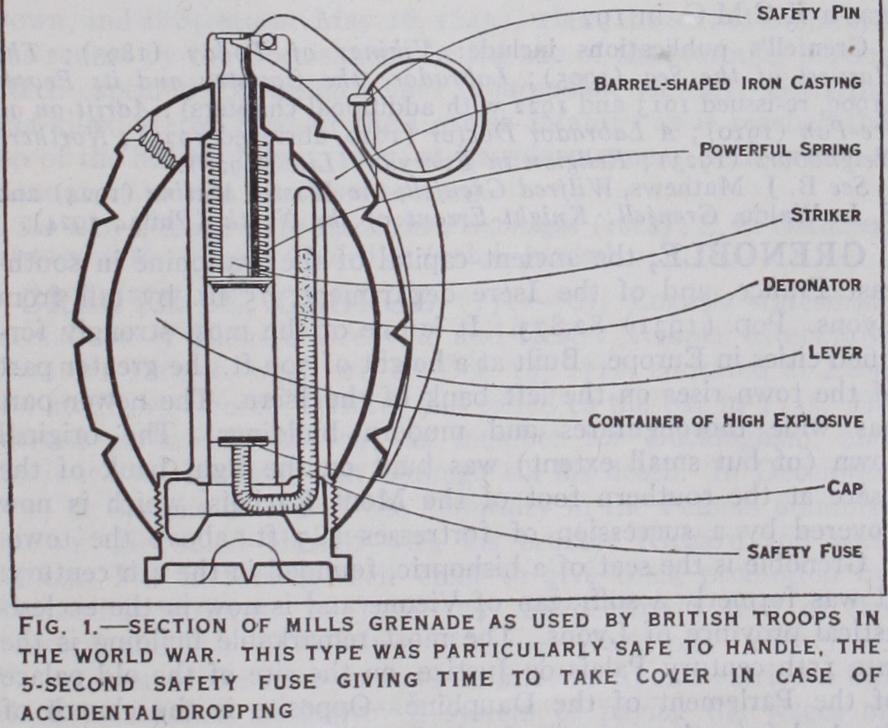
grenade (see fig. I), invented
during the war, of which
mous quantities were supplied
to the British forces. It
sists of a barrel-shaped iron
ing, externally grooved in
ments to ensure good
mentation, and of a size to be
conveniently clasped in the hand,
weighing I lb. 8 oz. and
taining 21 to 3 oz. of high
plosive ; amatol or ammonal in
powder form is convenient. The essential principle is that the
ignition of the time arrangement (the safety fuse) is caused
mechanically, as soon as the grenade is thrown. This is effected by
the release of a striker actuated by a powerful spring which until
then is restrained by a lever. On withdrawing the safety pin,
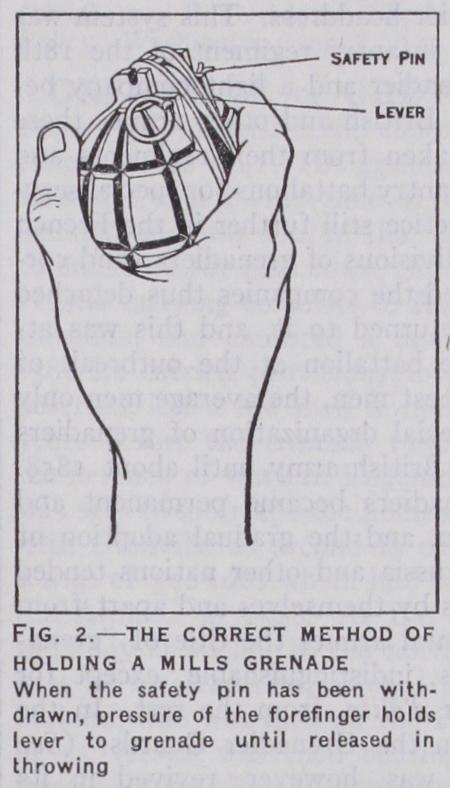
this lever is still held to the grenade by the thrower's fingers (see
fig. 2), but on the grenade leaving his hand, the loose lever flies
off and a cap is struck which ignites the 5sec. length of safety
fuse, which in turn fires the detonator and explodes the grenade.
Previous to the World War rifle grenades had been designed in order to obtain an increase of range beyond the restricted limits of hand throwing. These grenades were of the percussion type with a steel tail rod, which was inserted about join. into the muzzle of the ordinary service rifle and propelled by the gases from a blank cartridge, which impinges on the tail rod. The rodded rifle grenade, however, was not only unhandy, but tended to cause damage to the rifle. This led to the intro duction by the French of the discharger-cup or tromblon, a short cylindrical cup attached to the muzzle of the rifle. The grenade is placed in this cup and propelled from it by the gases from a blank cartridge fired in the rifle, acting on the base of the grenade. The Mills grenade can be adapted for firing from a dis charger-cup by the addition of a gas check plate, which is screwed into the base ; the side of the discharger-cup holds the loose lever in position until the grenade is projected clear, when it flies off and sets the grenade in action. In this way rifle and hand grenades can be made practically interchangeable, thus simplifying both supply and transport in the field.
The tendency of future design is in the di rection of percussion grenades, which are considered to be more effective than time ones, chiefly in that no time is given in which to get clear or to throw back the grenade before it explodes, in the event of the time fuse being too long in its burning. The chief difficulty to surmount is so to design the grenade that it is safe if dropped vertically by accident, but is made "live" in the space of a short flight. Other essential conditions are to act in any posi tion of impact or fall after throwing, to be interchangeable with trifling adjustment as a hand or rifle grenade, to be weatherproof and mudproof and to be simple in manufacture and use.
M. Ainslie, Hand Grenades (1917) ; G Dyson, Bibliography.-G. M. Ainslie, Hand Grenades (1917) ; G Dyson, Grenade Fighting (New York, 1917). See also the official Text Book on Service Ammunition.