
GROWTH may be defined as increase in volume or in bulk, and as such it may apply to anything, alive or dead. The most important use of the term is that which concerns the growth of living organisms, or organic growth, for growth is one of the fundamental properties of life.
Growth in Plants.—It is a peculiarity of the higher plants (trees, shrubs, etc.) that they grow actively throughout life, al though this growth may in other than tropical climates be re stricted to certain seasons. The apex of the stem is called the growing-point, and it is made up of a number of small, simple cells, capable of rapid multiplication. The simplicity of such cells is expressed by calling them embryonic or undifferentiated, and this condition is to be contrasted with that of older cells which are more complicated in structure (differentiated) and less easily capable of growth. New cells are thus continuously being pro duced and left behind by the growing-point as it moves further up. The material of which the new cells are composed is derived from the building up of new living matter or protoplasm out of food. The chief factor in the upward growth of the stem of a plant, however, is the absorption of water by the cells at some little distance beneath the growing-point. The result of this pro cess is that the cells become distended and elongated, and it illus trates the fact that growth may be due to the inflating effect of non-living substances (such as water), as well as to the produc tion of new living matter. The apex of the root is provided with a growing-point analogous to that of the stem, differing in that it is protected by a cap of cells which prevents the growing-point itself from being injured in its downgrowth through the soil. The root similarly elongates by the absorption of water by the cells.
In addition to growing in length, the stems and roots of dicoty ledons and gymnosperms are capable of another kind of growth, which results in the increase of their diameter. This is brought about by the formation of a cylindrical zone of embryonic cells, called the cambium, which, as its cells divide, produces new bast on the outside and new wood on the inside. In climates outside the tropics, this growth is seasonal, which accounts for the growth rings characteristic of cross-sections of stems.
Abnormal growths in plants are to be found in the case of galls, which are developed in response to the irritation caused by certain kinds of insects in the process of depositing their eggs, and in the development of these eggs.
Growth in Animals.—Growth is an important factor in the development of an animal from the egg to the adult, and also in regeneration, which is the replacement of lost parts. In some ani mals, and especially those which live in water, there appears to be no definite limit to the size to which they grow; that is to say that they grow throughout life. Maximum size is then determined by the time at which death occurs, and by the actual rate of growth. In other animals, such as birds and mammals, however, there is a fixed final adult size depending on a limit set by the bony skeleton. Insects also have a fixed adult size. When this size has been reached, only that small amount of growth takes place which is necessary for the repair of wear and tear and for the healing of wounds. The tissues whose cells are capable of mul tiplication throughout life are relatively undifferentiated (epi dermis, blood-corpuscles, certain glands), whereas highly differen tiated tissues such as nerve-cells never divide any more after birth in mammals. Elongated animals such as earthworms and tape worms have a special growth-zone, where the cells are embryonic and multiply to produce new segments which are intercalated in the body. This growth-zone is just in front of the hind end of the earthworm, and just behind the front end of the tape-worm; it is the nearest approach among animals to the growing-point of plants. In many cases the growth of animals may be seasonal as in bony fish, where the age and the size of the animal is propor tional to the number and size of the growth-rings on the scales. Abnormal growths in animals take the form of galls, as in some corals, or of tumours or can cers. These latter are groups of cells which start or continue to divide and grow at a time when they would not normally be doing so. Tumours may grow more or less fast, and they may lose the differentiated structure which they possessed more or less completely, and return to the embryonic condition. The fast-growing tumours which sometimes also invade the neighbouring tissues are called malignant, while more slowly growing tumours are described as benign.
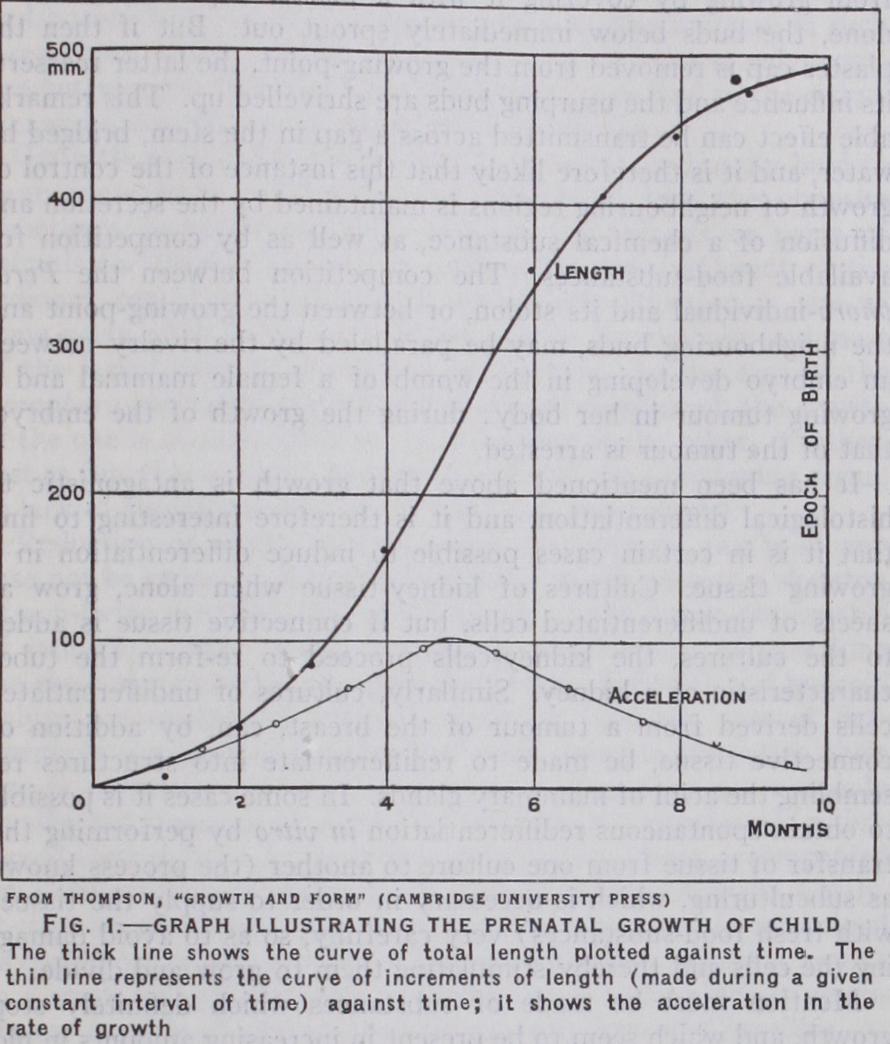
It is now necessary to return to the curve of total weight plotted against time, because its sigmoid shape is similar to that which characterises curves of certain chemical reactions called auto catalytic. In such a reaction, the speed of the reaction itself is accelerated by a substance (catalyser) which is a product of the selfsame reaction. As the reaction proceeds, more of this sub stance is produced, and the more of it there is, the faster the re action goes on, up to a point when half the material on which the reaction is working is used up. After this point, the speed of the reaction decreases through lack of "fuel." The similarity between the two curves has led to the view that growth itself is an auto catalytic chemical reaction. Some of the reactions which are con cerned in growth are possibly autocatalytic (such as the synthesis of nuclear matter during the cleavage of the egg), but it is not justified to regard growth as a whole as autocatalytic until chemi cal proof, now absent, is forthcoming, since S-shaped curves may result from various types of chemical process. In this connection, it may be mentioned that experiments on the growth of the nu cleus of certain Protozoa and embryos of sea-urchins at different temperatures, have given reason to believe that physical processes (such as imbibition, with temperature coefficients of zero or neg ative sign) are involved together with chemical processes (with positive temperature coefficients in the neighbourhood of Growth and Cell-multiplication.—Since living matter is divided up into cells, and true growth means the production of more living matter, it entails cell-growth, or cell-multiplication (by cell-division), or both. Now, the volume of a cell often stands in a quantitative relation to the volume of its nucleus. This has been shown experimentally in a number of cases in which it has been possible to alter the normal quantity of nuclear matter present in the cell. By causing eggs to develop parthenogenetically, the cells are made to contain only half the normal quantity of nuclear ma terial, and the volume of such cells is half the normal. This re lation can be expressed mathematically, and is called the nucleo cytoplasmic ratio. It varies with the tissue, the stage of develop ment, and with external conditions. Normally, all the cells of an organism contain an equal quantity of nuclear material, and it is found that for most types of tissue, at a given stage and under certain conditions, there is a characteristic normal cell-magnitude. It follows that since within a tissue cell-volume is more or less constant, tissue-growth is dependent on cell-division. Tissue growth by cell-growth alone (as in the case of the egg, or of the womb) is exceptional.
Interesting cases of growth are to be observed among the Arth ropoda. These animals, which include Insects and Crustacea, are characterised by the possession of a hard outer "shell," which is shed at intervals. Growth can only take place in jerks, during the intervals of time between the shedding of one shell and the forma tion of a new one. On comparing such animals after successive moults, it is common to find that their linear dimensions have been increased by a coefficient of about I.26. This figure is approxi mately the cube root of 2, and consequently, if each of the three linear dimensions has been multiplied by I.26, the volume of the animal has doubled. This would be expected if at each moult every cell of the body divided once, and the daughter-cells grew up to the characteristic cell-size. It is, however, not yet known if this is the correct interpretation.
The requirements of a plant are very simple. The carbon is ob tained from the carbon dioxide in the air, with the help of the green pigment chlorophyll and the energy of sunlight. Nitrogen is obtained from nitrates in watery solution in the soil, and this water may also contain the other necessary elements as simple salts. With these ingredients and the atmospheric oxygen ob tained in respiration, the plant is able to build up proteins, carbo hydrates and fats.
Animals, on the other hand, are unable to synthesise protoplasm from the simple f ood-constituents which suffice for the plant. Some of the simplest animals or Protozoa (q.v.) are capable of using substances such as ammonium glycerophosphate, but the majority of animals require for their food proteins, carbohy drates and fats. In other words, animals require the products which have been elaborated out of simpler substances by plants.
From the point of view of growth, carbohydrates and fats are important on account of the energy which they provide when they are oxidized, or burnt in the body ; but since they contain no ni trogen and nitrogen is present in protoplasm, the proteins, which are the only nitrogen-containing constituents of an animal's food, are of chief significance. This is not the place in which to deal extensively with the problem of nutrition, but attention may be called to a few points. Lysine is an amino-acid which is lack ing from certain proteins such as gliadin, and animals fed on glia din can maintain themselves in good health, but they cannot grow. Lysine is therefore necessary for growth, and these facts indicate that the processes which are concerned in the maintenance of protoplasm which has already been formed are not the same as those which are involved in the production of new protoplasm. An interesting point in connection with gliadin is that the young of gliadin-fed mothers grow normally so long as they are being suckled, showing that the mother can synthesise growth-promoting amino-acids, but when these young are fed on gliadin themselves, as stated above, they cease growing.
Vitamins (q.v.), or accessory food-factors, are well-known to be necessary in a diet, both for the maintenance of health and for growth. The quantity of vitamins necessary to allow of growth is insignificantly small compared with the amount of growth which their presence allows, and it is therefore clear that vitamins act in a manner similar to that characteristic of chemi cal catalysers. It is also known that an organic substance pro duced by seaweed is necessary for the growth of the microscopic plants called diatoms, and this substance is of importance because diatoms are at the beginning of the food-chain which ends in mar ketable marine fish. In a similar way, fermented peat produces a substance which greatly accelerates the growth of plants.
Of the internal secretions or hormones (q.v.) produced by special glands, those secreted by the thyroid, the anterior pitui tary and the cortex of the adrenal must be mentioned. Thyroid secretion raises the rate of metabolism of the tissues, and lack or excess of it may therefore affect a tissue's growth. The extent to which this occurs depends on the tissue, for a tadpole deprived of thyroid will grow nevertheless, but a mammal similarly deprived when young will remain small and undeveloped. Again, within an animal, the degree of susceptibility to thyroid varies with the tis sue, for when excess of thyroid is given to a tadpole, well-defined regions of the body (future limb-buds, lungs and tongue) respond by active growth, while other regions are unaffected, and as a re sult of the competition for foodstuffs may even be inhibited (e.g., tails) . The secretion of the anterior pituitary stimulates the growth of various tissues. An excess of this secretion in mam mals results in an exaggerated growth of the bones of the limbs and jaws, while a deficiency of it prevents young mammals from growing. The secretion of the cortex of the adrenal is mentioned here because, although its function in the body of the vertebrate animal which possesses it is still obscure, it has a powerful growth stimulating effect when given to such invertebrates as water-fleas (Daphnia) and pond-snails (Limnaea).
When a piece of tissue is removed from an animal and culti vated in vitro (see TISSUE-CULTURE) it will not grow well unless a substance obtained from embryos is added to it. This substance, which is called embryo-extract, appears to be derived from the embryo's liver, and it is remarkable in that it is not specific in its action, because embryo-extract derived from a bird will promote growth in mammalian tissues. Adult tissues are deficient in this substance. However, if adult tissue is killed and kept aseptically at body-temperature, disintegrative processes set in, resulting in what is called autolysis, in the course of which a very powerful growth-stimulant is produced. This substance, known as autolysed extract, when added to a tissue-culture, produces a violent onset of growth which lasts for about two days and then stops. It is probable that this substance is normally concerned in the process of repair of tissues after injury. When cells are damaged and killed in the body, they autolyse and produce enough of the auto lysed extract to stimulate neighbouring cells to grow, divide and replace the injured cells. Another interesting feature of auto lysed extract is the fact that its effects are similar to those ob tained when an extract from a growing tumour is added to a tis sue-culture. It appears therefore that apart from the already mentioned difference, as regards glycolysis in the presence of oxy gen, between normal tissues and tumours, the former possess the growth-stimulant of autolysed extract only occasionally (e.g., after damage), whereas the latter possess it permanently. It is further interesting to notice that extracts from malignant tumours have a more powerful growth-stimulat ing effect than those from be nign tumours. White blood corpuscles also appear to produce a growth-stimulant, the presence of which is necessary for the cicatrization of a wound.
Experiments on the cultivation of plant tissues in vitro have shown that the presence of vas cular bundles is necessary for the growth of potato tissue. In the vascular bundles are structures called "companion-cells," and their appearance suggests that they are the source of the growth promoting substance which is concerned with growth in diame ter of the stem. Injury to the cells of a plant may also result in the production of growth stimulating substances called "wound-hormones," which are sug gestive of the autolysed extract of damaged animal tissues.
There are a few other cases in which the presence of substances or of organisms is known or believed to be responsible for growth. Here may be mentioned the effect of tar, which, when applied to the skin of rats, results in the production of tumours. The pro duction of galls in plants is in some way associated with the lay ing of eggs by certain insects, and their development. A kind of tumour of the alimentary canal in rats is associated with the presence of a parasitic nematode worm (Gongylonema) which infests the cockroach as its alternative host. Lastly, there is the virus which is regarded by Gye as one of the factors responsible for the growth of tumours.
The nature of the restraining influence is very problematical. It seems that the region of the body where the rate of proto plasmic activity of the tissues is highest (see AXIAL GRADIENTS) exerts a physiological dominance over the other regions. The case of the sea-squirt Perophora is described in the article EXPERI MENTAL EMBRYOLOGY : Dedifferentiation, and it is only necessary here to recall the fact that under certain conditions the Perophora individual can stop the growth of its stolon (or stalk) while under other circumstances the stolon grows and absorbs the individual. In plants, the phenomenon known as correlation is in many ways comparable. It is found that the growing-point of the stem pre vents the buds immediately beneath it from shooting out, and this inhibitory influence extends for a certain distance beneath the growing-point : beneath this zone the buds do grow out unhindered. The range of this inhibitory influence can be reduced by subjecting a portion of the stem within the sphere of dominance to condi tions which depress vital activities, and it can be abolished alto gether by cutting off the growing-point or simply by preventing it from growing by covering it with a plaster cap. When this is done, the buds below immediately sprout out. But if then the plaster cap is removed from the growing-point, the latter reasserts its influence and the usurping buds are shrivelled up. This remark able effect can be transmitted across a gap in the stem, bridged by water, and it is therefore likely that this instance of the control of growth of neighbouring regions is maintained by the secretion and diffusion of a chemical substance, as well as by competition for available food-substances. The competition between the Pero phora-individual and its stolon, or between the growing-point and the neighbouring buds, may be paralleled by the rivalry between an embryo developing in the womb of a female mammal and a growing tumour in her body : during the growth of the embryo, that of the tumour is arrested.
It has been mentioned above that growth is antagonistic to histological differentiation, and it is therefore interesting to find that it is in certain cases possible to induce differentiation in a growing tissue. Cultures of kidney-tissue when alone, grow as sheets of undifferentiated cells, but if connective tissue is added to the cultures, the kidney-cells proceed to re-form the tubes characteristic of a kidney. Similarly, cultures of undifferentiated cells derived from a tumour of the breast, can, by addition of connective tissue, be made to redifferentiate into structures re sembling the acini of mammary glands. In some cases it is possible to obtain spontaneous redifferentiation in vitro by performing the transfer of tissue from one culture to another (the process known as subculturing, which is necessary in order to supply the tissues with fresh food-substances) very carefully, so as to avoid damag ing the cells and thereby stimulating them to grow and divide.
Mention must be made of substances which definitely stop growth, and which seem to be present in increasing amounts in old animals. A substance has been found which stops the growth of tumours. It is obtained by repeatedly injecting extracts of the tumour into an animal, the blood of which eventually produces an antiserum. This antiserum, when injected into an animal possessing a tumour of this kind, stops its growth.
Heterogonic Growth.—Information of great interest is ob tained from a study of the relative sizes of parts of animals at different absolute sizes. It is found in the case of the antlers of deer that the ratio between the weight of the antler and the weight of the body is not the same at all sizes : it increases with increasing body-weight, both in the individual life-history and also in com paring adult deer, so that the larger the deer the relatively larger are its antlers. Another case is that of the width of the abdomen of the common shore-crab (Carcinus) . In the male crab, the width of the abdomen is proportional to the length of the body at all .sizes. In the female, however, the width of the abdomen increases relatively to the length of the body at increasing sizes of the latter, throughout life. Several other instances might be given of the same phenomenon : the relative increase in the size of the claw in certain male crabs ; in the length of the mandibles in male stag-beetles; in the size of the head in neuter ants; in the size of the face in dogs. Such organs are said to show heterogonic growth. In all these cases, the relative growth-rates of the hetero gonic organ and of the rest of the body remain constant during long periods. As a rule, it is found that the weight of the hetero gonic organ (y) is proportional to the weight of the rest of the body (x) raised to a power, usually between I.25 and 2•0. Thus, y = bxk, where b and k are constants. Heterogonic growth is of interest for the following reasons. First, animals showing long-continued heterogonic growth of any part have no definitive shape, since it varies with absolute size. Next, when several species of animal in a genus have a heterogonic organ (such as antlers in deer), the species which are absolutely larger will in general have the rela tively larger heterogonic organ. The introduction of a constant differential growth-rate such as results in positive heterogony, explains the progressive enlargement of an organ during evolution, if f o: some other reason the absolute size of the body increases (which it often does). This may happen in different groups of related animals, in each of which the heterogonic organ seems to appear independently. This phenomenon, which has been attrib uted to a mysterious process of "orthogenesis," thus receives its explanation for it is a fact that absolute size does increase in such cases, as for instance in the Titanotheria (q.v.). Conversely, nega tive heterogony, and decrease of body-size, may lead to the reduc tion and disappearance of structures in evolution.
Growth and growth is ordinarily held to mean increase in size, it may be mentioned that the opposite sometimes happens, and it is possible for animals or parts of animals to "grow" smaller. In some cases, the fulfilment of the ordinary course of development entails the reduction in size of some parts, such as the tail and the gills in the tadpole, and most of the larval body in developing sea-urchins. In the case of the Perophora-individual and its stolon already mentioned, the growth of the one is accompanied by the reduction of the other. Further, just as function tends to increase the size of the functioning organ, so lack of function results in its reduction and atrophy.
Reduction of whole animals is not so common, and is in any case not be expected in the higher forms which possess a skeleton of non-living material. Nevertheless, sea-urchin larvae are capable of reduction under certain conditions, and thereby of unmaking the skeletal struts which support their arms. Jelly-fish and hydroid polyps are capable of extreme reduction, and the case of flat worms is especially interesting, for when owing to starvation their size is reduced to a fraction of what it was, they are not only smaller but younger, as judged by the rate of protoplasmic activi ties of their tissues. In their case, reduction has been accompanied by dedifferentiation and has resulted in rejuvenescence. Lastly, it may be mentioned that reduction can take place in an animal as highly organized as is the sea-squirt Clavellina, where it results in a small ball of relatively undifferentiated cells, which is never theless capable of redeveloping into a fully-formed Clavellina.
Growth Limits.—An animal with a positive heterogonic struc ture such as a pair of antlers must not exceed a certain size, or the structure becomes so large as to render it difficult for the animal to gain a living. This appears to have beet. the case with the now extinct Irish "elk" (really a giant fallow-deer). Numer ous examples might be given of limits to growth which affect phylogeny rather than ontogeny, i.e., of limiting factors which do not prevent an animal from growing but which result in its death if it exceeds a certain size, and thereby abolish its chance of leaving offspring. In the higher terrestrial animals, the weight of the body is supported by the legs. The weight of the body is proportional to its volume, or to the cube of its linear dimensions. The strength of the legs, however, is proportional to their cross sectional area, or to the square of the linear dimensions. It follows that when the absolute size of such animals increases, the weight of the body increases out of proportion to the increased strength of the supporting legs. If the skeletal material could be altered from bone to anything stronger, a margin of safety might be retained, but this is of course impossible, and the result is that there is a maximum size beyond which land-animals must not grow, for if they did, their legs would have to be so massive as to be immovable, and such animals could not live. The elephants appear to be close to this maximum limit. It is to be noticed that this limiting factor does not apply to animals which live in water and which are not supported by their limbs. The whales therefore have been able to grow to sizes vastly greater than any that would be possible for terrestrial animals.
See AXIAL GRADIENTS ; CANCER ; DEDIFFERENTIATION ; ENDOC RINOLOGY IN ANIMALS; EXPERIMENTAL EMBRYOLOGY ; GALLS; GRAFTING IN ANIMALS; HORMONES; REGENERATION IN ANIMALS; TISSUE-CULTURE ; VITAMINS.