
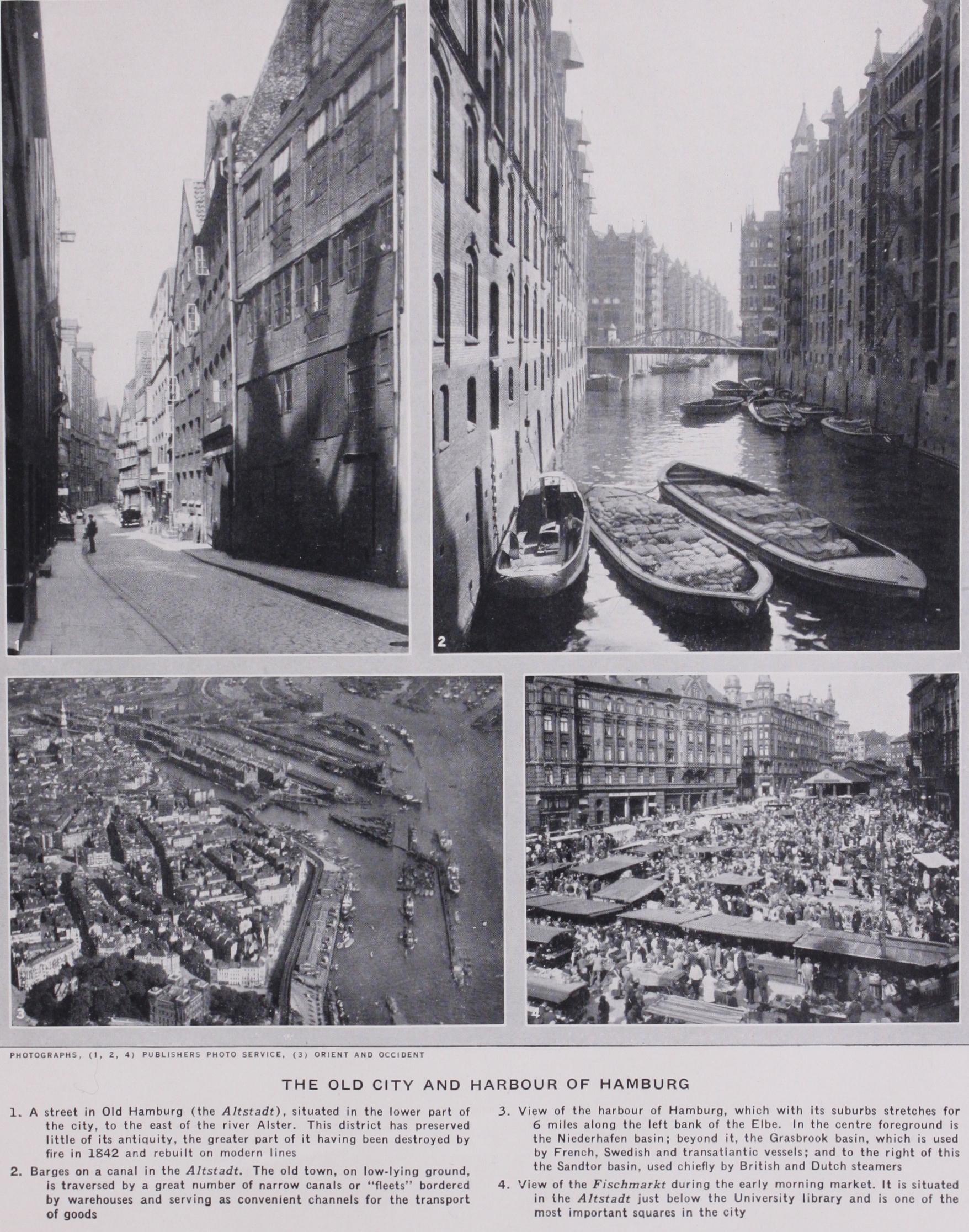
HAMBURG, a seaport of Germany, the capital of the Land of Hamburg, on the right bank of the northern arm of the Elbe, 75 m. from its mouth at Cuxhaven and 178 m. N.W. from Berlin by rail, is the largest seaport on the continent of Europe. Pop. 1,079,126. In 1927 the number of ships entering the port was 14,788 with a tonnage of 17,423,197. The city proper lies on both sides of the little river Alster, which, dammed up a short distance from its mouth, forms a lake, of which the southern portion within the line of the former fortifications bears the name of the Inner Alster (Binnen Alster), and the other and larger portion, that of the Outer Alster (Aucssen Alster). The oldest portion of the city lies to the east of the Alster. To the west lies the new town (Neustadt), incorporated in 1678; beyond this and contiguous to Altona is St. Pauli, incorporated in 1876, and towards the north-east St. Georg, which arose in the 13th century but was not incorporated till 1868.
The old town lies low, and it is traversed by a great number of narrow canals or "fleets" (Fleeten) which serve as convenient channels for transport of goods. They are bordered by warehouses, cellars and the lower class of dwelling-houses. As they are sub ject to the ebb and flow of the Elbe, at certain times they run almost dry. The Binnen and Aussen Alster are separated by the Lombardsbrucke and surrounded by newer buildings. Shallow draught screw steamers provide means of communication between the business centre of the city and the outlying suburbs, and down to Gliickstadt, Hamburg and Cuxhaven. The largest of the public squares in Hamburg is the Hopfenmarkt, which con tains the church of St. Nicholas (Nikolaikirche) and is the prin cipal market for vegetables and fruit. Others of importance are the Gansemarkt, the Zeughausmarkt and the Grossneumarkt. The St. Petrikirche, Nikolaikirche, St. Katharinenkirche, St. Jakobi kirche and St. Michaeliskirche give their names to the five old city parishes. The old Nikolaikirche was destroyed in the great fire of 1842, and the new building, designed by Sir George Gilbert Scott in 13th century Gothic, was erected 1845-74. The Michaelis kirche, on the highest point in the city, is remarkable for its bold construction, there being no pillars. The St. Petrikirche, originally consecrated in the 12th century and rebuilt in the 14th, was the oldest church in Hamburg; it was burnt in 1842 and rebuilt in its old form in 1844-49. It has the granite columns from the old cathedral. The St. Katharinenkirche and the St. Jakobikirche are the only surviving mediaeval churches.
The new Rathaus, a German Renaissance building, constructed of sandstone in 1886-97 contains the city archives. Immediately adjoining it and connected with it is the exchange, erected in 1836-41 on the site of the convent of St. Mary Magdalen. Along the line of the former town wall are the criminal law courts (1879-82, enlarged 1893) and the civil law courts (finished in 1901). Facing the botanical gardens a new central post-office, in the Renaissance style, was built in 1887. The picture gallery contains works by modern masters, while the museum for art and industry, with which is connected a trades school, founded in 1878, is one of the most important institutions of the kind in Germany. It also contains public zoological gardens, Hagenbeck's private zoological gardens in the vicinity, schools of music and navigation, and a school of commerce. In 1900 a high school for shipbuilding was founded, and in Igo' an institute for sea men's and tropical diseases, with a laboratory for their physio logical study, was opened. In 1919 a university was founded in the city.
Manufacturing industries developed greatly after 1888, when Hamburg joined the German customs union, and the barriers which prevented goods manufactured at Hamburg from entering into other parts of Germany were removed. The import trade of various cereals by sea to Hamburg is very large, and a considerable portion of this corn is ground at Hamburg itself. There are also, in this connection, numerous bakeries for biscuit, rice-peeling mills and spice mills. Besides the foregoing there are cocoa, chocolate, confectionery and baking-powder factories, coffee roasting and ham-curing and smoking establishments, lard re fineries, margarine, and fish-curing, preserving and packing fac tories. There are numerous breweries, spirit distilleries and fac tories of artificial waters. There are large jute-spinning mills and factories for cotton-wool and cotton driving-belts. Among other important articles of industry are tobacco and cigars, hy draulic machinery, electro-technical machinery, chemical products (including artificial manures), oils, soaps, india-rubber, explo sives, ivory and celluloid articles, furniture, wall paper and the manufacture of leather.
Shipbuilding is an important industry, and in Hamburg ocean going steamers of the largest class are built. Along with this we have the allied industries of iron founding, and the manu facture of steel plate, ships' paint, oil fuel, cork, nautical and other instruments. Bicycles, sewing machines, carriages and motor cars are also made, and tin, zinc and copper works are found here. In 1888 a portion of the port was set apart as a free harbour, altogether an area of 75o ac. of water and 1,75o ac. of dry land, with a system of docks, basins and quays, and since 1910 the area of the free port has been much enlarged. During the last 25 years of the i9th century the channel of the Elbe was greatly improved and deepened, and during the last two years of the i9th century some £360,00o was spent by Hamburg alone in regulating and correcting this lower course of the river. The total water area of the port is now 4,095 ac., the area for sea-going ships being 2,184 ac., with a quay length of 20 miles. University.—The University of Hamburg was formed in 1919 from the material of the Colonial Institute, and consists of the faculties of law, medicine, philosophy and natural science. Special facilities exist for study of phonetics and of the history and culture of the Orient generally, of India, China, Japan, Africa and the South seas. Anthropology, folklore and missionary prob lems are among the many notable features of the courses.
Hamburg probably had its origin in a fortress erected in 8o8 by Charlemagne, on an elevation between the Elbe and Alster, as a defence against the Slays, and called Hammaburg because of the surrounding forest (Hamme) . In 81 I Charlemagne founded a church here, perhaps on the site of a Saxon place of sacrifice, and this became a great centre for the evangelization of the north of Europe, missionaries from Hamburg introducing Chris tianity into Jutland and the Danish island and even into Sweden and Norway. In 834 Hamburg became an archbishopric, St. Ans gar, a monk of Corbie and known as the apostle of the North, be ing the first metropolitan. In 845 church, monastery and town were burnt down by the Norsemen, and two years later the see of Hamburg was united with that of Bremen and its seat transferred to the latter city. The town, rebuilt after this disaster, was again more than once devastated by invading Danes and Slays. In I I Io Hamburg, with Holstein, passed into the hands of Adolph I., count of Schauenburg, and it is with the building of the Neustadt (the present parish of St. Nicholas) by his grandson, Adolph III. of Holstein, that the history of the commercial city actually be gins. In return for a contribution to the costs of a crusade, he obtained from the emperor Frederick I. in 1189 a charter grant ing Hamburg considerable franchises, including exemption from tolls, a separate court and jurisdiction, and the rights of fishery on the Elbe from the city to the sea. The city council (Rath), first mentioned in 119o, had jurisdiction over both the episcopal and the new town. Craft gilds were already in existence, but these had no share in the government. The defensive alliance of the city with Lubeck in 1241, extended for other purpose by the treaty of 1255, practically laid the foundations of the Hanseatic League (q.v.), of which Hamburg continued to be one of the principal members. The internal organization of the city, too, was rendered more stable by the new constitution of 1270, and the recognition in 1292 of the complete internal autonomy of the city by the count of Schauenburg. The exclusion of the handicraftsmen from the Rath led, early in the 15th century, to a rising of the craft gilds against the patrician merchants, and in 141 o they forced the latter to recognize the authority of a committee of 48 burghers, which concluded with the senate the so-called First Recess ; there were, however, fresh outbursts in 1458 and 1483, which were set tled by further compromises. In 151 o Hamburg was made a free imperial city by the emperor Maximilian I.
In 1529 the Reformation was definitively established in Ham burg by the Great Recess of Feb. 19, which at the same time vested the government of the city in the Rath, together with the three colleges of the Oberalten, the Forty-eight (increased to 6o in 1685) and the Hundred and Forty-four (increased to i8o). The ordinary burgesses consisted of the freeholders and the master-workmen of the gilds.
The trade of Hamburg received its first great impulse in 1783, when the United States, by the Treaty of Paris, became an inde pendent power. From this time dates its first direct maritime communication with America. Its commerce was further extended and developed by the French occupation of Holland in when the Dutch trade was largely directed to its port. The French Revolution and the later occupation of the city by Napoleon, however, exercised a depressing and retarding effect. Under the long peace which followed the close of the Napoleonic wars, its trade gradually revived, fostered by the introduction of steam navigation and the Declarations of Independence of South and Central America, with both of which it opened close commercial relations. In 1866 Hamburg joined the North German Confedera tion, and in 1871 became a constituent state of the German empire.