
HINDENBURG LINE, BATTLES OF 1918. On Aug.
26, 1918, began the third stage of the series of offensive opera tions which formed the British share of the Allied advance to victory. This stage culminated on Oct. 5 in the capture of the last and strongest system of German defence, known as the Hindenburg Line. The first stage had been the attack by Rawlin son's IV. Army, assisted by the French I. Army under Debeney, eastwards and southeastwards from Amiens with the object of freeing the Paris-Amiens railway. In the second phase the Brit ish III. Army under Byng had extended the front of the attack northwards by a successful thrust towards Bapaume. The British I. Army under Horne was now to broaden the front of attack by driving eastwards from Arras with the object of turning the Ger man positions on the Somme battlefields.
On the night of Aug. 25-6 the British line extended from a point northwest of Chaulnes, where the right of the British IV. Army joined the left of the French I. Army, east of Bray, west of Bapaume to Croisilles, and thence northwest to the old British line, southeast of Arras. The IV. Army had the Australian and III. Corps in line ; the III. Army, which extended northwards from a point east of Albert, had the V., IV., VI. and XVII. Corps. The I. Army front was held by the Canadian Corps and the VIII. and I. Corps, of which only the Canadian Corps, astride the Scarpe, was involved in the operations to be described. The German troops who were to bear the brunt of the impending blow were the left wing of Billow's XVII. Army, the II. Army under Marwitz and the right wing of Hutier's XVIII. Army.
The attack of the Canadian Corps was launched at 5:oo A.M. by the Canadian 1st and 4th and the British 4th Divs., sup ported by some 500 guns and 4o tanks, on a front of 44 miles. All resistance on the first objective was speedily overcome, and by 9:15 A.M. the whole system of trenches on the front of the Canadian Corps was in the hands of the assaulting troops. On the XVII. Corps front, the attack was launched at the same hour and met with equal success. The 52nd Div. stormed the network of trenches at the junction of the two systems, and after heavy fighting succeeded in overcoming all resistance. The 57th Div., attacking north of the 52nd, pressed forward south of the Cana dians, and by nightfall had swung round to the right and were threatening the villages of Queant and Pronville from the north. The 63rd Div., which passed through to exploit the success, had heavy fighting during the afternoon, but by dark had reached the railway east of Queant.
During the afternoon the Canadian Corps met with increased opposition, particularly from machine-guns on the British 4th Div. front, but by the evening an advance of some 3m. had been made and British troops had captured Cagnicourt, Villers and Dury, and were approaching the outskirts of Buissy. Eight thousand prisoners and many guns were captured, bringing the total captures on the I. Army front alone since Aug. 26 to 16,000 prisoners and 200 guns. In eight days the io British and Cana dian divisions employed by the I. Army had defeated 13 German divisions and driven them back Iom., out of all their organized positions in front of Cambrai. Troops of the III. and IV. Armies prolonged the attack southward on Sept. 2, and substantial progress was made, though the fighting was severe.
The results of this most successful operation became obvious at once, as on the night of Sept. 2-3 the Germans fell back to the line of the Canal du Nord from Peronne to Hermies. The follow ing day they commenced to withdraw from the Somme, south of Peronne, and by the night of Sept. 8 they were back on a line Vermand (6m. west of St. Quentin)-Epehy-Havrincourt and thence along the east bank of the Canal du Nord to the Sensee.
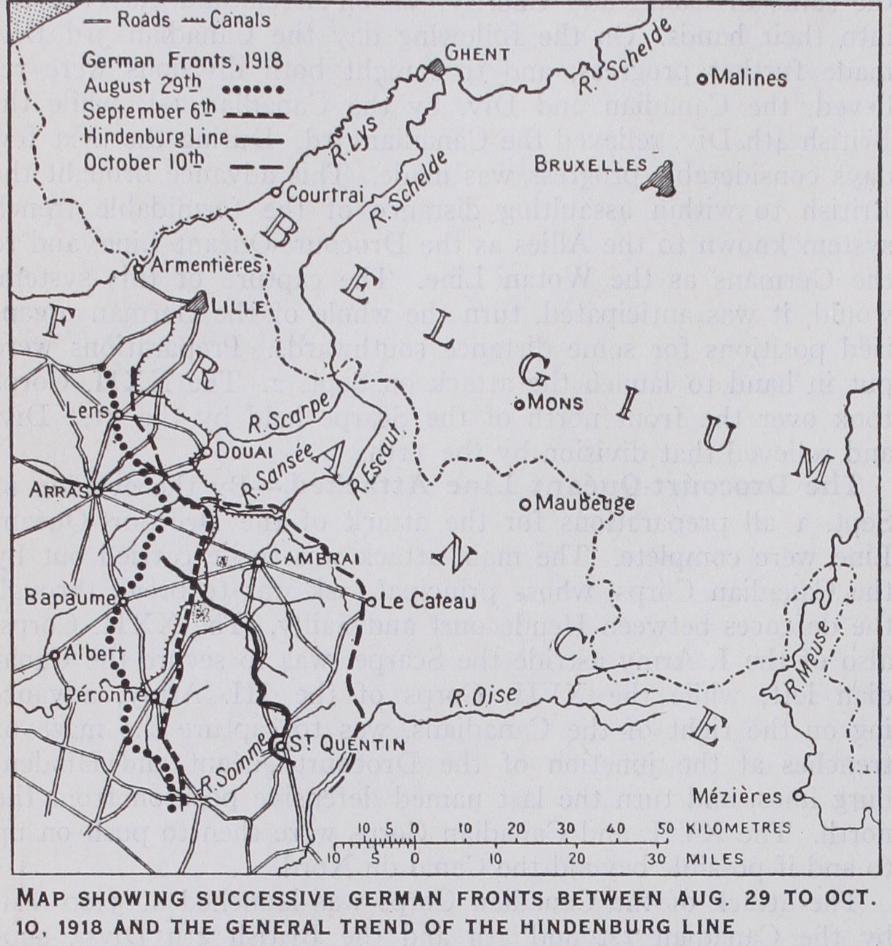
On Sept. 12 the III. Army attacked with the IV. Corps and the VI. Corps on a 5m. front in the neighbourhood of Havrin court Wood. A considerable advance was made and the villages of Trescault and Havrincourt were captured. Meantime the IV. Army had continued to press the German withdrawal, and be tween Sept. I I and 17 the line had been pushed forward at several points. On Sept. 18 a much more extensive operation was undertaken, in which the IV. Army in conjunction with the III. Army attacked the German forces on a 17m. front from Holnon to Gouzeaucourt. The French I. Army co-operated on the right. The final objective of the main attack was the old British outpost line running past Pont Ruet, west of Bellicourt, Bony and Vendhuille. It was not intended that this final objec tive must necessarily be reached on the first day—and in fact it was not reached until after several days of very severe fighting.
At 7:00 A.M. on Sept. 18 the IV. and III. Armies attacked in heavy rain. The attack was supported by 23 tanks and 978 guns, and in some sectors dummy tanks were used with considerable success. The IX. Corps advanced on the right with the 6th and Divisions. The first objectives were taken at 9:0o A.M., but the 6th Div. was checked at Holnon and west of Fresnoy. The 1st Div. was more successful, but was unable to reach Pont Ruet, and both divisions suffered severe casualties. The Australian Corps had very heavy fighting, particularly in and about Le Verguier, and was held up in front of its final objective till dusk. During the night a successful attack was made which completed the operation on the Australian North of the Australians the III. Corps attacked with the 74th, 18th, I2th and 58th Divs., and met with very stubborn resistance. Ronssoy was captured by the 18th Div. and Epehy by the I2th and 58th Divs., but little progress was made beyond these places. The V. Corps of the III. Army continued the front of attack to the north and all divisions made considerable prog ress, though it was not found possible to take Gouzeaucourt on this day. Minor operations were undertaken during the succeed ing week, which resulted in the capture of Gricourt and Pont ruet by the IX. Corps, and by Sept. 26 the British line had been advanced to a position from which the attack on the main Hin denburg system could be launched. In this last series of opera tions 15 divisions of the British III. and IV. Armies had driven back 29 divisions of the German II. and XVII. Armies into the Hindenburg defences, and inflicted on them a loss of 12,000 prisoners and i oo guns.
In accordance with the above general strategic plan the French and Americans attacked on Sept. 26; the British offen sive commenced on the 27th, and the Allied attack in Flanders was launched on the 28th. Haig's plan was to strike first with his left wing in the direction of Cambrai, while the right wing, which was faced by the more formidable defences, was to attack later after a very heavy preliminary bombardment. It was hoped that any success obtained by the left wing would draw off the German reserves, and deceive their higher command as to the point where the main blow was to fall.

A very heavy bombardment was opened on the night of Sept. 26-27 on the front of the British I., III. and IV. Armies, and at 5:20 A.M. on the 27th four corps attacked on a front of 13m. from Gouzeaucourt to the neighbourhood of Sauchy Lestree. On the northern flank the Canal du Nord was too formidable an obstacle to be carried in face of opposition, and consequently the plan was conceived of crossing on a comparatively narrow front, and then of turning the line of the canal farther north by a diver gent attack from the point of crossing. This difficult manoeuvre was most successfully carried out. On the right the 5th and 42nd Divs. of the IV. Corps established and held a strong flank be tween Beaucamp and Ribecourt. On their left the VI. Corps advanced with the 3rd and Guards Divs., and captured Ribe court and F1esquieres, while the 62nd and 2nd Divs., passing through, continued the advance in the direction of Marcoing. Farther north the 52nd and 63rd Divs. of the XVII. Corps forced the passage of the canal and, after heavy fighting, established themselves in Graincourt, and the 57th Div., in close co-operation with the Canadians, reached Anneux.
On the I. Army front the Canadian Corps attacked with the Canadian 4th and 1st Divs., and in the half light of dawn stormed the canal on the line Moeuvres-Sains-Marquion. With irresistible impetus the Canadian 4th Div. pushed on to Bourlon village and wood where the Canadian 3rd Div., taking up the attack, advanced towards Fontaine Notre Dame and Sailly. On the left the Canadian 1st Div. was equally successful, and, having captured Sains and Marquion, advanced rapidly towards Hayne court and Sauchy Lestree, while the British 11th Div. passed through and captured Epinoy and Oisy-le-Verger. Meanwhile the 56th Div. of the XXII. Corps crossed the canal, west of Sauchy Lestree, cleared that village. and advanced on Palleul. By the evening of Sept. 27 over 1 o,000 prisoners and 200 guns had been taken. As soon as the crossings of the canal were se cured the British and Canadian engineers began to construct the necessary bridges, and in spite of heavy artillery fire completed their task with remarkable speed, and contributed in no small degree to the success of the operation.
On Sept. 28 the advance was continued and Gouzeaucourt, Marcoing, Noyelles, Fontaine Notre Dame, Sailly and Palleul were taken, and a footing was obtained on the east bank of the Schelde Canal at Marcoing. At 5:5o A.M. on the morning of Sept. 29, after a preliminary bombardment lasting over two days, in which some 1,600 guns were employed, the British IV. Army advanced to the attack, covered by an intense artillery bar rage. The front of attack extended from Holnon to Vendhuile, a distance of about 12 miles. On the right the IX. Corps met with complete success. The 1st Div., advancing south of the bend in the canal at Bellenglise, established a flank facing south east from Gricourt to the Le Tronquoy tunnel. The 46th Div., which was faced by a most formidable task, advanced with the greatest gallantry, and with the assistance of rafts, mats and even life-belts, stormed the canal at and north of Bellenglise and rushed the German trench system west of the canal. The German defences here faced south, and the British troops swung to the right and took them in flank and rear, capturing many prisoners and guns. By P.M. the 46th Div. had broken through the Hindenburg Line to a depth of 3 miles, routed four German divi sions, and taken over 4,000 prisoners and 7o guns at the small cost of 800 casualties. The 32nd Div., passing through, completed the capture of the Hindenburg Reserve Line, and by nightfall had taken 800 more prisoners and 20 guns.
Work of the American the left of the IX. Corps the American II. Corps had been superimposed on the Australian Corps. The task of the American troops was to break through the Hindenburg Line at and north of Bellicourt, where the St. Quentin Canal passes through a tunnel. The Australian 5th and 3rd Divs. were then to take up the attack and advance on more distant objectives. The Americans advanced with the greatest gallantry, but owing to the uncertain issue of a preliminary attack that had been made to secure a good starting line, their left divi sion (the 27th) started half a mile behind the barrage—which the Army Command were reluctant to bring back. Without this pro tection its attack was quickly shattered with great loss. The Australian 3rd Div., following it up, could make but little head way and was finally checked in front of Bony. The American 3oth Div. on the right was more successful, but also suffered heavily from German reserves who came up from their shelter in the tunnel, and it was only after very heavy fighting that the Aus tralian 5th Div., passing through, finally succeeded in reaching the Hindenburg Reserve Line about Nauroy.
On the left the III. Corps carried out their task of securing the left flank of the IV. Army. On the same day the III. Army achieved an important success by securing the canal crossings at Masnieres and northward as far as Cambrai, while the I. Army front was advanced northwest of that town. On Sept. 3o the break in the Hindenburg system was widened by the capture by the IX. Corps of Thorigny and Le Tronquoy, and on the same day the Germans abandoned Villers Guislain and Gonnelieu. On Oct. 1, in co-operation with the French I. Army who occupied St. Quentin, the IX. Corps took Levergies and the Australians captured Joncourt, Estrees and Bony. The III. and I. Armies also achieved important successes. During the first week in Oct. the XIII. Corps relieved the III. Corps north of the Australians and a series of successful minor operations were carried out on the fronts of all three armies, and by Oct. 5 the whole of the rearward lines of the Hindenburg system were in British hands.
Results of the Offensive.—During this nine days' battle 3o British and two American divisions had broken through the last and most powerfully organized system of German defences, had overwhelmed 39 German divisions and captured 36,00o pris oners and 38o guns. The effect of the British victory was de cisive on the subsequent course of the campaign, and though there was still to be hard and bitter fighting before the termina tion of hostilities on Nov. 11, only natural obstacles such as woods, rivers and villages now lay between the British Armies and their objective at Maubeuge.