
THE HITTITE PROBLEM AND ITS SOLUTION The Old Testament, Egyptian and Assyro-Babylonian Knowledge of the Hittites.—The Hittite race, "the sons of Heth" (Hebr. Belie Heth) was known to the writers of the Old Testament. In Gen. x. 15. Heth was a son of Canaan; in Gen. xxiii. "the sons of Heth" abode in Hebron, where Abraham traded with them for a grave for his wife Sarah; in Num. xiii. 29, the Hittites occupied the mountains of Canaan; in Gen. xxvi. 34, Esau married the Hittite women, Judith and Basemath. Also Uriah, whose wife David had appropriated (II Sam. xi.), is called a Hittite. In I Kings ix. 20, the Hittites, in conjunction with the Amorites, Hivites etc. were an important element in the popu lation of Canaan. Yet according to the testimony of the Old Testament, Syria was the real home of the Hittites. In Joshua I. 4, the land of the Hittites reached to the Euphrates. In North Palestine, in the time of Solomon, the powerful kings of the Hittites ruled as sovereigns over separate Hittite states, besides the "kings of Araoreans" (I Kings x. 29). From there King Solomon obviously brought his Hittite women (I Kings, xi. 2).
In confirmation and amplification of these Old Testament accounts, Egyptian evidence shows that in the time of the 18th to the loth dynasties, between the years 1500-1190 B.C., a power ful northern kingdom Kheta sought perpetually to obtain political influence over Syria and therefore often f ought with Egypt. Already the Pharaoh Thutmosis III. (150I-1447), who had con quered Syria as far as the Upper Euphrates, received presents from the prince of Kheta. Under the succeeding rulers of the 18th dynasty the Hittites established themselves in Syria. Bitter strug gles took place between them and, especially, the Pharaohs of the 19th dynasty, Seti I. (c. 1313-1292) and Ramses II. (c. 1292– 1225). About the year 2288 B.C. a great battle took place between the two hostile powers near Kadesh on the Orontes; after further combats, about the year 1272 Ramses II. established an alliance with the Hittite king Khattushilish III. and married, about the year 1259, one of his daughters; on this occasion the Hittite king visited Egypt in person. About the year 1190, the Hittite king dom succumbed to the attacks of the so-called "sea nations." The Cuneiform inscriptions also know a powerful kingdom and people Khatti who gave much trouble to the Babylonians, Assyr ians and Egyptians during the II. and I. millenniums B.C. Accord ing to a Babylonian chronicle, about the year 1758 B.C. the Khatti people overwhelmed Akkad-Babylonia under the rule of King Samsuditana, and made an end of the Khammurabi dynasty. The increasing influence of the Khatti kingdom in Syria about 1400 B.C. is shown by the Amarna inscriptions. After the destruction of the Hittite empire in the 12th century B.C. the name Khatti is applied especially, according to the evidence of the inscriptions of the Assyrian kings, after Tiglath Pileser (cir. Ilia B.C.) , to the kingdom of Carchemish on the upper Euphrates, but it also denotes the whole of Syria. Sargon II., it is true, made an end of the Khatti kingdom of Carchemish in 717 B.C., yet the New Babylonian king, Nebuchadnezer II. (604-562), still used the name Khatti for Syria.
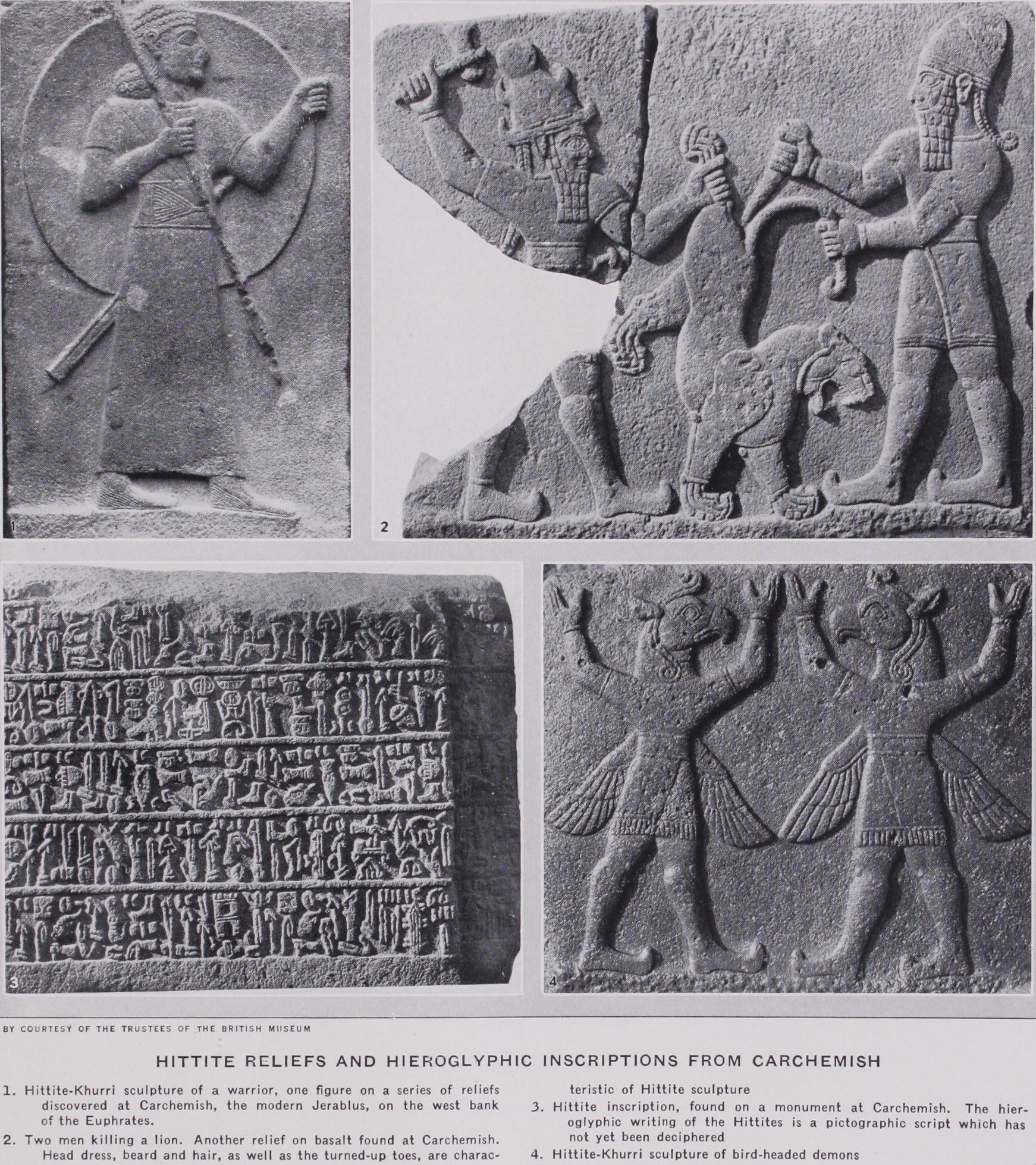
Hittite Monuments and Hieroglyphic Inscriptions.—The quoted information pointed to Syria and probably also to the adjoining regions of Asia Minor as the home of the Hittites. When during the 19th century, monuments of unusual style and inscrip tions written in an unknown hieroglyphic script, were found in Syria and Commagene, as for example, at Hamah on the Orontes, at Aleppo, at Jerablus on the Euphrates, at Marash and Malatia, further in Cappadocia, as at Boghazkeui and Euyuk, as well as in the Taurus mountains, at Bor, Ivriz and Bulgarmaden, and finally also in western Asia Minor, at Sipylos near Magnesia, it was very natural to attribute them to the Hittites. The native monuments, together with the Egyptian reliefs representing Hittites, showed the physical characteristics of the Hittite race ; in particular, the great curved nose and backward sloping forehead, which proved beyond any dispute that the Hittites were not Semites or Indo-Europeans. The hieroglyphic writing of the Hittites has nothing to do with the Egyptian hieroglyphic script. It is a pictographic script ; but the original meaning of many of the signs is still obscure. In the course of time many signs developed a cursive form. The inscriptions are written boustrophedon; after a line written from right to left (or the reverse) there follows one from left to right (or the reverse), so that the figures and heads always face towards the beginning of the line. So far about 200 of the signs of this writing are known. In regard to the age of this writing, the Hittite Archives of Boghazkeui, for example a clay bully bearing the seal of King Shuppiluliumash (about 1385 B.c.), the legend being written both in cuneiform and in hieroglyphics, proves that the latter was used as early as the 14th cent. B.C. Indeed this script may be much older, as is shown by its use in the very old Hittite sanctuary Yasili Kaya, not far from the chief Hittite city Khattushash-Boghazkeui. The invention of this writ ing may, therefore, be placed in the first half of the second mil lennium B.C. This script was employed by the Hittites on their rock and stone monuments especially, and upon seals made of stone and metal. It is their monumental writing; for their daily needs and especially for library and archive purposes, as the archives of Boghazkeui show, they used cuneiform writing and clay tablets.
Much ingenuity has been employed in deciphering the Hittite hieroglyphics. Systems of deciphering were published by F. E. Peiser, A. H. Sayce, P. Jensen, A. Gleye, R. C. Thompson, A. E. Cowley and C. Frank, yet none of them was accepted by the scientific world. It seems that from all these systems only the interpretation of very few signs will prove true. The task is, in fact, very difficult, since bilingual inscriptions are still too few ; those that have been discovered so far give but little help in de cipherment owing to their brevity, obscurity or damaged condition. They are these : the silver seal of a king Tarkutimme-Tarkondemos of Metan (?), the seal cylinder of one Indilimma, which is, possibly, not bilingual, and the seal impressions of the Kings Shuppiluliumash and Arnuvantash IV.
Very important was the discovery of a declension which is especially characteristic of Indo-European languages. It is the declension of the Hittite word vadar "water" whose meaning Hrozny succeeded in establishing with the help of the sentence : nu NINDA-an ezzatteni vadar-ma ekutteni. In this sentence the meaning of the Sumero-Babylonian ideogram NINDA "bread" was all that was known. The following Hittite ending -an has been established as the termination of the Acc. Sing. from examples in other places. In one sentence speaking of bread also the word for "to eat" might possibly (though not necessarily) be expected, and as this meaning fitted for the Hittite root ezza- everywhere, Hrozny identified the Hittite ezza- and also ad- (adanzi "they eat") with the Latin edo, old High German ezzan "to eat," etc. Other passages showed him that -teni is the ending of the second Pers.
'The ablative (not the locative as was originally assumed by Hrozny) in -az (a) is perhaps of the same origin as the Hittite instrum. in -et, -it. Compare kallarit uddanaz (Keilschriftt. aus Bogh. IV. 7, 6o) "from the disastrous thing," sharkhuvantazshet "from its belly" (Code Hittite par. 90), KAP-laz-tet "from thy left side" (KBo. 2482 II. 6) etc. Both the Hittite endings -az(a) and -et, -it are derived from the Indo-European ablative ending -ad, -ed; before the particle -a (from -e) the d is changed into z in Hittite. Thus two forms arise, -az(a) and -et, -it, which differ also in use: the first, as a rule, is used as the ending of the ablative, the second, chiefly as that of the instrumental.
'The origin of the ending -ash is still obscure.
P1. Pres. : ezzateni means consequently : "you eat, you will eat." As the sentence : vadaryna ekutteni was clearly in parallelism with the first one (NINDA-an ezzatteni), it seemed possible to see in vadar, which is parallel with "bread," also a simple victual. A meaning as "water" was here very convenient and also other passages confirmed this interpretation. A surprising comparison with the English water, old Saxon water "water," etc., offered itself and proved true. Then ekutteni that is parallel to ezzatteni "you will eat" must signify : "you will drink" ; and for the Hittite root eku-, aku- "to drink" and the cognate Hittite word akuvanna "drinking, drink" offered itself as a comparison with the Latin aqua "water." The Hittite sentence above thus runs when trans lated : "Now you will eat bread, further you will drink water." Astonishing as was the discovery of a word for "water" similar to the English one in an ancient oriental language of the middle of the second millennium B.C. the discovery soon after of the declension of this Hittite word was still more so : Sing. Nom. vddar, Gen. vedenash, Dat.-Loc. vedeni, Accus. vadar, Abl. vedenaz, Instr. vedenit; Plural Nom. and Accus. vidar. The Gen. Sing. of vddar is not, as we might expect, vddarash, but vede nosh, with an alteration in the suffix (n for the r, used in the Nomi native). The same very remarkable declension shows however also the quoted Indo-European word for "water" (Old Saxon avatar, etc.) : Gr. Nom. vbcop, Gen. vharos from van-ros. (Cf. Lat. femur, Gen. f eminis. ) The Hittite pronouns, as established by Prof. Hrozny, also bear marked resemblance to Indo-European forms as shown in the following list in which the Hittite forms are set in italics at the beginning of each line or paragraph: uga, ug "I", compare Lat. ego.
ammug, ammuga "to me, me," compare Gr.
zig, ziga "thou," compare Gr. crf yE or better perhaps according to Mar strander, the Accus. E.
tug, tuga "to thee, thee," compare Goth. thuk.
fuel "of thee, thy" with the Genitive ending -el, is also connected. vesh "we," compare Goth. Weis.
anzdsh "us," compare old High German uns.
anzel "our," compare Goth. unsaro.
shumesh, shurndsh "you," compare Gr. bµoir.
-mu "to me, me," -ta, -du "to thee, thee," compare Gr. /Lot, µO, rol, etc. -mish "my," -fish "thy," compare Lat. mews, tuns.
enish, annish (compare uni) "that," compare old High German ener "that," old Slay. onii.
kdsh "this," compare Oscan e-kas "these" (fem.) shash "this," compare Sanskrit sd.
knish "who, which," cf. Lat. quis.
knit neuter "what, which," cf. Lat. quid.
kuvabi "where, whither," cf. Lat. ubi, ne-cubi.
knish knish "whoever," neuter knit knit, cf. Lat. quisquis, quidquid. kuishki, neuter kuitki, "somebody, something," cf . Lat. quisque, quidque.
kuvatka, "something, perhaps," cf. Lat. quodque.
kuvabikki "somewhere," cf. Lat. ubique, etc.
On the other hand, the Hittite pronoun apdsh "that" is con nected with the languages of Asia Minor (see AsIANIC LAN GUAGES) ; cf. Lydian ebe "this," Lydian bis "he." Hrozny likewise proved that also the Hittite verb is essentially Indo-European. The present tense of the Hittite verb jami "I make" runs : Hittite Sanskrit Greek Sing. I. jami "I make" ydmi "I go" 2. jashi ydsi TiOns 3. jazi ydti TtOi7v4, rtOnT& (Dor.) Plur. i. javeni( javani, jauni) ydmah, y. I . pers. dual ydvah TIBE,uev 2. jatteni (jattani) ydtha, ydthana riBETE 3. janzi ydnti r Oka t, rLOevrn (Dor.) (The forms enclosed in brackets are found, but from another verb—not yet from jami.) The Hittite verb dakhkhe "I take" for example presents a some what different paradigm for the present tense: Sing. I. ddkhkhe, ddkhkhi "I take" (comp. Lat. fero? The Hittite kh or h is, perhaps, as elsewhere frequently, secondary) .
2. datti (comp. 2. Pers. pret. ddtta).
3. ddi (comp. o'MSE?) . Plur. i. (ddveni), ddvvani.
2. datteni, (dattani).
3. ddnzi.
The Imperative Pres. Active runs : Hittite Sing. i. jallu (KUB xiv. 27, 19) ; also (jallut, jallit)? Comp. eshlut, eshlit I will do.
Comp. for jal- old ecclesiastical Slay. Part. Pret.
Act. I i . neslu, umbr. Fut. ex. apelust, Armenian Part.
Pres. berot ? -u is an Imperative ending, which is found also in Indo-Iranian.
The -t in eshlut, eshlit is perhaps of medial origin ; see below especially the Preterite of the Hittite Medio-passive.
Very important is the proof of the existence of a Hittite Medio passive form which frequently has an -r ending as exhibiting re semblance to the Latin verbal forms such as amatur, amantur and similar forms in Italo-Celtic and Tocharish. Besides -r, a medial -ti, -t is found as ending in the Hittite Medio-passive in other forms, especially in the Preterite; the forms with -ti are in the old Hittite more frequent than those with -t.
The present of the Hittite medial verb jakhkhari, "I go" runs : Sing. i. jakhkhari (comp. Lat. feror? Hittite kh is secondary?), (jakha khari) "I go." See also Kurylowicz in Symbola grammatica in honor. Rozwadowski, p. 2. (jatta old Hittite), jattati (comp. otefa and 3. Pers. sing. jatta?) Also estari "thou sittest down," v. Gotze, Madduwattag, p. 104, n. I2.
3. jatta (comp. cOper at, &/ p€ro), jattari, jattdri (comp. Lat. amatur), also esha, eshari, "he sits down" (comp. Umbrian f erar) .
Plur. ,I. (javashta, javashtat, javashtati) (comp. Act. javeni, [ javani,j the pronoun ash "we" and I. Pers. dual Sansk. sv˘s?) 2. jadduma (jatumari old Hittite) (comp. Sanskrit abharadhvam, old Avestic mqzdazdi2m).
3. janta, (comp. 4Opovrau, O4 povro), jantari (comp. Lat. amantur).
The medio-passive imperative of Hittite, whose endings for the most part show the imperative ending -u, already known to us, runs : Sing. I. (jakhkharu, jakhakharu) "I will go." 2. jakhkhut, (jakhkhuti) (stem with a secondary kh-F-u of the Imperative -{--t, -ti of the medium?) 3. jattaru, also esharu.
Plur. 2. jaddumat, 2. Pers. Plur. Pres. and Preterite.) 3. jantaru.
The Preterite of the Hittite medio-passive runs : Sing. I. (jakhati), jakhkhat, jakhkhakhat "I went" (comp. I. pers. Sing. present).
3. (jatta?), (jatlati), jatlat (comp. 3. Sing. pres.), also eshati, eshat ( =3rd Sing. pres. esha+medial "he sat down," besides eshtat.
Plur. i. (javashiati), (comp. I. Plur. Pres.) 2. (jadumat), kishdumat, "you became" (comp. 2. Plur. Pres.) 3. (jantati), jantat (comp. 3. Plur. Pres.).
(Both Friedrich and Gaze have been successful in the inter pretation of some medio-passive forms of Hittite. However the paradigms cited above are given on the basis of independent re searches of Hrozny with the only exception of the forms javashta and javashtat [i], whose identification must be referred to Fried rich. Hrozny found also the form of the 1. Pers. sing. Imp. Act. independently of Friedrich.) Among others, Hittite had also verb stems in -shk-, as for example dashkishi, "thou takest" (to the simple stem dd- "to take"), as also verb stems in -nu, as for example arnumi "I send for," to the simple stem ar- "come" ; comp. Lat. posco, Greek 6pvvµe, etc.
That all this correspondence of Hittite with Indo-European lan guages shows that in its construction Hittite is an Indo-European tongue, is the substance of Hrozny's decipherment of the Hittite language : of his preliminary report Die Losung des hethitischen Problems--"The solution of the Hittite Problem" in the Trans actions of the German Oriental Society (Mitteilungen der deut schen Orientgesellscha f t) , No. 56 (1915) and especially of his Hittite grammar Die Sprache der Hethiter, ihr Bau and ihre Zzsgejiorigkeit zum indogermanischen Sprachstamm—"The Lan guage of the Hittites, its structure and its membership of the Indo-Germanic stock" (Leipzig, 1916-17) . Within the Indo-Euro pean group of languages the Hittite, which treats the gutturals like the West Indo-European languages, the so-called Kentum group (see INDO-EUROPEAN LANGUAGES), appears to be related chiefly in respect of its medio-passive endings, such as -tari, with the Italo-Celtic languages and Tocharish. (In 1902 Knudtzon published the view that the A.rzava language which, as we now know, is identical with Hittite, is an Indo-European language. But his opinion met with such severe and universal opposition from the Indo-European philologists that he withdrew it.) Foreign Influences.—In the Hittite language, the remains of which date from the second millennium B.C., and which therefore is one of the oldest Indo-European languages, there can be ob served a strange extensive simplification and attrition of the lan guage, in spite of the survival of certain ancient features. Further at the present time only a small proportion of the Hittite vocabu lary can be traced to Indo-European roots. This, it is true, is perhaps in some extent due to the fact that the cuneiform script invented by the Sumerians is poorly adapted for rendering an Indo-European language. For this reason it is very difficult to set up a complete system of Hittite phonology. In Hittite words such as khameshkhanza "spring," antukhshash, antuvakhkhash "man," idhiush "evil," karmalashai "remains crippled," etc., are very numerous, for which a clearly defined Indo-European. ety mology is—at least at the present time—wanting. All these strange facts are best explained by the supposition that Hittite was largely influenced by other, non-Indo-European, languages. We find in Hittite words, borrowed from Assyro-Babylonian as, for example, the verb khabalashaizi "he smashes," which is bor rowed from the Assyro-Babylonian verb khabalu "to destroy." The Hittite word for house pir has its origin perhaps in the old Egyptian word per "house," which is found also in the word Pharaoh, properly "great house, palace." For the far greatest number of such non-Indo-European words Hittite is however most probably indebted to the indigenous languages of Asia Minor, with which it was in close association for about i,000 years. It is even possible that Hittite derives a not unimportant part of its foreign words from non-Indo-European tribes with whom the nation was in contact when it occupied its earliest Indo European home. As the Hittites belong to the oldest Indo-Euro pean peoples, those who first left their earliest Indo-European home in the north, it must be supposed that they belonged to the borderland tribes of the earliest Indo-European home and, therefore, had already there come into contact with foreign peo ples. Later, probably in the second half of the third millennium B.e., when the Hittites, as a conquering apparently not very numer ous people, forced their way over the Caucasus, or (less probably) across the Bosporus, into Asia Minor, and overthrew the native inhabitants, also, the languages of the latter exercised considerable influence on the language of the Indo-European conquerors. At the same time the Hittites came into contact with the Assyro-Baby lonian colonies in Asia Minor, from whom they took over cunei form writing, many religious and cultural goods, and, naturally, many words of their language.