
BACTERIOLOGICAL INCUBATORS An incubator which will remain with o.5° C of the adjusted temperature gives sufficiently accurate heat regulation for all ordinary bacteriological purposes. Bacteriological incubators, un like bird incubators, do not re quire a continuous circulation of air nor is it necessary to pro vide any arrangement to moisten the contained air. The type in ordinary use is in the form of a rectangular box fitted with a double door in front and sur rounded on all the other sides by a water-jacket ; one or more shelves are fitted for the accom modation of flasks, racks of tubes, etc.
D'Arsonval Some of the older incubators were cylindrical in form, that of d'Ar= sonval being the best known. This apparatus (fig. 1) consisted essentially of a cylindrical jacketed chamber c'. The water-jacket was heated by gas and there was a gas regulator controlled by the expansion of the water in the jacket. The water expanding by heat rose in the tube T; this increased head of pressure acted upon a rubber diaphragm D which was forced outwards thus obstructing the gas flow into the regulator. A great disadvantage of the cylindrical incubator was its inconvenient shape ; there was also difficulty of access to the contents as compared with the modern types.
Hearson Incubators.—The incubators in use in most bacte riological laboratories at the present time are of the types shown in figs. 2 and 3 ; they may be heated by either an oil lamp or a gas burner or by electricity. The machines illustrated are made by Chas. Hearson and Co., Ltd., London.
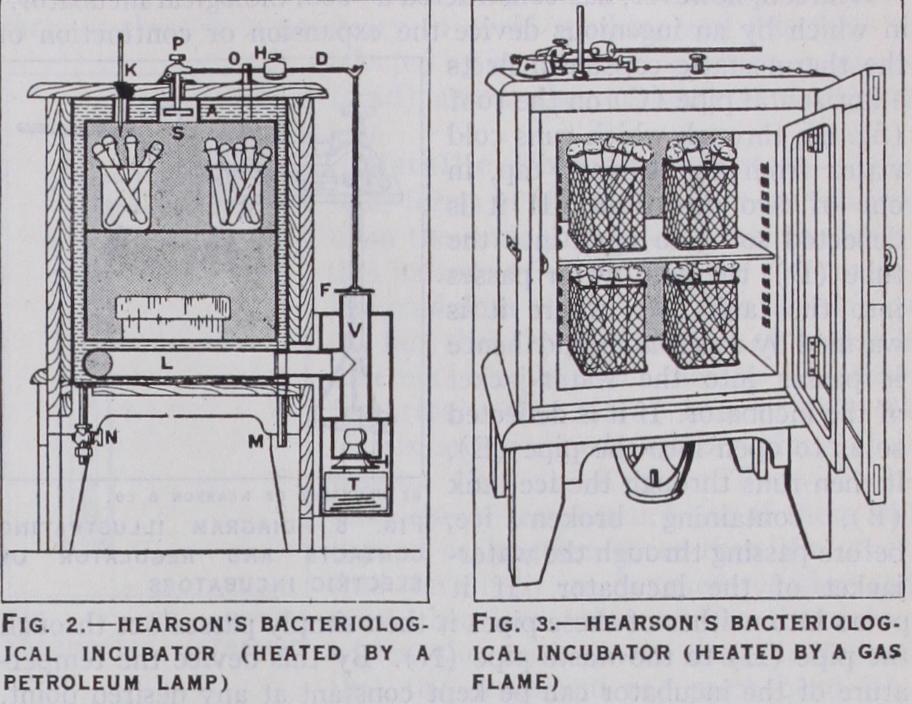
In the form heated by a lamp, for which, however, gas can be substituted, the incubation chamber is surrounded by a water-tank (fig. 2, A) and the lowest part of this is traversed by an in-going (L) and an out-going flue. The mode of regulation of the tem perature is by means of a thermostatic capsule which operates the movements of a cap (F) over the main flue (V), and it is identical in its chief features with the method employed in the chicken incubator. The capsule (S) is situated in the upper part of the incubation chamber.
In the other form (fig. 3) for which gas is used exclusively, there are no flues traversing the water-tank. This latter is heated from its conical floor by a burner beneath the incubator. The heat regulation is controlled by a thermostat of the same nature as in the form of incubator just described, but instead of operating by lowering or raising a cap over a main flue, so as to direct the heated gases either through the water-tank if the temperature is falling, or through the main flue directly to the exterior if it is rising, it actuates a gas-governor, so that the flame itself is in creased or diminished in size according to the needs of the incu bator. The gas-governor (fig. 4) is fixed to the roof of the incubator. The horizontal arm (D) is the same that raises the cap (fig. 2, F) over the flue in the other form of incubator, but in this case it simply acts as the bearer of the sliding weight. Beyond its fulcrum (fig. 4, G) it is continued into a detent-like spur (B) which pushes down upon a button attached to a rubber diaphragm, when the thermostat within the incubator is expanded by a rise in temperature. The button thus forced down, more or less completely closes the inlet gas aperture, and so reduces or cuts off the gas supply to the flame. There is a by-pass to prevent the flame from going out completely, and the size of this can be adjusted by the screw (S) .
In electrically-heated incubators the regulating mechanism is similar to that shown in fig. 2 except that the arm D is not con nected to a cap F but is fixed to the upper member of a pair of electrical contacts as in fig. 5. Electrical heating units either heat a water jacket or are arranged as a series of resistance wires en closed in a metal case occupying the position of the water jacket.
In bacteriological laboratories there are two standards of tem perature, one chiefly for the culture of non-pathogenic organisms and the other for the pathogenic forms. The first standard of temperature lies between 18° and 20° C, and the second between and 38° C. But in hot countries, and even in temperate regions during the summer, the external temperature is much higher than the former of these two standards, with the result that many cultures, especially the gelatine ones, are spoiled. The diffi culty is often partially overcome by running cold water through the incubator.
Hearson, however, has constructed a "cool biological incubator," in which by an ingenious device the expansion or contraction of the thermostatic capsule deflects a horizontal pipe (C) on the roof (fig. 6), through which runs cold water from an ordinary tap, in one of two directions. If it deflected so as to open into the tube (D), the cold water passes into the tank (F), where it is warmed by a gas flame, and thence it passes into the water-jacket of the incubator. If it is deflected so as to open into the pipe (E), it then runs through the ice tank (B), containing broken ice, before passing through the water jacket of the incubator. If it pours into neither of these pipes it then simply passes out through the pipe (H) to the waste pipe (N). By this device the temper ature of the incubator can be kept constant at any desired point, even though it may be some 3o° to 4o° C below that of the external air.