
EARLY MEDIAEVAL Har§a : Nalanda.—Harsavardhana in the first half of the seventh century revived the glories of the diminished Gupta empire. He may be regarded as responsible for the restoration of the great monastery at Nalanda, and for the transition from Gupta to mediaeval art in Magadha generally. He also took possession of the Valabhi kingdoms of Kathiawar and Gujarat; but was defeated by the Calukyan king Pulakesin II. A more detailed account can be given of early mediaeval art in the Dek khan and the far south.
Rastrakuta.—The Rastrakutas succeeded the Calukyas in the Western Dekkhan in 753. Their most important monuments are at Elura and Elephanta; the latter are easily accessible in an afternoon from Bombay. At Elura the famous rock cut Kailasa natha temple, a huge and complete monolithic shrine excavated in the side of the hill, is in a purely Dravidian style, immediately derived from that of the Virupaksa at Badami ; of the very nu merous sculptures illustrating 8aiva subjects, the finest represents Siva and Parvati seated on Mt. Kailasa, with Ravana imprisoned within the mountain below, endeavouring to cast it down, and succeeding in causing a tremor; this, and the Varaha Avatar of Udayagiri, above alluded to, are the finest examples of reliefs which deal with what may be described as cosmic or geotectonic themes. Remains of painting on the ceiling of the porch of the upper storey are of two periods, in part no doubt of the eighth century and nearly contemporary with the actual shrine; these are the oldest surviving Brahmanical frescoes, but literary refer ences show that painting had been practised both as a religious and secular art from time immemorial.

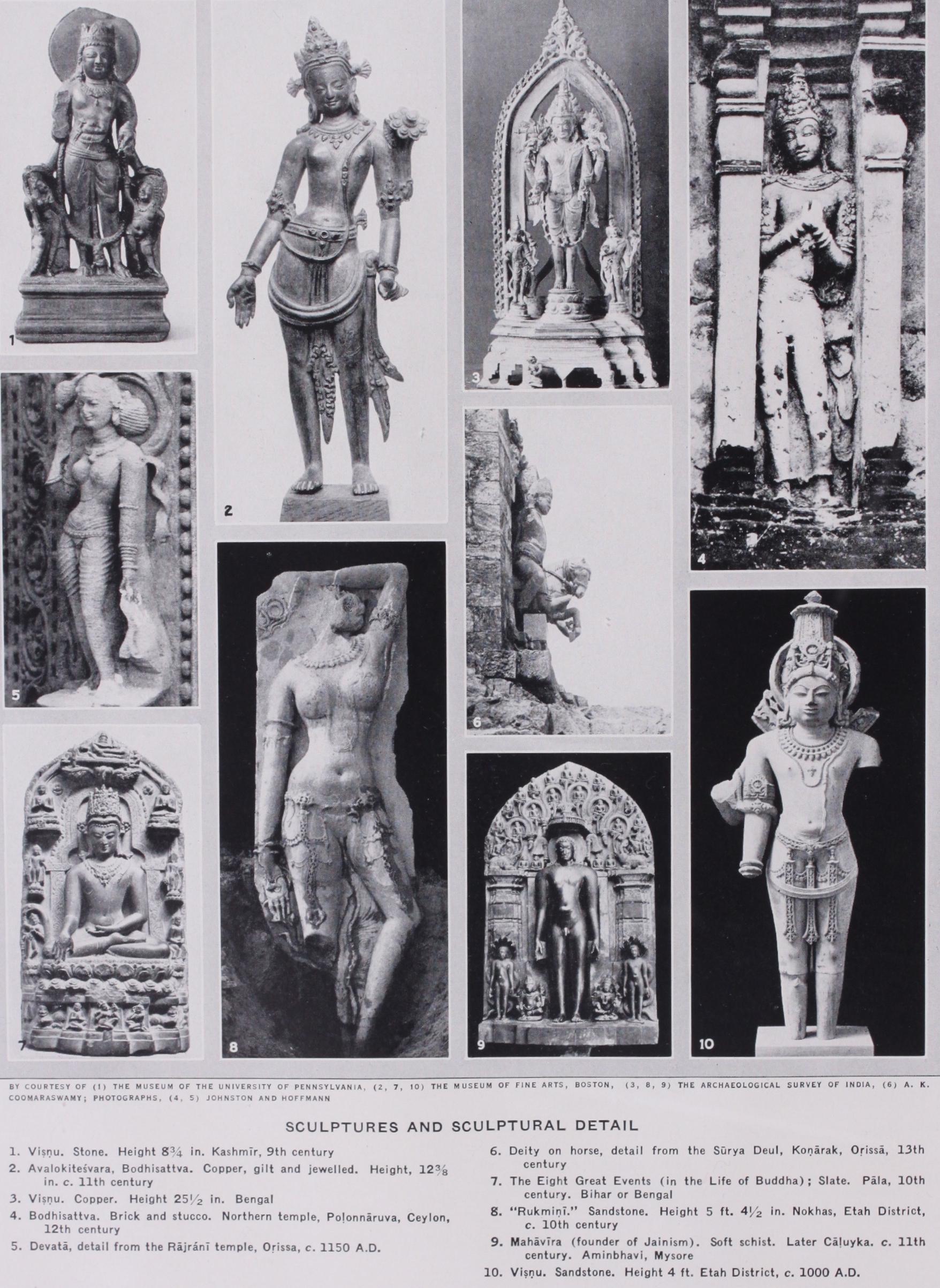
At Elephanta, the most famous, and perfectly preserved sculp ture is a colossal relief in the main excavation, a three-headed bust, which has often, though incorrectly been called a Trimurti; it is actually an icon of Siva in the form known as Mahesa, and many other examples exist, of which one of the best is a later relief in the Pennsylvania University Museum.
Kashmir.—The old town of Vijrabror has yielded early sculp tures in which the influence of the Graeco-Buddhist art of Gand hara is still apparent ; the most interesting of these are representa tions of the goddess of Fortune, Laksmi, seated with a cornucopia, and these types can be followed well into the mediaeval time, grad ually becoming completely Indianised. The remains of a tiled cock-pit of about the 5th century at Harvan are unique; the devices on the moulded tiles represent men seated, and in bal conies; equestrian archers in chain armour, deer, fighting cocks, lotuses, and a fleur-de-lys motif ; in technique they recall the so called Han but probably later grave-tiles of China.
The Vantipor temple sites of early 9th century date have yielded small and admirably executed stone figures of Visnu in a style peculiar to Kashmir and the neighbouring States of Camba and Kulu, and with these there appear also Siva types, including a three-headed Mahesa, and an Ardhanarisvara. Similar Vaisnava images of brass inlaid with silver and copper have been found in together with a Buddha image in the same technique, but of earlier (late Gupta) date. Buddhist "bronzes" found in Kash mir, and ranging from the 6th to the nth th century, show that Buddhism survived to a late date, although it had already declined by the end of the 8th century, all the foundations of Avantivar man in the 9th being Brahmanical. The stone sculpture architec turally associated with the great temples in Kashmir is unfortu nately almost all in a ruined state.