
ENGLISH FURNITURE English furniture has developed in the course of many years from a few primitive types to highly specialized varieties ; it has evolved gradually with the progress of civilization. So little survives from mediaeval times that information must be sought in contemporary references, supplemented by representations in illuminated manuscripts. Most of these miniatures are of foreign origin; but they are reliable evidence, for the governing classes were Continental in their habits and the equipment of their homes. The furniture made for them was strongly influenced in form and detail by Gothic architecture, and was freely embellished with colour and gilding. English oak was the chief material, but softer woods were also used.
The furniture usually found in important houses consisted of beds, chests, cupboards, tables and stools. These objects are the basic types from which the whole evolution can be traced. Wills and inventories prove that draped bedsteads were treasured posses sions of mediaeval householders, prized not for the rough frame work but for their magnificent woven and embroidered hangings. These draperies consisted of a celure (back), tester (canopy), curtains and valances, and on them were worked scenes from the chase and many fanciful devices. Such beds were placed in the principal living rooms, and served as couches in the daytime. Chests were almost the only receptacles for valuables. They sur vive in large numbers, many 13th century examples being pre served in churches. The fronts, formed of stout planks, are pegged into wide uprights, plain, or carved with grotesque monsters. Later specimens are sometimes carved with arcades of Gothic tracery, scriptural incidents or mythological subjects. Large travelling chests, called "standards," were bound with iron and covered with leather. At the ends were iron handles through which ropes could be passed to facilitate transport. The guild of cofferers already existed in Edward III.'s reign, but could not prevent the importation of Danzig chests and others of overseas work. On a dresser in the hall flagons and cups were displayed. It was an open framework of shelves with a projecting lower portion, sometimes enclosed by doors. Side-tables, used for serving meals, were in the form of a chest mounted on legs, the panels pierced with Gothic tracery. What are now termed cupboards were known as ambries. Existing specimens are of massive construction with cross divisions and foliated iron hinges. Until the close of the middle ages chairs were lofty, throne-like structures, few in number and regarded as symbols of authority. The ordinary seats were chests and stools with benches sometimes fixed to the walls. Mediaeval dining tables were of trestle construction, boards of oak or elm resting on a series of central supports. They had removable tops and could be stored away of ter meals. Two examples still remain at Pens hurst Place, the tops, nearly Soft. long, being supported on carved trestles with cruciform feet. Towards the end of the i 5th century panelled framing, or joinery with mortice and tenon, replaced the primitive method of construction in which planks split or sawn from the log were roughly put together with pegs. At this period panels were often carved with the linen-fold pattern, so called from its resemblance to linen arranged in upright folds.

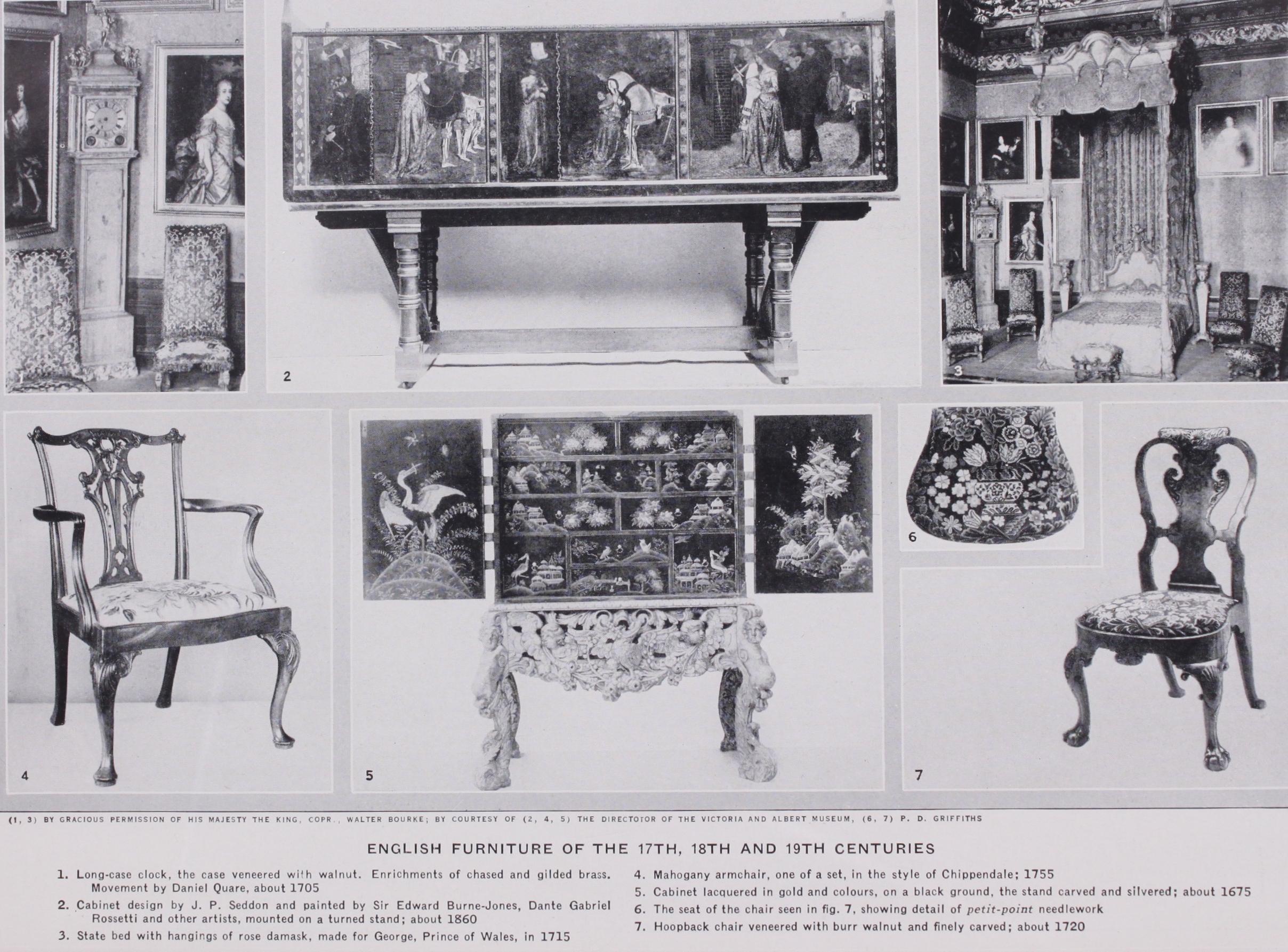


After the Restoration there was a striking change. The exiled court on its return introduced French fashions, and austerity gave place to lavish display. Furniture became lighter, more highly finished, and better adapted to varying needs. Walnut was the favourite material. Joinery developed into accomplished craftsmanship and new processes appeared, notably veneering wide surfaces with thin sheets of wood into which floral patterns in marquetry could be inserted. The passion for colour found an even better outlet in lacquer decoration. The importation of works of art from the East had begun in Tudor times, but was of small account until after the Restoration. Then the taste be came widespread, Evelyn and other observers reporting their friends' houses to be furnished with Indian screens or panelled in the finest Japan—descriptions implying oriental lacquer. Such things came from China and were soon imitated in England, the art of covering furniture with successive coats of coloured varnish being known as "Japanning." New forms of decoration coincided with a multiplication of types. Day-beds, a form of couch with an adjustable end, and winged arm-chairs served for repose. A little later, sofas with back and arms carried comfort a stage further, patterned velvets mainly of Venetian origin and damasks woven at Spitalfields being the usual coverings. Bureaux with an enclosed desk were produced towards the end of the century, and chests of drawers came into general use. Mirrors were no longer rarities after the duke of Buckingham had established his famous glass-works at Vauxhall, the frames being carved, lac quered or inlaid. Charles, says Evelyn, "brought in a politer way of living which passed to luxury and intolerable expense." An example of this extravagance is afforded by the tables, mirrors and stands covered with embossed silver with which the king's mistresses furnished their apartments. Fashions succeeded each other with great rapidity. Chairs show these changes most clearly, developing in a brief period from mere seats into movable decora tion. They had floridly carved crestings and stretchers, while for the structural members many varieties of turning were employed. Scrolled legs were general under Charles II., being succeeded by taper and baluster forms a few years after his death. In beds of this period, the tester, back and posts are covered with material pasted on to the wood and matching the hangings. They were of enormous height with elaborately moulded cornices, and had ostrich plumes or vase-shaped finials at the corners of the tester. The ornate stands and side tables of this age demand special notice, for, profusely carved and often gilt, they are among its most striking productions.
About the middle of the century a fresh wave of French fashions produced an Anglicized version of the rococo style. It was romantic in conception, fantastic and capricious in the man ner of its working out. It banished the straight line and made asymmetry a cult, while it sought its ornament in conventionalized renderings of natural forms—shells, foliage and flowers. With it flourished the Gothic and Chinese "tastes," the one a travesty of a forgotten art, the other an attempt to exploit the furniture of an unknown land. Architects with a hold upon tradition were now challenged by cabinet-makers who produced their own designs. Chippendale, Ince and Mayhew, Johnson, Manwaring and many others published illustrated trade catalogues to adver tise their wares. Of these works Thomas Chippendale's Director is the most important. It affords an apt summary of contempo rary tendencies, and is at once eclectic and original. Chippendale borrowed his rococo from Meissonier, but depended much on his own fancy for what he deemed Gothic or Chinese. It was an age of specialization, and many varieties of furniture are represented, ranging from extravagant side-tables for saloons to ingeniously contrived little objects for bedrooms. In the explanatory notes mahogany is generally recommended, but many of the designs are to be japanned or finished in burnished gold. The contents of such houses as Nostell and Harewood (where the original bills are preserved) show Chippendale to have been a craftsman of genius; though he had many rivals scarcely less gifted. His name affords a convenient label for furniture of the middle of the 18th century—mostly the work of other hands. The classical reaction, which set in shortly after 176o, swept away tortuous forms and terminated licence in design. Robert Adam, whose name is inseparably associated with this movement, had, like earlier architects, studied in Italy. His fastidious taste rejected the art of the later Renaissance, and sought inspiration in the remains of antiquity. When he was given a free hand, furniture and decoration were included in his architectural schemes. What he could achieve when "the subject was great and the expense unlimited" Syon and Nostell remain to show. They are brilliant essays in the "antique style" with the contents carefully thought out in relation to their surroundings. This furniture makes a learned use of classical ornament, but paterae, husks, rams' heads and urns are less eloquent of the change than the symmetrical structural lines. At this time commodes and other objects intended for display were often of satinwood with marquetry or painted decoration, the latter copied from designs by leading artists. The style as Adam conceived it was too severe and scholarly to be widely appreciated. It was modified by contemporary cabinet makers, and may be seen translated into popular terms in Hep plewhite's Guide (1788). In the process the furniture has lost its ceremonial character, and become simple, homely and graceful. It retains, for the most part, symmetry of form and excellence of proportion. Heart and shield-shaped backs on chairs and settees with tapered and fluted supports are noticeable features, while feathers, wheat ears and shells are prominent in the painted or inlaid decoration. The movement was towards lightness and elegance, and furniture of a distinctly feminine kind is found represented in Sheraton's Drawing Book (1791). This period saw the highest technical accomplishments, and a degree of specializa tion hitherto unapproached. Sheraton's designs for fitted washing stands, dressing- and work-tables are triumphs of ingenuity and eminently practical.
At the end of the century a strange archaeological revival, based upon a closer study of Greek, Roman and Egyptian remains produced the Empire style and that modified version of it which became current in England. The chief English exponent was Thomas Hope, an amateur designer with some antiquarian knowledge ; but when the fashion was taken up by cabinet makers the results were often woefully incongruous. They essayed the production of Roman bookcases and sideboards undeterred by the lack of classical precedents, and to what depths of incongruity they descended may be seen in Sheraton's later publications and in George Smith's Household Furniture. Rosewood was used with bronzed or gilt ornament and metal inlay, sphinxes and animal terminals being favoured as supports. With the last phase of this style, prolonged into the reign of George IV. and growing ever more grotesque, the making of furniture ceased to be an art. The introduction of machinery ended the craftsman's direct respon sibility and robbed him of pride in his work. The old tradition of sound craftsmanship lingered, and may be detected even in the cumbrous productions of the Victorian age, devoid though they be of any aesthetic interest. It may confidently be said that the domestic arts were never at lower ebb than during this period.
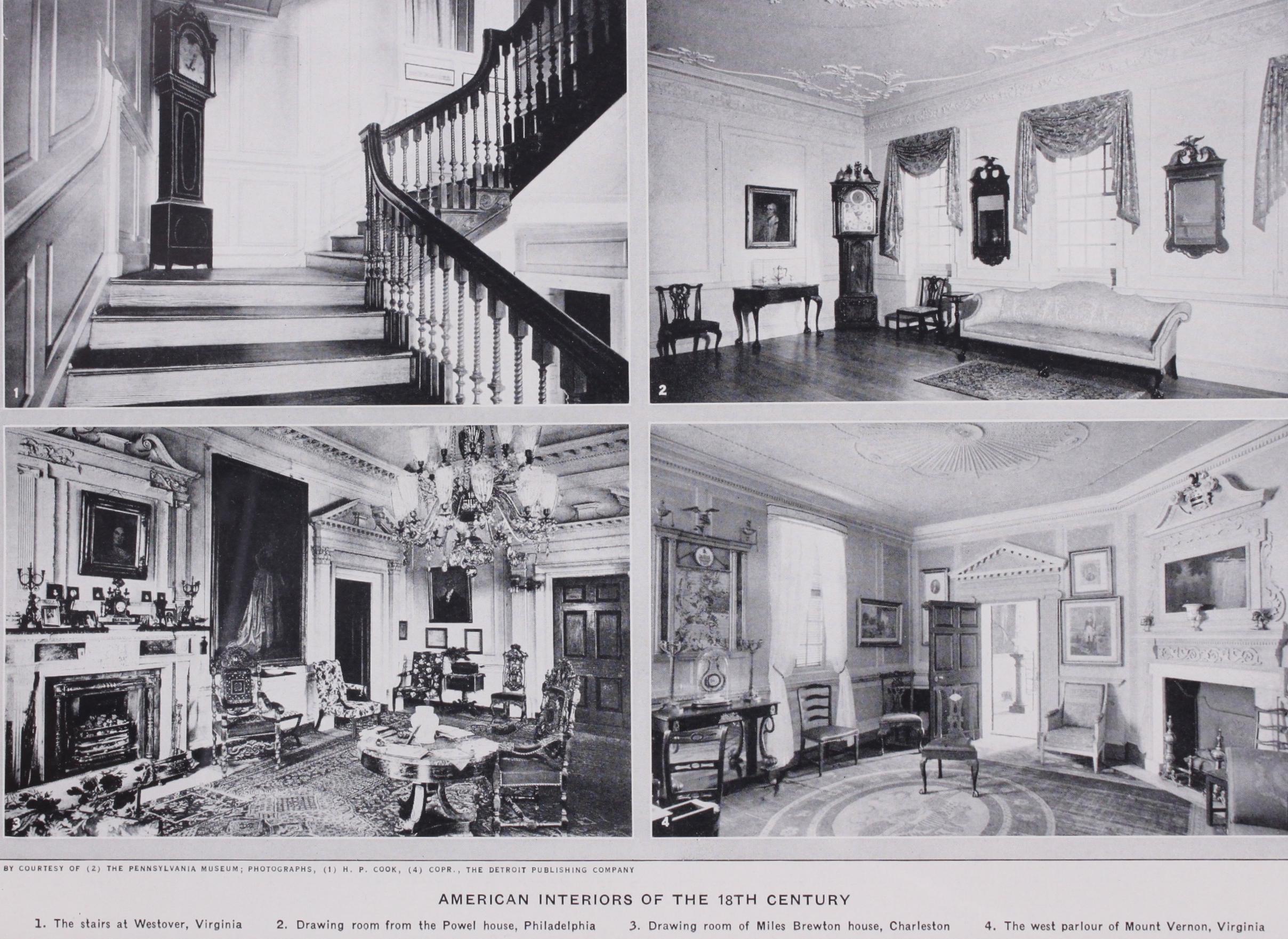


Thus in New England in the 17th century we find the clay filled walls, the timber houses roughly plastered and whitewashed, or perhaps wainscoted with wide moulded boards, which, standing vertically, served as the partitions. The joists of the ceiling were exposed, supported on heavy moulded summer-beams; the great fireplace was likewise spanned with a huge beam, and was devoid at first of any moulded frame. The effect was one of homely solidity, achieved by the frank revelation and elaboration of every element of the construction.
Into such houses in New England and Virginia went furniture of Jacobean oak, a few pieces doubtless brought over by the leaders, but the vast majority made in America after remembered models, from the abundant supply of native woods, chiefly American oak and pine. They included chests, court and press cupboards, trestled tables and forms and, at first, but a few chairs of the turned or wainscot types. One variety of armchair with turned spindles has acquired in America the name of Carver chair from the familiar example belonging to John Carver, still preserved at Plymouth. Other characteristically American types are two forms of chests found in the Connecticut valley : the "Connecticut chest" of the lower valley, with Jacobean spindles and the panels carved with a tulip decoration; the "Hadley chest" further up the valley, of which the frame likewise has incised carving. In the English colonies the furniture, as well as the woodwork, was generally left without paint or other finish. Inventories of the better 17th-century houses reveal that they contained much in the way of hangings, including tapestries and needlework, as well as treasures of plate made by the American silversmiths of the time, and pewter by local pewterers.
Similar in their generally mediaeval character were the interiors of the Pennsylvania-German houses, where, however, there was a rich colour, in the painted decoration of the chests with motives of birds, tulips and other traditional elements, the illuminated texts, birth and marriage certificates which hung upon the walls. It was the German colonists also who first made any high de velopment of pottery, as in the Pennsylvania slip ware, with similar decorations, and in glass-making, as in the wares of Stiegel and Wistar. The familiar hand-woven coverlets, chiefly of blue and white, were likewise derived from patterns brought in by the German weavers.
Following the evolution of style in England, under the Com monwealth and the Restoration, there appeared in America chairs of the Cromwellian and Carolean types, with spiral turnings and baroque scrolls, with seats and backs upholstered in needlework or with panels of cane. The chest with a drawer or drawers then made its appearance. The founding of Philadelphia by William Penn in 1682 brought to America for the first time the decoration of the period of Wren, which had appeared in London after the great fire and had been developed by Wren and Daniel Marot in the reign of William and Mary. Its influence only became wide in the colonies with the opening of the i8th century. The con struction disappeared beneath a formal interior finish. Panelling took the place of sheathing, the fireplace was surrounded by classic mouldings, at first boldly projecting, to produce the chimney-piece. The doors and windows, too, were surrounded by classic frames, and the wall might even be divided, in the finest houses, by pilasters. In the staircase the open string, with carved brackets at the end of the steps, was adopted; the balusters and newels, more slender, were richly turned, often in varied spirals.
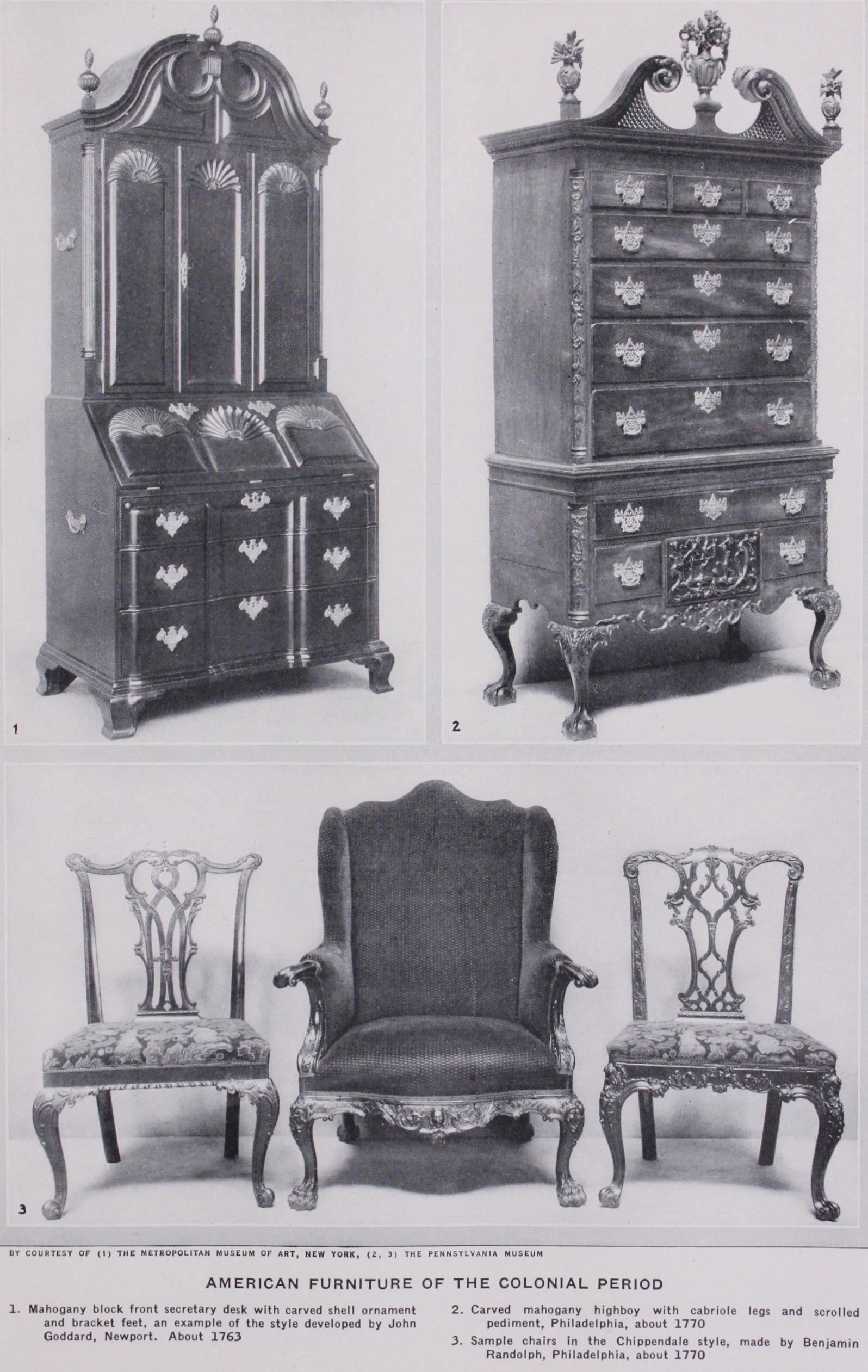
Walnut became the favourite wood in furniture, until super seded by mahogany in the middle of the century. The style of William and Mary, with its trumpet turnings in legs of chairs, dressing tables and chests of drawers (now elevated on frames to constitute "highboys"), its high curved chair-backs; and that of Queen Anne, with its cabriole legs, succeeded one another some score of years after the advent of these monarchs in England. To this time we may refer the first creation of the American types of Windsor chairs, many of them so different from the English Windsors and owing more to the roundabout chairs. In hickory the Americans found an admirable wood for the bows and spindles. The early Georgian style was adopted in America simultaneously with the use of mahogany, so that mahogany pieces are to be found in the colonies of types which in England were disused before the advent of this wood. Certain types were also created in America, most notably the "block front" secretaries and dress ing tables made by John Goddard of Newport about 1763, with alternate projections and recesses crowned by carved shells.
The heyday of the colonial style came in the fifteen years before the Revolution and coincided broadly with the Chippendale influ ence. Chiefly with the publications of Abraham Swan the forms of the French rocaille, with its characteristic pierced shell work, reached America and were used in the adornment of the great mansions of Annapolis and Philadelphia, and such fine houses as that of Jeremiah Lee in Marblehead and Miles Brewton in Charles ton, or the Philipse Manor in Yonkers. The delicate carving of the overmantels, with their scroll tops, was matched in the airy relief work of the plaster ceilings. This was the period of the great Philadelphia cabinet and chair makers, such as William Savery, whose earlier work is of a simpler character, Benjamin Randolph, James Gillingham and Jonathan Gostelowe, whose workmanship compares with that of the London craftsmen. The most characteristic pieces, distinctively American, are the high boys and lowboys of mahogany, their tops and skirtings carved with delicate shell ornament. The trade of the upholsterer now also flourished; the craft of the silversmith in the hands of such men as Philip Syng and Revere the elder excelled in adaptations of fine Georgian models.
On the eve of the Revolutionary War the influence of the Adam style began to be seen, as in the garlanded ceilings at Kenmore and those executed for Washington after the outbreak of hos tilities. The war postponed any widespread effect until after the resumption of relations in 1783. In the following year John Penn, of London, in building his little box, Solitude, on the banks of the Schuylkill, gave the first complete example, and others were furnished in the great Philadelphia mansion of the Binghams and the country seat of William Hamilton, the Woodlands, near by. The style was introduced in New England by Charles Bul finch who found an apt follower in the Salem carver, Samuel McIntire. Mantels and doorways were adorned with delicate composition ornaments, at first imported from London, later made also by American craftsmen like Robert Wellford of Phil adelphia. Ingenious adaptations of the Adam motives, made with gouge and auger, were widely employed about I Soo. Owing to war but little characteristic Adam furniture was made in America, but the developments of Heppelwhite and Sheraton were early and eagerly adopted. The later Georgian models also gave in spiration to silversmiths like the patriot Paul Revere, in Boston, and Joseph Richardson in Philadelphia. Through the new relations with France not a little fine French furniture of the Louis XVI. style was imported to America, as, for instance, by Washington and by such residents in Paris as Jefferson, when American min ister, and James Swan of Boston. Both Sheraton and Directoire models were adapted by the gifted cabinet-maker in New York, Duncan Phyfe, whose lyre tables and sofas are among the most refined of American furniture designs. Of this general character must have been the original furnishings of the White House under Jefferson, destroyed by the British in 1814. In the refurnishing of the White House under Monroe, about 1817, it was furniture of the French empire and Restoration which was imported. The heavy mahogany of this classic style with its gilt mountings filled the high, chaste interiors of the American houses of the Greek revival and persisted until the advent of Victorianism.
See TEXTILES ; RUGS AND CARPETS ; METAL WORK ; LAMP ; LIGHTING AND ARTIFICIAL ILLUMINATION ; TAPESTRY. (F. KI, ) BIBLIOGRAPHY.-For the interior architecture of houses see R. T.Bibliography.-For the interior architecture of houses see R. T.
Halsey and E. Tower, The Homes of our Ancestors (New York, 1925) . W. R. Ware. The Georgian Period (Boston, 3 vols., 1898-1902, 5th ed., New York, 1923) ; D. Millar, Measured Drawings of Some Colonial and Georgian Houses (New York, 2 vols., 1916 ff.) ; F. Kimball, Domestic Architecture of the American Colonies (New York, 1922) ; L. French, Colonial Interiors (New York, 1923). For furniture and crafts see I. W. Lyon, Colonial Furniture in New England (Boston, 1891, 2d ed., 1924) ; L. V. Lockwood, Colonial Furniture in America (New York, 2 vols., 1902, 3d ed., 1927) ; E. Singleton, The Furniture of our Forefathers (New York, 2 vols., 1901) ; F. C. Morse, Furniture of the Olden Time (New York, 1902, 2d ed., 1917) ; W. Nutting, Furniture of the Pilgrim Century, (Boston, 1921) ; C. O. Cornelius, Furniture Masterpieces of Duncan Phyfe (New York, 1922), and Early American Furniture (New York, 1926).
The Chinese mode of living is quite different from that of the Japanese, though in art and culture the two peoples have many points in common. The difference in the diet and the difference in the style of their dress, manifest themselves in their houses and in their mode of living. Unlike the Japanese, the Chinese house interior is profusely decorated and furnished with chairs, tables, beds, stands, cabinets, screens, etc.
In an ordinary Chinese house the guest room, which opens to the courtyard, has a bare tiled floor, and is furnished with tables and usually 8 chairs. The place of honour in the room is marked by the long table, kew tai (bridge table) placed at the middle against the back wall where hangs a painting or a pair of hanging scrolls bearing quotations from the Classics or both. Upon the long table are placed vases of flowers and objects of art. Directly in front of it one invariably finds a square table named, for good luck, Pa Hsien Tai (table for the eight Taoist immortals). On either side of it is placed a square stool or an arm chair for the honoured guests. The back wall is often formed of a screen partition, bing mun, behind which there generally is another room with a sacred shelf, sun low, where deities and the spirit of the ancestors are enshrined high up near the ceiling; and below on the floor a place is provided for the god of the earth, to chu sun. In homes of the common people, the sacred shelf constitutes the main feature of decoration in the house, usually occupying the most prominent place above the bridge table in the guest room. In the houses of the upper class, there is more than one guest room or parlour. There is an entrance room, through which the guests pass into the courtyard and into the cha tai, a small room where the visitors may change their street attire into a proper dress before appearing in one of the guest halls, ka dong.
By removing the Chang thou (the long windows), the latticed panels between the pillars, the guest hall is thrown open to the courtyard for the entire length. Some homes are provided with another guest hall, kwa tai (flower parlour), which may be used for the banquet as well. Whenever possible, the screen partitions (not sliding screens like the Japanese ones) are employed so that two or more rooms may be used as one big room when a large party is entertained. The main wall, as well as the side ones, are generally covered with many paintings or scrolls mounted as the Japanese kakemono, which are changed periodically so as to keep them in harmony with the season. In some houses tapestries take their places. The parlour generally has a tiled floor and the bed room a wooden floor, rugs or carpets being very seldom in evi dence even in the wealthy homes, though the country has long been famous for the production of splendid rugs.
The cabinet, tall and dignified, with shelves and chest of drawers inside the swinging doors, occupies an important position in the living rooms of the Chinese house. No less significant is the bedstead, which is often a work of art in its design and embellishment with carvings and paintings. The bedstead usually combines a small compartment to contain a chair and a table. Sometimes the bed is enclosed in a large portable structure with a ceiling, the wooden parts being decorated with beautiful carv ings, generally lacquered over. The curtains for the bed, during winter, are of double satin, and in summer either of white taffeta or of very fine gauze, both of which are open enough to permit the air to pass through and close enough to keep out mosquitoes and other insects. The structure is a room in itself, being pro vided with a door and generally so large that it is fitted with shelves and contains, not only the bed of ample size, but a table, chairs and a cupboard. The usual furniture is in the dark, heavy, precious hardwood, tzu-tan. The chairs with seats of the same material, and backs with an inset of tai-lee-sek, marble from Yunnang province which has natural pictorial marking like the paintings after the "southern school," have their simple dignity. Little square stands used for serving tea are often topped with wan-sek, the ordinary marble.
Both tables and chairs are often inlaid with mother-of-pearl in floral and bird designs, but the best wood is preferred to be admired in its natural state. Some pieces are lacquered in various colours, while others are lacquered and carved or incised, many of them presenting impelling dignity by their shape, size and tasteful decoration; some of the best examples may be seen at the Victoria and Albert museum. With the massive furniture, heavy carved beams on the wooden ceiling, and panels of latticework that shut off the glare of the courtyard, the room is restful. Superb workmanship in decorative art, with inlay of ivory, col oured horns, mother-of-pearl, etc., on a lacquered ground is shown on the tall folding screens used as partitions in the room. A single panelled screen, ping-mun, also called a devil screen, is placed at the entrance to the house to act as a buffer. While it prevents a view of the interior from outside, it serves to deflect, or ward off, according to the Chinese superstition, the evil spirit.
The refinement of simplicity, which finds its aesthetic ideal in the natural beauty of materials and is compatible with the aus terity of architectural form, is a keynote of a Japanese house interior.
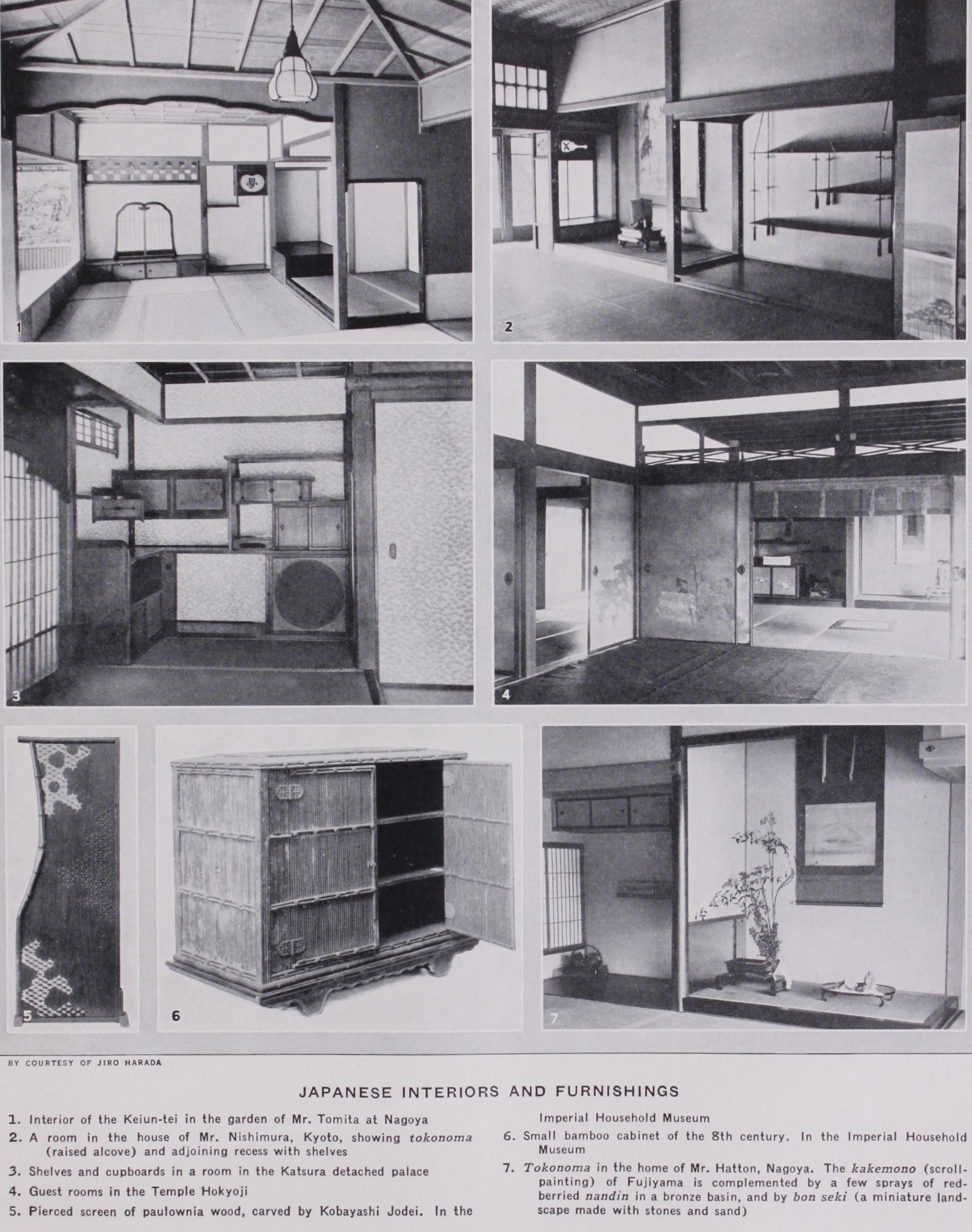

wide, whose monotony is broken by parallel strips some 18 in. apart running across the ceiling, and invisibly nailed from above. Since the grain of the wood forms part of the decorative scheme in the interior, the boards are cut from a single tree to insure uniformity. The panels, 6 ft. in length, must be so laid as to suggest continuity of the grain across the room, and must be carefully planed by the carpenter, for they are to be admired in their natural state and no flaw in human handicraft must be allowed to spoil their intrinsic beauty. All the woodwork of the interior must in the same way be left virgin, unspoiled by colour stain or paint, with occasional exception of the narrow framework of the fusuma, and the tokobuchi—a piece of wood several inches in width and thickness running along in front of the tokonoma (see below) to its full extent—both of which may be lacquered in harmony with tatami borders or the tokonoma post. This is often made from a tree having some special tint or texture, or else made to conform to its natural curve of growth. A portion of its bark or the worm-eaten marks beneath it, or the stump of a branch or some other witness of nature, is preserved, thus focus sing on the tokonoma—the most important feature of a Japanese interior—the significance of the design of the room.
Thus the guest is brought to feel the very spray from the waterfall, transforming the confined room into a fitting place in which to entertain visitors on the hottest of summer days. An alternative to the painting is a couple of lines of poetry on which the guest may meditate on his entrance into the room. His atten tion may next be led to a bon-seki (q.v.), a tiny landscape con trived with natural stones and sand, on a black lacquered tray at the foot of the kakemono. It may call to mind some familiar scene—a rocky promontory with an island near by, and beyond the moonlit sea the dim contours of undulating hills. The poem on the kakemono (for calligraphy is also treated as a pictorial art) thus quickens with new meaning for him and he can share the poet's inspiration.
Thus simplicity of display is fully compatible with wealth of possessions. The same object is rarely seen twice in a dozen visits. Hundreds of beautiful things may be stored in the treas ure-house. Guided by his knowledge of the character and tempera ment of his guest, his recollection of the impression made by the things on view on former occasions, a Japanese host will select from his store, always aiming at giving pleasure and a delightful surprise to his guest.
Sometimes a skirting of strong white or grey paper about a foot high as a protection against the broom is seen on a Japanese wall, but it is never papered or covered up by paintings, although a gaku, consisting of a painting or a few written characters expressing or suggesting a poetical sentiment or a truth may be framed above the fusuma. Plastered earth and. sand, variously coloured, and mixed with boiled funori (Gliopeltis Arcata) to give solidity, is used for the interior surfaces of the lath and plaster walls, and the pounded shell of little fresh-water bivalves or iron filings is sometimes mixed with the sand for their decorative value. Plaster in tint of smoke, mist or cloud, often has a hard and resistant surface.
Beds may be arranged on the floor in any room at night by piling up wadded quilts, which are folded and packed away in the closet, after airing in the sun, in the morning, leaving the room clear for other uses during the day. A tansu, a chest-of drawers in plain paulownia wood, may betray the sleeping apart ment, but this, too, is often placed in the closet, shut off by fusuma, so as not to be seen. A clothes-horse is as a rule also placed out of sight behind a screen. Byobu, ornamental folding screens of 2, 4 or 6 panels decorated with writing or painting, or carried out in plain gold, serve many a convenient purpose, warding off draughts or hiding an undesired view. A single-panelled screen called tsuitate is usually placed in the entrance-room, to allow of the front shoji being pushed open without exhibiting the interior of the house to a caller. Even the dining-room is without any sign of its use, a collapsible low table being brought in for family use at mealtime, or food being carried in and served to each individual on small low lacquer tables called o-zen, kept in the kitchen cupboard when not in use.
In the summer heat the ordinary fusuma and shoji are fre quently removed and replaced by others specially made of rushes or split bamboo to permit the passage of any breath of wind that may happen to stray into the house. The floor, too, may be covered over with rattan matting, to impart coolness; and misu or blinds made of split bamboo or rushes, may be suspended from the eaves to give shade and privacy.
Yet the movement, which ended with the beginning of the war in 1914, succeeded in making itself felt everywhere. To-day we are confronted by a movement which is even stronger and ob viously more radical than before, which has learnt in the hard school of war and poverty which followed it many a lesson which the great public needed and was bound to receive.
In modern interior decoration, now that it is recognized that dec oration alone, even new forms of decoration, admittedly does not create style, the great need is to have a complete apprehension of the task in all its essentials. We no longer think in terms of pil lars, window-frames and decorations of one type or another; we create the room to be the environment of some particular human occupation, adapted for that purpose, simple and concise in form, and constructed in the best and most suitable materials. Manifold needs give birth to equally manifold expressions and we are be ginning to construct with comparative certainty, without the risk of committing blunders. A city of to-day looks quite different from the city of a hundred years ago. With the help of new tech nical contrivances we can achieve quite unprecedented effects, be cause our first care is to apply all the methods of sanitation, to preserve correct proportions in design and to consider the needs of every class of society. In a modern house bacilli lead a sorry existence; light and air flow through every corner and cranny. Glass, manufactured in every possible way, set in metal, to econo mize space on the frames, is replacing white walls. We attach the chief importance not to the lighting apparatus but to the light, and similarly we care more for the heat than for the heating apparatus.
First consider the living rooms. The size and height must partly depend on circumstances ; the height must not be less than 7 ft. 6 in. to 8 ft. 6 in. One wall—facing east, south or west should be glass from ceiling to floor; many rooms, such as the breakfast room, winter garden, living rooms and day nurseries may have two or even three sides of glass. Double glass, reaching to the floor and lined with water-tight material, may provide a space for flowers, plants and perhaps statuary. Besides having a door in the inner glass wall there could be a second door in the outer glass leading on to a balcony or a terrace. There should be no pernickity curtains, blinds, etc., but some suitable means of protection against excessive sun. In first class work the actual wall surfaces are sometimes left without further treatment with fine effect. In rooms already built and wall surfaces already treated, it is necessary to treat the wall aright, making it either washable or porous, according to how the room is to be used. As room space is usually scanty, we cannot have walls which will be too easily damaged or stained during occupancy. The whole wall treatment, up to the ceiling, should be uniform. Above all, there should be no wainscots. Wood panelling is highly effective—choice woods, beautifully grained, the doors not unnecessarily large, and un framed, and simply cut out of the wood. In small rooms the ceil ing also may be executed simply in wood, a treatment which gives a good, severe, solid effect. Parquet floors, covered with self coloured linoleum or with loose carpets are often desirable; carpets are needed where the occupants are likely to spend long hours comfortably seated at ease. The carpets might be self coloured and of good material ; if they have broad or narrow stripes of dark colour marking the border, they look well and will certainly never be thought tasteless. Whatever cupboards are re quired in such a room should be built into the wall, and writing tables, etc., should be made to tilt up and disappear into the wall. Collectors will perhaps add glass cases, reaching to the ceiling, to these walls, and may even keep pictures in this way; for to use valuable pictures or statues as wall decorations is dangerous to occupants and the safety of the pictures or objects.
Heating and Lighting.—The approved method of heating to-day is by hot-water pipes, which give a fairly certain and regular warmth. As they require large radiating surfaces, on account of the not excessive warmth they impart, they might also be built into the lower parts of the wall—suitably isolated, of course. Light is best admitted through the window, hence this should be well lit up in the evenings also—perhaps by ceiling lights between the double glazing. This form of illumination will usually suffice, but a number of contact points at carefully chosen places, including some in the floor for standing lamps, etc., of the most varied types, will prove serviceable. The age of pompous lamps and chandeliers, etc., hung from the ceiling, is past ; they break up the space and blind the eye. It is important to note that candle-light burns upwards, and does not dazzle if the brilliance is not excessive. It was natural and necessary, in an age of magnifi cence, to assemble countless candles in a cluster; the flickering light, surrounded with polished crystals of glass, was capable of producing great effects. The form of illumination produced by imitation candles of frosted glass and electric lamps in the shape of flames—a lifeless copy—is one of the most incredible blunders in taste. Gaslight, as an open flame, or better, with mantle, also burns upward. Its characteristic mark is the supply of the fuel by means of pipes. The pipes must therefore be given special prominence. Electric light is used in incandescent wires ; its char acteristic note is that it hangs downward, and on a cable. This is the proper position of an incandescent lamp, and it is an abuse to place it sticking upward, for the sake of some favourite lamp. The modem age of incandescent lamps offers the most varied and origi nal combinations and will prove particularly serviceable in public localities and large apartments. The candle continues and will continue to be employed as a table illumination at meal-times, on account of its comfortable, and at the same time decorative effect.
(See LIGHTING AND ARTIFICIAL ILLUMINATION.) Colour Treatment of Walls, etc.—In deciding on the wall treatment of a room the governing factor is always its purpose or use, which should determine its form. In many rooms which are only meant to be occupied for short periods, and are made of masonry, the colour of the paint, in particular, can work wonders. A beautiful bright cinnabar red, pale yellow or green have a cheer ful effect. A deep red will certainly have a solemnizing, pale blue and grey a tranquillizing, effect. Very light brown, pink or pale violet are generally suitable for ladies' rooms. Blue is a very good colour for resting rooms and bedrooms. A white wall, as such, in a beautiful, natural material, will always remain in favour, and will invariably prove a good convenient background for furni ture and stuffs. In considering any other colour, the chief point is whether a warm tone (yellow, brown, red) or a cold one is re quired. This is where most mistakes are made; a very strong sense of colour is necessary if the whole effect is not to be spoiled by woods and stuffs which do not harmonize in colour. A new idea, which conforms with our feeling for space, is to put slashes of the colour of wall and ceiling on to the window wall. If we put in any exceptional piece of furniture, part of the wall, against which it stands, can be coloured to suit. It will sometimes be admirable to cover walls and ceiling altogether with stuff, giving an effect of warmth. It is preferable to do this first with stuffs in a single colour.
Disposition of Furniture.—We shall, then, need less and less furniture in our living-rooms, since everything put there merely for show, or, worse still, for symmetry, must vanish. The fireplace, burning wood or coal, should be retained on account of the ventilation which it affords, of the beauty of the open flames, and of its warmth in autumn and spring. The inmates of the house will love to gather round it of an evening, or in chilly weather, and this is the chief place in which seating accommodation, of varying size and shapes, is to be placed. A low occasional table, always placed beside a chair, never in front of it, and electric lamp, and perhaps a small moveable stand for books, newspapers, and possibly light refreshments, will meet all needs. As most, if possi ble, all articles of furniture should be fitted into the walls, we hardly need any more furniture in the living-rooms beyond chairs and tables, except perhaps a flower-pot for a beautiful, large in door plant. The latter should preferably be a lime or an oak, rather than a palm or anything else alien to native flora. Cut flowers in a beautiful glass or a good piece of pottery, set in the right place, give great pleasure. The first law of the decorative artist is to make life cheerful and full of joy by the simplest pos sible means. The time is gone when human beings were supposed to find pleasure in dark, cellar-like rooms with heavy carpets and festal plush curtains, innumerable ugly knickknacks such as balustrades, candelabra without lights, flowers with artificial dust to imitate the genuine, wardrobes and chests of drawers.
Bedrooms and Bathrooms.—The bedroom must be light, again with one wall all windows, the beds on simple steads of wood or metal, not unnecessarily large. The light must be behind the head, so that one can read easily, lying on either side. A roomy easy chair with a small table beside it, a footstool, small, light tables on either side of the bed on which to place books, medi cines or a glass of water, will be sufficient furniture, if we have made arrangements for everything else in the bathroom and dressing-room.
The bathroom has become increasingly important. It is impos sible to do without it, and for various reasons it is desirable to allow it ample space. It is used, not only for washing and bathing, but for gymnastics and massage and all sorts of exercises. It must allow of quick and thorough cleansing; both walls, floor and ceiling should therefore be tiled. Furniture, if any, should be of enamelled metal glazes, as in the operation room of a hospital. The walls and ceiling may, of course, also consist of enamelled metal glazes, and the colour, besides white, a very pale grey, or, for a lady, even a pale pink shade. The dressing-room may have cupboards for all purposes around three walls, with one wall wholly mirror, in front of which should be a small table for toilet articles and the like and a low, wide chair, painted in dull oil or varnished. The lighting should be built into the mirror wall on either side, the floor covered with heavy mats or carpets, as it will often be trodden by bare feet. It should be possible to see that the floor of the bathroom is warm, not ice-cold, without em ploying bath-mats. In small houses, however poor, at least a sheltered table-nook must be arranged.
Attics, Kitchen and Pantry.—The attics, kitchen and pantry, the latter next to the dining-room, should also be clean, easy to wash, and in every way practical in their arrangements. No ma chines or implements whose shapes are in any way decorative or ornate should be used. The stands for kitchen utensils should be open, the lighting from the ceiling, which, like the walls, should be covered with simple white, undecorated tiles. The floor should be paved with plain slabs, preferably in pale grey or black. Pans, jam pots, etc., are better put away in a separate niche than in a refrigerator.
Assistants must be trained to look on themselves not as servants but as colleagues. They must be lodged in a nice, cheerful room and have their own recreation and dining rooms, to avoid any feel ing of inferiority. It is advantageous, if only on practical grounds, to have each of these rooms in a different colour. Obviously there must be ample facilities for bathing and washing.
To turn to the nursery, it is well to separate the day from the night nursery. Where there are many children, a sickroom with all modern comforts would be very desirable. In the day nursery everything which might cause injury, such as sharp curves and angles, must be avoided. Special regard must be paid to the child ish habit of crawling about. Tables should be round and the edges of the surface and the feet rounded off. Toys may be kept in cupboards which can be opened easily and without danger. Walls and ceiling must be in bright colours, perhaps each with a different colour, red, yellow, green, white, the ceiling light blue and the whole decorated with small stars. A convenient low chair for the mother or governess is an absolute necessity: the cover should be bright stripes, of washable material ; the lighting again from the window wall and with convenient contact points for a port able lamp. Contacts for a wireless and cinematograph also must not be forgotten. A small darkroom for photographic purposes is desirable. In large houses a small workshop might be fitted out for the boys, to arouse their instinct to use their hands at an early age, and have a place where small repairs can be carried out.
There may still be workshops of this sort to-day; the tailor's workroom, perhaps, comes nearest to it. Let us consider a moment where their true value lies. Something is sewn, for example, with a machine invented on the grand scale, superior to handwork chiefly in accuracy and regularity. Superior except in one point, the feeling for material. Once set in motion, the machine can only work on mechanically, and so must fail wherever attentive hand-work, inspired by mind and feeling, takes account of every difference, however small, and thus gives even greater steadiness, being therefore better in quality and so also creating greater value.
Complete recognition of the task and unshrinking performance of it must lead to a new style. While the first necessity is the simple, unadorned form, we need have no fear of genuine talented enrichment. Talent will always find the right way by instinct, and need not shun the most complicated shape. Finally let it be said that where for any reason a richer shape is preferred the forms created must always be new and natural. Repetition of old forms, old styles that have already had their day, is simply ruinous. It is equivalent to a confession of poverty of ideas and destroys all natural understanding and enjoyment. At the Con gress of modern bridge building in Vienna, Sept. 1928, the presi dent, Dr. Otto Linton, of Stockholm, treated this question at length, declaring that the architect was now a back number, and had been replaced by the engineer. He sees in the architect, the decorator who sticks pointless rosettes into purposeful building— a misrepresentation of the artist's real role, which consists in giving expression to the requirement-plan, and order to the pur pose-form. He will always find aim and purpose for his work in satisfying fully the needs put forward by the builder, think in good proportions and rightly chosen material and express himself through these, and not through ornaments stuck on at random.
Style cannot, as Linton says, be dictated by the brain of the mathematician or the blue pencil ; it springs from the character of a nation. The determining factor is whether that character is natural or corrupt, crude or refined, and whether it has advanced to the stage of seeing and preferring the better. It will never be possible to make exact calculations regarding colour, and yet colour is one of the most important factors in modern build ing and decoration. It would be equally foolish to say that artistic painting is a back number to-day, varnishing and distemper alone required. The only true measure is to appreciate the value of modern painting, feel its quality and estimate that alone. The essential is not even the individual species within modern painting —although this, too, certainly needs to be considered, but solely the significant side and special quality within a capability. We see this best in photography, which can be splendid or absolutely uninteresting, according to the amateur who handles the camera. The main point is therefore to re-educate ourselves so far that we can choose the right forces in every field and allow only great capacities to influence us. The more true forces assert themselves, the higher will be the cultural level of a people. The work of the engineer is much less cramped than that of the architect, hence his untiring development, particularly in all creative fields. Respect for the achievement is still intact, and the success is consequently greater.

As for the cinematograph, the first requisites are good, com fortable seating accommodation and easy entry and exit. Tip-up seats covered with good leather, a good carpet on the floor (if possible of the same colour as the leather) ; the walls preferably hung with stuff, and similarly all curtains, partitions, etc. made of the same material, will give a good effect. An efficient system of ventilation and perfect lighting (q.v.) (preferably by means of soffits), for the intervals, is required. Particular attention must be paid to the vestibule, as this is very much used. Marble or inlaid wood are both suitable materials. If the till and the buffets are made automatic, great simplification in running will result. If the rooms are given convenient shapes, the staff can be re duced. In cinematographs and the like special attention must also be paid to securing the electric cables. They are best laid in the walls; but it is advantageous for the purpose of repairs, to have them easily accessible. The cables must therefore either be laid in grooves in the walls, or stretched free, absolutely taut ; for the frequent, untidy crooked laying and fastening is dangerous as well as ugly. Absolutely perfect fixing is the first duty. The last word on this point has not yet been said. It is best if the cables can be fastened without visible screws, for screws are always a makeshift. Otto Wagner declares permanence to be the first law of all architectural expression. This calls for good material and excellent work well planned and designed. To achieve this, re quires constant practice and the possession of a natural capacity of identifying oneself with one's task. For example, in decorating and fitting a butcher's shop. Our immediate thought is to cover walls, ceiling and floor with a material which will keep cool and can be washed, therefore tiles are used. In old days we should have wanted to adapt it to Roman precedents; to-day we invent good fittings, avoid all ornamentation, but put the signs in the right place, and in perfect lettering. The lettering, which is usually a disturbing element, has assumed particular importance to-day.
There have always been certain objects which accurately reflect our age, and a later age will find it easy to recognize in these the forms in which we express ourselves. This is especially relevant to the coach-work of motors and modern carriages, rolling-stock, aeroplanes, etc., and many machines, if designed solely to express their purpose and not marred by antique decoration. The arm chair, too, has been altered and adapted to suit modern require ments, solely on practical grounds. The interior fitments of many theatres, hotels, restaurants, cafes, cabarets and bars must be described as quite new and successful. The equipment of ocean liners, especially in the working parts, is also modern, even though here, as with the American sky-scrapers, an absolutely modern construction is often spoiled by incomprehensible, antiquated decorations.
In 1843 Rossetti founded the pre-Raphaelite Society in Lon don; in 1881 Morris and Co. was founded. New stuffs, carpets, books, book-bindings and furniture were related. In 1881 the workshops were removed to Morton Abbey in the South of London.
The intention is to do justice to the construction and accommo dation, to avoid all statistic forms and simply let the construction speak for itself, the chief stress being laid on well-chosen propor tions. Fahrenkamp in Dusseldorf, Pfeffer and Mendelssohn in Berlin go further, and prefer a richer style for internal accommo dation. Bruno Paul and Arnold Nechansky have also created rich and original interiors in Charlottenburg. After the war, the whole trend was towards greater simplicity. Walter Gropius in Dresden built solely in concrete and glass. He constructed the Stadttheater in Jena in 1922, the Bauhaus in Dessau in 1925. W. M. Dudok, of Hilvershum, Holland, built the school at Boschrift on three lines in 1922. To the same school belong also the designs and buildings of Corbusier and Pierre Jeanneret in Paris, Mies van der Roho, Bruno and Max Taut in Berlin, and the works of Freysinnet, Mallet-Stevens and Chaneau in Paris. The arrange ments of the Stuttgart settlement in 1927 give a good indication of the new projects. The chief authors here, besides Gropius, are Corbusica and the Viennese Josef Frank. The most grandiose achievement is the Stuttgart railway station, together with the festival buildings in Salzburg by Behrens and Holzmeister. The buildings and decorations of the exhibition on the "Pressa" in Cologne in 1920 and the Dusseldorf Art Exhibition give a true picture of the whole development. In America the leader is Frank Lloyd Wright, who has been following the same path for 20 years. Many utility buildings, such as the imposing granaries in Montreal, and others in South America, are completely satisfying. The sky-scrapers are unluckily marred by unharmonious archi tecture; on the other hand, a granary of the Washburn-Crosby Company, built in Minneapolis in 192o, is an absolute model.
The collections of stuffs and wall-papers in the Wiener Werk statte and the Deutsche Werkstatte show patterns which are original and usually successful. Good and successful work in lace, embroidery, carpets and tapestries can also be found everywhere. The treatment of metal has also made extraordinary advances. Angela Stodthen's room, of pure beaten copper, in the Austrian pavilion at the International Arts and Crafts Exhibition of 1925 in Paris, is an example of this type of work. Similarly, ceramics has developed greatly, and plays an important part in fireplaces, wall-decoration and above all in frescoes. The free painting of walls, particularly in restaurants, cafes and similar localities is also much in use, but fresco-painting is also often successfully employed. (See also RUGS AND CARPETS ; LIGHTING AND ARTIFI CIAL ILLUMINATION.) • (J. HO.) BIBLIOGRAPHY.-America: R. T. Townsend, Country Life Book of Building and Decorating (1922). Austria: J. Folnesics, Innenraiime and Hausrat des Empire and der Biedermeierzeit (1920). England: "Country Life," Modern English Interiors (1928) ; Technical Institute, Ltd., Garden City Houses and Domestic Interior Details (1913) ; James and Yerbury, Modern Houses and Interiors (1925) . France: R. Prou, Interieurs au salon des artistes decorateurs (1928). Colour Interiors: H. W. Frohne and Jackson, Colour Schemes for the Home (1919) ; Anonymous, Colour Schemes for Modern Interiors (Hoffmann, Stuttgart, 1923) ; L. Deshairs, Interieurs en couleurs (1925) .
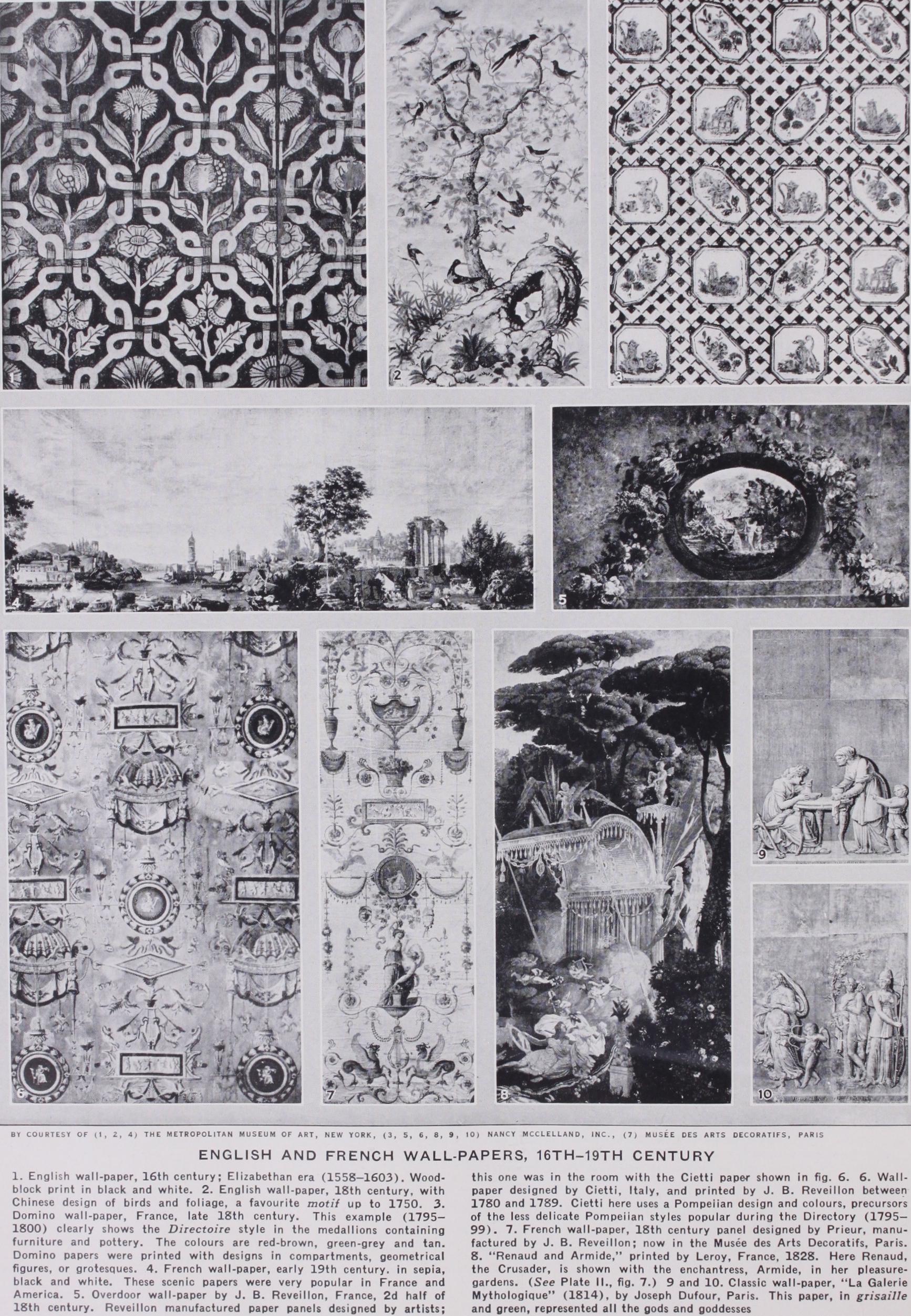
Paper wall-hangings were first invented as inexpensive substi tutes for the costly and sumptuous hangings of brocade, broca telle, tapestry, stamped leather and Genoese velvet, used in the palaces and the great houses of Europe in the i6th and 17th centuries.
The earliest beginnings of this art are still in some obscurity. It is evident, however, that printed wall-papers were not made until after the discovery that type could be cut on wood-blocks and printed. Apparently some of the earliest paper wall-coverings were produced by the letter-press printers themselves. This fact is substantiated by a discovery made in 1911, during restorations to the entrance hall of Christ's college, Cambridge. On the orig inal beams of the ceiling, in the entrance hall and dining room, was found the oldest block-printed wall-paper known to be in existence. The design is in black and white, done on the reverse of the proclamation of the accession of Henry VIII. Scarcity of good stock evidently led to this economic use of both sides of the paper. The pattern is that of a contemporary velvet or brocade. It is signed with "a great H and a goose," the mark or rebus of the master-printer, Hugo Goes, who was living and working in Steengate, York, in 1509.
Domino Papers.—But the real development of the wall-paper idea is due to the dominotiers of France, a group of men working in the i6th century in Rouen and other cities of the provinces to make domino papers and mar bled papers, which were eagerly bought by the peasants as a dec oration for their fireplaces. Un doubtedly this inspiration came from the decorative Italian pa pers used to line boxes and books.
The Frenchmen, however, were the first to put such papers to general use as wall-hangings.
Domino papers were printed with little geometrical figures, de signs in compartments, or gro tesques. Marbled papers required no printing, but were made by floating off the colours from the surface of water, after "combing" them into various marble de signs. Both domino papers and marbled papers were also used in France for end-covers of books, and for covering or lining boxes. Special marbled papers in black and white were made for funeral prayer-books and other mortuary requirements.
By permission of the king, the dominotiers merged with certain wood-engravers in 1586, and formed a corporation or guild of "dominotiers, tapissiers et imagiers." Small sheets of paper like those used for the Images d'Apinal (c. 12X 16 in.) were employed for these paper-hangings, which were sold by the quire or by the ream. The outline of the de sign, engraved on wood-blocks, was printed by means of a simple press. The design was then coloured by hand, by means of sten cils, using distemper colours mixed with glue. The French name of papier peint for wall-paper is a descriptive relic of this early process. No attempt was made in these earliest wall-papers to arrange designs in such a fashion that they would match when the small sheets were put together on the wall. It was not until the master dominotier, Jean Papillon (1661-1723), invented con tinuous matching designs about 1688, that people were relieved of the casual effects created up to that time whenever wall-paper was used.
Jacques Chauvau, who was a pupil of Papillon, improved on his master's ideas by printing all the colours from successively applied wood-blocks instead of stencilling them by hand. He had great success from his initiative ; his method was quickly taken up by Boulard in Paris; and papers of the same sort were soon printed in Chartres and in Orleans. During Papillon's time the popularity of wall-paper increased. Savage opened a factory in Reims; Le Tourmy and Rabier-Boulard had wall-paper factories in Orleans; Isnard of Strasbourg, Descouteaux of Chaumont, Vautrain of Nancy, and Roche of Lyons became well-known for their work in engraving and printing paper-hangings. The new technique of printing in colour was not universally substituted for the old. Until the end of the 18th century, there were still small ateliers that remained faithful to "illuminated" papers. Nevertheless the process was widely used.
Both paper-printers and paper-hangers had been greatly handi capped up to this time by the fact that they were obliged to work with small-sized sheets of paper. In 176o Fournier, a merchant on the rue Carre St. Martin, Paris, made the first attempt to produce paper in long strips by pasting the small sheets together before printing, thus forming a roll. An edict of Louis XVI. in 1778 decreed that each such "roll" should contain 24 sheets of paper, pasted end to end, making the length about 34 feet. The name and address of the maker was obligatory on the two end sheets. This was the standard size for a roll of wall-paper until the metric system was adopted.
Flock Papers.—The discovery was made in 162o that chopped wool could be used to produce wall-paper which resembled velvet and tapestry so closely as to deceive both the eye and the fingers. This new invention, especially suited to contemporary fashions in house-decoration, was launched by Le Francois of Rouen. His process was very simple. Instead of the ink or distemper colours used by the dominotiers for printing their wood-blocks, he employed a mordant or greasy varnish. Before it dried he shook or blew over it, by means of small bellows, very finely chopped wool in different colours. This substance adhered to the varnish and covered the design. The superfluous wool was then shaken off, and a perfect imitation of brocaded velvet was obtained.
The cost of flock papers was small, in comparison with the sumptuous stuffs imitated, and their effect was so impressive that they attracted great attention and made the name of Le Francois famous in all the countries of Europe. Jerome Lanyer, of England, was inspired to attempt the same process under a grant made by Charles I. in 1634, giving him the exclusive right to manufacture flock hangings which he called "Londriniana." For this privilege he paid the sum of L I o a year to the crown. Lanyer's flocks were made, however, on "linnen, cloath, silke, cotton, leather and other substances," probably because there was not at the time any English-made paper strong enough to use for the purpose.
Fifty years later Dunbar of Aldermanbury was advertising an amazingly large assortment of flock papers, "some after the man ner of real tapestry, others in imitation of Irish stitch, flowered damasks, sprigs and branches; others yard wide in imitation of marble and other coloured wainscots, others in yard wide em bossed work, and a curious sort of flock work in imitation of Cassaws and other hangings of curious figures and colours." In France the first generation of flock papers died out before they were in general use, to be succeeded by the illuminated papers of the school of Papillon. In England, on the contrary, flock papers took root and flourished. The process was perfected and improved in this country, and in 175o England suddenly began to ship flock papers back to France. The greatest success was the brocaded paper done on blue or gold grounds, which quickly became the rage in Paris. Madame de Pompadour com manded it to be hung in her dressing room at Versailles and in her bathroom at the Château des Champs. Ladies of the court sent their Gobelin tapestries to storage, in order to put "English blue paper" in their place. The charming designs of Papillon were forgotten or depreciated in devotion to this new fashion.
An English paper-stainer named Lancake went so far as to get permission to establish a factory at Carrieres, near Paris, for the production of flock papers, and French manufacturers were driven to defend themselves against the English invasion. They knew the secret process and had no difficulty in adapting them selves to the taste of the day. To prove their superiority they used chopped silk instead of chopped wool, imitating the finest silks that came from the looms of Lyons.
It is interesting to observe how these papers were applied to the wall. Early papers in England were nailed on with flat-headed nails. Later papers, both in France and England, were applied with paste—but flock papers were treated with as much courtesy as if they had been the actual stuffs of which they were imitations. They were mounted on a chassis, or stretcher, which was first nailed to the wall and covered with stout linen, tightly stretched. Over this brown paper was pasted as a lining paper ; the flock paper was applied when this was dry.
Paper Imitating Painted Panels.—The second half of the i8th century was marked by a new development in paper hang ings, due largely to the genius of Reveillon, a Paris manufacturer, who took his inspiration from painted room-decorations executed by the artists of the day. Reveillon determined to make paper panels of such a character that they might be used in wood-pan elled rooms in place of decorations painted on canvas or on wood, and to employ the best artists as his designers. The panels created for him by Huet, Cietti, J. B. Fay, Prieur and Lavallee-Poussin, executed with Reveillon's amazing knowledge of technique, are undoubtedly the most beautiful wall-papers that have ever been made. (Several panels by Prieur will be found in the Musee des Arts Decoratifs in Paris.) In Reveillon's opinion, no paper stock existed that was fine enough to be worthy of these designs. He reports in his Memoires that he saw a piece of vellum paper brought to France by Ben jamin Franklin—paper that was used in England by Baskerville in printing fine books—and that he greatly desired to reproduce it. In 177o he purchased a paper-mill at Courtalin-en-Brie, and began there the fabrication of the paper for which in 1786 he was awarded the Prize for the Encouragement of Useful Arts.
His wall-paper factory in Paris employed about 30o workmen. It received from Louis XVI. in 1784 the title of "royal manu factory," which gave Reveillon among other privileges the right to add to his sign the crown and the three fleurs-de-lys. The establishment met disaster in the riot of April 28, 1789, at the beginning of the French Revolution. Incited by jealous competi tors, and roused by the rumour that their wages were to be cut, his band of employees pillaged the factory, leaving destruction and ruin in their wake. Unable to find and murder Reveillon himself, they burned him in effigy. The guards, ordered out to quell the disturbance, fired on the mob. Many persons were killed and several were sent to prison.
Reveillon fled to refuge, and from his retreat sent a despairing letter to Necker; in reply he was offered by the king a sum of 30,00o francs to offset his loss and was assured of protection and continuance of royal favour if he would resume his work. Discouraged and broken in health and spirit, however, he emi grated to England where he died a few years later, leaving his factory in the hands of Jacquemart and Benard, who proved to be worthy successors. Although chiefly noted for panel-decora tions designed by eminent artists, Reveillon also made all the various sorts of papers that expressed the taste of his day; to these he gave a distinction of design and colouring that endowed them with a special sense of refinement and grace.
Similar developments in the printing of paper panels occurred in England around 1754 under the direction of John Baptist Jackson, who is the most interesting and prominent character in the history of English wall-paper. Jackson published a book on the "Invention of Engraving and Printing in Chiaro obscuro . . . and the application of it to the Making of Paper Hangings of Taste, Duration and Elegance." The book is written largely about himself, styled "Author of that Paper Manufactory now carrying on at Battersea." It was here that Jackson produced the famous series of Venetian prints ordered by Horace Walpole for Straw berry Hill, and also the large landscape-panels and medallions which are a curious mixture of Pillement and Piranesi.
Jackson's papers were printed in oil on a rolling press of his own invention. He guaranteed that "the colour will never fly off— no water or damp can have the least effect on it." Engravings made by him in Rome and in Venice, copies of Canaletto, Rem brandt, Titian and other old masters, were used as subjects of these panels. He also reproduced statues like the Belvedere Apollo, the Dying Gladiator, and the Venus de' Medici, so that "the person who cannot purchase the statues themselves may have these prints in their places." The latter part of the i8th century in England was also notable for the work of Francis Frederick and George Eckhardt, who established a factory in Chelsea in 1786 and executed some remarkable papers with needlework designs, and others with printing in silver-leaf.
In 1712, under Queen Anne, a tax of one penny a square yard was assessed on English paper-hangings. In 1714 this tax was increased one-half. No change in duty was made thereafter for nearly a century. Wall-paper was exempted from duty in 1825, the same year in which prohibition of importation of this manu factured article was removed.
Paper in continuous rolls was invented by Nicholas Louis Robert, of Essones in 1799, and the English patents, "to make paper without seam or join," were obtained in London in 1801 by John Gamble and Didot St. Leger. The use of paper of con tinuous lengths was not, however, permitted in England before 1830, because of the important revenue derived from the tax stamps on the small sheets. France, meanwhile, made use of the new invention after 181o.
Scenic Papers.—The attempts made by Reveillon and Jackson to produce paper which represented paintings in panels had a natural development in wall-paper history. They were followed by the epoch of scenic papers—panoramas that covered the entire room with a landscape or a story without repetition.
Late in the i 8th century, after the papers of the Revolution with their liberty caps and tricolor cockades and fasces, their pyramids and palms, had come and gone, the makers of wall paper took up this new idea and carried it out with infinite detail. Robert, whose partner, Arthur, died on the guillotine, produced a Directoire paper with designs of Bosio. Jacquemart and Benard printed the "Hunt" at Compiegne, of which there is a set in the Metropolitan Museum of Art in New York and also in the Vic toria and Albert Museum, London. But the two specially prom inent names in the realm of scenic papers are those of Zuber and Dufour.
Zuber's factory, founded in 1790 and still in operation, is at Rixheim in Alsace. In 1804 this paper factory issued the "Vues de Suisse," which, although crude in colour and style, roused great interest because of their decorative possibilities. In 1825 appeared "Paysage des Lointains," and in 1830, "Paysage de Brezil," designed by Rugendas. In 1831 Zuber printed the Paysage a Chasse. "Scenic America" was first edited in 1834, designed by Zipelius and Ehrmann. With its colourful views of West Point, Niagara Falls, New York Bay, Boston Harbour, the Natural Bridge in Virginia, and the Dance of the Winnebago Indians, it has proved to be one of the most popular of all the scenic papers, and new editions are still being issued each year.
In 1838 came the "Courses des Chevaux" in grisaille, with chariot racing in Rome, obstacle racing in France and flat racing at Newmarket. In the same year, Zuber issued "The War of Independence," which was printed with the background of Scenic America, but with Continental soldiers, Washington's triumphal entry into Boston, and the surrender of Cornwallis at Yorktown in place of the figures in the foreground. This paper, of which no editions were printed for more than 6o years, has recently been re-edited. "Isola Belle" was brought out by Zuber in 1843, and "Eldorado" appeared in 1848. Zuber was the only manufacturer in the provinces who rivalled the scenic papers produced by the Parisian makers, and is the only one, except Desf osse, whose papers are still published today, using the old blocks. The Zuber factory printed the first continuous rolls in colour in 1829, and obtained from Manchester in 185o the first cylinder colour-press to come into France.
At the head of the distinguished Parisian group making fine scenic papers in the early 19th century, stood Joseph Dufour, who made his reputation with the Captain Cook wall-paper printed in Macon in 1804-1805 (anno XIII.). This picture-paper repre sented a number of scenes from Captain Cook's voyages in the islands of the Pacific ocean; it is very rich in colouring, and tapestry-like.
It was the usual custom to publish a descriptive booklet with each scenic paper, giving careful instructions for matching and putting the strips together, whenever a new design appeared. Many of these papers were sent to America, wrapped in tin-foil tubes to protect them against dampness. They were put on the walls with the aid of a numbered chart, after the fashion of children's picture-puzzles. Their success in France and America was not repeated in England, where they were little known.
In 18o8, Dufour presented to his public twelve panels repre senting the Twelve Months of the Year, designed by Fragonard fils; and in 1814, a classic paper in grisaille, with all the gods and goddesses, known as the "Galerie Mythologique." But his masterpiece was the "Cupid and Psyche" paper, which appeared in 1816. The designs for this paper were made by Louis Lafitte, who exhibited them in the Salon in 1817. Two of Dufour's papers, especially popular in America, were "The Bay of Naples" and "The Monuments of Paris" (1815) . They may still be found in many old New England houses. Other notable scenic papers from Dufour's ateliers were "Paul and Virginia" (18 2o, designed by Brock) ; "Olympic Fetes" (1824, designed by Mader pere) ; "The Voyages of Antenor"; "The French in Egypt" (1814) ; "Tele machus in the Island of Calypso" (1825) ; "The Banks of the Bosphorus" (1816) ; "Views of Hindustan," and "Views of Turkey." Other famous makers of scenic papers were Jourdan Villars, who issued the "Battle of Austerlitz" in 'Soo ; Delicourt, producer of "The Great Hunt" in 1851; and Cler and Margeridon, who edited the "Fetes Louis XIII." The operations of making scenic papers were common to all fabricants. Small sheets were first glued together to form a "roll," the paper was then sized, and spread out to its full length on long tables, where it received the background colour, put on by a workman with a brush in each hand. After the rolls had been hung up to dry, they were polished on the back. They were then ready for the printer and his wood-blocks. Tempera colours, mixed with hot glue, were used for printing, and a different block was used for each colour, which necessitated as many blocks as there were colours or shades in the design. One colour was printed at a time throughout each roll, and left to dry before proceeding with another. The printing of such papers in this fashion to-day is not a commercial possibility, because of lack of workmen sufficiently skilled in the art, the high cost of labour, and the length of time required to complete a set.
Scenic papers of a date later than the discovery of continuous • paper were still printed on small sheets, the economical manu facturers having a supply of the old paper in stock, and finding that it was of better quality than machine-made paper. It may be noted that the i9th century scenic papers still in existence owe their long life to the durability of the material of which they were made. Panoramic decorations of wall-paper commenced to fall into disfavor about the middle of the century. The advent of the printing machine in 1849 discouraged any further attempts of this magnitude, and, since then, the old order of hand-printers has almost passed away.
They were sold by book-sellers and stationers in quires and reams, as they were sold abroad. For the convenience of housewives, they were also peddled about from door to door. "Painted paper" is found in the inventory of Michael Perry in Boston in 1700; Daniel Henchman of the same city records the sales of quires of painted paper between 1712 and 1714. "Stampt paper in rolls for to paper rooms" is first advertised by John Phillips in the New England Journal in 173o.
Plunket Fleeson of Philadelphia founded the first American manufactory in 1739, and sold his papers in the shop with his other wares, which included "bedticks, live geese feathers, blan kets and sacking bottoms." In 1769 he advertised "American paper-hangings, made in Philadelphia, of all kinds and colors, not inferior to those generally imported, and as low in price." He suggested also that "every one among us who wishes prosperity to America will give preference to our own manufacture, especially on the above proposition, if equally good and cheap." Wall-paper was not yet important enough to induce merchants to devote their whole time to it; so it was often sold by the upholsterers and undertakers, as well as by the ironmongers and those who furnished army equipment. James White, arriving from London in 1754, announced "paper-hangings, put up so as not to be affected by the hottest weather, also funerals furnished and shrouds, either pinked in London or plain and pleated, and sheets." Between the years of 174o and the outbreak of the Revolution, there were constant importations of paper-hangings, arriving from London and Paris by every ship. It is to be supposed that Ameri can manufacturers kept pace as best they could with foreign fashions. In Philadelphia, Ryves and Fletcher, Joseph Dickinson, Burrill and Edward Carnes, and William Poyntell were importers and manufacturers. In Boston, Jerathmeel Pierce, John Welsh, Jr., Moses Grant, Joseph Hovey, and Prentiss and May made paper-hangings "equal to any on the continent." In New York State were John Rugar and John Howell and Son. In Spring field, New Jersey, was the important firm of Mackay and Dixey. An event in the history of American wall-paper was the printing of the "Washington Memorial" paper in 1800 by Ebenezer Clough of Boston.
Brissot de Warville reported to France in 1795 that paper hangings were "universal in the United States. No other dec oration is known there ; almost all houses are neat and decent." The rage for scenic papers possessed New England by 1817. Many of them were brought across the ocean as wedding gifts, or birthday or anniversary presents, in special charge of the sea captains. Wall-paper establishments soon followed the new fash ion, and imported many sets of these "varieties of views." In 1844 John Howell brought from England the first colour-printing machine, and wall-paper entered on a great era of development which continued until the close of the Victorian age.
Such gifts were the objects of great admiration and curiosity, and many friends desired similar sets. Orders for them went back on the next ship and soon a regular commerce in Chinese papers was established. Shipments were made with the tea-boxes; Minc ing lane in London became the centre for their distribution. To avoid the long delay caused by ordering paper specially painted in China, attempts were made to imitate them, both in France and in England, thus creating what are known as Anglo-Chinese and Franco-Chinese wall-papers. As such designs were looked on fav ourably by Badminton and Versailles, both the original Chinese papers and their imitations were stamped with royal approval.
Interesting examples of some Anglo-Chinese designs exist in the Victoria and Albert Museum, London. The average height of Chinese papers was 12 feet. The favourite designs up to the middle of the 18th century were birds and flowers; after 175o these were largely superseded by landscapes with figures.
Occasionally Anglo-Chinese papers were ordered for American homes, as for example the one executed in London for Thomas Hancock in 1793 in accordance with his command to make "a great variety of different Sorts of Birds, Peacocks, Macoys, Squir ril, Monkys, Fruit and Flowers." The English Gothic Revival.—Notable in the last half of the 19th century in England was the Gothic revival in paper-hangings. In 1843 Augustus Welby Pugin made for the new Parliament Buildings the papers in Gothic patterns that are an admirable ex pression of the spirit of the architecture. The Daisy pattern of William Morris, the first of a long series, including the Trellis, the Pomegranate and the Acanthus, was published in 1862. All of these papers were an attempt in colour and pattern to revive some thing from the old Gothic tapestries. They gave inspiration in their turn to Owen Jones and later Gothicists. Since then, no great achievements are to be noted in the history of English paper hangings.
Wallpaper, however, has recently come back into its own. A definite attempt to revive the old designs of the 18th century and the old processes of printing has resulted in great benefit to this humble art. With this revival of old designs, much study has been made of the fashions of hanging wall-papers a century ago. In many early houses only three walls of a room were covered with design; the fourth, usually the fireplace wall, was panelled with wood. This idea is being repeated in many country houses to-day.
Modern lovers of wall-paper have also discovered that a par tially-papered wall is sometimes more successful than a wholly papered wall. Hence the use of wall-paper in panels, outlined either with wood mouldings or with paper borders such as were used in olden times to complete a room. These panels are care fully designed to fit the architecture of the room, and the paint ing of intervening wall-spaces and door and window-trims is care fully studied to complement the colours of the paper.
An enthusiastic revival of the use of scenic papers may also be noted, which has resulted in the pillaging of many houses that contain original examples of Dufour's and Zuber's work. Such papers as the "Bay of Naples," the "Monuments of Paris," and "Captain Cook" are eagerly sought for use in entrance halls and dining-rooms, where there are few high pieces of furniture to hide the panorama. To protect these papers, and assure the possibility of their safe removal, it is customary to line the walls with can vas before the paper is applied. Canvas and paper may be re moved with great facility. The decorated bathroom is a new development of the day, and here again wall-paper has lent its aid. Gay designs, given a coat of waterproof varnish, make bath rooms into places of colour and beauty, and provide a durable decoration.
In rooms where plain walls are a requirement, a wall-paper cornice is sometimes used, with a border above the chair-rail, in a fashion that recalls the old stencilled rooms of early days, where each member of the family took part in stencilling a frieze. Paper panels are again being set into wood rooms, as Reveillon desired, making a pleasant contrast between the panel-decorations and the natural colour of the wood.
Modern manufacturers are producing many good "background papers" for those who have pictures to hang on their walls, and also many papers that are an adequate decoration in themselves. There are glazed papers for the kitchen, marbled papers for the hall, and an imitation of wood-graining that gives the effect of pine.
Papers that represent stuffs, such as toile de Jouy, chintzes and damasks ; papers that represent paintings ; and papers that are good imitations of the Chinese are relied on to give decorative effects and variety in modern homes.
Present-day schemes of modernist decoration include, beside the textures of wood and glass and metal, many gold and silver wallpapers, and others done in brilliant colours and daring designs. These are used by the modernists in a curious fashion, four or five different papers being combined in the same room—a frieze of one color and pattern at the ceiling line, another paper on the dado, and two or more different papers with their borders on the field of the wall. Many examples of this type of room were seen in the 1926 Paris exhibition of Arts decoratifs.
Wall-paper has also been found useful for enlivening the small decorative objects of the household. Wall-paper screens give a note of colour and interest to a room, and have become practical since the discovery of a method of making them puncture-proof. Wall-paper desk-boxes, blotters, and scrap-baskets, with a coat of shellac, are quite as decorative as leather. Wall-paper lamp shades in bedrooms and country houses are amusing and gay. Wall-paper shelf-borders decorate a closet at small expense, while bandboxes and dress-boxes of wall-paper on the shelves make uni form and colourful dust-protectors.
See PAINTING; PAPER.
See Kate A. Sanborn, (New York, 19o5) ; George Leland Hunter, Decorative Textiles (1918) ; Captain Cook (Bulletin of the Pennsylvania Museum, May, 1921). See also P. Ackerman, Wallpaper, its History, Design and Use (1923) ; N. McClelland, Historic (with full bibliog., 1924) ; A. V. Sugden and J. L. Edmondson, A History of English (1926).
(N. V. McC.)