
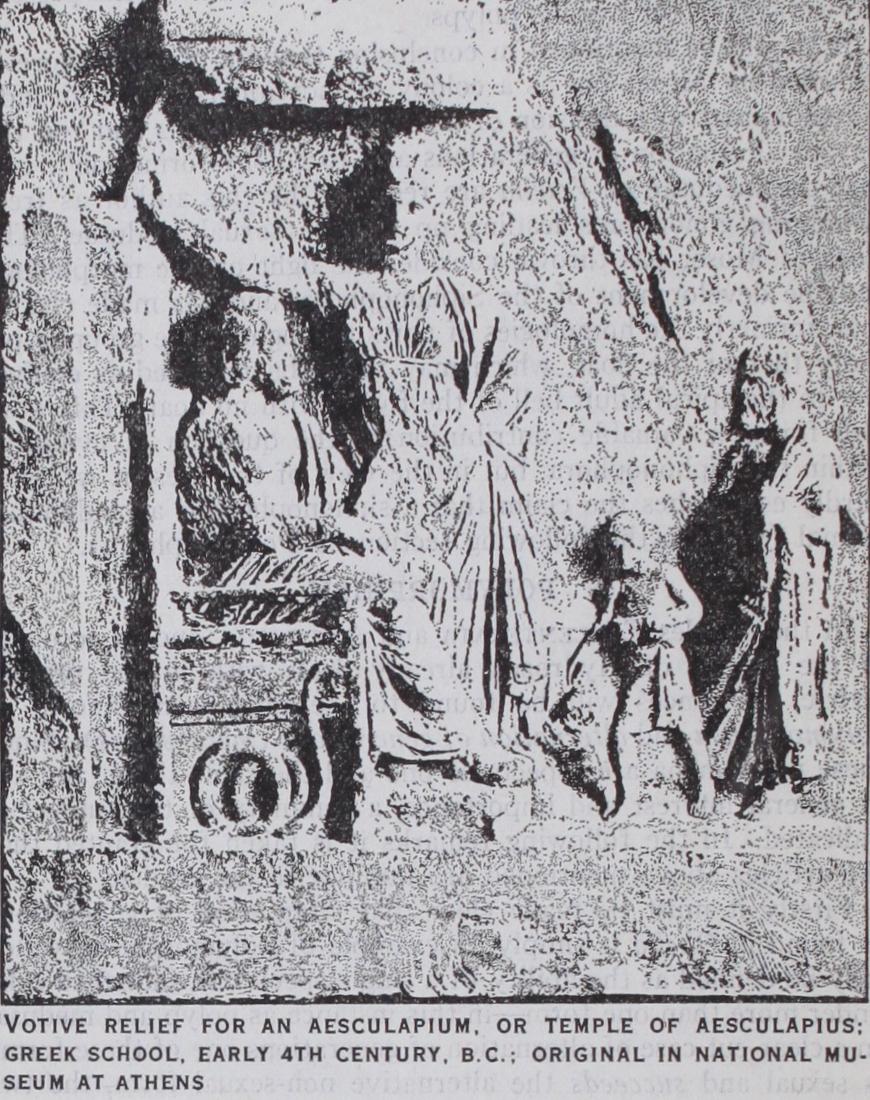
HYGIEIA, in Greek mythology, the goddess of health. The oldest traces of her cult, so far as is known at present, are to be found at Titane in the territory of Sicyon, where she was wor shipped together with Asclepius, to whom she appears completely assimilated, not an independent personality. Her cult was not introduced at Epidaurus till a late date, and therefore, when in 420 B.C. the worship of Asclepius was introduced at Athens coupled with that of Hygieia, it is not to be inferred that she accom panied him from Epidaurus, or that she is a Peloponnesian importation at all, but rather a new invention, an offshoot of the already existing worship of Athena Hygieia. At first no special relationship existed between Asclepius and Hygieia, but grad ually she came to be regarded as his daughter, the place of his wife being already secured by Epione. Later Orphic hymns, how ever, and Herodas, iv. I-9, make her the wife of Asclepius. The cult of Hygieia then spread concurrently with that of Asclepius, and was introduced at Rome from Epidaurus in 293, when she was gradually identified with Salus (q.v.). While in classical time Asclepius and Hygieia are simply the god and goddess of health, in the declining years of paganism they are protecting divinities.
See H. Lechat in Daremberg and Saglio's Dictionnaire des antiquites, with full reference to authorities; and E. Thramer in Roscher's Lexikon der Mythologie.